The NVIDIA Jetson AGX Thor Developer Kit marks a significant breakthrough in edge AI and robotics technology. This kit is built on the NVIDIA JetPack 7.0 SDK, integrating the Ubuntu 24.04 operating system and CUDA 13 acceleration libraries, providing developers with high-end hardware capabilities that are aligned with next-generation intelligent applications. This innovative platform enables developers to efficiently build and deploy edge intelligent applications through software and hardware co-optimization, achieving stronger computational performance and energy efficiency in scenarios such as robotics, industrial automation, and smart cities, thus accelerating the innovation process in the AIoT era.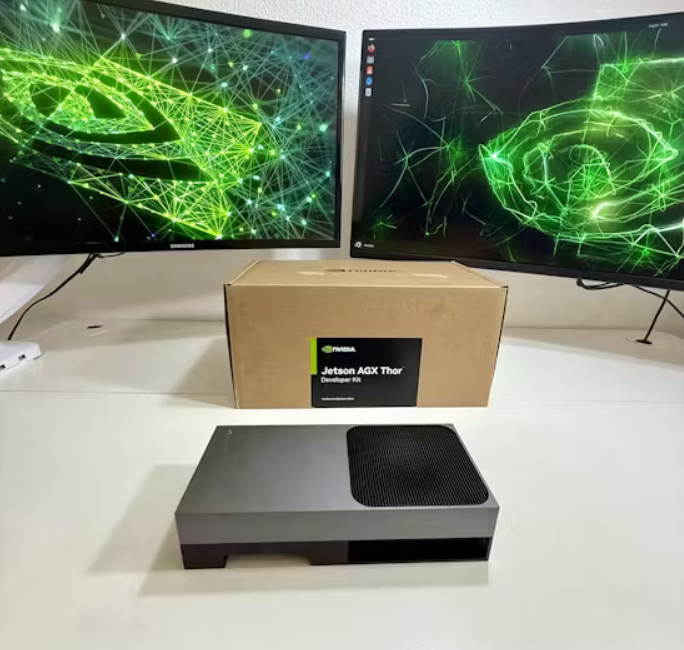
This article will construct a Hardware-in-the-Loop (HIL) simulation demonstration system to achieve precise control of the NVIDIA GR00T N1 base model over humanoid robots in the Isaac Sim virtual environment.As an open foundational model for general humanoid robot inference and skill building, NVIDIA Isaac GR00T N1 is designed specifically for handling embodied intelligence tasks through a multi-modal perception fusion architecture. Its core capabilities are reflected in the collaborative processing of multi-dimensional inputs, including:
– Visual perception: Real-time parsing of 3D scene semantics and dynamic object tracking
– Language goal specification: Converting natural language instructions into executable robotic behavior targets
– Robot state and proprioception: Fusing multi-source proprioceptive signals such as joint encoders and force sensors
– Action planning: Generating continuous motion trajectories and task execution strategies that comply with physical constraints
This multi-modal intelligent processing capability makes GR00T N1 an ideal foundational model for complex robotics research. Especially when combined with the edge inference hardware of Jetson AGX Thor, it can form a complete technical closed loop from cloud model training to real-time inference at the edge—utilizing the powerful AI computing units and low-latency inference characteristics of Jetson Thor to validate the decision instructions generated by GR00T N1 under real hardware constraints, ultimately achieving end-to-end robotic intelligent system validation from virtual simulation to physical execution.
System Requirements and Setup
This demonstration uses hardware and software to work collaboratively over a local network:
– Workstation PC (Ubuntu 24.04 + NVIDIA RTX GPU, running Isaac Sim)
– NVIDIA Jetson AGX Thor Dev Kit (running GR00T inference)
Configure Docker to enable container access to the GPU using NVIDIA Container Runtime.
NVIDIA Jetson AGX Thor Developer Kit flashing
This process will not be elaborated here; please refer to the NVIDIA Jetson AGX Thor Developer Kit unboxing and flashing experience
Hardware-in-the-Loop (HIL) Technology Analysis and Value ExplanationHardware-in-the-Loop (HIL) is an advanced system verification method that deeply integrates virtual simulation environments with real hardware platforms to construct a physical-digital hybrid testing system. Compared to traditional Software-in-the-Loop (SIL) testing, HIL achieves a qualitative leap:
– SIL mode: Both the model and simulation environment run on a single workstation, suitable for rapid algorithm iteration and pure logic debugging, but cannot reflect real hardware constraints.
– HIL architecture: The simulation environment resides on a high-performance workstation, while the core decision-making unit of the robot—such as the GR00T N1 model in this project—is deployed on the Jetson AGX Thor edge computing platform. Through real-time data stream transmission, the workstation pushes multi-modal observation data such as visual and force data to Thor for inference computation, and Thor then sends the generated control instructions back to the simulator to drive the robot’s behavior, forming a closed-loop verification link.
The strategic value of this design pattern lies in early exposure of hardware-level constraints: During the development phase, it can accurately reproduce computational resource bottlenecks, thermal management challenges, network communication delays, and other physical world characteristics that SIL cannot capture. For example, the thermal throttling effect of Jetson Thor’s AI computing unit under sustained high load, the real-time jitter of the ROS2 communication framework in cross-device data transmission, and resource competition issues during GPU-CPU collaborative computing can all be pressure tested and parameter tuned during the simulation phase using the HIL architecture. This dual assurance mechanism of “digital twin + physical validation” significantly enhances the reliability of robotic systems from virtual development to real-world deployment, making it a key technical path for building highly robust intelligent robotic systems.
Understanding the HIL Workflow Diagram
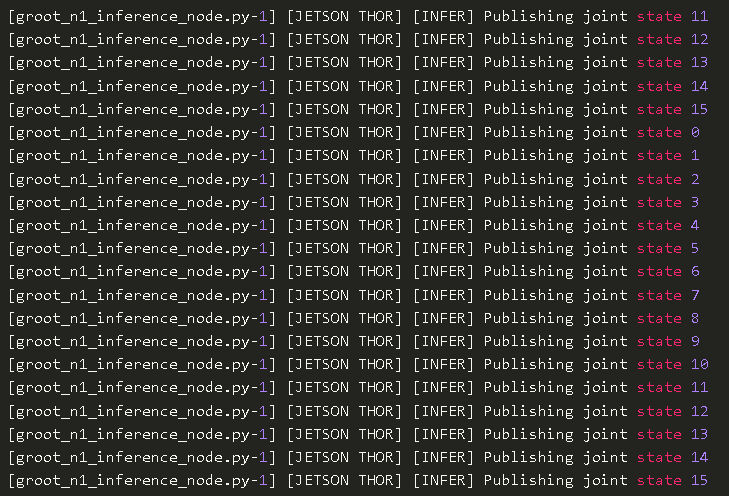
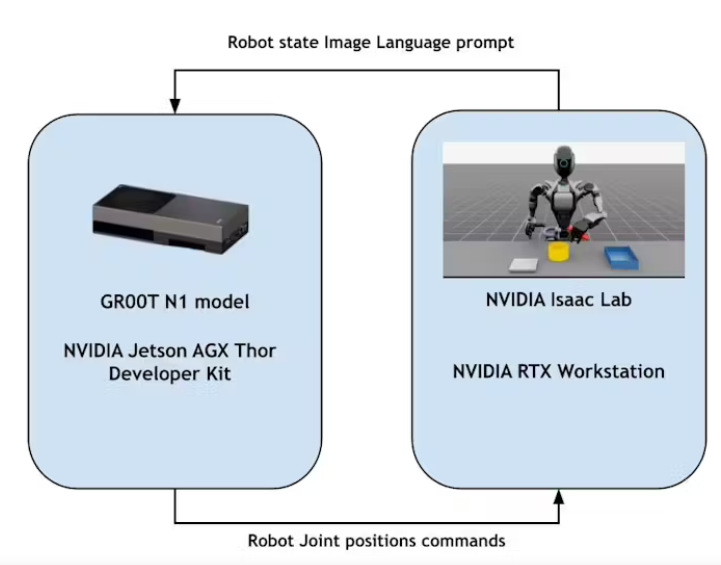 In the Hardware-in-the-Loop (HIL) testing architecture, the NVIDIA Jetson AGX Thor Developer Kit serves as the “physical brain” core of the robot, running the GR00T N1 model to execute real-time inference decisions. Its data interaction logic is as follows: The NVIDIA RTX workstation running Isaac Sim and Isaac Lab transmits multi-modal sensory inputs, including robot state data, 3D visual images, and natural language task prompts, to Thor via a high-speed network; the GR00T containerized inference node on Thor receives the data, processes it in real-time to generate joint position control commands, and sends them back to the workstation to drive the virtual humanoid robot to perform actions, forming a closed-loop cycle of “perception-decision-execution.” This design decouples high-fidelity simulation rendering from low-latency inference computation, allowing developers to intuitively observe the impact of real hardware constraints—such as the thermal management characteristics of Jetson Thor’s AI computing unit and cross-device communication delays—on system performance. The containerized deployment of GR00T on Thor adopts the NVIDIA Container Runtime optimization scheme, ensuring zero loss of GPU resources, and combined with the quantization acceleration of the TensorRT inference engine, compresses end-to-end control latency to the millisecond level, achieving reliable performance mapping from digital twin to physical execution.On Jetson Thor, GR00T runs as a containerized inference node. It publishes joint commands back to the workstation in real-time:
 On the RTX workstation, Isaac Sim receives these commands and updates the humanoid robot’s actions.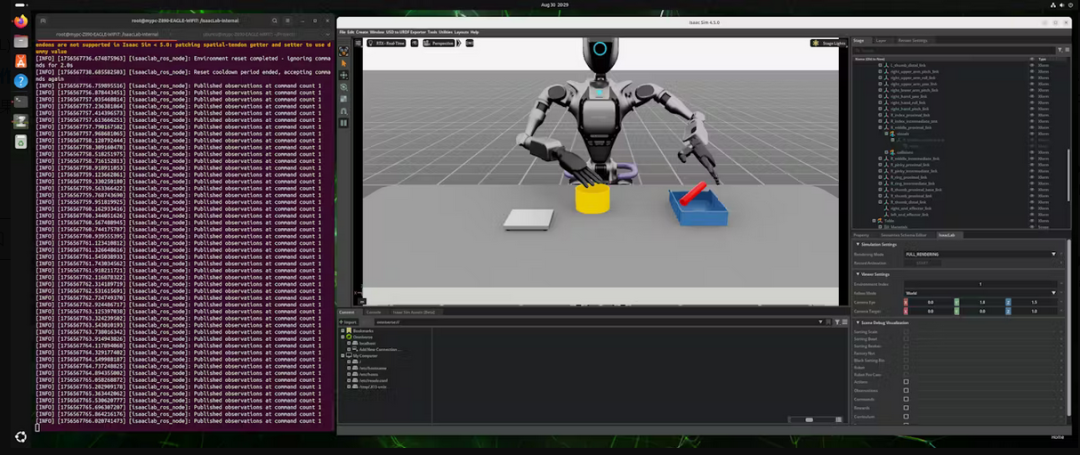
Deep Analysis of Hardware-in-the-Loop (HIL) DemonstrationThis demonstration will showcase an advanced testing architecture based on Hardware-in-the-Loop (HIL)—the GR00T N1 base model running directly on the NVIDIA Jetson AGX Thor Developer Kit to achieve precise control of robots in the Isaac Sim virtual environment. The simulation system is deployed on a high-performance workstation equipped with an NVIDIA GeForce RTX 5090 GPU, where the robot needs to perform a high-precision nut sorting task: grabbing metal nuts from a container and accurately sorting individual nuts into a spherical container, ultimately placing the sphere on an electronic scale for weighing.
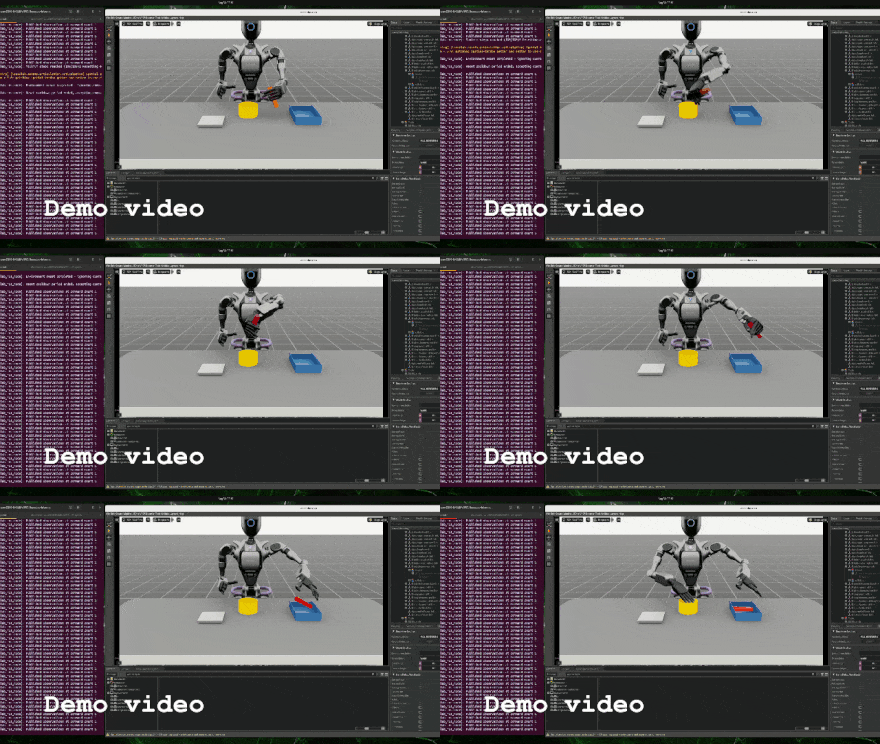
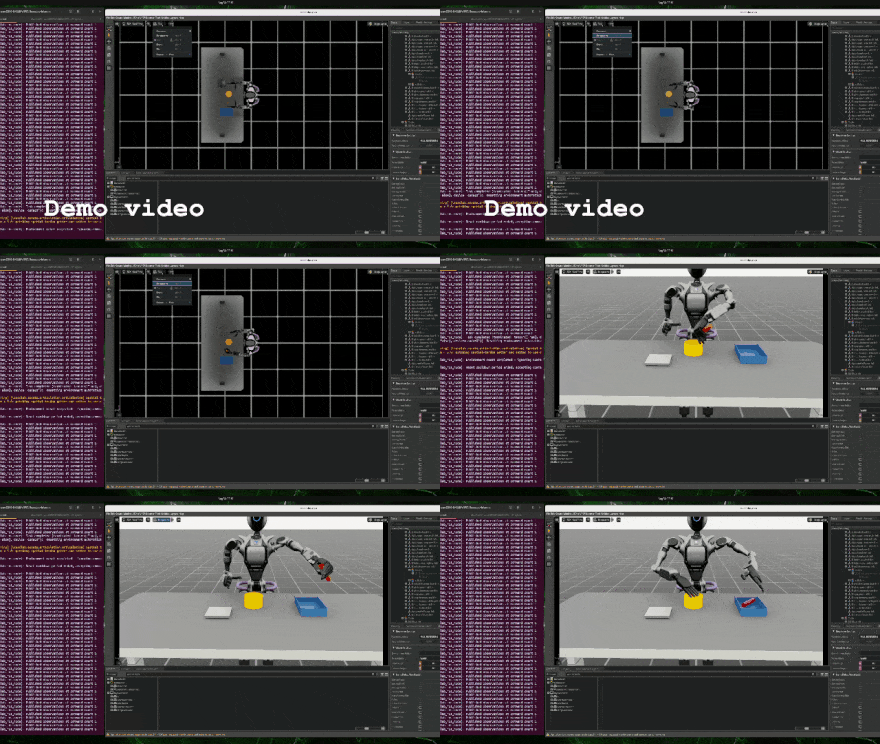
The system architecture adopts a distributed computing design: the GR00T N1 visual-language-action model is deployed on the Jetson AGX Thor edge computing platform, while the Isaac Lab simulation engine runs on the RTX workstation, forming a cross-device collaboration of “simulation rendering-physical execution.” The specific data flow mechanism is as follows: Isaac Lab streams robot state data, 3D visual images, and natural language task instructions to Jetson Thor in real-time; the GR00T containerized inference node receives the data and generates joint position commands that comply with physical constraints through multi-modal fusion algorithms, and sends them back to the simulator to drive the robot to perform sorting actions, forming a complete “perception-decision-execution” closed loop.
The core value of this HIL architecture lies in the explicit verification of real hardware constraints: During the execution of the nut sorting task, key metrics such as the AI computing unit load of Jetson Thor, end-to-end control latency (≤10ms), CUDA core utilization, and cross-device communication delays can be monitored in real-time. This design allows developers to accurately assess the actual performance boundaries of the deployed hardware during the virtual simulation phase—such as the impact of thermal management characteristics on sustained high-load inference, the real-time jitter of ROS2 cross-device communication, and resource competition issues during GPU-CPU collaborative computing.
The complete workflow follows an industrial-grade development paradigm: from the selection and loading of the pre-trained GR00T N1 model, to data generation and augmentation in Isaac Lab, through model fine-tuning and Software-in-the-Loop (SIL) verification, and finally deploying to the HIL architecture for end-to-end testing. This “training-validation-deployment” full-link design ensures seamless connection from cloud model training to edge real-time inference, guaranteeing both the correctness of algorithm decisions and the feasibility of deploying hardware execution, providing dual assurance for the landing of highly robust robotic systems.
More:
NVIDIA Jetson AGX Thor Developer Kit unboxing and flashing experience
NVIDIA Duel: DGX Spark vs. Jetson Thor, who is the “performance king” for large language model development?
Say goodbye to repetitive compilation! CUDA 13.0 unified Arm/server toolchain boosts edge development efficiency by 300%
Jetson crashes after installing Jetpack 6.x? One-click guide to revive it
Is the Isaac ecosystem coming? JetPack 7 software stack exposed, developers may gain access to NVIDIA’s strongest AI toolset.