 In the era of rapid technological advancement, every major breakthrough has the potential to reshape the future landscape. Today, NVIDIA has brought forth a piece of news that is sure to excite the tech community — the official unveiling of its next-generation computing platform, Jetson Thor, designed specifically for physical AI and humanoid robots. NVIDIA’s founder and CEO, Jensen Huang, hailed it as the “ultimate supercomputer driving the era of physical AI and general robotics.” This innovative achievement undoubtedly injects a shot of adrenaline into the robotics field, so what exactly makes it so remarkable? Let’s take a closer look.01
Performance Leap: Powerful Computing Power Leads New Transformation
Jetson Thor is based on NVIDIA’s latest Blackwell architecture GPU, showcasing its dominance at the hardware level. It integrates 2560 CUDA cores and 96 fifth-generation Tensor cores, laying a solid foundation for its subsequent powerful performance.
-
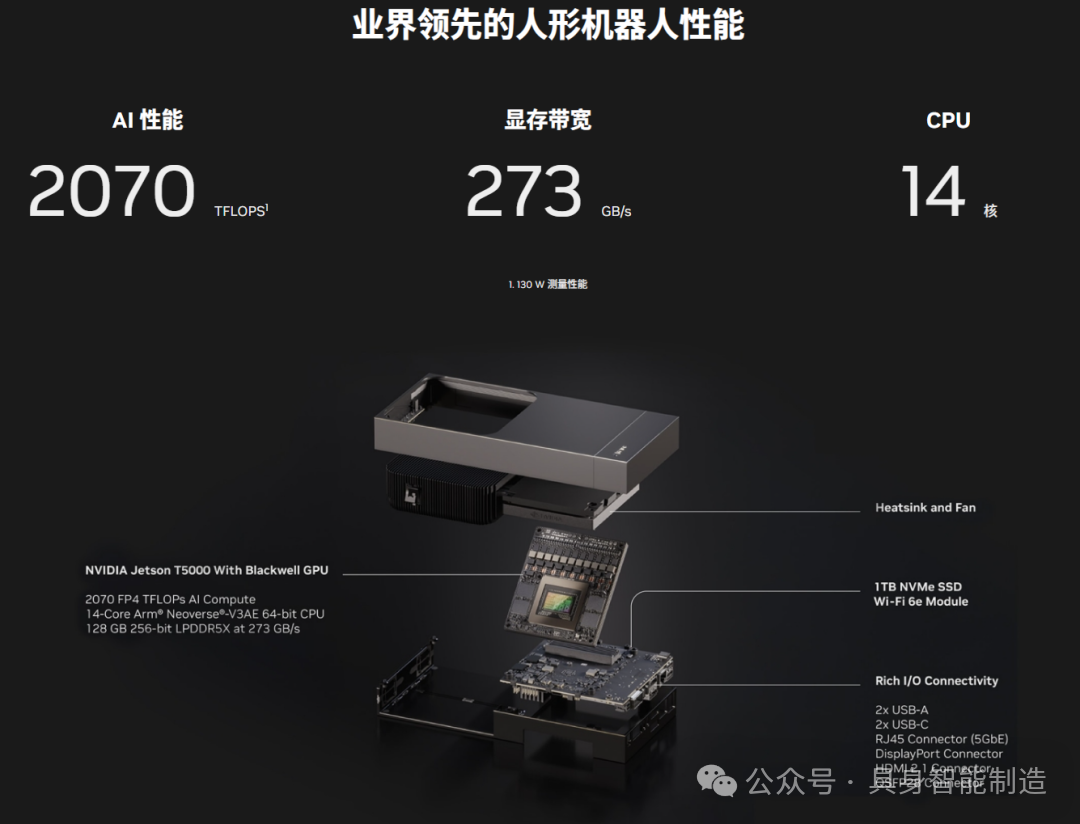
Amazing AI Computing Power: In terms of critical AI computing performance, it can achieve an astonishing 2070 TFLOPS at FP4 precision and 1035 TFLOPS at FP8 precision. Compared to the previous generation Jetson Orin, AI computing performance has increased by a staggering 7.5 times. Over a decade, AI performance has seen a leap of 7000 times compared to products from ten years ago. Such powerful computing power enables robots to make precise decisions quickly in complex tasks.
-
Multi-faceted Performance Improvement: Energy efficiency has improved by 3.5 times, meaning that Jetson Thor can provide more powerful computing capabilities at the same power consumption, significantly extending the robot’s battery life or reducing its energy consumption. CPU performance has also increased by 3.1 times, and I/O throughput has grown by 10 times. It is equipped with a 14-core Arm Neoverse-V3AE CPU, 128GB of video memory, and a memory bandwidth of up to 273GB/s.
-
Flexible Power Configuration: Its power consumption can be flexibly configured between 40W and 130W based on actual needs. Whether for industrial robotic arms that require extremely high computing power and stable long-term operation, or for high-dynamic humanoid robots that need to adapt to complex environments and are sensitive to power consumption, Jetson Thor can easily adapt for full-scene deployment.
02
Function Upgrade: Multi-task Processing and Real-time Inference
The new Jetson Thor is meticulously optimized for multi-AI task flows, directly addressing the critical pain point of running multiple AI workflows in robotics technology. This enables robots to engage in real-time, intelligent interactions with humans and the physical world, greatly advancing visual AI entities and complex robotic systems.
-
Outstanding Real-time Inference Capability: In terms of real-time inference, Jetson Thor performs exceptionally well. It can simultaneously process data from 16 sensors, and when running the Llama 3B and Qwen 2.5 VL 3B models, it generates the first token in under 200 milliseconds, with subsequent token generation times of only 50 milliseconds, outputting over 25 tokens per second. This response speed represents a significant improvement over previous generations, providing strong support for rapid decision-making in complex environments. For example, in complex rescue scenarios, robots can quickly analyze surrounding environmental information and make swift action decisions, saving lives and property in critical moments.
03
Ecological Integration: Broad Compatibility with Mainstream Models and Software Stacks
Jetson Thor demonstrates excellent software compatibility, fully compatible with NVIDIA’s software stack from cloud to edge, establishing a complete and efficient ecosystem.
-
Support for Mainstream AI Frameworks and Models: It supports all mainstream AI frameworks, as well as generative AI models from numerous companies including ByteDance, DeepSeek, Alibaba Qwen, Google Gemini, Meta, Mistral AI, OpenAI, and Physical Intelligence (π). From mainstream large language models to visual language models and visual language action models, all can run smoothly on this platform. This means developers need not worry about model compatibility issues and can focus more on developing and optimizing robot functionalities.
-
Seamless Integration with Multiple Platforms: It can also seamlessly integrate with NVIDIA’s Isaac robotics platform, GR00T humanoid robot base model, Metropolis visual AI platform, and Holoscan real-time sensor processing system. This comprehensively enhances system collaboration efficiency, providing developers with a full-stack toolchain from training to deployment. Developers can leverage the Isaac Sim simulation platform for digital twin training, and then use the JetPack 7 SDK to seamlessly deploy models to edge devices, achieving a convenient and efficient “cloud-edge-end” integrated development process, significantly shortening product R&D cycles.
04
Market Response: Leading Companies Adopt En Masse
Upon the announcement, the market response was enthusiastic. Several leading robotics companies have already adopted Jetson Thor, proving its strong appeal in the industry.
-
International Companies Actively Apply: Agility Robotics has applied it to its fifth-generation robot Digit and plans to use it as the computing core for the sixth-generation Digit, helping to optimize operational efficiency in customer warehouses and factories. Boston Dynamics has integrated Jetson Thor into its Atlas humanoid robot, supporting further performance enhancements and expanding application scenarios.
-
Domestic Companies Eager to Experiment: Domestically, companies such as United Imaging Healthcare, Wanji Technology, UBTECH, Galaxy General, Yushu Technology, Zhongqing Robotics, and Zhiyuan Robotics have also eagerly “tasted” it. Wang Xingxing, founder and CEO of Yushu Technology, commented: “Jetson Thor brings a tremendous leap in computing power, empowering robots with greater agility, faster decision-making, and higher autonomy, which is crucial for navigation and interaction in the real world.” Wang He, founder and CTO of Galaxy General, also stated that after adopting Jetson Thor, their G1 Premium robot has achieved significant improvements in movement speed and action fluidity.
Currently, the starting price for the Jetson AGX Thor developer kit in the U.S. is $3499, with a unit price of $2999 for orders of over 1000 production modules, now available for global customers including China.
The launch of NVIDIA Jetson Thor undoubtedly presses the “accelerator button” for the development of the robotics industry. With powerful computing capabilities and advanced features, the application of robots across various fields is expected to experience explosive growth. We believe that in the near future, we will see robots equipped with Jetson Thor making significant contributions in manufacturing, logistics, healthcare, agriculture, and many other industries, bringing more convenience and surprises to our lives and work. Let us all look forward to witnessing the comprehensive arrival of the era of physical AI and general robotics!
For further information on NVIDIA’s innovative products, technology trends, and application cases across various fields, please visit NVIDIA’s official website:https://www.nvidia.com/. Here, you can access detailed technical documents and application guides on cutting-edge products like Jetson Thor, and stay updated on NVIDIA’s latest developments, exploring the infinite possibilities of technology.