
Abstract: On August 26, 2023, NVIDIA officially announced the full launch of its next-generation robotic computing platform, the Jetson Thor development kit and production module. This revolutionary product, known as the “robot brain,” will provide powerful computational support for robots worldwide. As a high-performance computing platform designed specifically for physical AI and robotic applications, the release of Jetson Thor marks a key step in NVIDIA’s expansion of its ecosystem in the robotics field and represents another milestone breakthrough in the robotics industry.
01 NVIDIA’s Robotics EcosystemThe newly released Jetson Thor by NVIDIA is a high-performance computing platform designed for physical AI and robotics, referred to as the “robot brain.” Jetson Thor is based on NVIDIA’s latest Blackwell GPU architecture, featuring a 14-core Arm Neoverse-V3AE CPU and 128GB of video memory, with a memory bandwidth of 273 GB/s. At FP4 precision, its AI peak computing power reaches 2070 TFLOPS, representing a performance increase of up to 7.5 times compared to the previous generation Jetson Orin, with energy efficiency improved by 3.5 times, CPU performance increased by 3.1 times, and I/O throughput enhanced by 10 times. Jetson Thor can run multiple AI models simultaneously, supporting various generative AI models, including large language models (LLM), visual language models (VLM), and visual language action models (VLA), laying the hardware foundation for robots to achieve true multimodal perception and decision-making capabilities.
What does this leap in performance mean for Jetson Thor? For instance, when running the Qwen3-32B model, Jetson Thor achieves an output speed of 79.1 tokens/second, while Jetson Orin only reaches 16.84 tokens/second, marking a performance improvement of up to 4.7 times. In terms of visual language models, when running Qwen2.5-VL-7B, Jetson Thor’s output speed reaches 252 tokens/second, approximately 64% faster than Orin’s 154.02 tokens/second.
This leap in performance addresses a significant challenge faced by robot developers: how to process high-speed sensor data in real-time at the edge and execute complex visual reasoning. With its high memory bandwidth and capacity, Jetson Thor enables smooth operation of multimodal AI applications at the edge, laying the groundwork for the intelligence of robots, especially humanoid robots.
Figure 1: NVIDIA Jetson AGX Thor Developer Kit
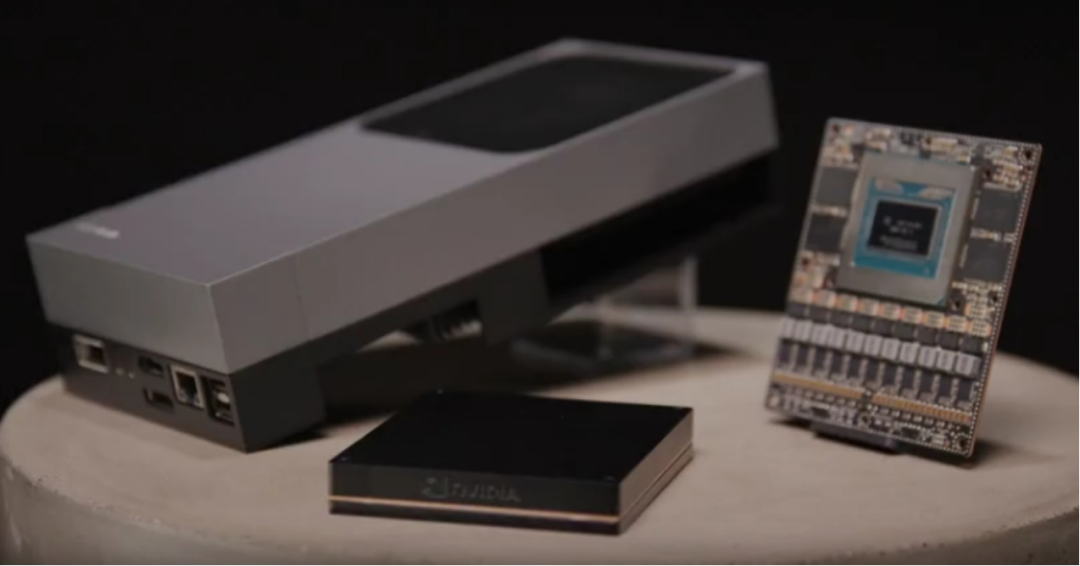 Data Source: NVIDIA Official Website
The release of Jetson Thor by NVIDIA is not only a leap in hardware performance but also a systematic upgrade of its robotics ecosystem strategy, building a complete ecosystem from underlying chips to upper-layer applications. This platform is deeply integrated with the NVIDIA Isaac GR00T N1.5 VLA model, which provides critical support for robots’ precise decision-making and actions in complex environments, enabling robots to intelligently understand their surroundings and execute tasks.
At the same time, Jetson Thor’s support for multiple software frameworks, including the Isaac robotics platform, Metropolis video analysis platform, and Holoscan edge AI platform, greatly expands its application boundaries. The Isaac robotics platform offers a wealth of development tools and resources, covering the Robot Operating System, Isaac Manipulator for robotic arm development, and Isaac Perceptor for autonomous mobile robot development. By combining Jetson Thor with the Isaac robotics platform, developers can more efficiently develop, train, simulate, deploy, and optimize various robots, such as autonomous mobile robots and humanoid robots, accelerating the process from concept design to practical application.
From an ecosystem strategy perspective, the ecosystem built by NVIDIA through Jetson Thor possesses strong attractiveness and competitiveness. It provides developers with a one-stop solution, lowering the barriers and difficulties of robot development, attracting more developers to innovate in the robotics field. Numerous Chinese robotics companies, such as UBTECH, Yushu Technology, and Galaxy General, have already adopted Jetson Thor, covering various subfields including humanoid robots and industrial robots. Among them, Yushu Technology stated that Jetson Thor has significantly enhanced computational capabilities, granting robots greater agility, faster decision-making speed, and higher autonomy; Galaxy General noted that its G1 Premium robot has shown significant improvements in movement speed and action fluidity after adopting Jetson Thor.
It is worth mentioning that these Chinese companies that have adopted Jetson Thor first have shown significant financing activity, which also reflects the capital market’s high recognition of the robotics industry’s prospects. According to data from Lai Mi PEVC, companies like Galaxy General and Yushu Technology have undergone multiple rounds of financing. This phenomenon indicates that the robotics industry has typical capital-intensive characteristics, requiring several years of technological iteration cycles from concept validation to commercial mass production, during which continuous funding investment is needed in hardware development, algorithm optimization, talent acquisition, and production line construction. Sufficient funding support allows these companies to quickly upgrade products and integrate technologies after the release of advanced computing platforms like Jetson Thor, without being constrained by financial limitations. This rapid technology adoption capability, in turn, provides NVIDIA’s robotics ecosystem with rich application scenarios and practical cases, forming a virtuous cycle of interaction between technology suppliers and demanders.
From an industry development perspective, these robotics companies that have received ample financing are often the pioneers most capable of bearing the risks and costs of new technology applications. Their successful practices will provide important demonstration effects for the entire industry, encouraging more companies to adopt similar technological solutions, thereby expanding the coverage and influence of NVIDIA’s robotics ecosystem. This diffusion effect from point to area is also an important mechanism for NVIDIA’s ecosystem strategy to scale quickly.
Figure 2: Financing Situation of Chinese Robotics Companies Adopting Jetson Thor by 2025 (Incomplete Statistics)
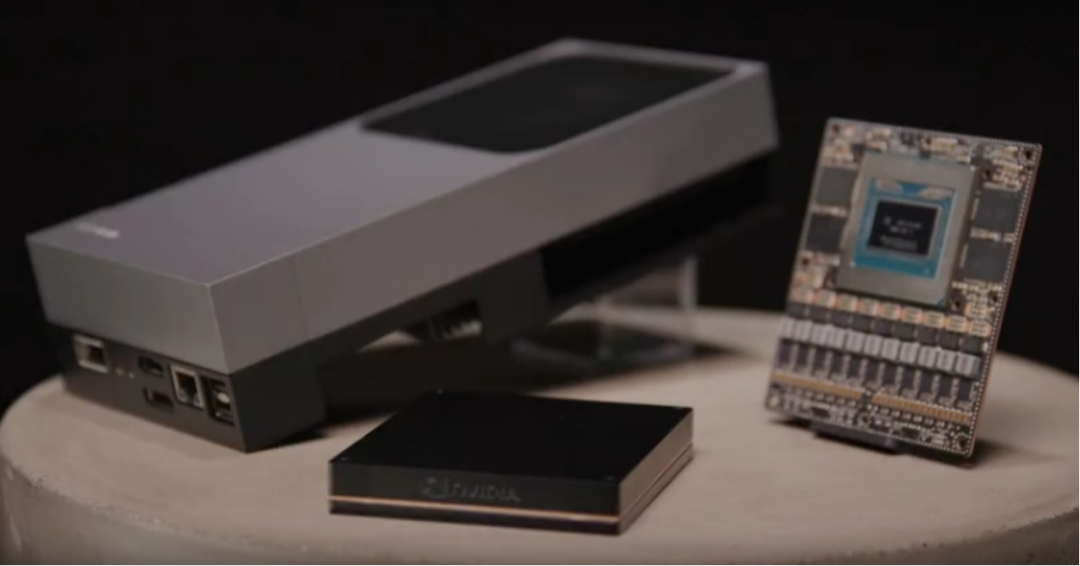 Data Source: Lai Mi Data
NVIDIA has previously renamed its “automotive business” to “automotive and robotics business,” indicating its strategic focus extending into the robotics field. However, from the latest Q2 fiscal report for 2026, it only mentioned revenue from the automotive business and has not formally listed revenue from the robotics business. This somewhat indicates that NVIDIA places strategic importance on the robotics business, but its commercialization process is still in the early stages. From NVIDIA’s layout, it is preparing for the long-term explosion of the robotics business, and the release of Jetson Thor is an important manifestation of this layout. By continuously investing in R&D and improving the performance and ecosystem of robotics-related products like Jetson Thor, NVIDIA is gradually attracting high-quality enterprise collaborations in the industry, laying the foundation for the large-scale commercialization of its robotics business in the future.
From the perspective of investment return cycles, NVIDIA’s strategy in the robotics field resembles “investing in the ecosystem first, then reaping scale.” By providing a powerful computing platform and a complete development toolchain, it nurtures the robotics developer ecosystem, waiting for the industry to mature before achieving scaled returns. Referring to its successful path in the AI chip market, NVIDIA gradually builds a moat through early technological investments and ecosystem construction, reaping huge returns when the market explodes. Currently, the revenue contribution from the robotics business is limited, but it could be NVIDIA’s next potential growth explosion point.
It is expected that with the promotion and application of new products like Jetson Thor, as well as the large-scale mass production of partner products, the robotics business is likely to contribute revenue to NVIDIA in the future. At that time, the naming of “automotive and robotics business” will truly be justified, and robotics will transform from NVIDIA’s strategic layout into an actual performance growth point.
02 Prospects of the Robotics IndustryJensen Huang previously stated that robotics is a $10 trillion industry and mentioned that by 2030, there will be at least a shortage of 50 million workers globally, necessitating the “employment” of robots to work. Therefore, the future development potential of the robotics market is enormous. Taking humanoid robots, one of the fastest-growing subfields in the past year, as an example, GGII (Gaogong Robotics Industry Research Institute) predicts that the global humanoid robot market will reach 6.34 billion yuan by 2025, and exceed 400 billion yuan by 2035, with an average annual compound growth rate of over 50%.
Figure 3: Global and Chinese Humanoid Robot Market Size from 2024 to 2035E (Billion Yuan)
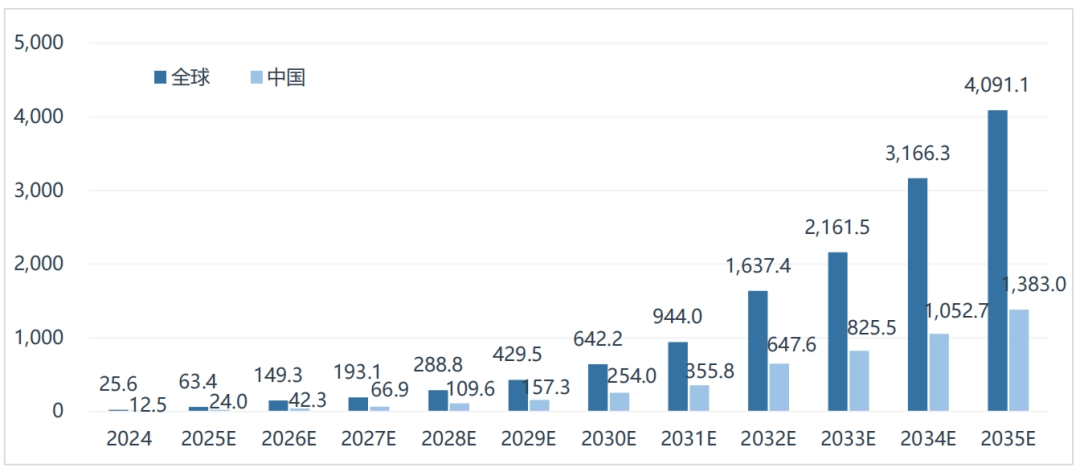 Data Source: GGII, Lai Mi Data CompilationOverall, the continuous growth of the robotics market size is driven by technology, policy, and market factors. From a technological perspective, the key to robot intelligence lies in the advancement of AI technology. For example, due to insufficient edge computing power, robots previously struggled to run complex AI models and could only perform fixed actions in preset scenarios, while Jetson Thor elevates AI computing power to 2070 TFLOPS, supporting the local operation of large language models (LLM) and visual language models (VLM) in robots, enabling them to possess complete capabilities of “perception-reasoning-decision-making.”
From a policy perspective, countries are introducing a series of favorable policies, clarifying development goals and support measures. For instance, China has released the “14th Five-Year Plan for Robotics Industry Development,” proposing that by 2025, the annual growth rate of the robotics industry’s operating income will exceed 20%, and 3-5 internationally influential industrial clusters will be established, doubling the density of manufacturing robots; South Korea has released the “Robotics Development Strategy,” proposing that the South Korean government and enterprises plan to invest over 30 trillion won by 2030, increasing the robotics market size from 56 trillion won in 2021 to over 200 trillion won by 2030. These policies not only provide financial support but also construct a complete ecosystem of “standard systems + application scenarios + talent cultivation.”
From a market perspective, as technology matures, the application scenarios for robots are extending from traditional industries to various fields such as healthcare, consumer, agriculture, and emergency response, forming a market pattern of “full-scenario coverage.” Coupled with the increasingly severe global labor shortage and aging population issues, the demand for robots across various industries will continue to rise.
03 OutlookThe robotics industry is at a critical juncture, transitioning from “technology demonstration” to “scene implementation.” The launch of the NVIDIA Jetson Thor platform, along with the ongoing global increase in AI investment, will bring more development opportunities to the robotics industry. In the short term, as robotics-related platforms like Jetson Thor are applied in robotic products, the ability of robots to adapt to complex environments and execute diverse tasks will improve. In fields such as industrial automation, medical assistance, and public services, robots will demonstrate higher practical value and economic efficiency.
In the medium to long term, robotics technology will deeply integrate with artificial intelligence, big data, cloud computing, and other technologies, forming a more complete industrial ecosystem. Continuous innovation in artificial intelligence technology will continually enhance the intelligence level of robots, enabling them to better understand and adapt to complex and changing environments, achieving higher levels of autonomous decision-making and task execution. At the same time, big data and cloud computing technologies provide strong data storage and computing support for robots, allowing them to obtain and process large amounts of information in real-time, further enhancing their intelligent interaction and collaborative working capabilities.
Moreover, factors such as policy support, industry chain collaboration, and capital investment are also jointly promoting the robotics industry towards large-scale and intelligent development. Global investments in the robotics field are shifting from early concept validation to commercial applications, with investment scales continuing to grow. According to Lai Mi PEVC data, since 2025, the financing amount for domestic robotics has exceeded 20 billion yuan, indicating the capital market’s continued optimism about this track. As technology continues to advance and application scenarios continue to expand, the robotics industry is expected to become an important engine for driving economic and social development, creating a better future for humanity.
The following chart shows the investment and financing events in the robotics track since 2025. Interested readers can log in to the Rime PEVC platform to obtain comprehensive financing cases, invested projects, and in-depth data analysis in the robotics field.
Figure 4: Investment and Financing Events in the Robotics Track Since 2025
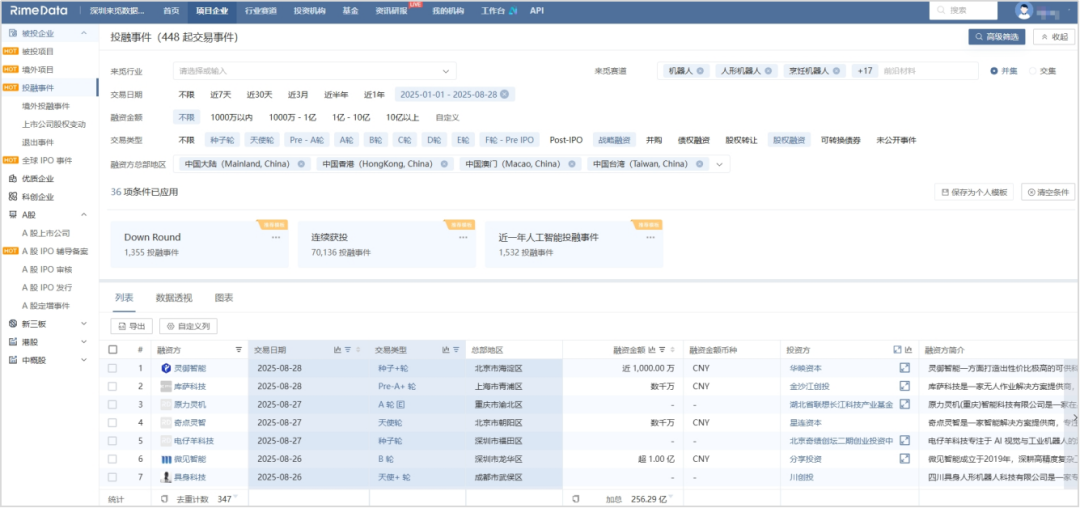 Data Source: Lai Mi Data

Recent Hot Articles Recommended

-
From “Internet+” to “Artificial Intelligence+”: A Transformation from “Connection” to “Empowerment” in Industry
-
On the Eve of Embodied Intelligence Explosion, the Humanoid Robot Industry Accelerates
-
Financial Support for New Industrialization, Basic Software Welcomes New Development Opportunities
-
Novartis Invests Heavily in Small RNA Liver Delivery
-
Energy Revolution and Artificial Intelligence Reshape Demand, Power Semiconductor Track Investment and Financing Warm Up
-
“Double Subsidy” Policy Implementation, Which Consumer Tracks Will Ignite Investment Enthusiasm?
-
AI-Driven, Cycle Warming! Simulation Chips Renew Their Image
-
Financial Support for New Industrialization, Medical Equipment Welcomes Good News
-
Computer Software Q2 2025 Investment and Financing Market Report
-
Financial Support for New Industrialization, Integrated Circuits Become Policy Focus
Copyright and Disclaimer: The content of this article is written by Lai Mi Research Institute, and its copyright belongs to Shenzhen Lai Mi Data Information Technology Co., Ltd. (hereinafter referred to as Rime or Lai Mi Data). Without permission or authorization from Lai Mi Data, any unit or individual is prohibited from reprinting, quoting, publishing, modifying, or translating the content of this article, and other commercial uses. When citing or reprinting with permission or authorization, the source must be indicated as Rime or Lai Mi Data. Any unauthorized commercial behavior using this report will violate the Copyright Law of the People’s Republic of China and other laws and regulations as well as relevant international conventions, and Lai Mi Data reserves the right to pursue its related legal responsibilities.
The content of this article is based on publicly available information or field research data that Lai Mi Data considers credible. We strive for objectivity and fairness in the content of this article, but we do not make any explicit or implied guarantees regarding the accuracy, reliability, timeliness, and completeness of the information, opinions, and data contained in this article, nor do we bear relevant legal responsibilities. Due to limitations in research methods and data acquisition resources, all content of this report is for reference only and does not constitute any advice for anyone’s investment, business decisions, legal operations, etc. In any case, Lai Mi Data does not bear any responsibility for any impact and consequences caused by referencing this report.