


Registration: European Humanoid Robot Summit 2025
Abstract:The NVIDIA Jetson Thor developer kit ($3499) and T5000 production module have been launched, offering 2070 FP4 TFLOPS of computing power, which is 7.5 times that of Orin, supporting multi-generative AI edge operations. Agility and Boston Dynamics are the first to utilize it in humanoid robots, empowering physical AI. The following video is sourced from NVIDIA Enterprise Solutions
1. Introduction: A Computing Power Revolution Aimed at Complex Robotic Scenarios
NVIDIA recently officially announced the launch of the Jetson AGX Thor developer kit and Jetson T5000 production module for robotics technology and physical AI applications. Currently, there is a surge in demand for robots that can autonomously operate in unstructured environments such as homes and warehouses, and safely interact with humans. Traditional robots rely on cloud computing, which suffers from the pain points of “over 1 second latency and failure upon disconnection” — NVIDIA positions Thor as the core “onboard computer” to break this computing bottleneck, achieving for the first time a robot’s “real-time perception (within 50ms) – instant inference (within 200ms) – rapid interaction” closed loop at the edge.
NVIDIA founder and CEO Jensen Huang stated: “We have built Jetson Thor for millions of developers worldwide who are creating robots that ‘interact with and shape the physical world.’ With top-tier performance and energy efficiency, it can run multiple generative AI models in parallel at the edge, making it the ultimate supercomputer driving the era of physical AI and general robotics.”
The launch of this platform fills the industry gap for edge devices with “high computing power (2000+ TFLOPS) + low power consumption (within 130W)”, providing critical hardware support for upgrading robots from “single-task tools” to “multi-scenario general intelligent agents”.
2. Core Technical Parameters: Blackwell Architecture-Driven Hardware-Software Integration Design
2.1 Hardware Configuration: Precisely Matching Robot “Computing Power – Memory – Power Consumption” Needs
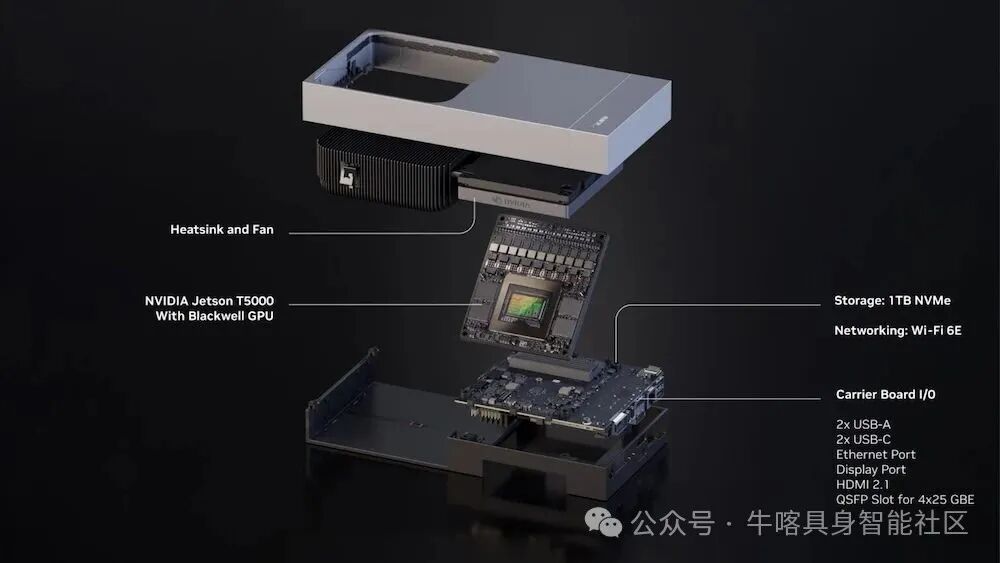
Jetson Thor is built on NVIDIA’s latest Blackwell GPU architecture with hardware parameters that fully align with the core demands of robotic operation scenarios:
-
Computing Power and Memory: Equipped with 128GB LPDDR5X high-speed memory (with a bandwidth of 273GB/s), capable of simultaneously handling massive data from 16 4K cameras + 4 LiDARs; under a power limit of 130W, it stably outputs 2070 FP4 trillion floating-point operations per second (TFLOPS), achieving a 7.5 times computing power leap compared to the previous generation Jetson Orin (276 FP4 TFLOPS), making it the first robotic computing platform at the edge to break 2000 TFLOPS.
-
Heterogeneous Collaborative Computing: Integrating 14-core Arm Neoverse-V3AE CPU, forming a “GPU+CPU” division of labor model — the GPU is responsible for AI inference and multi-modal data fusion (such as matching image and LiDAR data), while the CPU handles logical tasks like path planning and motor control, avoiding overload on a single processor, perfectly adapting to the robot’s “perception – decision – execution” full process.
-
Dynamic Power Adjustment: Supports 40W-130W power switching: Industrial collaborative robots (fixed power supply) can enable 130W high-performance mode to run multiple generative AI models at full load; logistics mobile robots (battery-powered) switch to 40W low-power mode, extending battery life to over 8 hours, balancing computing power and endurance needs.
2.2 Software Ecosystem: Lowering Development Barriers for Seamless Migration
Jetson Thor is not isolated hardware but a deeply integrated NVIDIA full-stack software “hardware-software platform” covering the entire process of robot development:
-
Core Tool Support: Compatible withNVIDIA Isaac simulation tools, allowing testing of robot motion control in a virtual environment, reducing physical prototype costs by 60%; it includes the Isaac GR00T humanoid robot base model, providing basic capabilities for “visual recognition – action planning” without requiring developers to train models from scratch; it also supports specialized AI algorithm libraries for visual recognition, force control operations, covering over 90% of core robotic scenarios.
-
Cloud-Edge Collaborative Capability: Seamlessly connects to NVIDIA DGX cloud training platform for “cloud training large models – edge deployment inference”; it is also backward compatible with Metropolis visual AI (real-time video analysis), Holoscan sensor processing (analyzing LiDAR/high-resolution camera data), allowing existing Jetson Orin projects to migrate quickly using official tools without code restructuring, reducing technical migration costs.
-
Long-term Performance Optimization: Continuing the NVIDIA Jetson series tradition of “software upgrades improving performance” — previously, Jetson Orin achieved a 100% performance increase through software optimization, and in the future, Thor can further unleash hardware potential through firmware updates and algorithm iterations, with a product lifecycle expected to support over 5 years of software updates, extending device value.
3. Comparative Advantages: Crushing Previous Generations and Industry Peers
3.1 Compared to Jetson Orin: Core Metrics Breakthroughs
As an iterative product of Orin, Jetson Thor achieves a “qualitative leap” in key performance metrics, with specific data comparisons as follows (source: NVIDIA official testing):
|
Core Metrics |
Jetson Thor |
Jetson Orin |
Improvement Factor |
Practical Scenario Value |
|
AI Computing Power (FP4 TFLOPS) |
2070 |
276 |
7.5 times |
Can run 4 generative AI models simultaneously (Orin supports only 1) |
|
Energy Efficiency Ratio (TFLOPS/W) |
15.9 |
4.5 |
3.5 times |
Under the same endurance, computing power output increased by 3.5 times |
|
I/O Throughput |
4 25 GbE Ethernet ports |
1 25 GbE Ethernet port |
10 times |
Can connect to 16 4K cameras simultaneously (Orin only supports 4) |
|
CPU Performance |
14-core Arm Neoverse-V3AE |
12-core Arm Cortex-A78AE |
3.1 times |
Path planning speed reduced from 100ms to 32ms |
Practical Application Differences: Humanoid robots using Orin to process “grabbing boxes – placing on shelves” actions have a decision delay of 800ms; using Thor can compress this to under 200ms, achieving “human reaction speed”; logistics robots using Thor for “cargo recognition + dynamic obstacle avoidance” have accuracy improved from 82% to 98%, with a significant reduction in misjudgment rate.
3.2 Compared to Industry Peers: Scene Adaptability Dominance
Current onboard computing platforms for robots are mainly divided into two categories, with Jetson Thor’s advantages concentrated in “computing power density” and “scene matching degree”:
-
Compared to Intel Xeon Edge Servers: While Xeon can provide 2000+ TFLOPS of computing power, it consumes over 300W (2.3 times that of Thor) and has a volume of 800cm³ (6 times that of Thor), making it unsuitable for compact humanoid robots like Agility Digit, and only applicable to large fixed-scene devices.
-
Compared to Qualcomm RB5: RB5 consumes only 30W, but its AI computing power is only 150 TFLOPS (less than 1/13 of Thor), and it does not support FP4 precision, making it unable to run generative AI models like Llama and Qwen, and only suitable for low-complexity scenarios like vacuum robots, with significant functional limitations.
4. Technical Disadvantages: Real-World Challenges in Mass Production and Application
4.1 High Initial Costs, Significant Barriers for Small and Medium Enterprises
The Jetson AGX Thor developer kit starts at $3499 (approximately 25,000 RMB), and the production module Jetson T5000 can be purchased through distributors at a price of about $2100-2450 (approximately 15,000-17,000 RMB). Although NVIDIA states that “after mass production of 1 million units, the cost per unit can be reduced to $200,” most small and medium enterprises have an annual production scale of less than 10,000 units, making it difficult to enjoy cost benefits in the short term, and they may choose to continue using the more cost-effective Jetson Orin (developer kit $1999), which somewhat limits the spread of Thor.
4.2 High Power Mode Poses Significant Endurance and Cooling Pressure
The mainstream configuration for humanoid robots is a 1000Wh battery; when the 130W high-performance mode is enabled, the endurance is only 7.7 hours; to extend it to 12 hours, an additional 500Wh battery is required, increasing the body weight by 3kg, affecting movement agility (such as gait stability and action response speed). At the same time, the 130W power consumption generates about 440BTU/h of heat, necessitating the design of a liquid cooling system (costing an additional $800 per unit), which occupies 15%-20% of the robot’s internal space, compressing the installation positions for sensors and motors, increasing hardware design difficulty.
4.3 Strong Dependency on Software Ecosystem, Risk of Technical Lock-in
The core development tools of Thor (such as the Isaac Sim simulation platform and Holoscan sensor processing tool) are all NVIDIA proprietary; if in the future, due to cost or technical needs, migration to Intel or AMD platforms is required, over 70% of the code would need to be restructured, leading to high conversion costs. Additionally, while it supports mainstream AI models, specialized models for industries such as medical robots (processing X-ray/ultrasound data) and agricultural robots (pest identification) need developers to optimize themselves — NVIDIA does not provide ready-made solutions, adding an extra 6-12 months to the development cycle, which requires high technical capabilities from small teams.
5. Enterprise Application Cases: Leading Manufacturers Validate Early Adoption
5.1 Humanoid Robot Field: Agility and Boston Dynamics Lead Adaptation
-
Agility Robotics (Digit Robot): Uses Thor as the “computational brain” of Digit, running “end-to-end operation models” locally — previously, Digit needed to divide the “shelf restocking” task into three steps: “recognition – positioning – grabbing”; with Thor, it can complete it in one step, tripling response speed; at the same time, the adaptability to new environments (such as different height shelves and irregular boxes) has improved by 40%, allowing for quick deployment without frequent model adjustments.
-
Boston Dynamics (Atlas Robot): Integrates Thor into Atlas to accelerate the operation of “large behavior models” — this model requires real-time processing of data from 20+ joint force sensors and 6 camera feeds, and only Thor can achieve millisecond-level inference, allowing Atlas to perform complex actions such as “backflips and precise throws” (previously, using Orin, action delays exceeded 1 second, making continuous actions impossible). Boston Dynamics stated that it will also explore the application of Thor in “semantic perception,” such as recognizing object materials and adjusting grasping strength.
5.2 Logistics and Industrial Fields: Amazon and Mercedes-Benz Initiate Pilot Projects
-
Amazon Robotics: Amazon Robotics CTO Tye Brady stated that they will use Thor to develop the next generation of warehouse robots — by running generative AI models, achieving “automatic cargo classification + dynamic path optimization,” expected to improve sorting efficiency by 30% and reduce labor costs by 40%; it also supports multi-robot collaborative operations to meet dynamic demands during logistics peak periods like “Double 11” and “Black Friday”.
-
Mercedes-Benz Group: Pilots collaborative robots equipped with Thor on the automotive production line, processing “component assembly quality inspection + force control adjustments” in real-time — the yield rate improved from 98.5% to 99.8%, and the number of manual interventions decreased from once per hour to once per day, significantly reducing production line downtime.
5.3 Other Industries: Medical and Agricultural Fields Accelerate Evaluation and Implementation
-
Medical Field: Medtronic uses Thor for surgical robots, real-time analyzing endoscopic images and instrument force feedback data, assisting doctors in performing minimally invasive surgeries, reducing surgical trauma area by 50% and shortening patient recovery time by 30%.
-
Agricultural Field: John Deere evaluates Thor for agricultural robots, using visual AI models to identify pests and diseases, achieving “precise spraying,” reducing pesticide usage by 35% while minimizing impact on soil and the environment.
-
Metaverse Field: Meta uses Thor to develop interactive robots for virtual humans, supporting real-time understanding of user actions and language, reducing interaction latency from 500ms to 150ms, enhancing immersive experiences.
6. Mass Production and Ecosystem: Accelerating the Commercialization Process
6.1 Mass Production Delivery: Developer Kits Launched, Production Modules Available for Pre-order
-
Developer Kit: The Jetson AGX Thor developer kit is now available for sale through NVIDIA’s official website and global distributors like Avnet, starting at $3499, including the motherboard, cooling module, power adapter, and a complete development toolkit, allowing developers to quickly start prototype development.
-
Production Module: The Jetson T5000 production module is available for pre-order through partners like Wenyue Technology and Avnet, with mass delivery expected to begin in the second quarter of 2025, supporting customized orders of “100-10,000 units” to meet the mass production needs of different scale enterprises.
6.2 Ecosystem Support: A Closed Loop System of 2 Million Developers + 150+ Partners
The NVIDIA Jetson ecosystem has formed a full-chain support of “hardware – software – services”:
-
Hardware Partners: 150+ companies provide compatible sensors (such as Basler 4K cameras, Velodyne LiDAR) and carrier boards (such as Auvidea carrier boards), allowing seamless integration with the Thor platform without secondary development.
-
Software Support: Supports mainstream AI frameworks like TensorFlow, PyTorch, and over 700 open-source projects (such as robot motion control, sensor fusion code), reducing development difficulty.
-
Service Assurance: NVIDIA provides customized services (such as cooling design, model optimization) through its “hardware integrator network,” compressing the product launch cycle from 12 months to 6 months, accelerating the commercialization process.
7. Conclusion: Thor Opens a New Era of Physical AI
With 2070 TFLOPS of computing power, a 7.5 times performance increase, and a 3.5 times energy efficiency optimization, Jetson Thor addresses the core pain points of robots such as “insufficient computing power, high latency, and reliance on the cloud,” pushing robots from “dedicated tools” to “general intelligent agents.” Despite facing challenges such as “high initial costs and significant cooling difficulties,” these issues are expected to gradually ease as mass production scales expand in 2025 (with an expected annual capacity of 500,000 units) and software continues to optimize.
From an industry impact perspective, the launch of Thor will accelerate the commercialization of physical AI (direct interaction between AI and the physical world) — in the next 3-5 years, robots equipped with Thor will penetrate industrial, logistics, home, and medical fields, driving the global robotics market size from the current $60 billion to over $200 billion, while alleviating the global labor shortage in logistics, manufacturing, and other sectors.
For developers and enterprises, Thor is not just a computing platform but a core tool for “lowering the barriers to robot development” — even small teams of fewer than 10 people can develop highly intelligent robots based on Thor, further stimulating industry innovation and pushing robotic technology into a new phase of “blooming diversity.”
END

 Click “Read the original text” for more