
On August 25, NVIDIA (NVDA.US) announced the full launch of its next-generation robotics computing platform, the NVIDIA Jetson AGX Thor developer kit and production modules, which will be available for global customers, including those in China.
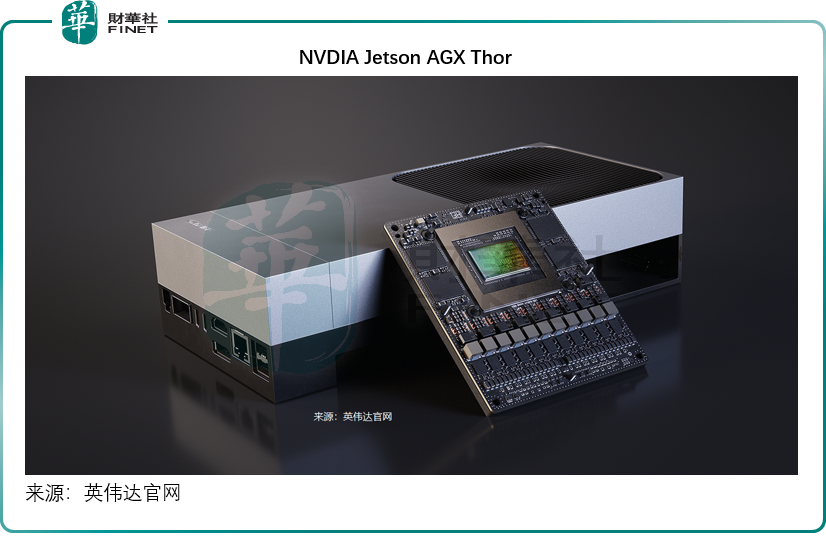
This product, referred to in the industry as the “robotic super brain,” not only embodies NVIDIA’s ambitions in the edge AI field but may also become a pivotal turning point in advancing the global robotics industry from the era of “functional machines” to “intelligent machines.”
Thor’s Technological Breakthrough: When Blackwell Meets Robotics
The core highlight of Jetson Thor lies in its use of NVIDIA’s latest Blackwell architecture GPU. Although Blackwell chips were previously aimed at data centers for training trillion-parameter large models, NVIDIA has adapted them for the edge, demonstrating its foresight regarding the computational needs of robotics.
Specifically, Jetson Thor achieves 2070 FP4 TFLOPS of AI computing power at a power consumption of 130 watts, a 7.5-fold increase over the previous generation Orin, with a 3.5-fold improvement in energy efficiency. This means it can run multiple types of generative AI models in parallel on end devices— including vision-language-action models (like GR00T), large language models (LLM), and vision-language models (VLM). More importantly, its 128GB memory capacity is sufficient to support real-time inference of complex multimodal models, addressing the long-standing “computational wall” issue in the robotics field.
Notably, Jetson Thor achieves for the first time the collaborative operation of multiple AI workflows. For example, a humanoid robot can simultaneously handle multiple tasks such as environmental perception, language interaction, action planning, and anomaly handling, rather than relying on cloud collaboration or sequential execution as traditional robots do. This capability enables real-time, natural interaction between robots and humans.
Ecological Layout: From “Tool Maker” to “Ecosystem Builder”
NVIDIA’s list of early adopters announced this time includes nearly all of the world’s top robotics companies and innovative forces:
In the field of humanoid robots: Agility Robotics (bipedal robot Digit), Boston Dynamics (Atlas), Figure (in collaboration with BMW), 1X (NEO robot);
Industry Giants: Amazon logistics robots, Caterpillar (construction machinery), John Deere (agricultural machinery), Medtronic (surgical robots);
AI Labs: OpenAI, Physical Intelligence (embodied intelligence research).
This list reflects NVIDIA’s ecological strategy: by providing standardized high-performance hardware and software stacks (Isaac Sim, GR00T, etc.), it lowers the barriers to robotics development while positioning itself as the “infrastructure provider for the robotics industry.”
As Deepu Talla, NVIDIA’s Vice President of Robotics and Edge Computing, stated: “We do not produce robots, but we will empower the entire industry through our computing platform.” This “shovel seller” model is similar to its strategy in the autonomous driving field—empowering car manufacturers through the DRIVE platform rather than building cars itself.
UBTECH as a Pioneer in the Thor Ecosystem
Chinese robotics company UBTECH (09880.HK) quickly announced after the launch of Jetson Thor that it would deploy the Jetson Thor platform on its industrial humanoid robot Walker S2. Walker S2 is a robot launched by UBTECH in July aimed at smart manufacturing scenarios, characterized by its use of the “Group Brain Network 2.0” architecture and self-developed Co-Agent collaborative intelligence, supporting multi-machine collaboration and autonomous battery swapping.
UBTECH’s choice is representative: Chinese robotics companies urgently need high-performance computing platforms to support complex scenario implementations, but the cost and time of developing chips independently are high. The emergence of Jetson Thor provides the possibility of “overtaking on a curve”—companies can focus on algorithms, scenario adaptation, and commercialization while leaving the underlying computing power to NVIDIA.
However, this also raises concerns: once Jetson Thor becomes the industry standard, NVIDIA may replicate its “monopolistic advantage” in AI training chips within the robotics field, leading downstream companies to form path dependence.
Strategic Intent: Robotics Has Become NVIDIA’s Second Growth Curve
NVIDIA’s emphasis on its robotics business has long been evident. A year ago, the company integrated its robotics business into the autonomous driving division, which reported revenues of $567 million in the May 2025 fiscal quarter, accounting for only 1.29% of total revenue, but with a year-on-year growth rate of 72.34%, second only to the data center business.
Jensen Huang has repeatedly emphasized: “Humanoid robots will become NVIDIA’s largest growth engine after AI.” Industry estimates suggest that the global humanoid robot market will reach a scale of hundreds of billions of dollars by 2030, and NVIDIA’s goal is to become its “core computing power supplier” and even define industry standards.
From a technical perspective, NVIDIA is promoting the evolution of robotics from “dedicated control systems” to “general AI platforms”:
Traditional robots: rely on pre-programmed code, fixed tasks, and poor adaptability;
The next generation of robots empowered by Jetson Thor: achieve autonomous decision-making, multimodal interaction, and continuous learning through generative AI.
Challenges and Future: Hardware-Software Collaboration and Industry Competition
Despite the clear advantages of Jetson Thor, NVIDIA still faces multiple challenges:
Power Consumption and Cost: 130 watts of power consumption is still high for mobile robots, and high-end computing power inevitably comes with high pricing;
Competitors: Qualcomm (QCOM.US), Intel (INTC.US), Tesla (TSLA.US), and Google (GOOG.US) are all laying out robotics computing platforms;
Scenario Adaptation: Industrial, medical, agricultural, and other scenarios have significant demand differences, requiring deep customization support.
Moreover, the robotics industry is still in a “fragmented” stage, with no explosive application scenarios yet. Whether Jetson Thor can give rise to “killer applications” will determine its commercial success or failure.
Conclusion: How Far Away is the Robotics “iPhone Moment”?
The launch of Jetson Thor marks the official entry of the robotics industry into the “large model-driven” era. Its significance lies not only in the enhancement of computing power but also in providing robots with the possibility of a “general brain”—understanding the world, interacting with humans, and learning autonomously through generative AI.
Just as the iPhone redefined mobile phones through the iOS ecosystem, NVIDIA aims to become the “rule maker” of the robotics industry through the integration of “hardware (Jetson) + software (Isaac) + development ecosystem.” Although there are still technical, commercial, and ethical challenges ahead, it is undeniable that the competition in the robotics industry has shifted from “hardware performance” to “intelligence level.”
And NVIDIA has already grasped the most important chip.
✍ Author丨Mao Ting
✍ Editor丨Danna
Previous Highlights
After the performance drop, the stock price fell 17%. What hidden worries are behind Bruker’s turnaround?
[Conference Highlights] Signs of performance bottoming out, Li Ning: expects full-year revenue to remain flat
Meta’s $10 billion contract raises speculation, will the AI race ignite a new battle in the cloud?
Why is Baidu struggling to gain favor in the capital market?