1. Explanation of Core Concepts
-
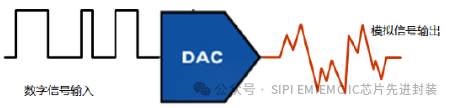
DAC (Digital-to-Analog Converter): Its function is to convert digital codes (0s and 1s) into real analog voltage or current signals. It serves as a bridge between the digital world and the analog world.
-
Sampling Rate: Refers to the number of times the DAC can perform this conversion operation per second. The unit is SPS (Samples Per Second).
-
12 GSPS: Indicates that it performs 12 billion digital-to-analog conversions per second.
-
<span>G</span>= Giga (billion, 10^9) -
<span>SPS</span>= Samples Per Second -
Thus, 12 GSPS = 12 × 10^9 Samples/Second.
2. Intuitive Understanding: Why Such a High Sampling Rate is Needed?
According to the Nyquist-Shannon Sampling Theorem in the fields of communication and signal processing, to reconstruct an analog signal without loss, the sampling rate must be at least twice the highest frequency component of the signal.
-
Bandwidth of the Reconstructed Signal: A DAC with a sampling rate of 12 GSPS can theoretically be used to reconstruct an analog signal with a maximum frequency of 6 GHz.
-
<span>f_max = Sampling Rate / 2 = 12 GSPS / 2 = 6 GHz</span> -
Higher Quality Signals: In practical applications, to achieve higher quality and smoother signals, the sampling rate typically needs to be 4 times or even higher than the signal bandwidth. Therefore, a 12 GSPS DAC can excellently generate complex waveforms in the range of 1.5 GHz to 3 GHz.
A Simple Analogy: To create a smooth circle (analog signal), you need at least several points (sampling points) to connect. However, the more points you use (the higher the sampling rate), the smoother and more realistic the circle becomes. 12 GSPS means you have 12 billion points per second to “draw” this signal, allowing for the depiction of extremely complex and high-frequency waveforms.
3. Technical Challenges in Achieving 12 GSPS
Reaching such a high sampling rate is no easy task; it involves cutting-edge semiconductor processes and innovative circuit designs:
-
Advanced Semiconductor Processes: Typically using CMOS or SiGe (Silicon-Germanium) processes, which have very small feature sizes (such as 16nm, 7nm, or even smaller), allowing transistors to switch at extremely fast speeds to keep up with the pace of 12 billion times per second.
-
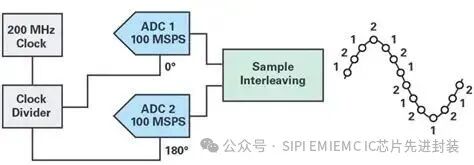
Time-Interleaving: This is the core technology. A single DAC core finds it difficult to operate directly at a 12 GHz clock. Therefore, multiple (e.g., 16) slightly lower-performance DAC cores are typically used to work in parallel.
-
The system demultiplexes (De-mux) a high-speed data stream into 16 parallel low-speed channels.
-
Each core operates at
<span>12 GSPS / 16 = 750 MSPS</span>. -
Their outputs are precisely time-aligned and combined at the analog end, ultimately synthesizing a 12 GSPS ultra-high-speed data stream.
-
Challenges: The gain mismatch, offset mismatch, and timing mismatch between the various DAC cores must be calibrated to extremely low levels; otherwise, spurious signals will appear in the output spectrum.
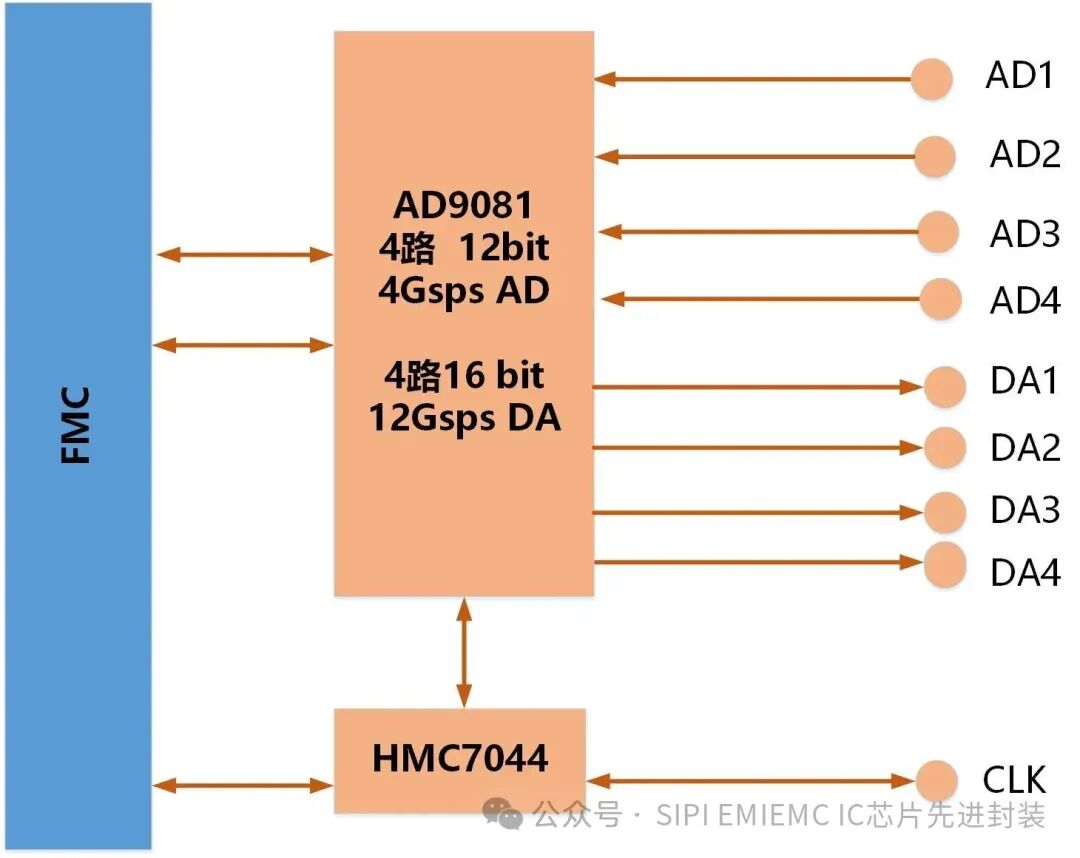
Digital Data Interface: Feeding 12 billion digital samples per second accurately to the DAC is a significant challenge. This requires very high-speed serializers (SERDES) and interfaces (such as JESD204B/C).
Power Consumption and Heat Dissipation: Such high-speed switching operations generate significant heat, making power management critical.
Analog Output Circuit: Designing output amplifiers and drivers that maintain linearity and fidelity at a bandwidth of 6 GHz is also extremely challenging.
4. Major Application Areas
A DAC with a capability of 12 GSPS is the engine of system performance, primarily used in scenarios that require generating extremely high frequencies or very complex waveforms:
-
High-End Test and Measurement Equipment:
-
Arbitrary Waveform Generators (AWG): Directly generate complex radar pulses, ultra-high-speed digital communication test signals (such as PAM4 for 400G/800G Ethernet), quantum computing control signals, etc.
-
DAC Channels in High-Speed Oscilloscopes: Used to output reference signals or trigger signals.
Communication Systems:
-
Microwave Backhaul/Front-haul: Generate high-order modulation (such as 1024QAM) microwave signals for communication between 5G base stations.
-
Satellite Communication: Generate broadband signals up-converted to the Ka band or even higher frequencies.
Radar and Electronic Warfare (EW):
-
Automotive Radar (77 GHz): Although the DAC does not operate directly at 77 GHz, it can easily up-convert to the millimeter-wave band by generating an intermediate frequency (IF) signal and mixing it with a high-frequency local oscillator.
-
Military Radar/Electronic Warfare: Generate complex jamming waveforms and radar pulses to achieve advanced functions such as high precision and low probability of intercept (LPI).
Scientific Research:
-
High Energy Physics: Control systems for particle accelerators.
-
Astronomical Radio Telescopes: Generate local oscillator signals or calibration signals.
Conclusion
A DAC sampling rate of up to 12 GSPS means:
-
Top Performance: It represents the pinnacle of current digital-to-analog conversion technology.
-
Wide Bandwidth: Capable of directly synthesizing analog signals with frequencies up to 6 GHz, opening doors for microwave and millimeter-wave applications.
-
Core of the System: It is the core chip of high-end test equipment, advanced communication, and radar systems, determining the performance ceiling of the entire system.
-
Technological Achievement: Its realization integrates advanced semiconductor processes, precise time-interleaving architectures, and complex calibration algorithms, representing an outstanding achievement in electronic engineering.