Author: Li Baozhu
For reprints, please contact this public account for authorization and indicate the source.
NVIDIA’s Physical AI has achieved new results, with the robot brain going online, enabling real-time intelligent interaction with the physical world.
Jensen Huang has publicly stated that robots are NVIDIA’s biggest growth opportunity beyond artificial intelligence. At CES 2025, which opens in early January 2025, Huang proclaimed, “The next frontier of AI is the physical world,” similar to his previous bet on OpenAI; his current choice is the robotics track led by Physical AI.
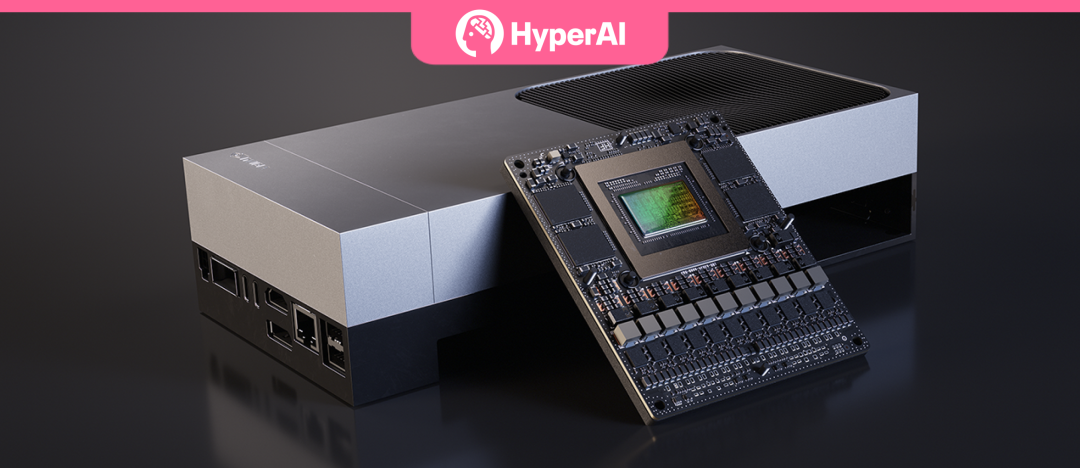
On Monday (August 25), NVIDIA announced the official launch of the Jetson AGX Thor development kit, starting at $3499, with the mass-produced module Thor T5000 also available to enterprise customers.
NVIDIA refers to the Jetson AGX Thor as the “robot brain,” aiming to empower millions of robots across industries such as manufacturing, logistics, transportation, healthcare, agriculture, and retail. Initial users include Agility Robotics, Amazon Robotics, Boston Dynamics, Caterpillar, Figure, Hexagon, Medtronic, and Meta. Additionally, 1X, John Deere, OpenAI, and Physical Intelligence are also evaluating the platform.
Huang stated at the launch event: “We created Jetson Thor for the millions of developers working on embodied systems. These systems are interacting with the physical world and gradually reshaping our lives. With unparalleled performance and energy efficiency, as well as the ability to run multiple generative AI models at the edge, Jetson Thor will become the ultimate supercomputer driving the era of Physical AI and general robotics.”
7.5 Times Computing Power + 3.5 Times Energy Efficiency: Key Breakthroughs in Physical AI
The Jetson AGX Thor is equipped with NVIDIA’s latest Blackwell GPU architecture and features up to 128GB of memory, providing 2070 FP4 TFLOPS of AI computing power at a power consumption of 130 watts. Compared to the previous generation Jetson Orin, Thor has improved computing power by 7.5 times and energy efficiency by 3.5 times, significantly breaking through the performance bottleneck for running generative AI models in robots.
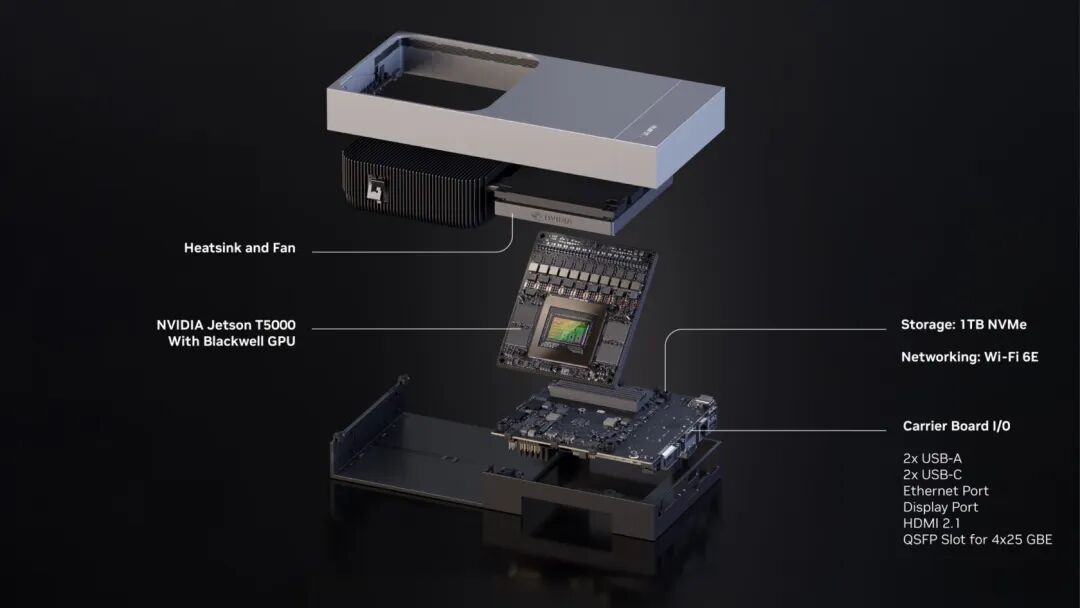
Jetson AGX Thor Development Kit
This means that robots can not only run mainstream large language models (LLMs) but also execute visual language models (VLMs) and humanoid robot foundational models like Isaac GR00T N1.5, enabling real-time understanding and reasoning about the physical world. NVIDIA emphasizes that this performance advantage allows Jetson Thor to support multiple AI workflows, helping robots interact intelligently and in real-time with humans and their environments.
Building the Physical AI Supercomputer
Jetson Thor is not just a hardware upgrade; it also carries the complete NVIDIA Jetson software stack, fully supporting mainstream AI frameworks and generative AI models, and is completely compatible with NVIDIA’s software ecosystem from cloud to edge.
Including:
* NVIDIA Isaac: Robot simulation and development platform;
* Isaac GR00T: Humanoid robot foundational model;
* NVIDIA Metropolis: Visual AI platform;
* NVIDIA Holoscan: Real-time sensor data processing.
Since its launch in 2014, the Jetson platform has attracted over 2 million developers and more than 150 ecosystem partners, with Jetson Orin being used by over 7,000 customers for edge AI deployments. With the launch of Jetson Thor, NVIDIA aims to further promote the implementation of complex systems such as visual AI entities, humanoid robots, and surgical robots.
At the same time, NVIDIA has also released a series of new world AI models, libraries, and other infrastructure for robot developers, such as Cosmos-Reason1-7B, a reasoning visual language model with 7 billion parameters, designed specifically for Physical AI applications and robotics; Cosmos Transfer-2, which accelerates the generation of synthetic data based on 3D simulation scenes or spatial control inputs; and a distilled version of Cosmos Transfer, optimized for running speed.
Get high-quality papers and in-depth articles in the AI4S field for 2023-2024 with one click ⬇️
Previous Recommendations





Click“Read the original text” to get a wealth of dataset resources for free!