*This article is adapted from The Wall Street Journal “Robots and AI Are Already Remaking the Chinese Economy,” with slight modifications.
Robots and Artificial Intelligence Are Already Remaking the Chinese Economy
Sam Altman hopes that artificial intelligence can cure cancer. Elon Musk believes AI robots will eliminate poverty. China is focused on more practical matters: making better washing machines. While China’s long-term goals in artificial intelligence are as ambitious as those of global tech giants, its immediate priorities are to solidify its position as the global manufacturing hub for decades to come. This drive is evident throughout this vast country, where dozens of companies—backed by billions in government and private technology development—are transforming every aspect of manufacturing and exporting goods. A fashion designer noted that with the help of AI, the time to produce samples has been reduced by over 70%. In China, washing machines are now produced under the direction of an AI “factory brain.”
At one of China’s largest ports, driverless trucks zip around the port with hardly any workers in sight, while the scheduling is managed by an AI system.
Author: Brian Spegele
Executives involved in projects in China say that future factories will operate like “living organisms,” capable of autonomous thought and action, rather than merely following pre-set programs in traditional automated factories. This will further drive the proliferation of “dark factories,” which are highly automated and can operate around the clock in dim lighting.
However, for the country, these advancements could come faster; China does not want to lose its status as the world’s factory. Against the backdrop of slowing population growth, young people are less inclined to work in factories, and Chinese exports face resistance in some countries.
Artificial intelligence is seen as a lifeline to address these risks, helping China manufacture and transport more products faster and cheaper. Despite global concerns about how quickly AI will change the world, China is not waiting: it aims to rapidly deploy existing technologies to secure its advantages.
“Only by actively embracing change can we remain undefeated in this revolution,” said the chairman of one of China’s largest steel groups to state media this year. Its publicly listed subsidiary, Baosteel Group, had already implemented 125 AI applications by the end of last year, with plans to increase that number to 1,000 in the future.
Robot Deployment
According to the International Federation of Robotics, China installed 295,000 industrial robots last year, surpassing the total of all other countries combined. By 2024, the number of robots operating in China is expected to exceed 2 million, ranking first in the world.
Globally, the World Economic Forum recognized 131 factories and industrial bases that have enhanced productivity through cutting-edge technologies like AI, with 45 of them located in China.
According to media reports, at Baosteel’s “dark factory” in Shanghai, three operators monitor real-time data updates from dozens of screens. A deputy director at the factory stated that AI has reduced the frequency of human intervention from once every three minutes to once every 30 minutes.
A strong manufacturing sector is key to a strong economy, and a strong economy ultimately enhances national power. A quarter of China’s GDP comes from manufacturing, a figure significantly higher than the global average.
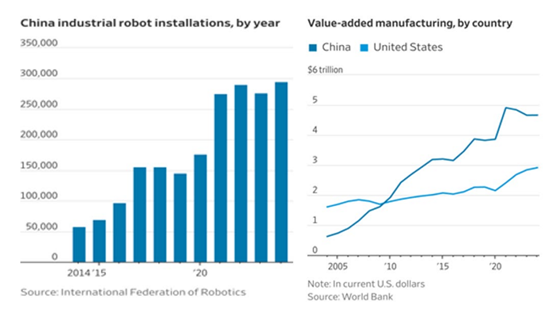
The Deputy Minister of the Ministry of Industry and Information Technology of China stated that embracing AI is “a necessary task, not an option.”
Factory Brain
China’s advantage lies in its ambitious scale, reflected not only in national-level technology centers but also in regions like Jingzhou. This area is a major production base for Midea Group, one of the world’s largest home appliance manufacturers.
At the Jingzhou factory, humanoid robots work in tandem with the factory brain to transport molded parts to inspection stations, where a 3D camera checks them. If a part fails inspection, the factory’s AI system identifies solutions to the problem.
When the assembly line needs to fix different models of dryers, the factory brain can identify the specific model, allowing the robots to perform the correct tasks—providing human-like flexibility and improving production efficiency, Midea stated.
In areas still requiring human operation, some workers have been equipped with AI glasses that can highlight common product defects based on past inspection records. Tasks that previously took 15 minutes can now be completed in just 30 seconds.
As a sign of the company’s desire to leverage technology for efficiency, Midea Group reported that its employees’ income grew by nearly 40% from 2015 to 2024.
The emergence of DeepSeek showcases the capabilities of Chinese engineers in developing AI models. Additionally, the majority of Chinese people hold an optimistic view of AI, enabling the government to rapidly deploy related technologies. A survey found that 83% of Chinese respondents believe that AI-driven products and services bring more benefits than drawbacks, a figure that is double that of the United States.
The Role of Huawei
In addition to DeepSeek, Huawei is also at the core of China’s AI efforts. The company has launched a large model named “Pangu,” named after a character in Chinese mythology who created the world, and provides other AI services to help businesses become more agile and efficient.
Huawei has partnered with a large cement producer in Wuhu, Conch Group. Conch’s cement has been used in projects such as the Three Gorges Dam and the Burj Khalifa in Dubai.
Facing the issue of overcapacity in China’s cement industry, Conch Cement aims to consolidate its competitive advantage through the rapid adoption of AI, including in the clinker production process. Clinker is a key component of cement, made by heating limestone and other materials at high temperatures.
Conch Group and Huawei have jointly developed AI tools to more accurately predict clinker strength and control the energy consumption of kilns producing clinker. Today, the conveyor belts at the Wuhu factory are monitored by AI, helping Conch respond more efficiently when issues arise on the conveyor belts.
During a recent visit, workers at Conch Group’s massive clinker production facility observed how AI models automatically adjust production in real-time. Conch Group and Huawei stated that with AI, they can now predict clinker strength with over 85% accuracy, compared to only 70% accuracy with human estimates. This allows them to adjust raw material ratios to avoid producing clinker with inappropriate strength.
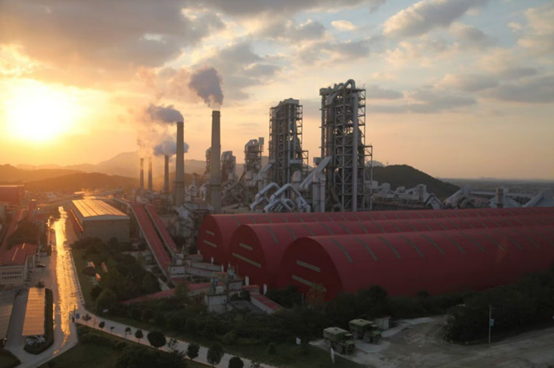
Conch’s factory is utilizing AI to improve the production efficiency of key cement components.
Conch reports that the application of AI models has already reduced coal consumption by 1%, equivalent to nearly $300,000 saved per production line annually. The company plans to increase this rate to 2% by the end of 2026, which could result in savings of tens of millions of dollars if implemented company-wide.
Conch and Huawei stated that reaching this level involved a challenging process, requiring extensive trial and error to get the models to function properly. This experience also highlights that global AI capabilities remain limited, and its impact—including in China—may only become apparent gradually.
“We Are the Future”
Chinese leaders emphasize upgrading national ports as a key step in consolidating China’s status as a global manufacturing powerhouse.
Tianjin Port, one of China’s largest ports, has partnered with Huawei to launch a fleet of driverless trucks and a system called “OptVerse AI Solver.” This system optimizes millions of variables and constraints, such as ship arrival times and crane capacities, for scheduling management.
According to Huawei, planning work that previously took 24 hours can now be completed in just 10 minutes.
A port executive revealed to the media that as of last year, the port also launched PortGPT, an AI model co-developed with Huawei. This model has the capability to analyze on-site videos and images, and is expected to replace human security personnel in the future.
Similar stories are unfolding across China; according to data from the World Bank and S&P Global Market Intelligence, half of the top 20 ports in the world by vessel turnaround time are located in China, including Tianjin Port.
The vice president of Tianjin Port stated that its highly automated operations require 60% fewer workers than traditional ports.
According to official media reports this year, over 88% of the large container equipment at Tianjin Port has been automated. For visitors, a video summarized China’s growing confidence in AI: “We are the future.”
