Every day, I select a small question from my hundreds of overseas WeChat groups and tens of thousands of overseas WeChat friends to write an article.
Sometimes it involves cross-border resources or business service collaborations, and I introduce suitable ones to everyone. So far, I have connected over 150 resources. If you are interested in collaboration, please add zhihuiabo.
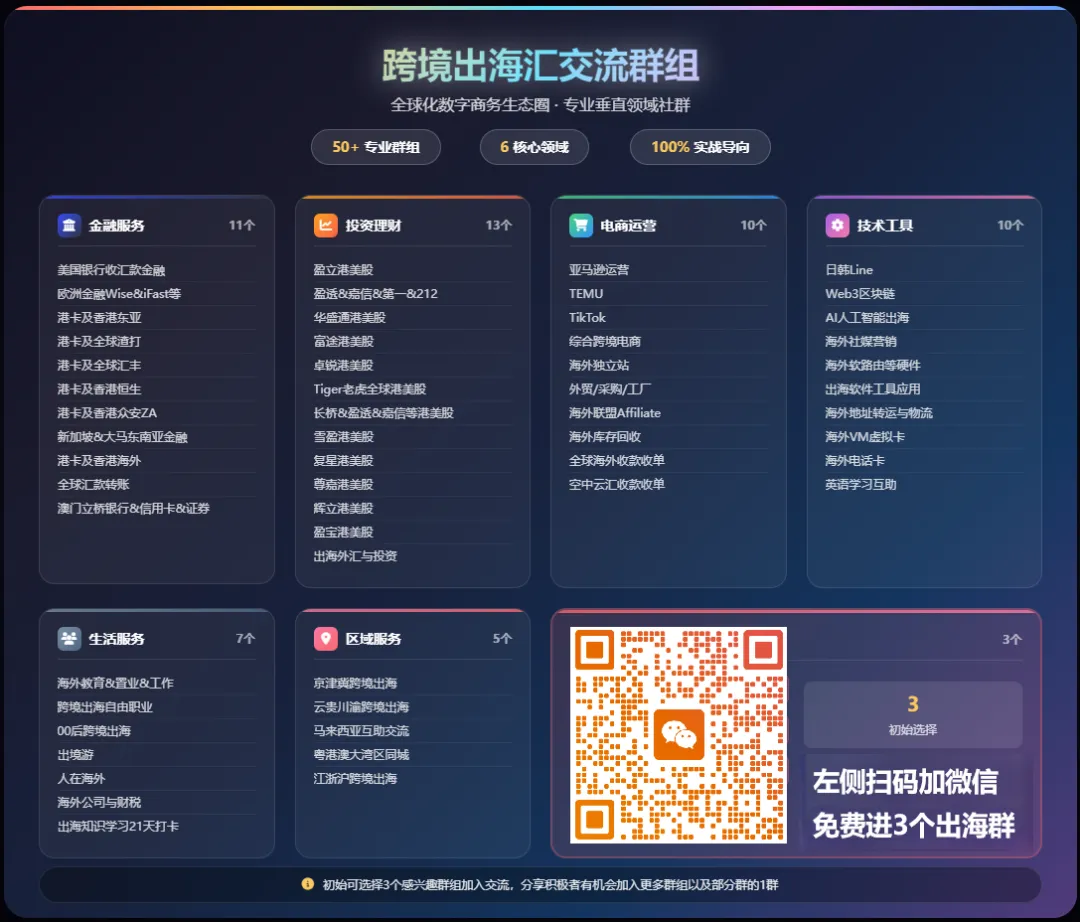 If you are interested in enhancing efficiency with AI, you can scan the QR code in the poster above and note “AI” to be added to the AI group chat for free.
A few days ago, I received an invitation to write about my practical experiences with AI (whether I was selected or not doesn’t matter; it’s just a way to organize my thoughts).
Upon reflection, I realized that for the past two years, I have been using AI for over 12 hours a day.
The real catalyst for this change was attending the first AI conference organized by the Wealth Navigation Association. After participating in person, I grasped one or two key points and began to practice deeply, which transformed my entire work approach.
The article requires 1500–3000 words, and I cannot cover everything, so I decided to focus on a “small and specific” point:
How to Transform AI from “a Chatbot” into “a Cross-Disciplinary Expert Team” by Your Side.
I won’t discuss advanced techniques, but rather focus on methods that everyone can implement immediately and see results the same day.
1. Make AI a “Team” Rather Than a Chat Partner
Many people use AI in the following way:
They ask whatever comes to mind, and once a conversation ends, they forget it.
After a few days, they ask the same question again, starting from scratch.
This is like “flirting with strangers” every day.
In fact, I believe you should never casually use an AI tool to ask a few questions.
The reason is simple:
Without accumulation, you will never be able to provide smarter and more suitable answers based on your “historical context”.
Switching between third-party AI tools and asking the same question again is called:repetitive labor, which wastes energy and lacks long-term compounding.
The correct approach is:
Use one tool (for me, it’s ChatGPT) as your only “long-term brain”.
Utilize it in a project-based manner, structure your accumulation, and continuously expand your knowledge base.
Consider AI as a long-term collaborative “multi-disciplinary expert team”.
In each field, there is an independent “project space” for perpetual accumulation and long-term evolution.
For example, I create a bunch of “projects” in ChatGPT (which can be simply understood as categorized folders; this feature used to be exclusive to Plus members, but now it seems available to everyone. However, I strongly recommend everyone to get a Plus membership, as the limitations for non-members can significantly affect our productivity):
-
Global Payment Collection
-
Google Ads
-
US Banking Finance
-
Web3
-
Affiliate Marketing
-
Overseas Self-Media
-
Cross-Border E-commerce
-
Hong Kong Banking Finance
-
……
You can even think of it as:
This is not a “folder”; this is a “department”.
From now on, I will ask all related questions in the corresponding “project”.
Over time, the records in this project will become richer, and AI’s understanding of this field will deepen.
The next time you ask a question, it won’t be based on just your one sentence; it will be based on the entire project’s context, like a true colleague who “understands your business”.
This is the first step towards “AI assetization”!
I used to think that with AI, there was less information disparity, and it was no longer possible to make money through information gaps (like consulting services, etc.). However, in some aspects, the information gap is still widening because the same question (slightly more specialized, not just objective right or wrong) can yield significantly different answers from AI depending on who asks it, as it becomes increasingly personalized and specialized through interaction.
2. Projects Can Be Further Subdivided: Structuring AI’s Knowledge System for Accumulation
Suppose I created a project called “Global Payment Collection”.
Then I would continue to break it down into:
-
US PayPal
-
Stripe Payments
-
Cash App
-
Revolut
-
Hong Kong Virtual Banks
-
Tax Information from Various Countries
Each topic has its own conversation thread.
In the future, if there is any related content, I can directly continue to ask.
ChatGPT has a limited conversation length, so when it fills up, I can start a new conversation.
For example, “US PayPal 2” or “Stripe Payments (Process)”.
But all are kept within the same project.
The benefits of this approach are:
Knowledge will not be lost
The system will become increasingly structured
All questions on the same topic can be understood in relation
This is crucial for us in the cross-border industry, as we deal with “long chains, many links, numerous pitfalls” every day.
3. NotebookLM / IMA: Upgrading Projects to “Proactive Content Mining Researchers”
Once a field accumulates to a certain extent, I will import this content into NotebookLM or Tencent IMA.
Why?
Because:
NotebookLM has a superpower:
It will tell you “what points in your knowledge base are worth writing into separate articles”.
I often ask it:
-
“What viewpoints have I never written about?”
-
“What themes are worth making a separate issue?”
-
“What gold mines have I not dug into?”
NotebookLM will directly generate:
-
Usable article titles
-
Core viewpoints
-
Complete logical frameworks
-
Citable cases
-
Risk alerts
-
Perspectives suitable for my readers
In short:
It can break down your input into an inexhaustible pool of topics.
And once you feed it enough material, NotebookLM / IMA becomes more than just a tool; it is:
-
Your “researcher”
-
Your “summary expert”
-
Your “inspiration partner”
-
Your “content production factory”
The more you input, the more it can help you mine content in return.
4. A Highly Efficient Workflow: Reverse Questioning
I often ask questions like this:
-
“Based on this knowledge base, give me 10 article titles worth writing”
-
“Summarize it into a framework that can be directly published on WeChat”
-
“List the 20 most common misconceptions in this field”
-
“Generate a PPT outline”
-
“Write a script for Bilibili”
-
“Give me ten pieces of fragmented content for X/Twitter”
-
“Help me create key points for a poster”
-
“Provide lecture notes”
NotebookLM excels at structuring content
IMA is more suitable for the domestic ecosystem
The combination of both creates a stable content production line.
When I find content through Gemini, Claude, or Perplexity (sometimes I collect and compare multiple answers to the same question, or when ChatGPT isn’t working, or when different AIs specialize in different areas, I also ask other AIs), I will sync it back to ChatGPT, making it my “main brain”.
5. Why Am I Willing to Entrust Many Complex Problems to AI Projects?
The cross-border industry is not like other industries:
It has long chains, many nodes, numerous blind spots, a lot of jargon, and significant compliance risks.
I tend to do the following:
In the corresponding project, I ask AI to:
-
First, help me clarify the entire process
-
Then, point out possible risk areas
-
Generate a “client-readable” explanatory document (manus)
-
Then produce a PPT / graphic version (skywork)
-
Finally, feed it back into my community, knowledge planet, and social circle
By doing this, you will find:
Problems that used to take two or three hours to sort out can now be resolved in half an hour, and they are complete, clear, and reusable.
6. When You Transition from “AI User” to “AI Asset Builder”, Everything Changes
My experiences over the past two years have taught me:
When you chat with AI, you are always “taking”;
When you build structures with AI, you start to “own”.
Once you have built a complete knowledge system in a field—
It will naturally generate new content, new topics, new viewpoints, and new business inspirations continuously.
To be more realistic:
If you can continuously produce high-quality vertical content, you can continuously attract precise customer traffic.When traffic comes, monetization will naturally follow; isn’t that a way to generate wealth?
To be honest, I am currently facing enormous and unimaginable difficulties, but with the support of AI, my capabilities have actually multiplied, and I can easily turn ideas into practical applications that generate income. Earning six figures a month as an individual is quite simple, but how to create a scalable effect and replicate myself in bulk is the key focus I need to execute next.
The real barrier is not the tools, but:
Are you treating AI as a “long-term asset” to manage?
I hope this article can provide you with some inspiration:
Don’t be an AI user; be the leader of an AI team.
Working with a group of AI experts will elevate your productivity to unimaginable levels, and wealth will come closer to you.
By the way, I feel that Google’s Gemini (“Unlock numerous hidden AI features in Chrome for free, transforming your browser into a super assistant!”) has become increasingly powerful in terms of compatibility and capabilities with Chinese.
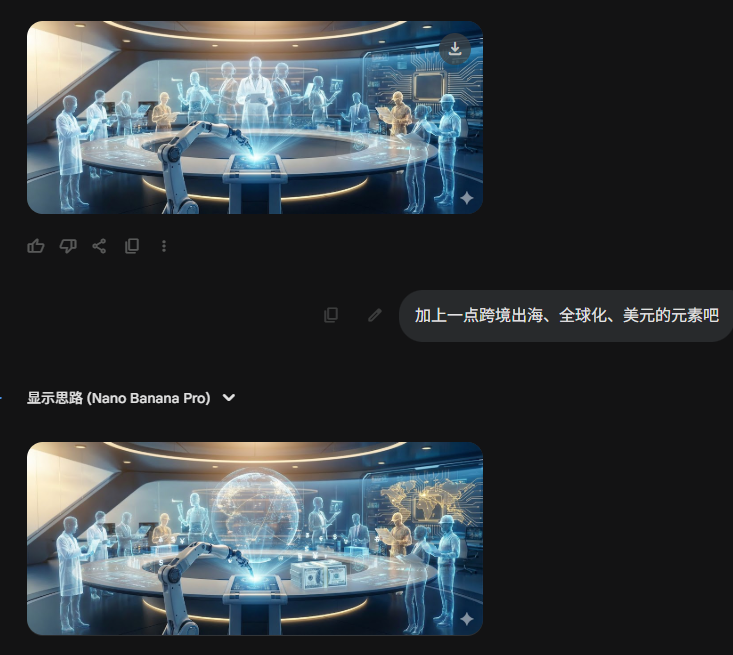
Now, when comparing the same question horizontally, I feel that Gemini surpasses ChatGPT, and it also has strong image generation capabilities (NanoBanana) and video generation capabilities (Veo), along with the mentioned NotebookLM, making it truly powerful overall.
As shown in the image below, Gemini’s image generation capability can easily create article cover images and modify details at will, which is perfect.
 Recommended Cross-Border Services

 That’s all for today’s tutorial. Thank you for reading. If there are any errors or omissions, or if you have other questions, feel free to correct or raise them in the comments.The WeChat public account articles maintain their original intention, not chasing traffic, just writing and chatting based on daily questions from friends.If you found this helpful, please like and share it with your friends!Also, feel free to click on the business card below to follow my WeChat public account. Thank you!