In the world of embedded systems and mission-critical devices, Real-Time Operating Systems (RTOS) are the core foundation of reliable computing. Among numerous RTOS options, VxWorks, developed by Wind River Systems, has become one of the most trusted and commercially successful solutions due to decades of development.
History of VxWorks
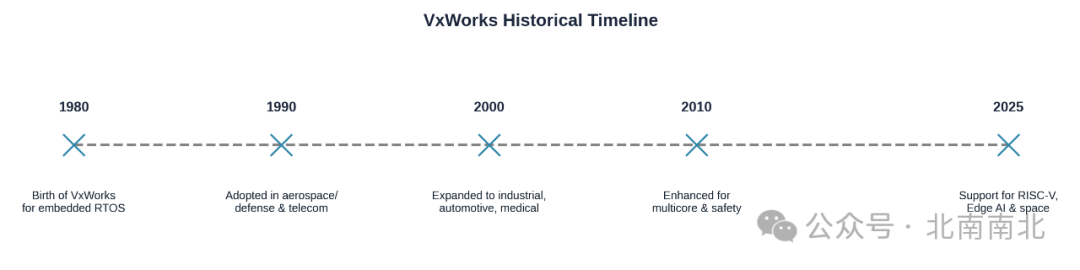
Figure: The evolution of VxWorks from the 1980s to the present
- • 1980s: VxWorks is born, positioned as a deterministic real-time operating system for embedded applications.
- • 1990s to 2000s: Widely deployed in aerospace, defense, and telecommunications systems.
- • Today: Still used in spacecraft, industrial automation, automotive safety, and medical devices in critical scenarios.
Why Choose VxWorks?
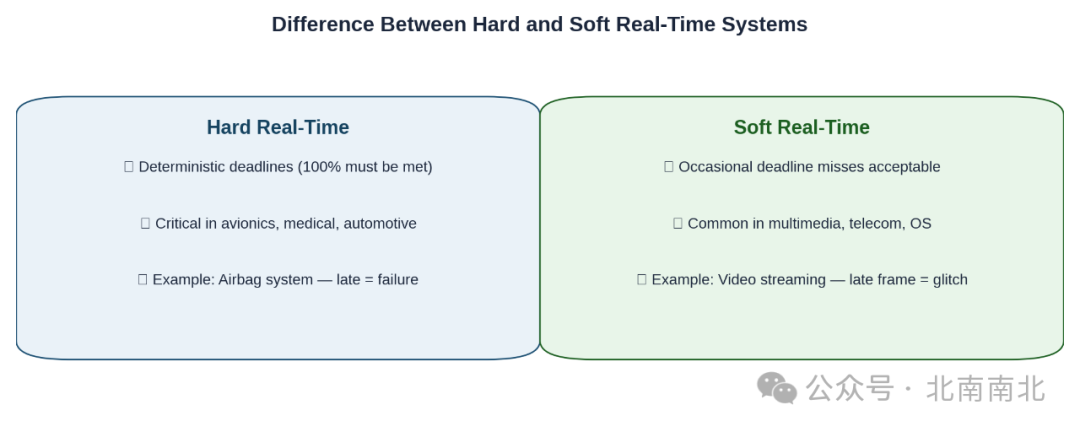
Unlike general-purpose operating systems such as Linux / Windows, VxWorks provides hard real-time guarantees, ensuring that critical tasks are completed within strict time windows.
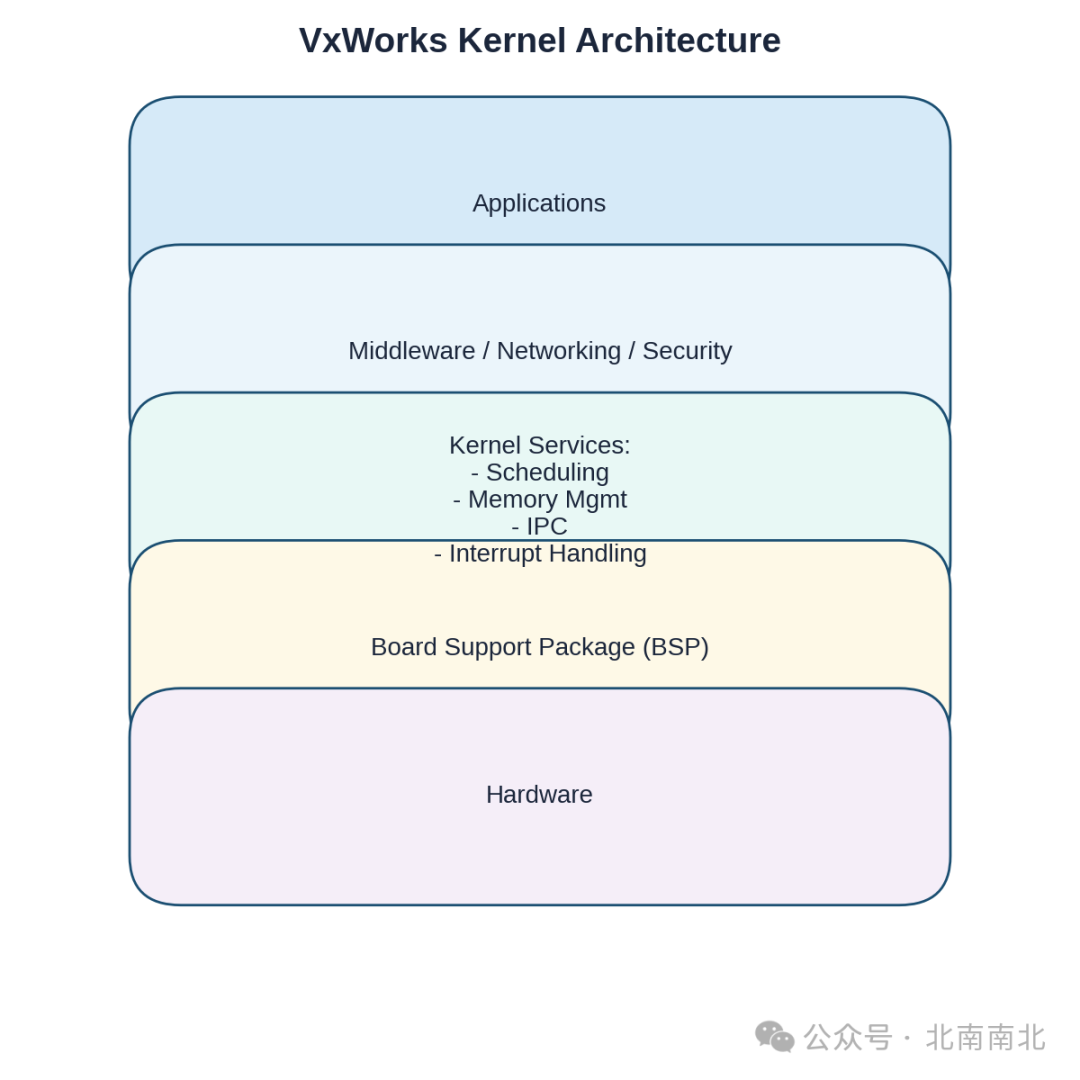
Diagram of VxWorks kernel architecture
Figure: VxWorks kernel and task scheduling mechanism
- • Preemptive priority scheduling
- • Memory protection and process isolation
- • Complete TCP/IP stack
- • Rich IPC communication mechanisms
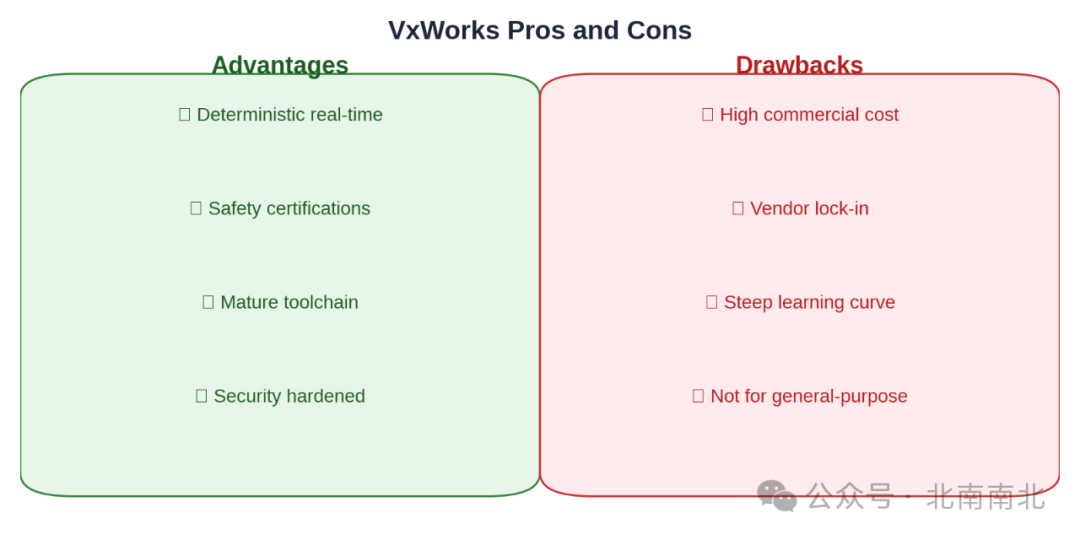
Figure: Key advantages and limitations of VxWorks
Advantages
- • Deterministic real-time performance
- • Support for safety certifications
- • Mature toolchain
- • Security enhancements
Disadvantages
- • High cost
- • Vendor lock-in
- • Steep learning curve
- • Not suitable for general applications
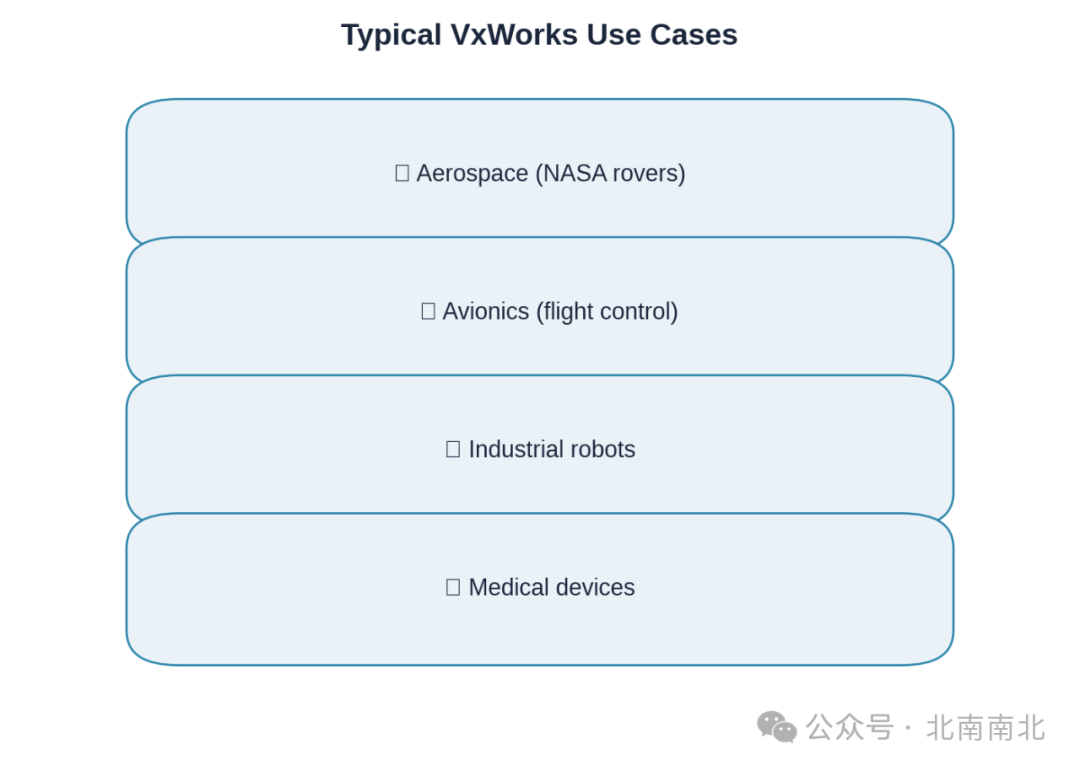
Figure: Examples of VxWorks applications in aerospace, medical, industrial, and automotive fields
- • 🚀 NASA Mars Rover
- • ✈️ Flight control systems
- • 🏭 Industrial robots
- • 🏥 Medical devices
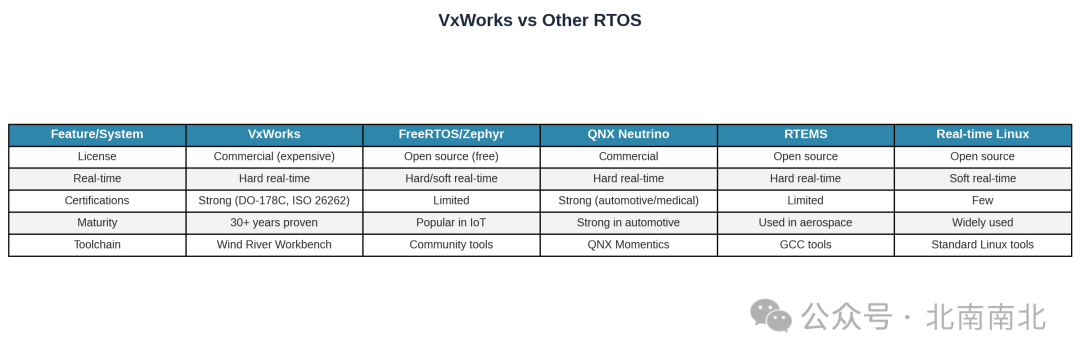
Figure: Comparison of VxWorks with FreeRTOS, QNX, RTEMS, and real-time Linux
| Feature / System | VxWorks | FreeRTOS / Zephyr | QNX Neutrino | RTEMS | Real-Time Linux |
|---|---|---|---|---|---|
| Licensing | Commercial (expensive) | Open-source (free) | Commercial | Open-source | Open-source |
| Real-time capability | Hard real-time | Hard/soft real-time | Hard real-time | Hard real-time | Soft real-time |
| Safety certification support | Strong | Limited | Strong | Limited | Minimal |
| Maturity | 30+ years | Popular in IoT | Strong in automotive | Aerospace research | Widely used |
| Toolchain | Wind River | Community toolchain | QNX Momentics | GCC tools | Linux tools |
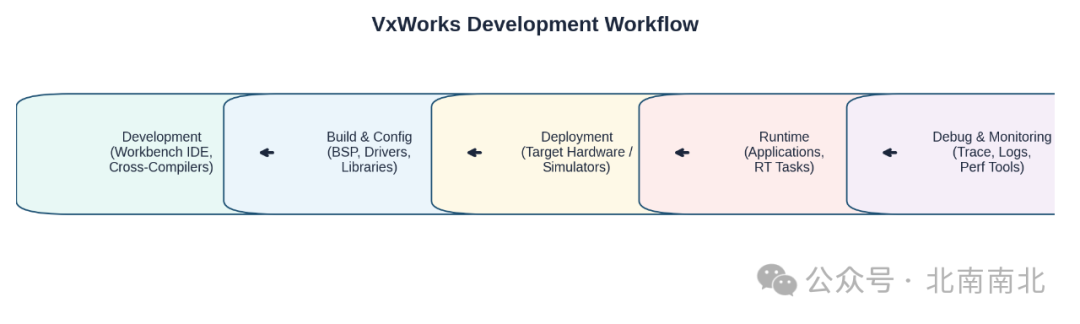
Figure: Typical development process based on Wind River Workbench
- • Cross-platform compilation
- • Emulator support
- • Debugging & performance analysis
- • CI/CD integration
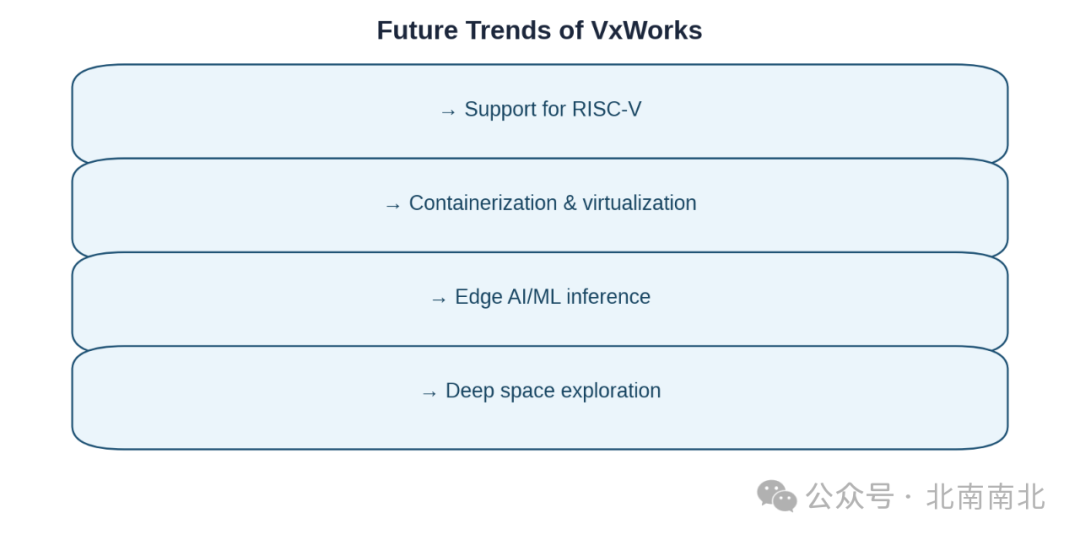
Figure: Future application trends of VxWorks in AI edge, RISC-V, and space exploration
- • Support for RISC-V
- • Containers and virtualization
- • Edge AI/ML inference
- • Deep space exploration missions
Author’s Perspective
I believe:
- • High safety certification scenarios (aerospace, medical, automotive safety) → VxWorks is the best choice.
- • Cost-sensitive projects → FreeRTOS / Zephyr is more suitable.
- • Need for real-time + coexistence with Linux → Hybrid critical systems are the trend.
Conclusion
VxWorks remains the cornerstone of real-time, mission-critical systems. Its deterministic performance, certification qualifications, and mature ecosystem make it irreplaceable in critical industries.
Although its cost and vendor lock-in are drawbacks, the practical applications in spacecraft, aircraft, medical devices, and industrial robots prove that the reliability premium is worth it.