On August 26, the State Council released the “Opinions on Deepening the Implementation of the ‘Artificial Intelligence+’ Action Plan,” marking the accelerated arrival of the ‘Artificial Intelligence + Agriculture’ era. It clearly states the need to “accelerate the innovation of breeding systems driven by artificial intelligence. Just prior, on August 6, Academician Qian Qian’s team published a paper in an internationally renowned academic journal, proposing the ‘Breeding 5.0’ framework driven by artificial intelligence and robotics technology.
Crop breeding technology is crucial for global food security. While traditional methods have played an important role in improving yield, resilience, and nutritional quality, new challenges such as climate change, land degradation, and pest pressures are forcing humanity to seek more efficient and intelligent solutions. The ‘Breeding 5.0’ framework from Academician Qian Qian’s team resonates with policy goals, marking a profound shift in crop improvement from “experience-based selection” to “intelligent systems”.
The core innovation lies in the ability of artificial intelligence to “understand germplasm“—not only recognizing genetic markers but also decoding the structure, plasticity, regulatory logic, and environmental interactions of germplasm. This “germplasm intelligence” will drive the realization of trait prediction modeling, parent optimization design, and targeted selection.
The research team summarized four major technical paradigms to support this transformation:
-
Multimodal data integration: Bridging the gap between genotype and phenotype;
-
Fully simulated environments: Predicting crop performance through virtual performance testing;
-
Unmanned data collection: Utilizing robotics and automation for scalability and precision;
-
Expert explainable AI: Ensuring the scientific and transparent nature of biological decisions.
These technologies combine to form an accelerated cycle of the “breeding flywheel“: as breeding strategies are continuously optimized and phenotypic gains amplified, a self-reinforcing intelligent system is formed, providing faster and smarter solutions for a sustainable food future.
Development of Breeding Technology
Breeding 1.0: Traditional selection based on experience, relying on phenotypic observation but inefficient.
Breeding 2.0: Hybrid breeding guided by Mendelian genetics, establishing quantitative selection theory.
Breeding 3.0: Molecular marker-assisted genomic selection, achieving precise operations at the molecular level;
Breeding 4.0: Integration of biotechnology and big data, with tools like CRISPR making gene editing more precise;
Breeding 5.0: AI-driven intelligent breeding, achieving autonomous decision-making through the integration of multi-omics data and algorithm optimization.
The evolution from Breeding 1.0 to 5.0 showcases the technological transformation in crop improvement, shifting from traditional empiricism to scientific methods, from molecular biology to big data analysis, and from precise breeding to comprehensive intelligent systems. Each breakthrough systematically enhances breeding efficiency and selection accuracy, laying the foundational capabilities for the sustainable development of modern agriculture. Looking ahead, the integration of next-generation AI, functional genomics, and heterogeneous big data will drive breeding technology towards super-intelligent operations and atomic-level precision. These advancements will provide powerful technical solutions to global challenges such as food security demands, climate adaptation requirements, and resource optimization constraints.
Currently, global crop breeding technology is in a parallel development stage, with developed countries leading with Breeding 4.0 (e.g., AlphaFold, generative models, and biological large models are advancing Breeding 5.0), while Africa and developing regions still rely on Breeding 2.0-3.0, with 4.0 applications still in their infancy. The coexistence of multiple generations of breeding technologies both regionally and globally supports the emergence of Breeding 5.0 (generative breeding). The integration of AI revitalizes traditional frameworks by promoting the shift from experience-based methods to data-driven intelligent decision-making, demonstrating the deepening integration of AI and agricultural innovation in ongoing development practices.
Development of AI Technology
Artificial intelligence, as an important branch of computer science, enables machines to perform tasks such as language processing, image recognition, and decision-making by simulating human intelligence. The evolution of AI can be divided into five distinct development stages:
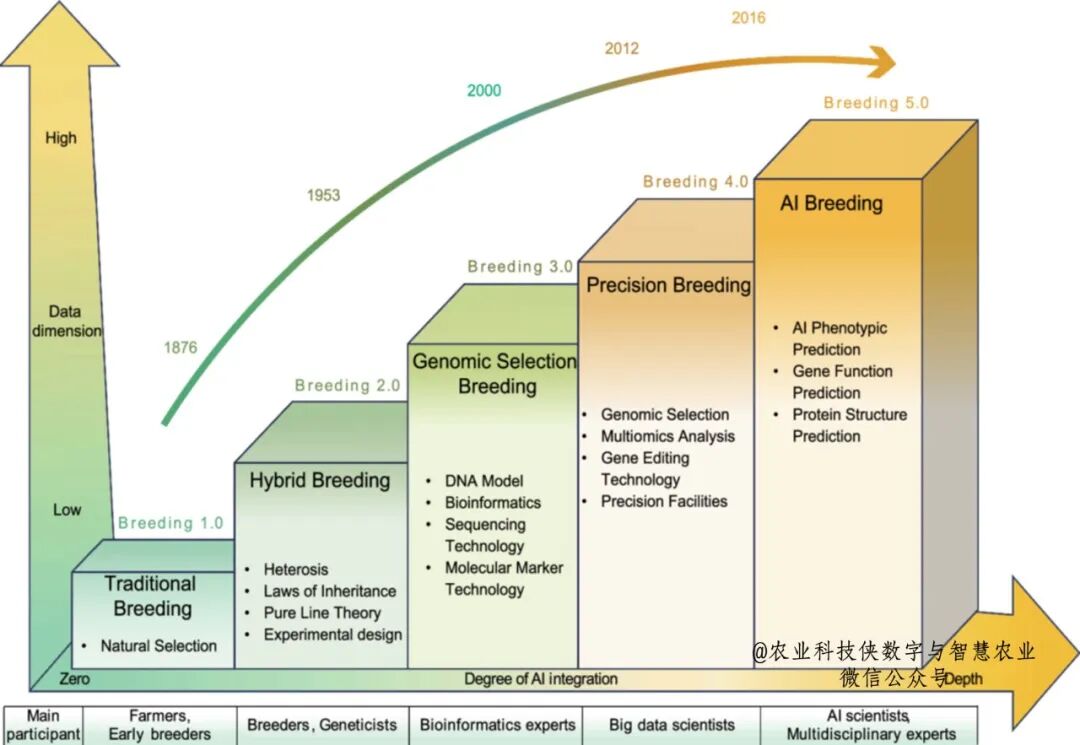
Evolution of Breeding Technology: From Empirical Methods to AI-Driven Paradigms
First Generation: Rule-based reasoning systems (1956-1980). Such as expert systems and deductive reasoning, limited by the lack of self-learning capabilities.
Second Generation: Statistical machine learning (1980-2000). Achieving basic pattern recognition (for example, when teaching a machine to recognize cats, the simplest method is to provide a large number of cat images, allowing the machine to analyze the data and summarize common features such as ears, whiskers, and fur to recognize cats in new photos).
Third Generation: Deep learning neural networks (2010-2018). Using multi-layer architectures for nonlinear hierarchical processing, capable of autonomously extracting high-level features from data to complete complex tasks.
Fourth Generation: Reinforcement learning and self-supervised learning (2018-2022). By autonomously interacting with the environment, machines can optimize decision-making processes without explicit instructions, demonstrating adaptability in dynamic scenarios.
Fifth Generation: Generative AI and Artificial General Intelligence (AGI) (2022-). Possessing human-like abilities such as cross-domain cognition, causal reasoning, and multimodal perception. Fifth-generation AI integrates four strategic capabilities: generative synthesis (creating new content from existing data), predictive analytics, autonomous decision-making, and complex logical reasoning. Generative AI focuses on creating new content based on existing data, emphasizing creativity and production; while foundational models serve as the technological backbone, leveraging vast amounts of data and training to provide strong general capabilities, forming the core support of fifth-generation AI, representing an important direction in technological development.
This evolutionary path demonstrates the technological leap from single-task processing to complex cognitive systems, laying the algorithmic foundation for agricultural intelligence. Notably, the emergence of foundational models (such as ChatGPT) has propelled AI’s application across the entire breeding chain, including agricultural decision support, DNA sequence analysis, and germplasm mining, making AI a core pillar of modern crop improvement.
Application of AI in Crop Breeding
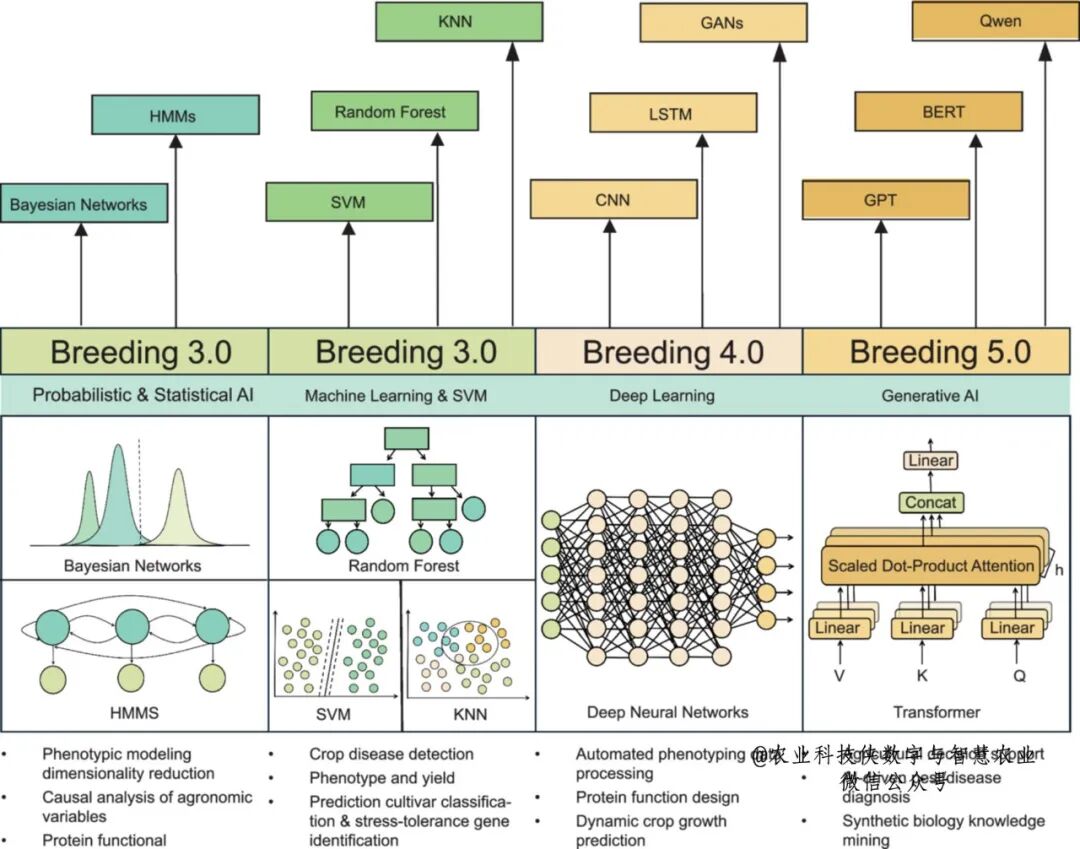
Application of AI in Crop Breeding
The application of AI in breeding shows differentiated characteristics across technological generations:
Second Generation AI (Breeding 3.0): Bayesian networks and Hidden Markov Models (HMMs) for phenotypic dimensionality reduction and trait prediction;
Third Generation AI (Breeding 3.0): Support Vector Machines (SVM) and Random Forests (RF) for high-dimensional data classification;
Fourth Generation AI (Breeding 4.0): Convolutional Neural Networks (CNN) for spatial feature processing, Recurrent Neural Networks (RNN) for modeling temporal data;
Fifth Generation AI (Breeding 5.0): Multimodal foundational models (such as GPT) integrating natural language and biological data, supporting full-chain decision-making.
Notably, fifth-generation AI demonstrates transformative potential in the deep mining of germplasm resources: by integrating genomic, phenomic, and environmental data, AI can decipher the genetic architecture of complex traits, predict favorable allele combinations, and optimize hybrid designs, significantly shortening the breeding cycle (from 5-8 years to 2-3 years). This ability of “AI to decode germplasm” is transforming static gene banks into dynamic intelligent data sources.
Application of Robotics Technology
Inspired by the biological basis of human intelligence, algorithmic systems undertake advanced cognitive functions analogous to the higher cognitive abilities of the human cerebral cortex, while robotic systems serve as effectors governed by neural signal analogies (analogous to the human motor system). Here, “robots” refer not only to humanoid robots but also to various intelligent automated products such as drones, autonomous driving systems, unmanned ground vehicles, quadrupedal robots, and embodied intelligence. In the breeding field, robotic systems can be applied in multiple scenarios: phenotypic trait collection, cultivation management and automated production, harvesting operations, rapid breeding, and gene editing assistance.
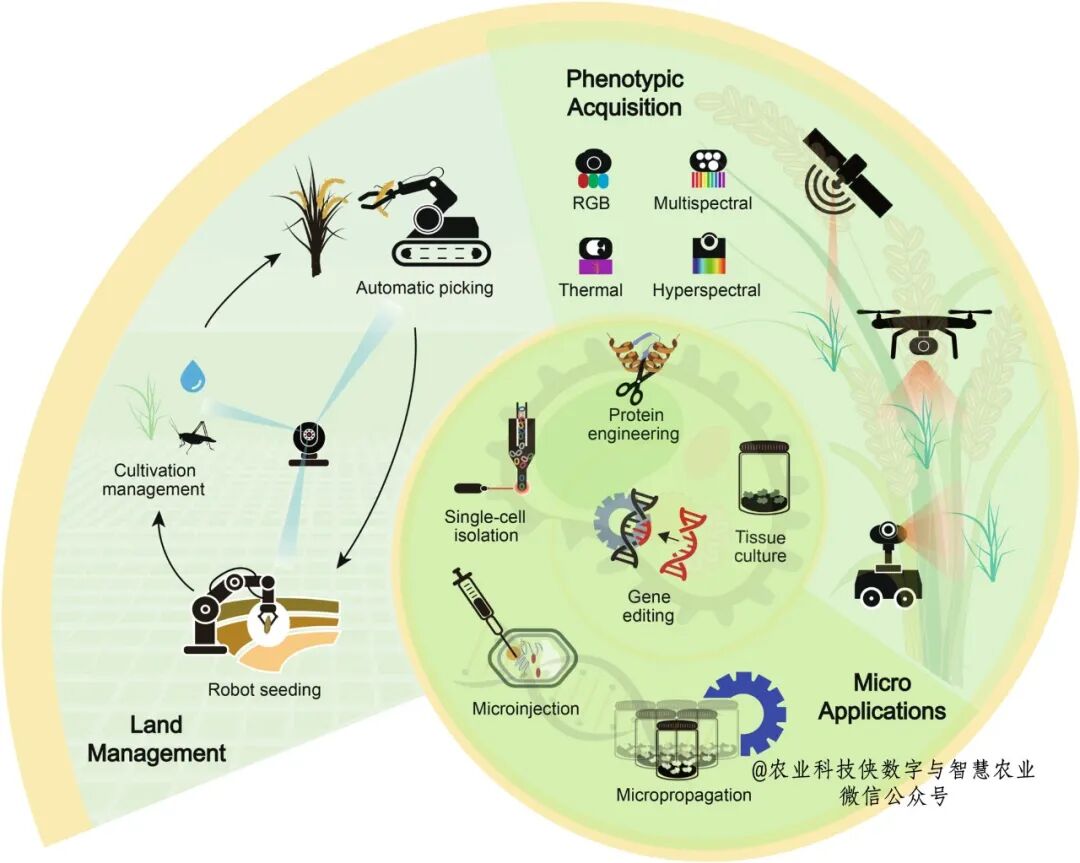
The Role of Robotics in Breeding: Cross-Scale Integration from Molecules to Fields
Microscopic Operations: Embryo microinjection platforms achieve high-precision genetic transformation, single-cell separation systems support high-throughput operations, and AI-driven protein engineering platforms accelerate functional design.
Phenotypic Collection: Ground robots conduct close-range phenotypic scanning, drones equipped with multispectral sensors achieve field monitoring, and 3D reconstruction technology enhances in-situ analysis accuracy.
Field Management: Autonomous navigation devices complete precise sowing/fertilization, intelligent greenhouse systems achieve closed-loop environmental control, and machine vision-guided harvesting robots enhance efficiency through innovative theoretical frameworks.
The Core Framework of Breeding 5.0
AI-Robotics Collaborative Driven Breeding Flywheel
The breakthrough of Breeding 5.0 lies in constructing the “breeding flywheel”—a data-driven self-reinforcing system. The flywheel metaphor depicts the process from initiation to sustained growth. Initially requiring substantial impetus, the system gradually accumulates momentum, entering a self-sustaining acceleration phase, ultimately establishing a self-reinforcing growth cycle.
Initiation Phase: Deploying sensor networks and robotic terminals to accumulate initial datasets. This phase is crucial for energy accumulation to start the flywheel. Once operational, high-speed breeding robots execute AI-generated instructions with precision, completing tasks such as sowing, phenotypic scanning, and sample collection under greenhouse or field conditions.
Acceleration Phase: AI analyzes multidimensional data (genomic, phenotypic, environmental) to optimize breeding plans. Continuous input of multidimensional data streams into the AI breeding brain drives deep learning iterations to analyze disease resistance traits, predict environmental impacts on yield, and simulate gene combinations. Enhanced accuracy allows AI to optimize hybrid strategies, compressing the breeding cycle from 5-8 years to 2-3 years while identifying drought-resistant, pest-resistant, or nutritionally enhanced candidate varieties.
Self-Circulation Phase: Promotion of superior varieties generates new data, continuously iterating models. The deployment of superior varieties in the field generates new IoT collection data, forming a closed-loop system: rapid variety release → expanding data scale → smarter models → accelerated breeding iterations. This framework allows for rapid climate adaptation and targeted breeding (e.g., high-protein wheat, salt-tolerant rice), providing sustainable solutions for food security.
AI-Driven HOPE Technology System
With advancements in AI technology, the vision of Breeding 5.0 is to seamlessly integrate multiple key processes through AI, creating an intelligent breeding management system.
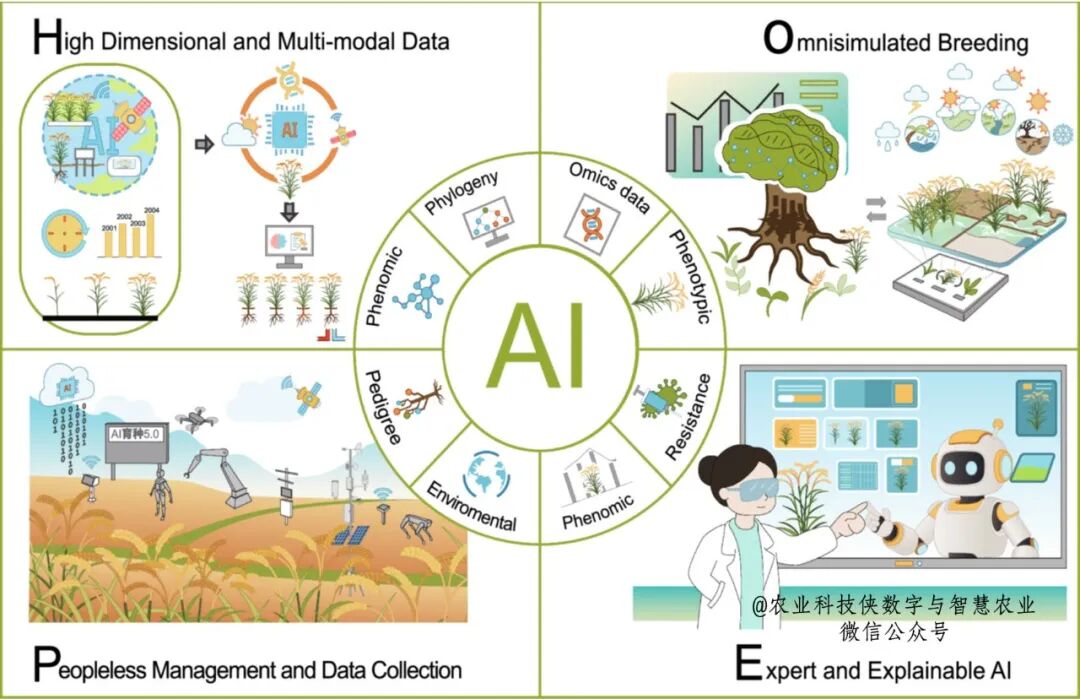
HOPE: An AI-Driven Framework for Future Smart Agriculture
High-Dimension: Thousand-dimensional phenotypic feature analysis
Omni-Simulation: Testing in 10^6 environmental scenarios
Peopleless: 99% automation operation coverage
Explainable: Biologically interpretable decision paths
This framework relies on four major pillar technologies:
High-dimensional multimodal data: Integrating information from molecular to ecosystem levels. Over time, AI enhances prediction accuracy by continuously aggregating historical data and tracking detailed changes in crop development. Spatially, AI expands data collection to include not only ground sensors but also integrates remote sensing technologies (such as satellite imagery), extending to various environments from soilless cultivation to field management. This holographic data integration enables breeders to comprehensively understand genotype-environment interactions, providing scientific basis for precise breeding decisions.
Fully simulated environments: Digital twins predict variety performance. Fully simulated breeding represents a revolutionary approach, predicting crop performance under various conditions by creating virtual environments. AI-driven simulation platforms can construct digital twin crops, testing thousands of gene combinations and environmental scenarios before actual field trials. This “breeding in silicon” method significantly reduces reliance on physical trials, accelerates breeding cycles, and lowers costs.
Unmanned systems: Robotics achieve scalable precision operations. Unmanned management represents a fundamental transformation in breeding operations, achieving full-process automation through robotic systems and IoT technologies. From automated greenhouses to intelligent field robots, these systems can continuously perform tasks such as sowing, irrigation, fertilization, and phenotypic collection around the clock. AI algorithms analyze sensor data in real-time and dynamically adjust management strategies, forming a closed-loop optimization system. The advantages of unmanned management lie not only in improving efficiency and reducing costs but also in minimizing human interference with crop growth.
Expert explainable AI: Ensuring decision transparency and reliability. While AI demonstrates exceptional data processing capabilities and decision advantages in breeding applications, its transparency and explainability are equally critical. Especially in areas affecting human ethics and welfare, the AI decision-making process must be understandable and traceable, ensuring that technological advancements align with social values and ethical principles. Explainable AI technology will play a key role, enabling experts and breeders to clarify the basis of AI-driven decisions, thereby enhancing trust in AI systems.
Breeding 5.0: Silicon-based Systems Serving Carbon-based Sustainable Development
Driven by the robust capabilities of fifth-generation AI, Breeding 5.0 and flywheel breeding technology are innovating crop breeding efficiency at an unprecedented pace. Through precise data analysis and predictive modeling, scientists can quickly identify varieties with excellent traits such as high yield, resilience, and low pesticide dependency, significantly enhancing agricultural productivity and sustainability.
At the same time, the rise of unmanned management and vertical agriculture is bringing revolutionary changes to modern agriculture. Utilizing advanced sensor technologies and automated control systems, agricultural production can now achieve precise and intelligent management, ensuring product quality and safety. These innovations also significantly reduce water and fertilizer inputs, with savings exceeding 90%. These advancements have profound implications for alleviating global water shortages, reducing environmental pollution, and promoting sustainable agricultural practices.
Even more exciting, these technological advancements provide potential agricultural solutions for future human colonization of Mars. Under extreme environmental conditions, the deep integration of technology and biological systems may enable the establishment of self-sustaining agricultural ecosystems on Mars. These systems will provide the necessary material foundation for interstellar exploration and colonization, demonstrating how Earth-derived precision agriculture and closed-loop resource management innovations can adapt to extraterrestrial life support.
Looking to the future, we have every reason to believe that with technological advancements and continuous innovation, humanity will gain a deeper understanding and better utilization of natural laws, achieving harmonious coexistence with the environment. We will leave a more prosperous, healthy, and sustainable world for future generations, allowing them to continue exploring the mysteries of the universe under the guidance of technology, writing a new chapter in human history. Let us work together to create a future full of hope and possibilities.
This paper was jointly completed by Academician Qian Qian’s team at the Yazhou Bay National Laboratory in collaboration with the Institute of Crop Science of the Chinese Academy of Agricultural Sciences, the National South Breeding Research Institute of the Chinese Academy of Agricultural Sciences in Sanya, Zhejiang University, and other institutions. The paper was supported by the Hainan Provincial Science and Technology Special Fund (ZDYF2022XDNY260, ZDYF2024KJTPY001), the Sanya Yazhou Bay Science and Technology City Project (SCKJ-JYRC-2023-47, SKJC-2023-02-001), and other research projects.