Point “Jinan CNC Mould Technology Research Institute” focuses on
Industry Frontiers, Mechanical Videos, CNC Machining Technology, 3D Printing, Industrial Robots, Production Processes, Molds, Machine Tools, and other cutting-edge information are waiting for you here.
01
Composition of Industrial Robots
Industrial robots are mainly composed of three basic parts: the body, drive system, and control system.
Body – This refers to the base and the actuators, including the arm, wrist, and hand. Some robots also have walking mechanisms. Most industrial robots have 3 to 6 degrees of freedom, with the wrist typically having 1 to 3 degrees of freedom.
Drive System – This includes the power unit and transmission mechanism, with the core being the reducer and servo motor, which enable the actuators to perform corresponding movements.
Control System – This sends command signals to the drive system and actuators according to the input program and performs control.
Classification of Industrial Robots
Regarding the classification of industrial robots, there is no unified standard internationally. They can be classified according to load capacity, control method, degrees of freedom, structure, application field, etc.
Classified by structural form as follows:
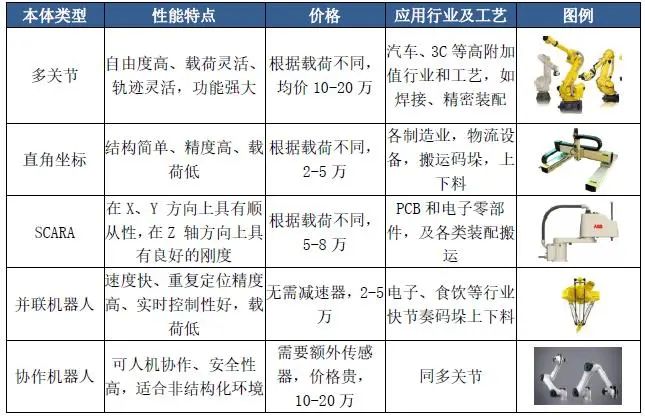
Classified by application as follows:
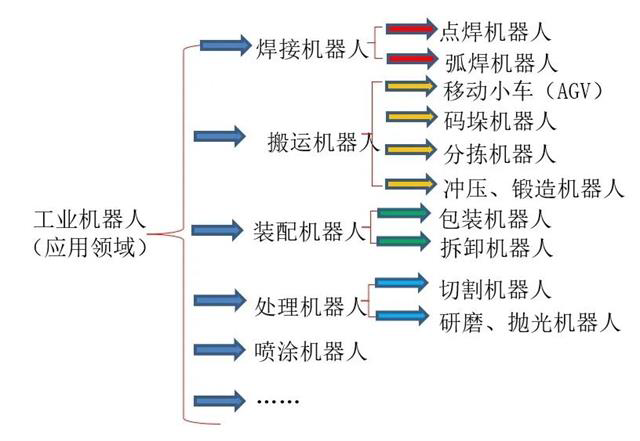
03
Industrial Robot Industry Chain
The industrial robot industry chain mainly consists of robot component manufacturers, robot body manufacturers, agents, system integrators, and end users. The body is the core of the robot industry chain. Typically, body manufacturers design the body, write software, and procure through agents to sell to system integrators, who directly face end customers. Some body manufacturers and agents may also act as system integrators.
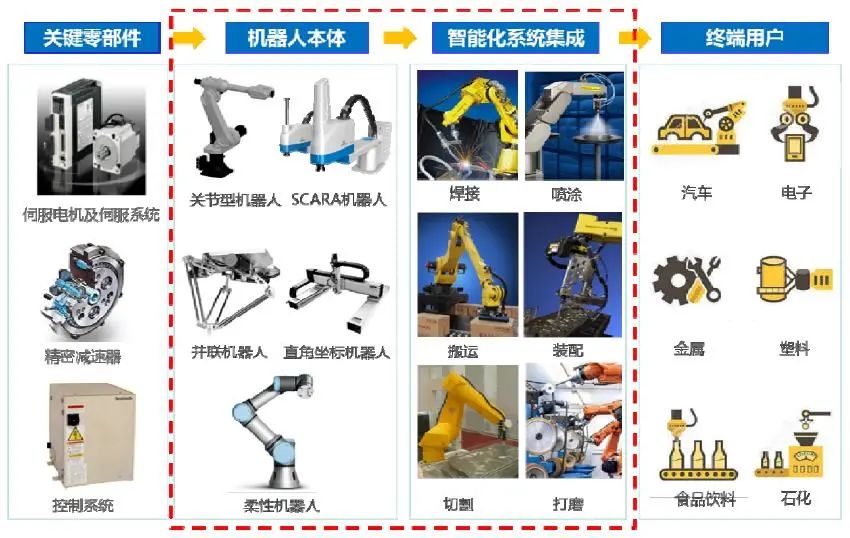
From a regional perspective, Europe and Japan firmly dominate the industrial robot market. Japan and Germany’s industrial robots are world-leading, mainly due to their first-mover advantage and technological accumulation. Japan has strong technical barriers in the R&D of key components for industrial robots (reducers, servo motors, etc.). Germany has certain advantages in raw materials, body components, and system integration.
From a corporate perspective, ABB, Fanuc, KUKA, and Yaskawa are the four major families of industrial robots, becoming the world’s primary suppliers of industrial robots, accounting for about 50% of the global market share.
04
Working Principles of Industrial Robots
The working principle of robots is a relatively complex issue. Simply put, the principle of robots is to imitate various human limb movements, thought processes, and decision-making abilities. From a control perspective, robots can achieve this goal through the following four methods.
“Teaching and Reproduction” method: It teaches the mechanical arm how to move through a “teaching box” or by human “hand-in-hand” methods. The controller memorizes the teaching process, and then the robot repeatedly performs the taught actions according to memory, such as in spray painting robots.
“Programmable Control” method: Workers pre-program the control program based on the robot’s work tasks and movement trajectories, then input the control program into the robot’s controller. When the control program is started, the robot completes the actions specified by the program step by step. If the task changes, the control program can be modified or rewritten, making it very flexible and convenient. Most industrial robots operate according to the first two methods.
“Remote Control” method: The robot is controlled by a person using a wired or wireless remote control to complete tasks in locations that are difficult to reach or dangerous for humans, such as bomb disposal robots, military robots, and robots working in environments with nuclear radiation and chemical contamination.
“Autonomous Control” method: This is the highest and most complex control method in robotics, requiring the robot to have the ability to recognize the environment and make autonomous decisions in complex unstructured environments, which means it must possess certain intelligent behaviors similar to humans.
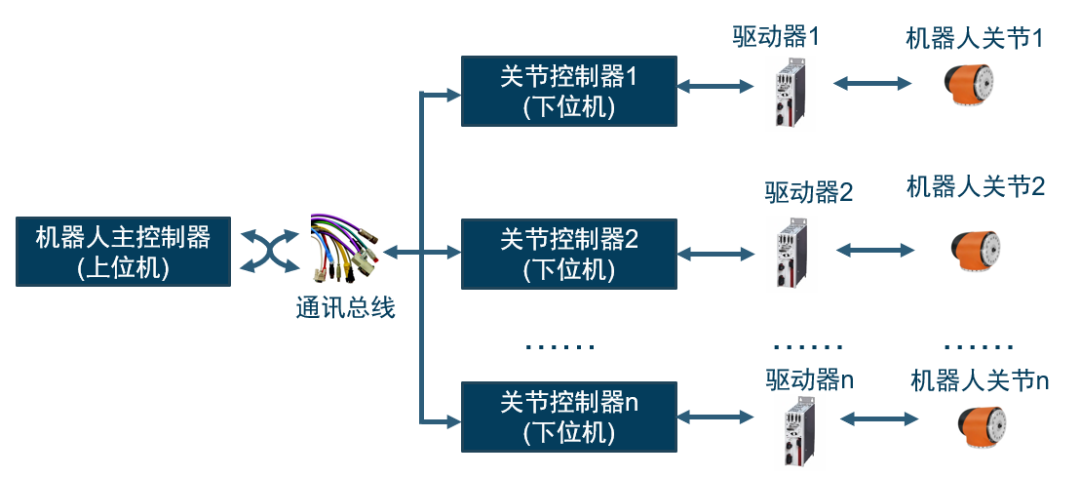
Taking a six-axis vertical multi-joint robot as an example (as shown below), through the robot controller and its control system, actions such as S-axis rotation, L-axis lower arm tilting, U-axis upper arm tilting, R-axis arm swinging, B-axis wrist pitching, and T-axis wrist rotation can be achieved, enabling the operation and coordination of six axes.
If a centralized control system is used, its control principle will be as shown below:
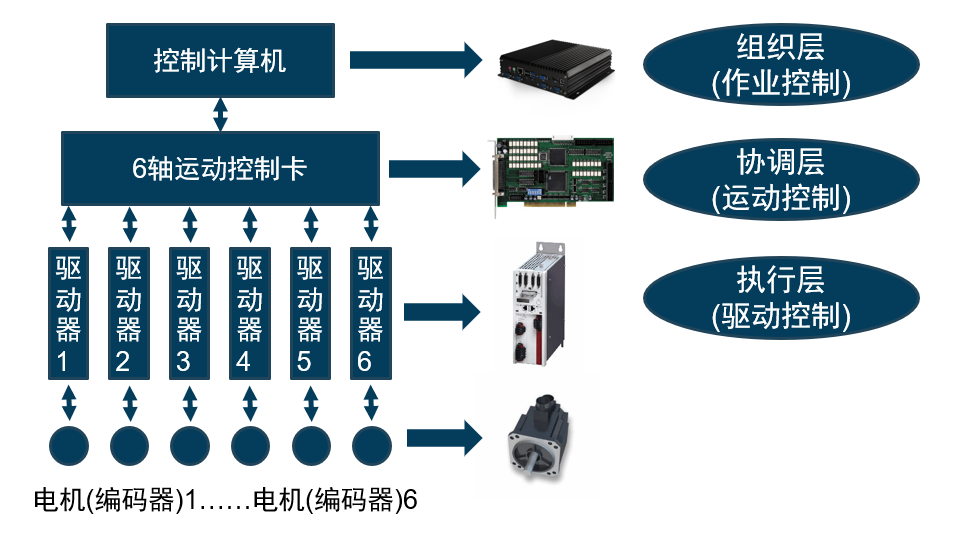
However, if a distributed control system is used, its control principle will be as shown below:
05
Issues Faced by Industrial Robot Manufacturers
With the continuous industrial upgrading of the manufacturing industry and the emergence of various new technologies, robot manufacturers must also consider the usage needs of their end users during production. For example, some factories and production lines require upgrades and renovations, and robot manufacturers need to adapt to market changes and make corresponding adjustments.
Jinan CNC Mould Technology Research Institute
Vocational Training Base for College Graduates——The Jinan CNC Mould Technology Research Institute mainly conductsCAD/CAM Advanced Programming, UG Five-Axis Programming, CNC Machine Maintenance, Injection Mold Design, Stamping Mold Design, Reverse Modeling, Industrial Robots, 3D Printing, etc. Pre-employment training. One-time registration for lifetime learning, during the training period, teachers conduct periodic testing to fully control the students’ learning progress, with small class teaching, one-on-one tutoring, and a combination of theory and practice until mastery. After completion, free job recommendations are provided. The research institute provides long-term technical support and employment services to students. All teachers and students of the Jinan CNC Mould Technology Research Institute welcome your visit and learning. The institute is located at 20333 Panwang Road, Building A4, Gate 4, Zhangqiao District, Jinan City.
Consultation Hotline: 0531-85708996