Click the top left corner “MDPI Social Sciences News” to follow us for more latest news.

Dr. Anja Møgelvang and her team from the Western Norway University of Applied Sciences published a mixed-method study involving 2,692 university students in the journal Education Sciences, revealing significant gender differences in the use of generative AI. The study shows that men use AI more frequently, have a broader range of applications, and express a stronger interest in its relevance as a tool and for future careers; women, on the other hand, tend to use AI for text-related tasks and express deeper concerns about two main issues: first, the fear that AI will undermine their critical and independent thinking abilities; second, a strong need to learn the criteria for “when to use AI” and “how to trust AI outputs.” This raises alarms for individuals, society, and higher education institutions: if left unaddressed, these differences may lead to the reproduction of inherent societal patterns, weaken diversity capabilities, and jeopardize educational equity. Therefore, universities must adopt balanced teaching strategies to address this new challenge.
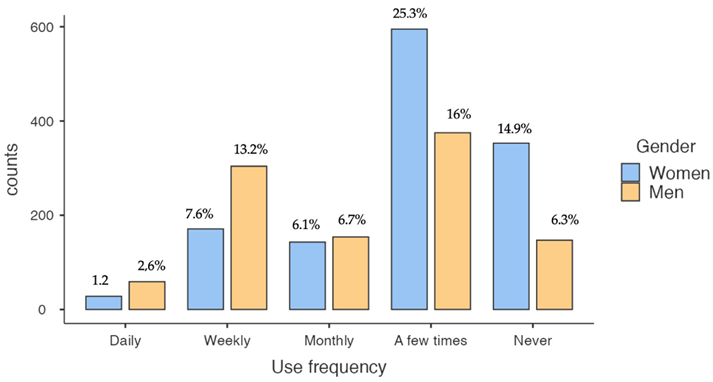
Frequency of GenAI chatbot usage by gender
Research Process and Results
This article employs a mixed-method research design that balances quantitative and qualitative approaches, conducting a large-scale survey of 2,692 students at a major university in Norway to explore gender differences in the use of generative AI chatbots in higher education. The study combines quantitative statistics with qualitative content analysis, confirming the existence of differences and revealing their specific manifestations.
At the quantitative research level, the data reveals a clear and widespread pattern of gender differences. First, in terms of usage frequency, male students show a higher level of engagement. Second, in terms of application scope, males use AI significantly more than females in 14 out of the 16 application scenarios listed in the survey, particularly in technical areas such as programming code writing and testing, and solving mathematical statistics problems. In contrast, female users’ application scenarios are relatively concentrated on text comprehension, translation, and writing assistance tasks. Finally, regarding learning needs, females exhibit a stronger cautious attitude, expressing a more urgent need to learn “how to judge when it is wise to use AI” and “how to trust AI’s output results.” Males, on the other hand, focus more on maximizing the use of AI to complete academic tasks (such as writing papers) and understanding its technical principles.
At the qualitative research level, content analysis of thousands of words of open-ended text responses provides rich context and depth of interpretation for the quantitative data. Keyword and contextual analysis show that males and females use distinctly different discourses when describing AI. Males are more likely to view AI as a “tool,” frequently using terms like “efficiency,” “problem-solving,” and “future workplace,” reflecting a functional and opportunistic perspective. They focus on how AI can assist their learning processes and prepare for their careers. In contrast, females’ narratives are filled with critical reflection and emotional considerations, using terms like “critical thinking,” “independent thought,” and “feelings,” expressing deep concerns about the potential degradation of their abilities due to over-reliance on technology, and emphasizing the importance of using AI responsibly and ethically.
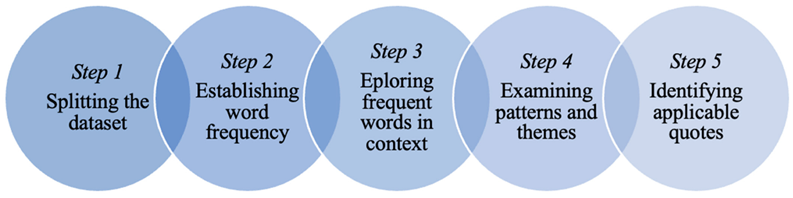
Qualitative research content analysis steps.
Research Summary
This study, based on data from Norway, which has a relatively high level of gender equality, strongly indicates that the gender gap in traditional technology fields has undeniably extended into the emerging field of generative AI. If these differences are not addressed and intervened, they may lead to serious consequences on multiple levels.
At the individual level, males, having been exposed to and used AI earlier and more extensively, may accumulate valuable “cultural capital,” thus gaining a significant advantage in the future job market; whereas females may face a relative decline in competitiveness due to insufficient frequency and breadth of use, exacerbating existing occupational gender inequalities.
At the social level, if the future labor market favors males due to differences in AI skills, it will not only solidify gender inequality but may also lead to the absence of female critical perspectives in technology design and application. This lack of “diversity capability” is extremely detrimental to ensuring that AI technology develops in a fair, just, and inclusive manner.
Therefore, for higher education institutions, the research results serve as a wake-up call. Universities have a responsibility to go beyond mere technological promotion by adjusting curriculum design, systematically integrating critical AI usage training into teaching practices, and encouraging collaboration between teachers and students to co-create learning scenarios, in order to actively bridge this gender gap. The ultimate goal is to build an inclusive learning environment that ensures all students, regardless of gender, can equally acquire the digital literacy and critical thinking skills necessary to thrive in the age of artificial intelligence, thus preventing the education system from becoming a tool for the reproduction of social inequality.

Scan the QR code
Read the original English text
Original article fromEducation Sciences journal:
Møgelvang, A.; Bjelland, C.; Grassini, S.; Ludvigsen, K. Gender Differences in the Use of Generative Artificial Intelligence Chatbots in Higher Education: Characteristics and Consequences. Educ. Sci. 2024, 14, 1363.

Education Sciences journal introduction
Editor-in-Chief:Daniel Muijs, Queen’s University Belfast, UK
The journal mainly publishes articles related to education, with nine subject sections covering various aspects such as educational administration and management, educational philosophy and principles, educational history and policy, educational technology, pedagogy, curriculum and instruction, special education, teacher education, and educational measurement and evaluation. The journal is currently indexed in several well-known databases including ESCI (Web of Science), Scopus, DOAJ, and CNKI.
|
2024 Impact Factor |
2.6 |
|
2024 CiteScore |
5.5 |
|
Time to First Decision |
29.2 Days |
|
Acceptance to Publication |
3.9 Days |

Scan the QR code,
Subscribe to the latest news from Education Sciences journal.
Featured Videos
Related Articles Recommended
Social Science Research Case Sharing: Making Complex Research Logic Clear at a Glance | MDPI Graphics
MDPI Related Public Account Recommendations
MDPI Recruitment
MDPI Recruitment official public account, the latest recruitment information awaits you.
Copyright Statement:
*The content of this article is edited and written by the MDPI China office, and the detailed content should be based on the original English version. For reprints, please consult through the public account.
Due to updates in WeChat subscription account push rules, you can set “MDPI Social Sciences News” as a star, so you can easily find us in the message bar and stay updated on the latest open publishing dynamics!
Click the bottom left “Read the original text“, to read the original English text.

Like today’s content? Give us a 【like】!