Click the “blue text” above to follow us! Abstract
Bone defects pose a significant challenge in the field of orthopedics, and their related complications continue to present numerous difficulties in clinical practice. In the biomedical field, advancements in three-dimensional (3D) printing technology have made bone tissue engineering (BTE) scaffolds a promising and effective therapeutic strategy. These scaffolds not only provide structural support for cells but also serve as templates to guide bone tissue regeneration. In recent years, two-dimensional nanomaterials (2D NMs) have garnered widespread attention due to their excellent physicochemical properties and have been extensively explored as additives for the preparation of BTE scaffolds. This review focuses on the latest advancements in the application of 2D NMs combined with 3D printing in BTE. First, a brief summary of common synthesis and surface modification methods for 2D NMs is provided; subsequently, a comprehensive review of their latest applications in BTE is presented; finally, the existing challenges and future development directions of 3D printed scaffolds based on 2D NMs in bone tissue regeneration are discussed.
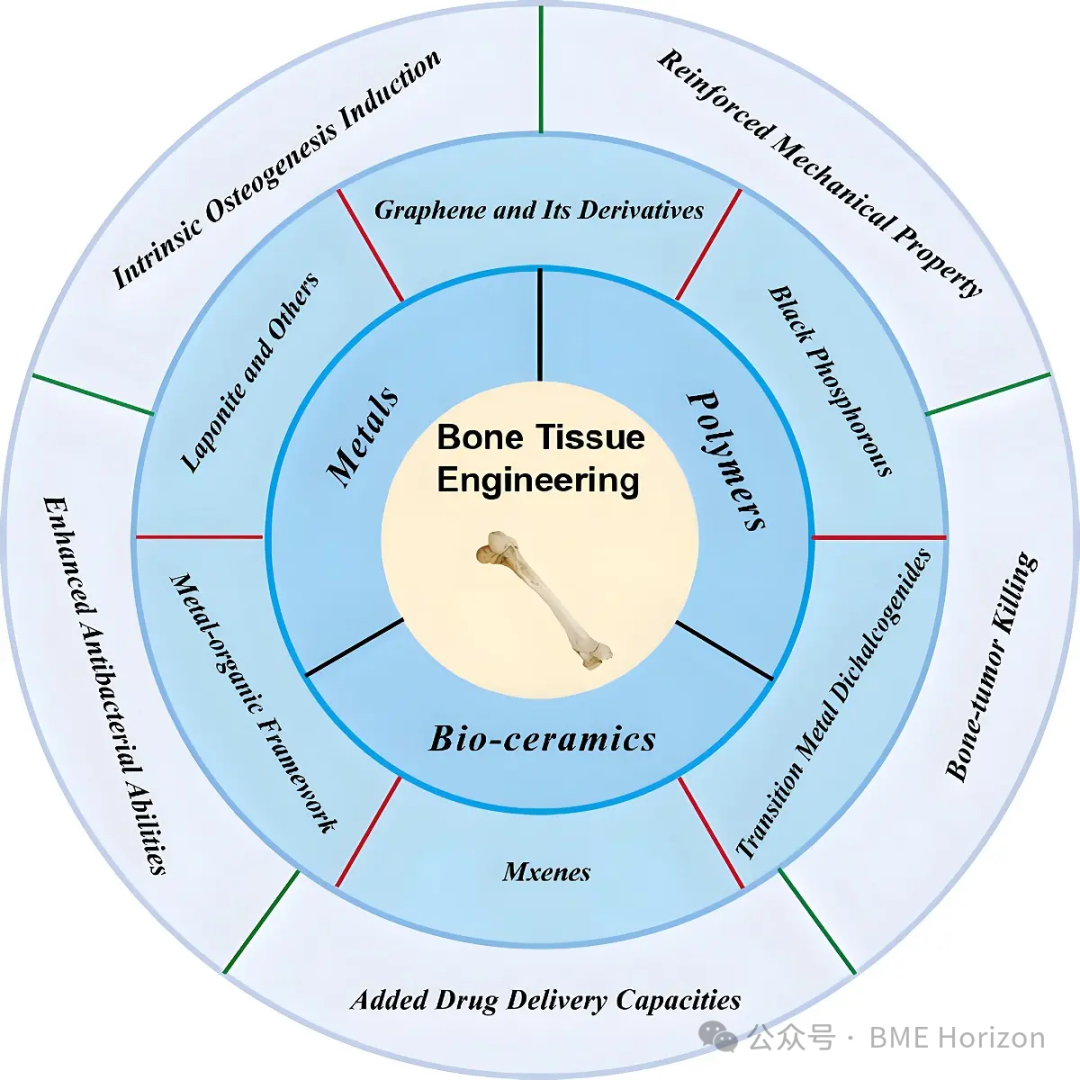
Figure: Various types of 2D NMs and their applications in BTE
NMs: Nanomaterials; BTE: Bone Tissue Engineering
1
Open the link to read the full article
https://www.sciexplor.com/articles/bmeh.2025.0002
2
Citation
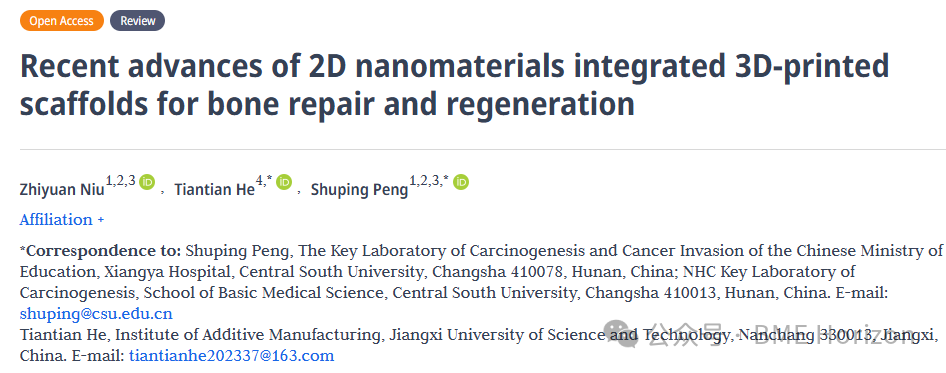
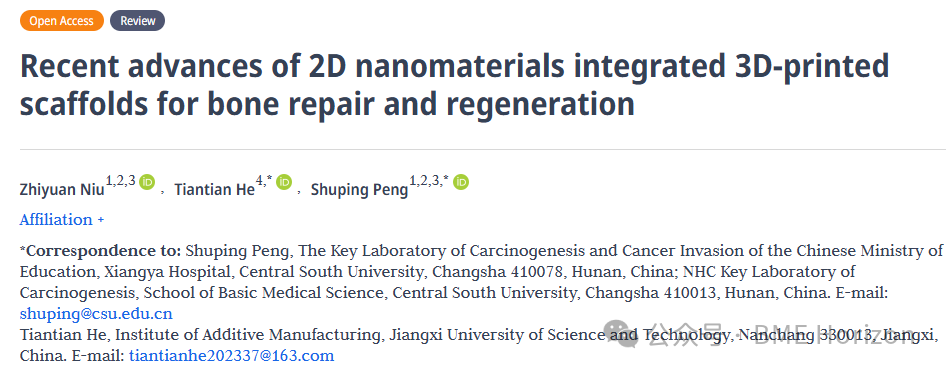
Niu Z, He T, Peng S. Recent advances of 2D nanomaterials integrated 3D-printed scaffolds for bone repair and regeneration. BME Horiz. 2025;3:202416. https://doi.org/10.70401/bmeh.2025.0002
Article Introduction
Large bone defects caused by trauma, infection, tumor resection, and degenerative diseases remain a clinical challenge. BTE is gradually gaining attention as a strategy to replace bone grafting, where 3D printing offers a new avenue for personalized bone repair through precise control of structure and porosity. In recent years, two-dimensional nanomaterials (2D NMs) such as graphene, black phosphorus, transition metal dichalcogenides, and MXenes have shown unique advantages in improving mechanical properties, promoting cell adhesion, and enhancing osteogenesis due to their high specific surface area, excellent optoelectronic properties, and good biocompatibility. This article reviews the latest advancements in the combination of 2D NMs and 3D printing in BTE, covering material synthesis and modification methods, practical applications in scaffolds, and the challenges of stability and safety, while also looking ahead to future development directions.
Core Content of the Article
This article primarily discusses the application progress of combining 2D NMs with 3D printed scaffolds in BTE. It first introduces the mechanical properties, biocompatibility, biodegradability, and the ability to promote osteogenesis and angiogenesis that an ideal BTE scaffold should possess. 3D printing is widely used for the preparation of personalized bone repair scaffolds due to its precise control over macrostructure and internal porosity; while 2D NMs, with their ultra-high specific surface area, excellent electrical and optical properties, and active surface sites, have been proven to have unique advantages in improving scaffold mechanical properties, promoting cell adhesion and differentiation, and providing antibacterial and photothermal therapy functions. Various 2D NMs such as graphene, black phosphorus, transition metal sulfides, MXenes, and layered double hydroxides have been successfully applied in scaffolds, showing potential in mechanical enhancement, drug delivery, osteogenic induction, and tumor/infection treatment.
Despite significant progress, 2D NMs still face challenges before clinical translation. Firstly, their long-term biosafety and biodegradability remain uncertain, especially non-degradable materials that may cause local inflammation or toxicity; secondly, the stability of materials in the in vivo environment is insufficient, requiring surface modification to enhance dispersibility and biocompatibility. Additionally, temperature control for photothermal therapy, precision in immune modulation, and the adaptability of scaffolds to different anatomical sites of bone defects are key focuses for future research. Future trends include developing new functionalization strategies, combining different 2D NMs to achieve synergistic effects, and systematically evaluating their comprehensive roles in osteogenesis, angiogenesis, and nerve regeneration. These efforts are expected to advance 2D NMs-3D printed scaffolds from experimental research to clinical applications, providing more efficient and personalized solutions for bone repair and regeneration.
Future Outlook
2D NMs possess a large specific surface area, excellent mechanical and optoelectronic properties, enabling scaffolds to have multifunctionality, such as enhanced mechanical performance, photothermal tumor ablation, antibacterial properties, promotion of osteogenesis, and drug delivery, with the synergistic application of various materials expected to optimize efficacy. Future research should focus on their biosafety and degradation characteristics to avoid risks associated with aggregation, interface instability, and long-term toxicity. Additionally, achieving efficient photothermal antibacterial and antitumor effects at low temperatures, combined with immune modulation strategies to promote bone repair, is an important direction. Furthermore, personalized nano-composite scaffolds suitable for different anatomical sites should be developed, with systematic assessments of their safety and tissue regeneration potential during long-term implantation. The synergistic application of various 2D NMs and the introduction of immune modulation functions will provide new breakthroughs for clinical translation.
Corresponding Author Introduction
Peng Shuping, MD, researcher at Central South University, doctoral and master’s supervisor, deputy director of the Institute of Oncology, School of Basic Medicine. Youth member of the Oncology Etiology Committee of the Chinese Anti-Cancer Association, member of the Hunan Pathology and Pathophysiology Committee, and member of the Hunan Anti-Cancer Association Oncology Etiology Committee. He has conducted postdoctoral work at Yale University and the Medical University of South Carolina, focusing on oncology and stem cell biology research, primarily studying the functions and gene expression regulatory mechanisms of long non-coding RNAs in malignant tumors (ovarian cancer and osteosarcoma), and the mechanisms and regulation of directed differentiation of mesenchymal stem cells.
He has published over 100 SCI research papers, with representative first/corresponding author papers mainly published inNano Energy, Bioact Mater, Bone Res, Chem Eng J, Int J Biol Sci, Cell Death Dis, Oncogene, Cell Proliferat, Stem Cells, Biochem Soc T, Sci Rep, J Biomed Nanotechnol, J Bio Chem, Stem Cell Res and other international journals, with over 2000 citations in international journals such asNat Rev Mol Cell Biol, Nat Rev Cancer, Cell, Genome Res, Nat Struct Mol Biol, Trends Cell Biol, PNAS. He serves as an editorial board member forBioMed Res Int, and an editorial board member forIRMS (International Review of Molecular Sciences). He is a peer reviewer for international SCI journals such asMol Cancer, Cancer Lett, J Biomed Nanotech, Biofabrication, Clin Exp Metastas, J Transl Med, and has authored books such as “Cancer: Basic Volume”, “Non-coding RNA and Tumors”, “Cancer: Basic Volume: Introduction to Molecular Biology of Cancer”, and “Micro-nano Manufacturing Technology for Artificial Bone”.
He has hosted and undertaken over 20 projects including the National Natural Science Foundation, the Ministry of Education New Century Excellent Talents Support Program, and the Hunan Provincial Natural Science Foundation. He has received the “Young Scientist Award” from the Japanese Cancer Association, the “New Century Excellent Talents Support Program” from the Ministry of Education, the “Outstanding Doctoral Dissertation” award from Hunan Province, the “10th Hunan Medical Science and Technology First Prize”, the “Shenghua Yuying Program” from Central South University, the “Tianyi Fei Young Excellent Teacher Award” from China Telecom, the “First Prize of Natural Science” from Jiangxi Province, the “Second Prize of Natural Science” from Hunan Province, the “Second Prize of the 11th Hunan Medical Science and Technology Award”, and the “First Prize of the 15th Hunan Province Excellent Academic Paper in Natural Science”. He has received the “Lu Huilin Fund Teacher Research Award” from Central South University, the “10th Hunan Youth Science and Technology Award”, the “Outstanding Youth Fund” from Hunan Province, and has applied for and authorized 25 patents.
Recommended Reading
Researcher Zhang Lei from Zhejiang University reviews the progress of flexible stretchable epidermal electrodes for wearable ECG monitoring.
BMEH Article Share | Gel Effect: Innovations in Hydrogel to Promote Healing of Diabetic Foot Ulcers
BMEH Frontier Forum | Professor Sabine Szunerits from Lille University, France: Applications of Graphene Field Effect Transistors in Biosensing: Future Development Trends
BMEH Scholar’s Voice | Interview with Professor Zhou Qihui from Rehabilitation University: Promoting the Transformation and Innovation of Intelligent Biomaterials from Clinical Needs
BMEH Scholar’s Voice | Interview with Dr. Simona Iconaru from the National Institute of Materials Physics in Romania: Multidisciplinary Exploration of Functional Nanomaterials in Biomedical Frontiers
About the Journal
BME Horizon (BMEH, Online ISSN 2972-449X) is a gold open access, peer-reviewed quarterly journal published by Science Exploration Press. The journal is edited by Professor Ma Buyong from Shanghai Jiao Tong University and is dedicated to promoting cutting-edge research and innovation in biomedical engineering and its interdisciplinary fields.
As a platform focusing on multidisciplinary intersections, BMEH aims to break down barriers between engineering, life sciences, medicine, and environmental sciences, promoting deep integration of technology and theory to address major challenges in healthcare and sustainable development today. We focus on a wide range of topics from basic research to clinical applications, from new material development to intelligent medical systems, encouraging the publication of high-quality results that are groundbreaking, leading, and socially impactful.BMEH is becoming an important academic platform for researchers in the global biomedical engineering field to explore the future and share results.
Journal Website:
https://www.sciexplor.com/bmeh
Submission Link:
https://www.intellimanus.com/#/login?journalPath=bmeh
Contact Us:


Journal Website
Submission Link

Science Exploration Press is an open access publishing company dedicated to disseminating high-quality scientific research results. Since its establishment, Science Exploration Press has collaborated with experts in various fields to launch multiple academic journals covering various disciplines such as biomedicine, architecture, computer science, and materials.
Our Mission
We strive to be a trusted knowledge dissemination platform for global researchers, promoting scientific progress, encouraging the collision of ideas, and ensuring high-quality research reaches every corner of the world.
Our Core Values
-
Academic Integrity: Adhering to rigorous, fair, and transparent review and publication processes, respecting every genuine scientific effort.
-
Open Sharing: Supporting the free flow of knowledge, allowing research results to truly serve society.
-
Author-Centric: Providing an efficient and friendly publishing experience centered around authors, offering comprehensive support for research dissemination.
-
Diversity and Inclusion: Encouraging academic voices across disciplines, regions, and perspectives, making diversity the soil for innovation.
-
Impact: We believe that the impact of research goes beyond numbers. We focus on how research inspires practice, serves society, and ignites the future.
What We Stand For
We are not just a publishing platform; we are an actor promoting a virtuous cycle in the academic ecosystem. We firmly believe:
-
A good journal helps truly valuable research to be seen, understood, and continued.
-
A good collaboration is a long-term partnership based on shared ideals.
For more information, please visit the Science Exploration Press website:
https://www.sciexplor.com/
Or contact us:

Publisher’s Official Website
 Journal Recommendations— Science Exploration Press —






 *Click the image to learn more about the journal