I have been following the practical implementation of multi-agent systems in healthcare, and today I came across a multi-agent project: Smart Health Agent, which has a high level of code completion and represents a realistic approach to multi-agent systems. I would like to share some of my observations and judgments based on this project.
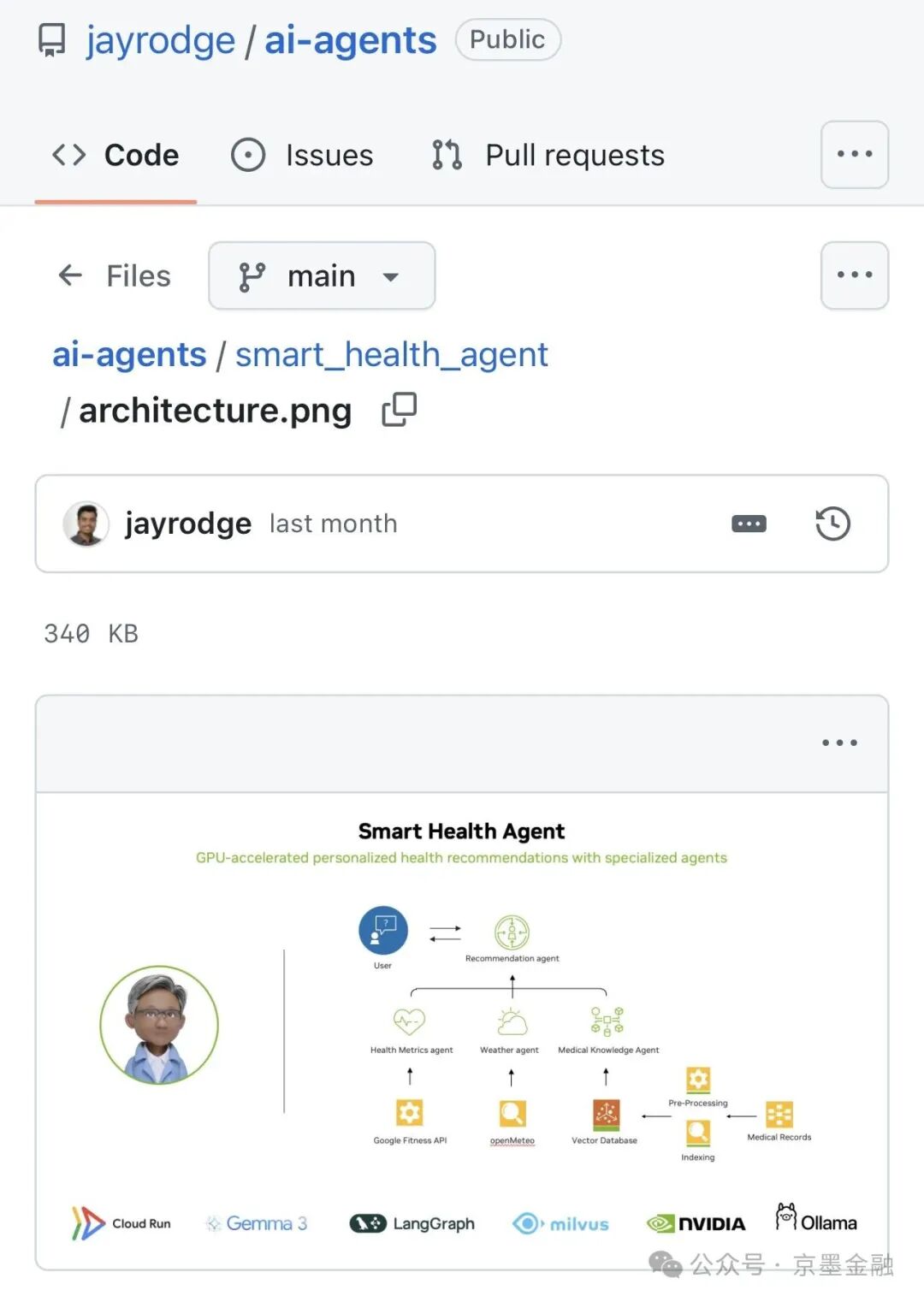
1️⃣ First, let’s talk about this project. It is lightweight but has a clear structure. The main process built by LangGraph is not complex, yet it seamlessly connects an entire health service chain. The user initiates a health inquiry → intent recognition agent → triggers subsequent metrics monitoring, data analysis, anomaly alerts, and suggestion generation agents → finally, all feedback is provided to the user. Each agent has its own role, and the entire chain is connected through memory and routing, achieving a lightweight health assistant pipeline in a very simple way. If you want to create versions for pets, the elderly, or employee health monitoring, you can simply swap agents, allowing for easy expansion. This clear modularity combined with flexible routing makes it extremely convenient for scenario expansion and agent adjustments, making it well-suited for B-end integration or SaaS packaging. The Customer Service Agents Demo released by OpenAI last week actually follows a similar route: a unified front-end entry point with multiple agents collaborating in the back-end to structure services. Smart Health Agent is a more compact but functional example.
2️⃣ Regarding the two paradigms of multi-agent systems, application response vs. in-depth research. The mainstream multi-agent systems can be broadly categorized into two types: ✅ Research-oriented (deep task paradigm) focuses on “long-term tasks + multi-round reasoning + autonomous agent scheduling,” allowing agents to function like researchers, generating reports, analyzing trends, and completing complex workflows. Examples include DeepResearch, manus, Lovart, etc. This type leans more towards being an “AI researcher” and is currently a very hot direction in the market, helping users solve procedural challenges while leaving much room for imagination. ✅ Application-oriented (immediate response paradigm) differs significantly from the above in that its core is to recognize user intent and quickly dispatch multiple agents to complete tasks. It is more about “immediate service,” such as customer service assistants, health consultants, corporate Q&A, etc. Smart Health Agent and Customer Service Agents Demo are representatives of this type, with a unified front-end entry point and multiple specialized agents executing tasks based on intent. These systems do not aim for AGI or run benchmarks; they are very practical, essentially using AI to realize a “next-generation customer service/assistant system,” applicable in many areas: health consulting, corporate knowledge Q&A, financial customer service, patient companionship, light diagnostic suggestions, etc. I will provide a few examples in the health scenario, such as: • Pet health feeding assistant (facial recognition + dietary intake analysis) • Chronic disease follow-up monitoring system for the elderly (blood pressure + heart rate + intervention suggestions) • Corporate employee health data analysis (stress assessment + proactive alerts). Application-oriented (immediate response paradigm) systems do not show off technical prowess, but structurally they already possess a replicable intelligent service paradigm. If you are also working on AI agents or health-related applications, this type of project is definitely worth studying to see how it is done.