💥💥💞💞Welcome to this blog❤️❤️💥💥
🏆Author’s Advantage: 🌞🌞🌞The blog content aims to be logically clear and well-structured for the convenience of readers.
⛳️Motto: A journey of a hundred miles begins with a single step.
💥1 Overview
Palm texture recognition is a biometric technology used for verifying and identifying individual identities. It utilizes the unique texture features within the palm for identity verification and recognition. These features include the main lines, wrinkles, folds, protrusions, and singular points of the palm, all of which are unique to each individual. First, a palm image needs to be captured. This can be done using various devices, such as dedicated palm scanners or smartphone cameras. During image capture, the individual being verified is usually required to place their palm in the scanning area and ensure that the image quality is sufficient for subsequent processing. Once the palm image is obtained, the next step is to extract features from the image. This typically involves preprocessing the palm image, such as removing noise and enhancing contrast, followed by using image processing techniques to extract feature points and patterns of the palm texture. Finally, based on the matching results, the system can perform one of two operations: verification or identification. In verification, the system compares the palm image with the individual’s known identity to confirm a match. In identification, the system compares the palm image with samples in the entire database to determine identity. Palm texture recognition is widely used in identity verification, access management, and security control due to its high accuracy, reliability, and convenience.
1. Introduction
Palm texture recognition, as an important branch of biometric recognition, shows broad application prospects in identity verification, security control, and human-computer interaction due to its uniqueness, stability, and difficulty in replication. Compared to fingerprint recognition, palm texture contains richer information and has a higher recognition accuracy; compared to facial recognition, it is less affected by expressions, postures, and lighting changes, making it more stable. This report aims to systematically review the current research status, key technologies, application scenarios, and future development trends of palm texture recognition, providing references for research and applications in related fields.
2. Composition and Features of Palm Texture
2.1 Composition of Palm Texture
Palm texture mainly consists of microstructures such as grooves, wrinkles, and pores on the skin surface, arranged in a certain pattern to form unique texture features. Palm textures can be classified into the following categories:
Main Lines: The most prominent lines in the palm, such as the life line, wisdom line, and heart line, which have stable shapes and directions.
Wrinkles: Fine lines formed on the palm skin due to long-term activity, distributed relatively randomly.
Folds: The folds at the joints of the palm, such as inter-finger folds and palm folds, which have a certain regularity.
Dermal Papillae: Tiny protrusions on the surface of the palm that form unique texture details.
2.2 Features of Palm Texture
Palm texture has the following significant features:
Uniqueness: Each person’s palm texture is unique; even identical twins have subtle differences in their palm textures.
Stability: Palm texture gradually forms during individual development and remains stable after adulthood, unchanged throughout life.
Difficulty of Replication: The complexity and uniqueness of palm texture make it difficult to forge or replicate, ensuring high security.
3. Key Technologies in Palm Texture Recognition
3.1 Image Acquisition
The acquisition of palm texture images is the first step in recognition, and the quality of the acquisition device directly affects the accuracy and reliability of subsequent processing. Commonly used acquisition devices include palm scanners and high-resolution cameras. During acquisition, the following issues should be noted:
Uniformity of Illumination: Uneven lighting can cause shadows or reflections in the image, affecting the extraction of texture features.
Hand Position: The placement posture and angle of the palm can affect the display of texture, so the palm should be naturally extended to avoid distortion or deformation.
Resolution: High-resolution images can provide richer texture details but also increase data volume and processing complexity.
3.2 Preprocessing
The raw palm texture images captured often contain noise, background interference, and other redundant information, requiring preprocessing to improve image quality. Preprocessing steps include:
Noise Reduction: Using non-Gaussian Gabor filters, median filtering, and other methods to remove noise from the image while preserving texture features.
Grayscale Conversion: Converting color images to grayscale to simplify subsequent processing.
Image Enhancement: Enhancing the texture details of the image through histogram equalization, contrast adjustment, and other methods to improve readability.
Binarization: Using peak-valley thresholding to convert the image into a binary image, facilitating subsequent contour extraction and feature extraction.
3.3 Feature Extraction
Feature extraction is the core step in palm texture recognition, aiming to extract representative feature information from the preprocessed image. Common feature extraction methods include:
Texture-based Methods: Utilizing the texture direction, frequency, and other information of the palm print to extract features. For example, Gabor filters can extract texture features at different scales and orientations in the frequency domain, exhibiting good scale invariance, rotation invariance, and illumination invariance.
Structure-based Methods: Focusing on structural features such as the main lines and intersections of the texture. For instance, edge detection operators can extract the edge contour information of the palm image, and morphological processing can be used to remove noise, resulting in a clear palm print area.
Local Descriptor-based Methods: Extracting features from local areas of the palm print, which are highly adaptable to local variations. For example, SIFT (Scale-Invariant Feature Transform) descriptors generate feature description vectors by constructing scale spaces, detecting key points, and calculating the gradient directions and magnitudes in the key point neighborhoods; SURF (Speeded-Up Robust Features) descriptors accelerate feature point detection and description vector calculation using integral images, improving computational efficiency.
Deep Learning-based Methods: Utilizing Convolutional Neural Networks (CNN) to automatically learn the feature representations of palm textures. For example, by constructing deep CNN models and training them on a large number of palm texture images, the model can automatically learn deep features of the palm, maintaining good recognition performance even in complex backgrounds and noisy environments.
3.4 Matching and Recognition
Matching and recognition is the process of comparing the extracted features with known features in the database to determine identity. Common matching methods include:
Euclidean Distance Matching: Calculating the Euclidean distance between feature vectors, with smaller distances indicating higher matching degrees.
Cosine Similarity Matching: Calculating the cosine similarity between feature vectors, with higher similarities indicating higher matching degrees.
Classifier Matching: Using classifiers such as Support Vector Machines (SVM) and Random Forests to classify features for identity recognition.
4. Application Scenarios of Palm Texture Recognition
4.1 Access Control Systems
Palm texture recognition technology can be applied in access control systems for enterprises, communities, schools, etc., enhancing the security and convenience of access management. Users only need to place their palm in front of the recognition device to quickly complete identity verification without carrying access cards or remembering passwords.
4.2 Financial Security
In the financial sector, palm texture recognition technology can be used for remote account opening and large transaction verification in banks, ensuring the authenticity of user identities and effectively preventing financial fraud risks. For example, when users perform large transfers, they need to undergo identity verification through palm texture recognition to enhance transaction security.
4.3 Criminal Investigation
Palm texture recognition technology can assist law enforcement agencies in criminal investigations and identity recognition. By collecting palm texture information from suspects and comparing it with known information in the database, it helps quickly identify suspects and improve case resolution efficiency.
4.4 Intelligent Transportation
In the transportation sector, palm texture recognition technology can be applied in security checks at airports and train stations, quickly and accurately verifying passenger identities, improving security check efficiency, and ensuring travel safety. For example, during security checks, passengers only need to place their palm in front of the recognition device to complete identity verification, reducing waiting times.
4.5 Medical Diagnosis
Palm texture features are correlated with certain diseases and can assist in medical diagnosis. For example, studies have found that the average atd angle of patients with congenital intellectual disability is about 70°, significantly higher than that of normal individuals; certain genetic disease patients also show significant differences in fingerprint types and ridge counts compared to normal individuals. Analyzing palm texture features can provide auxiliary diagnostic references for doctors.
5. Research Progress and Challenges in Palm Texture Recognition
5.1 Research Progress
In recent years, significant progress has been made in palm texture recognition technology, mainly reflected in the following aspects:
Diversification of Feature Extraction Methods: In addition to traditional texture and structure-based methods, local descriptor-based and deep learning methods have gradually become research hotspots, improving the accuracy and robustness of feature extraction.
Emergence of Multimodal Fusion Technology: Fusing palm texture with other biometric features (such as palm veins, fingerprints, etc.) for recognition improves accuracy and security. For example, palm print and palm vein fusion recognition technology combines the advantages of both biometric features, effectively reducing false acceptance and rejection rates.
Application of Deep Learning Technology: Deep learning technology has been widely applied in palm texture recognition, automatically learning deep features of the palm through constructing deep CNN models, improving recognition accuracy and generalization ability.
5.2 Challenges Faced
Despite significant progress in palm texture recognition technology, it still faces the following challenges:
Image Quality Issues: In practical applications, captured palm texture images may have noise, deformation, uneven lighting, etc., affecting the accuracy and reliability of feature extraction.
Individual Similarity Issues: There is a certain similarity in palm texture features among different individuals; accurately distinguishing these similar palm prints to improve recognition accuracy is a key problem that palm print recognition algorithms need to solve.
Computational Complexity Issues: Some algorithms have high computational complexity, making it difficult to meet the real-time requirements of high-demand applications, such as rapid security checks and real-time payments.
Cross-domain Application Issues: Applying palm texture recognition technology in different fields requires addressing adaptability issues, such as auxiliary diagnosis in medical diagnosis and passenger identity verification in intelligent transportation.
6. Future Development Trends
6.1 Deepening Application of Multimodal Fusion Technology
In the future, palm texture recognition technology will undergo deeper integration with other biometric recognition technologies (such as fingerprints, palm veins, faces, etc.), forming multimodal biometric recognition systems to improve accuracy and security. For example, by constructing shared convolutional layers and fully connected layers, multiple biometric features can be learned simultaneously, achieving feature-level and decision-level fusion.
6.2 Continuous Optimization of Deep Learning Technology
With the continuous development of deep learning technology, future efforts will further optimize deep learning models in palm texture recognition to improve model accuracy and generalization ability. For example, by introducing attention mechanisms, residual connections, and other techniques, the model’s ability to extract complex palm texture features can be enhanced.
6.3 Increased Real-time Requirements
For applications with high real-time requirements, future research will focus on developing more efficient algorithms and hardware devices to reduce computational complexity and increase recognition speed. For example, by optimizing algorithm structures and adopting parallel computing techniques, rapid and accurate palm texture recognition can be achieved.
6.4 Expansion of Cross-domain Applications
In the future, palm texture recognition technology will be applied in more fields, such as virtual reality, augmented reality, and smart homes. By combining the specific needs of application scenarios, targeted palm texture recognition algorithms and systems will be developed to promote the popularization and development of the technology.
7. Conclusion
Palm texture recognition technology, as an emerging identity recognition method, shows broad application prospects in identity verification, security control, and human-computer interaction due to its uniqueness, stability, and difficulty in replication. In recent years, with the diversification of feature extraction methods, the rise of multimodal fusion technology, and the application of deep learning technology, significant progress has been made in palm texture recognition technology. However, the technology still faces challenges related to image quality, individual similarity, computational complexity, and cross-domain applications. In the future, with the deepening application of multimodal fusion technology, continuous optimization of deep learning technology, increased real-time requirements, and expansion of cross-domain applications, palm texture recognition technology will usher in broader development space.
📚2 Running Results
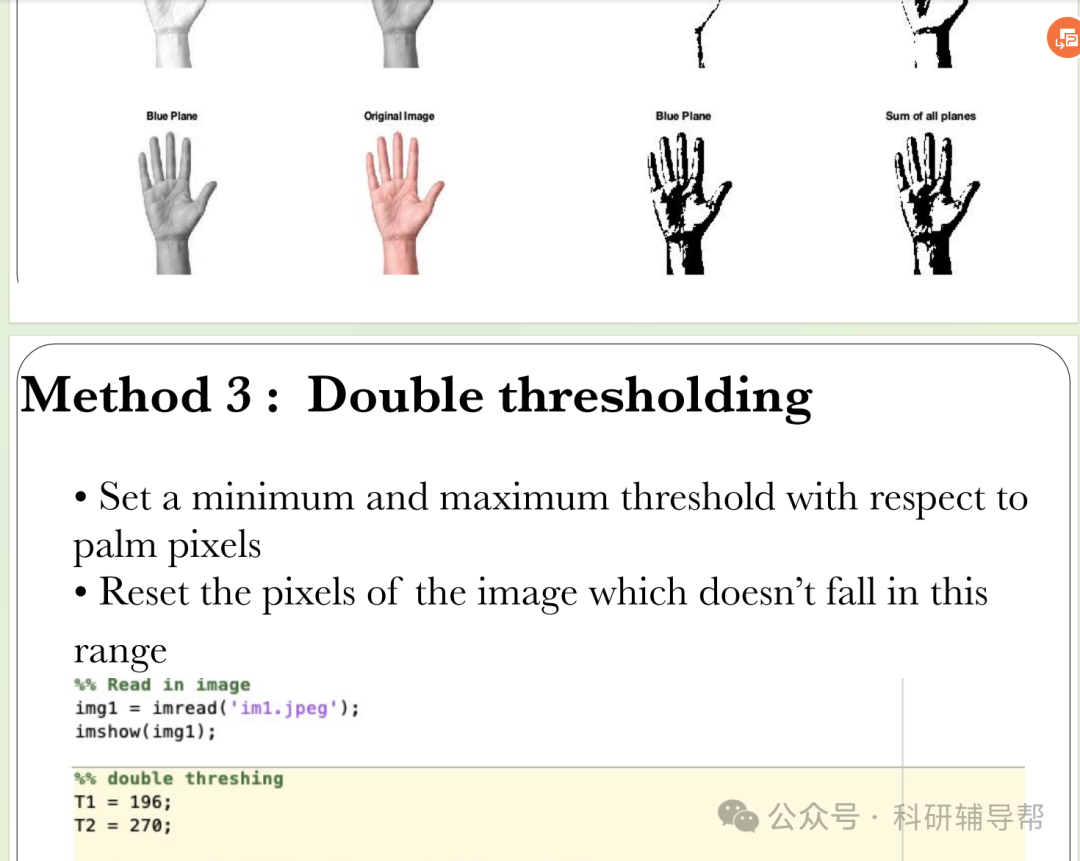

Main Function Code:
%% Read in image
img1 = imread(‘im1.jpeg’);
imshow(img1);
%% RGB Color Space
img = img1;
Rmatrix = img(:,:,1);
Gmatrix = img(:,:,2);
Bmatrix = img(:,:,3);
figure;
subplot(2,2,1) , imshow(Rmatrix);title(‘Red Plane’);
subplot(2,2,2) , imshow(Gmatrix);title(‘Green Plane’);
subplot(2,2,3) , imshow(Bmatrix);title(‘Blue Plane’);
subplot(2,2,4) , imshow(img);title(‘Original Image’);
%%levelR = 0.62;
levelG = 0.65;
levelB = 0.7;
redImg = im2bw(Rmatrix,levelR);
greenImg = im2bw(Gmatrix,levelG);
blueImg = im2bw(Bmatrix,levelB);
SumImg = (redImg & greenImg & blueImg);
% Plot the data
subplot(2,2,1), imshow(redImg);title(‘Red Plane’);
subplot(2,2,2), imshow(greenImg);title(‘Green Plane’);
subplot(2,2,3), imshow(blueImg);title(‘Blue Plane’);
subplot(2,2,4), imshow(SumImg);title(‘Sum of all planes’);
%% Complement image and Fill in holes

🎉3 References
Some content in this article is sourced from the internet, and references will be noted. If there are any inaccuracies, please feel free to contact us for removal.
[1] Luo Meimei. Palm Print Recognition Based on Neural Network Technology [J]. Environment and Development, 2024, 6(1).
[2] Sheng Congyu, Liu Chang, Kong Yihan. Design of Campus Epidemic Prevention and Control Management System Based on Palm Print Recognition Technology [J]. Inner Mongolia Science and Technology and Economy, 2023(16):115-117+133.
🌈4 Matlab Code Implementation
Reply in the public account: Program Download