
Click the blue text above to follow us



1 Overview
This article perfectly reproduces the following article:

The emergence of smart grids and active distribution networks has increased the relevance of reliability in the operation and planning of distribution systems. Traditionally, reliability is analyzed and assessed through several standard indices. Unfortunately, the analysis of reliability assessment relies on simulation, which necessitates the use of imprecise heuristic or meta-heuristic solution methods to operate and plan distribution systems when considering both economic and reliability criteria. To overcome this shortcoming, this paper proposes a method based on optimization to compute standard network-dependent reliability indices, which are widely used in reliability-constrained distribution optimization models. Compared to traditional simulation-based methods, the reliability indices are a key feature that is equivalently determined by an effective linear programming-based approach, where the network topology is explicitly represented by the decision variables of the optimization process. The proposed method has been tested on several benchmark tests, including a 1080-node system. Numerical simulations indicate that the proposed method yields results comparable to traditional algorithms. Furthermore, a moderate computational workload is suitable for integrating the proposed equivalent formulas into reliability-constrained optimization models for distribution operation and planning. This successful numerical experience supports the potential of the proposed formulas, which can solve reliability-constrained distribution system operation and planning optimization models using reasonable techniques different from existing heuristics and meta-heuristics.
For the reliability-constrained optimization model of distribution systems, the computation of standard reliability indices depends on knowledge of the network topology and load conditions. In this optimization-based framework, the following practical assumptions are typically adopted for ease of handling:
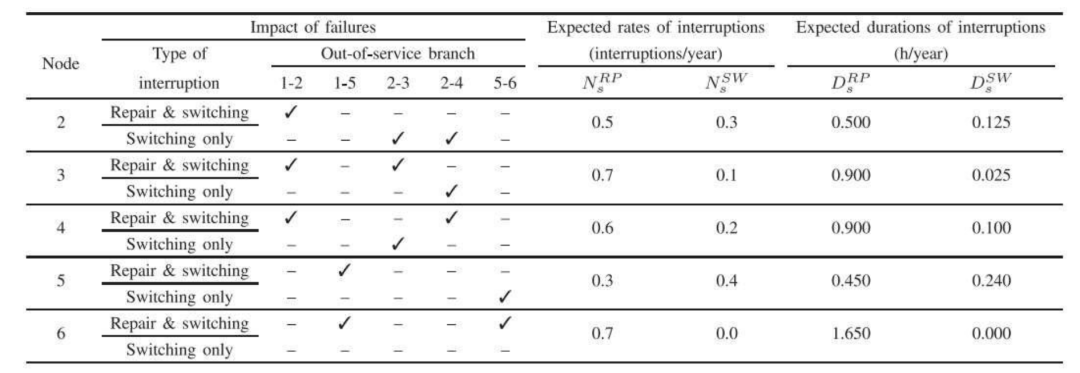
1) Only sustained interruptions due to single branch failures are considered. Branch failures are characterized by failure rates and interruption durations.
2) It is assumed that the distribution system is radial, where each branch connected to the substation is equipped with circuit breakers, and automatic reclosing occurs at the outgoing line of the substation. Additionally, all branches are equipped with switches to isolate the faulty section while meeting the demands of the remaining system. Therefore, once a sustained fault occurs, the first circuit breaker upstream of the faulty branch will trip, cutting off all downstream load demands. Subsequently, to reduce the outage load, network reconfiguration is performed by operating switches and circuit breakers. To this end, the first switch upstream of the fault is opened to isolate the fault. Then, the circuit breaker is closed to restore the supply of all load demands between the circuit breaker and the switch. Finally, once the isolated fault is cleared, the corresponding switch will close to restore full service.
Load nodes are thus affected by two types of interruptions: 1) repair and switch-over interruptions, where the load node will be restored only after the fault is repaired; 2) interruptions limited to switch actions, where the fault will be repaired once the switch-over is completed.
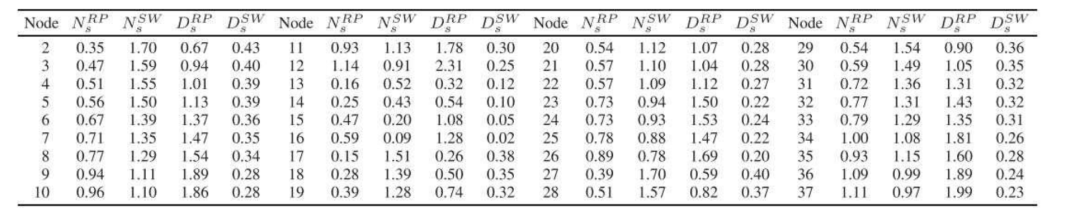
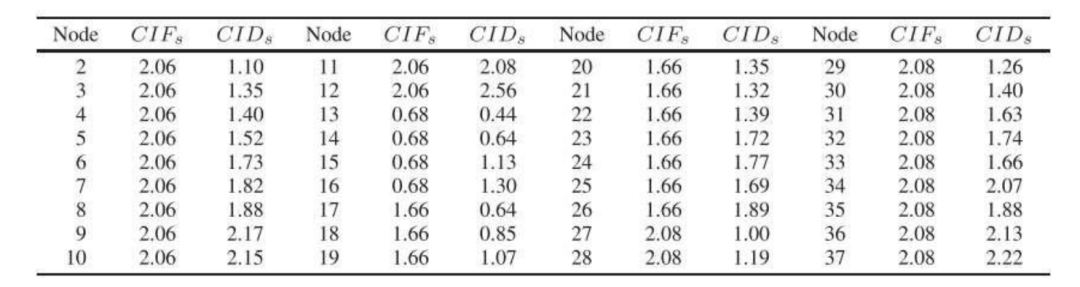
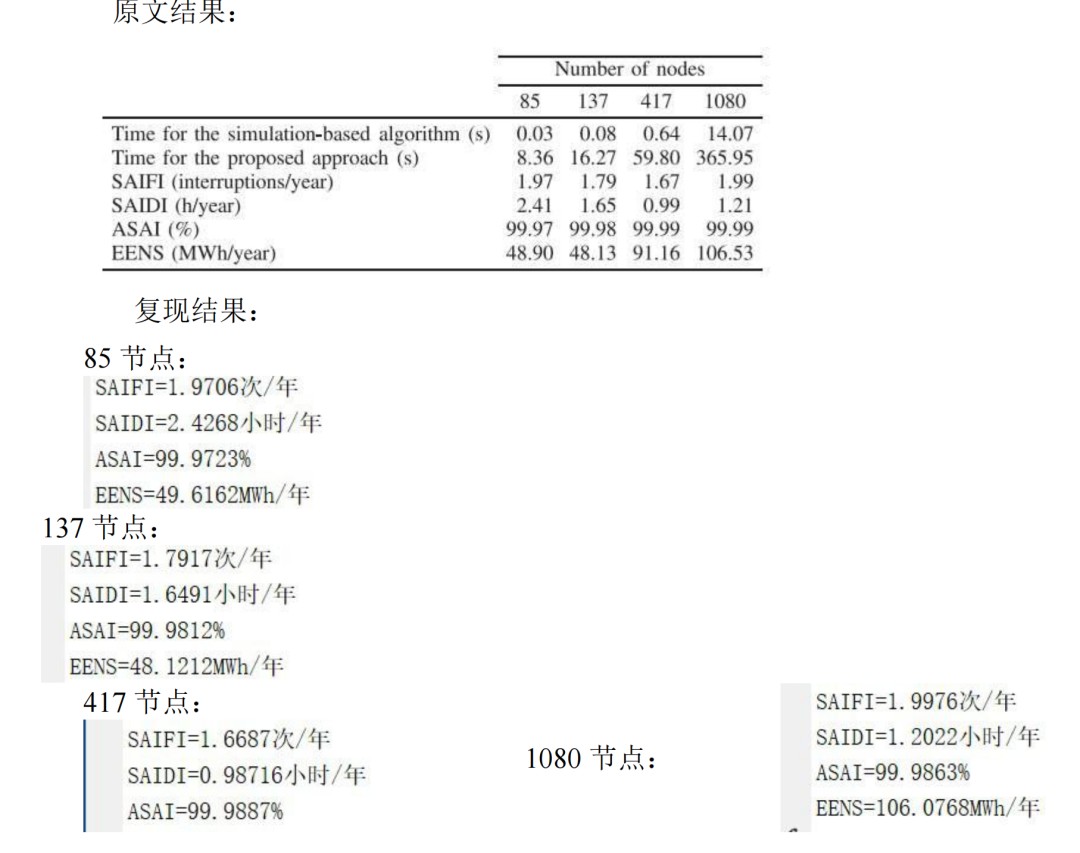
2 Operational Results
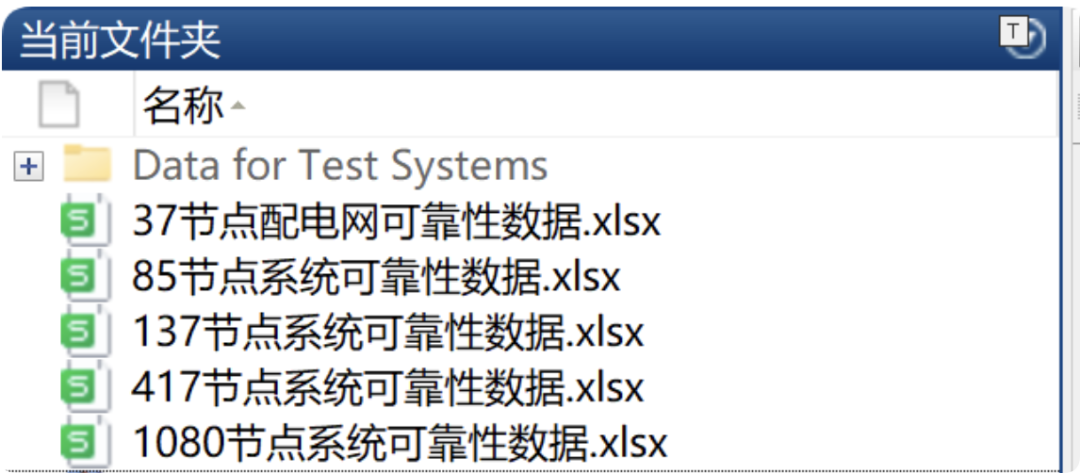
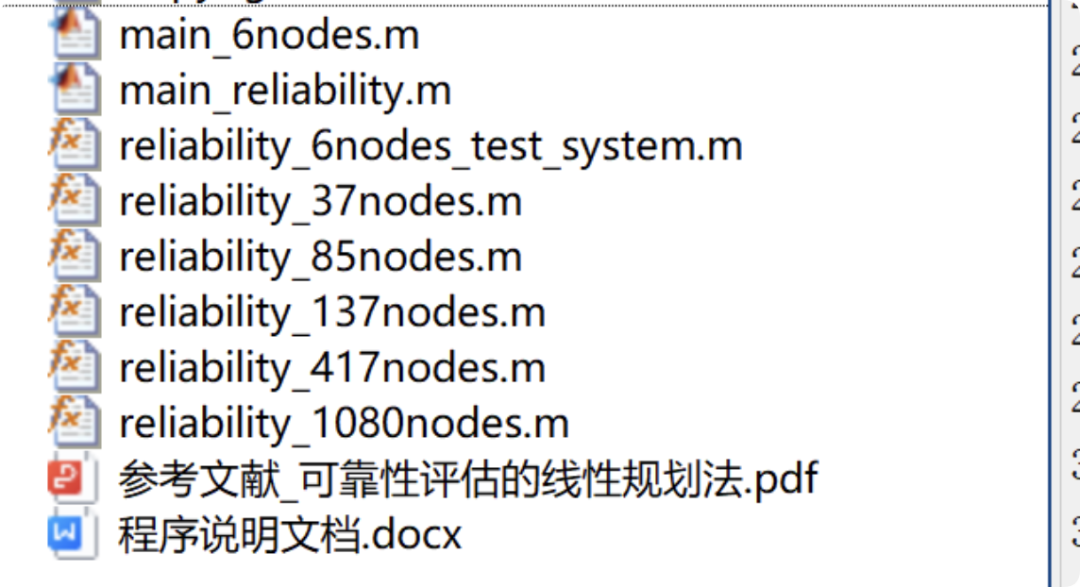
Perfect Reproduction:


3References
Some content in this article is sourced from the internet, and references will be noted. If there are any inaccuracies, please feel free to contact us for removal.

[1] G. Muñoz-Delgado, J. Contreras and J. M. Arroyo, “Reliability assessment for distribution optimization models: A non-simulation-based linear programming approach,” 2017 IEEE Power & Energy Society General Meeting, Chicago, IL, USA, 2017, pp. 1-1.


4 MATLAB Code, Data, Article Download