💥💥💞💞Welcome to this blog❤️❤️💥💥
🏆Author’s Advantage: 🌞🌞🌞The blog content aims to be logically clear and coherent for the convenience of readers.
⛳️Motto: A journey of a hundred miles begins with a single step.
💥1 Overview
Research on Short-Time Fourier Transform and Wavelet Transform based on MATLAB for image processing
Abstract: With the rapid development of digital image processing technology, tasks such as image analysis, enhancement, compression, and restoration have shown great potential in fields such as medicine, industry, military, and entertainment. Time-frequency analysis, as an important signal processing tool, plays a key role in image processing. This paper focuses on two mainstream time-frequency analysis methods: Short-Time Fourier Transform (STFT) and Wavelet Transform (WT), explaining their basic principles, analyzing their advantages and limitations in image processing, and exploring their effects in applications such as image denoising and edge detection within the MATLAB environment, while looking forward to future research directions.
Keywords: image processing; Short-Time Fourier Transform; Wavelet Transform; MATLAB; time-frequency analysis
1. Introduction
Digital images are important carriers of information about the objective world and are widely used in many fields. Effective processing and analysis of images is the foundation for many applications. Traditional image processing methods are often based on spatial or frequency domains. For example, Fourier Transform (FT) can convert images from the spatial domain to the frequency domain, facilitating the analysis of overall frequency components, but it cannot reveal the variation of frequency components with spatial location and fails to provide frequency information for local areas of the image, making it difficult to meet the needs of tasks requiring local feature analysis. To overcome this limitation, time-frequency analysis methods have emerged, with Short-Time Fourier Transform and Wavelet Transform becoming research hotspots. MATLAB provides a convenient and efficient platform for the application of these two transforms in image processing.
Short-Time Fourier Transform (STFT), Wavelet Transform (WT), and image processing are commonly used techniques in the fields of digital signal processing and image processing. The signal is divided into short segments, and Fourier Transform is applied to each time segment to obtain the short-time frequency spectrum in the frequency domain. Image processing is the process of operating on and analyzing digital images, including image enhancement, filtering, segmentation, feature extraction, etc. Image processing has wide applications in medical imaging, computer vision, remote sensing images, digital photography, etc., such as medical image analysis, face recognition, image segmentation, and object detection. The techniques of Short-Time Fourier Transform, Wavelet Transform, and image processing based on MATLAB can effectively process signal and image data, providing powerful tools and support for various applications.
2. Principles of Short-Time Fourier Transform (STFT) and Its Applications in Image Processing
2.1 Basic Principles of STFT
STFT is an improvement of the Fourier Transform, aimed at solving the problem of lack of time-domain local information in Fourier Transform. The basic idea is to introduce a finite-length window function to segment the signal, treating the signal as approximately stationary within each window, and then applying Fourier Transform to the signal within the window to obtain the frequency distribution of the signal over different time segments. In image processing, the image can be viewed as a two-dimensional signal, applying STFT to each row or column of the image to analyze the frequency characteristics of the image at different locations, assisting in subsequent processing such as image enhancement and feature extraction.
2.2 Advantages and Limitations of STFT in Image Processing
Advantages
STFT performs spectral analysis of local areas of the image through a sliding window, where different texture areas have different frequency characteristics. STFT can help identify and classify these textures. It can also perform frequency domain filtering based on local spectral information, enhancing specific features of the image by identifying noise frequency components and suppressing them in the local frequency domain, achieving image denoising.
Limitations
The fixed window size of STFT leads to a trade-off between time resolution and frequency resolution. According to the Heisenberg uncertainty principle, time resolution and frequency resolution cannot both be infinitely high. Under a fixed-length window, a narrow window has high time resolution but low frequency resolution, while a wide window has high frequency resolution but low time resolution. This makes STFT unable to simultaneously capture transient high-frequency details (such as edges) and slowly varying low-frequency information (such as smooth areas), making it inadequate for processing images with multi-scale features.
3. Principles of Wavelet Transform (WT) and Its Applications in Image Processing
3.1 Basic Principles of WT
To overcome the limitations of STFT, Wavelet Transform has emerged. It is a multi-resolution analysis tool that analyzes signals by stretching and shifting wavelet basis functions (mother wavelets). Unlike Fourier Transform, which uses infinitely long sine/cosine functions as basis functions, Wavelet Transform uses finite-length basis functions with good time-frequency localization properties. Wavelet Transform can simultaneously analyze the frequency components of images at different scales, using narrow windows for high-frequency components (such as edges and textures) and wide windows for low-frequency components (such as smooth areas), achieving adaptive resolution in both time and frequency domains, overcoming the fixed window problem of STFT. Wavelet basis functions have good localization properties in both time and frequency domains, allowing for precise capture of local features of images, such as transient signals and singular points. The energy of images in the wavelet domain is often more concentrated, which is beneficial for image compression and denoising, and can effectively decorrelate image data, reducing information redundancy.
3.2 Advantages of WT in Image Processing Applications
Image Denoising
Threshold processing of wavelet coefficients can effectively remove image noise while preserving image detail information. Noise typically manifests as small amplitude coefficients in the wavelet domain, while image details are represented by large amplitude coefficients. For example, in medical image processing, wavelet transform denoising can clearly present lesion areas, providing accurate basis for doctors’ diagnosis.
Image Compression
Utilizing the energy concentration of wavelet transform, efficient image compression can be achieved through quantization and encoding of wavelet coefficients. The JPEG 2000 standard is based on wavelet transform, which can achieve better image quality at the same compression ratio compared to traditional compression methods, reducing image storage space and transmission time.
Edge Detection
Wavelet transform has a strong response to abrupt changes (edges) in images, and edge detection can be achieved by detecting the local maxima of wavelet coefficients. In remote sensing image processing, accurately detecting edges helps identify ground objects, providing important data support for geographic information systems.
Feature Extraction
Wavelet coefficients can serve as effective features of images for image retrieval, object recognition, etc. In the field of face recognition, extracting wavelet features from face images combined with classification algorithms can achieve efficient and accurate face recognition.
4. Experimental Comparison of STFT and WT Based on MATLAB in Image Processing
4.1 Experimental Setup
A test image containing rich texture and edge information was selected as the experimental object, applying STFT and WT for image denoising and edge detection experiments, respectively. In the MATLAB environment, relevant functions were used to implement the two transforms, employing different threshold processing methods for the denoising experiment, and different edge detection algorithms combined with the results of the two transforms for the edge detection experiment.
4.2 Analysis of Experimental Results
Image Denoising Results
The experimental results indicate that wavelet transform outperforms STFT in image denoising. Wavelet transform better preserves image detail information, removing noise while making image edges clearer, resulting in better visual effects. In contrast, the image edges after STFT denoising are blurred, with significant detail loss, due to the fixed window of STFT being unable to adapt to the frequency characteristics of different areas of the image, leading to improper handling of high-frequency details and low-frequency information during denoising.
Edge Detection Results
Wavelet transform can more accurately detect image edges, with good edge continuity and stronger robustness to noise. Edges detected by STFT exhibit breaks and discontinuities, being sensitive to noise, which is due to the trade-off between time resolution and frequency resolution in STFT, preventing it from accurately capturing edge information during edge detection.
5. Future Research Directions
5.1 Adaptive Wavelet Basis Selection
Research on how to adaptively select the optimal wavelet basis function for different types of images and application scenarios to achieve better processing results. For example, in medical image analysis, selecting appropriate wavelet bases based on the characteristics of different organs and tissues can improve the accuracy and efficiency of image processing.
5.2 Applications of High-Dimensional Wavelet Transform
Exploring the application of higher-dimensional wavelet transforms in video processing and three-dimensional image processing. With the continuous increase of video and three-dimensional image data, high-dimensional wavelet transforms can provide more effective solutions for tasks such as video compression and three-dimensional image reconstruction.
5.3 Integration with Deep Learning
Combining the feature extraction capabilities of wavelet transforms with the powerful classification and regression capabilities of deep learning is expected to achieve breakthroughs in fields such as image recognition and object detection. For example, using wavelet transforms to extract image features as inputs for deep learning models can enhance model performance and generalization ability.
5.4 Design of Image Hashing Algorithms
Utilizing wavelet transforms for feature extraction to design robust image hashing algorithms for image retrieval and copyright protection. In the internet age, with a vast number of images, fast and accurate image retrieval and effective copyright protection are crucial. Wavelet transform-based image hashing algorithms have broad application prospects.
6. Conclusion
This paper deeply explores the basic principles of Short-Time Fourier Transform and Wavelet Transform and their applications in image processing. STFT provides local spectral information through a sliding window, but has limitations in time-frequency resolution due to the fixed window; Wavelet Transform, with its multi-resolution analysis capability and excellent time-frequency localization properties, shows significant advantages in image denoising, compression, enhancement, and feature extraction. Experimental results further validate the superiority of wavelet transform in image processing. In the future, with ongoing research, wavelet transform will have broader application prospects in the field of image processing, providing more effective methods for solving complex image processing problems.
📚2 Running Results
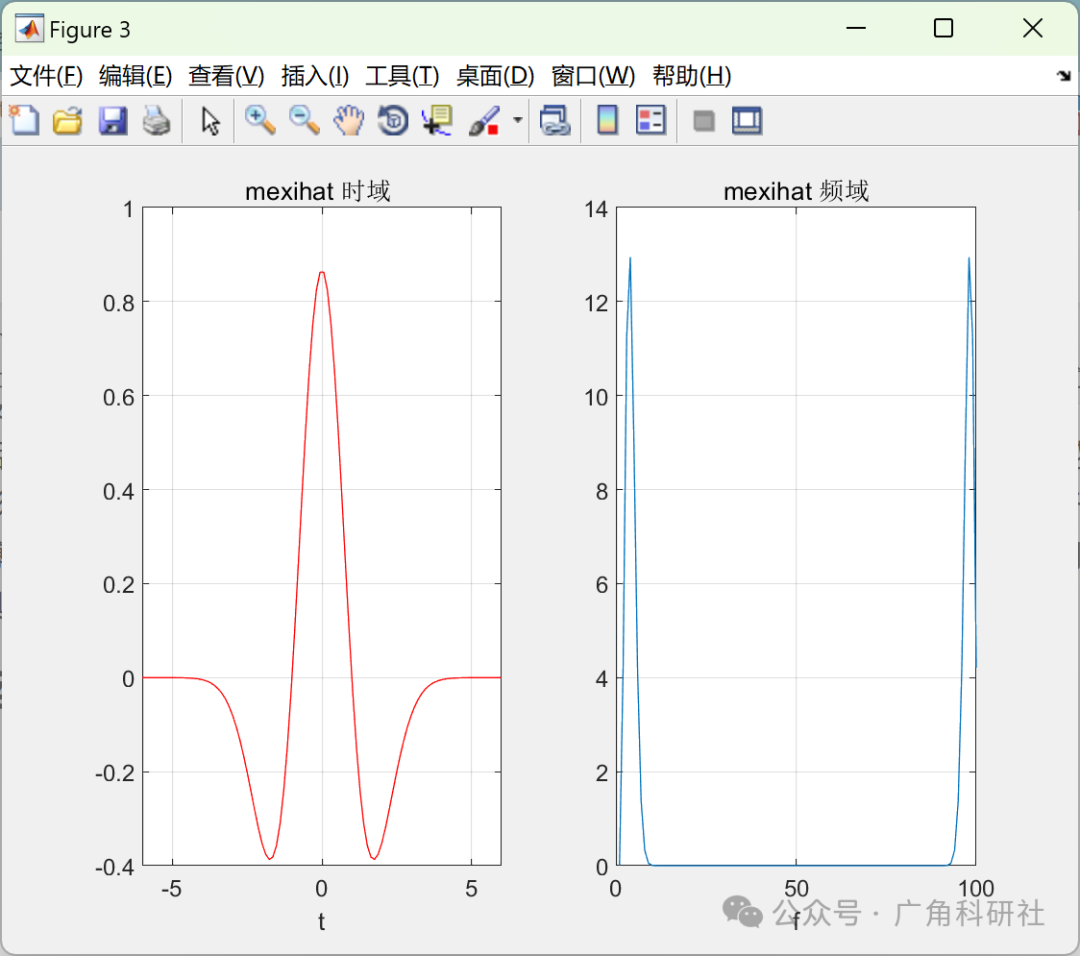

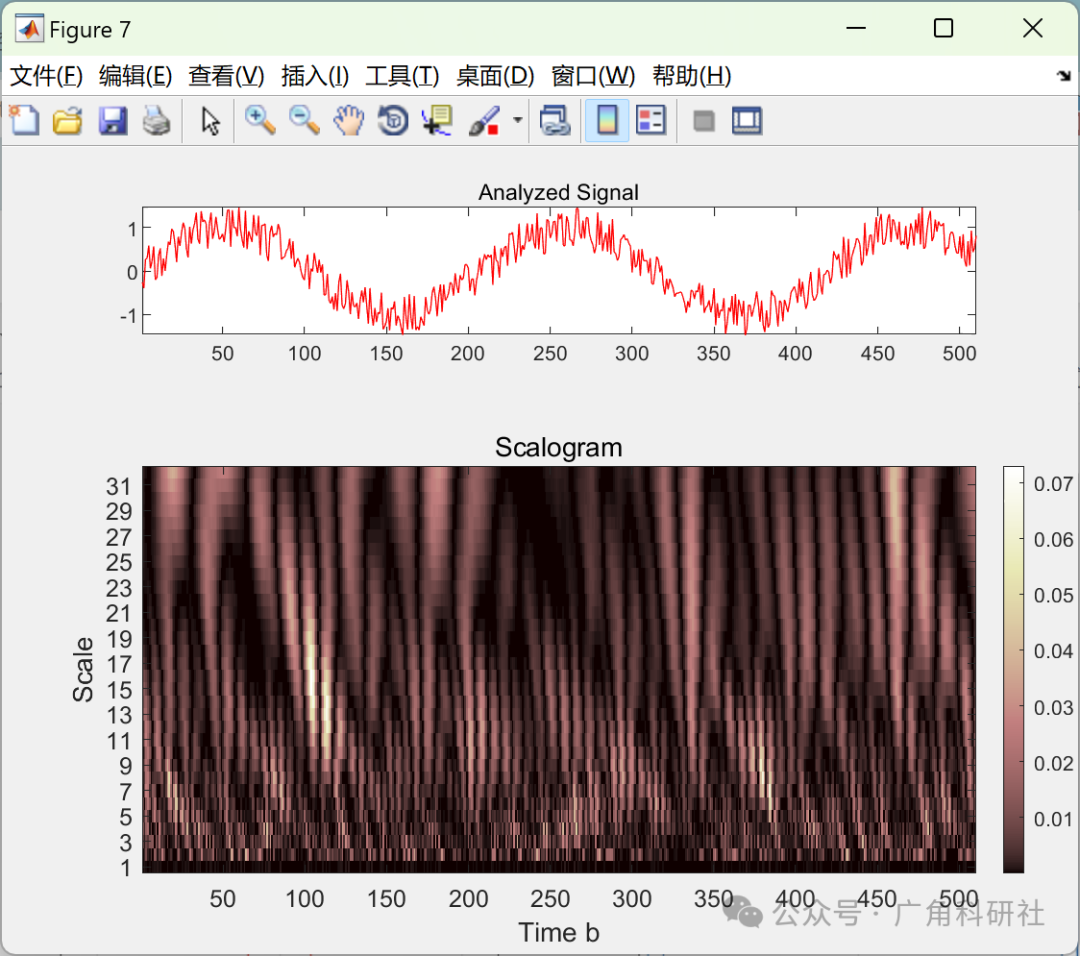

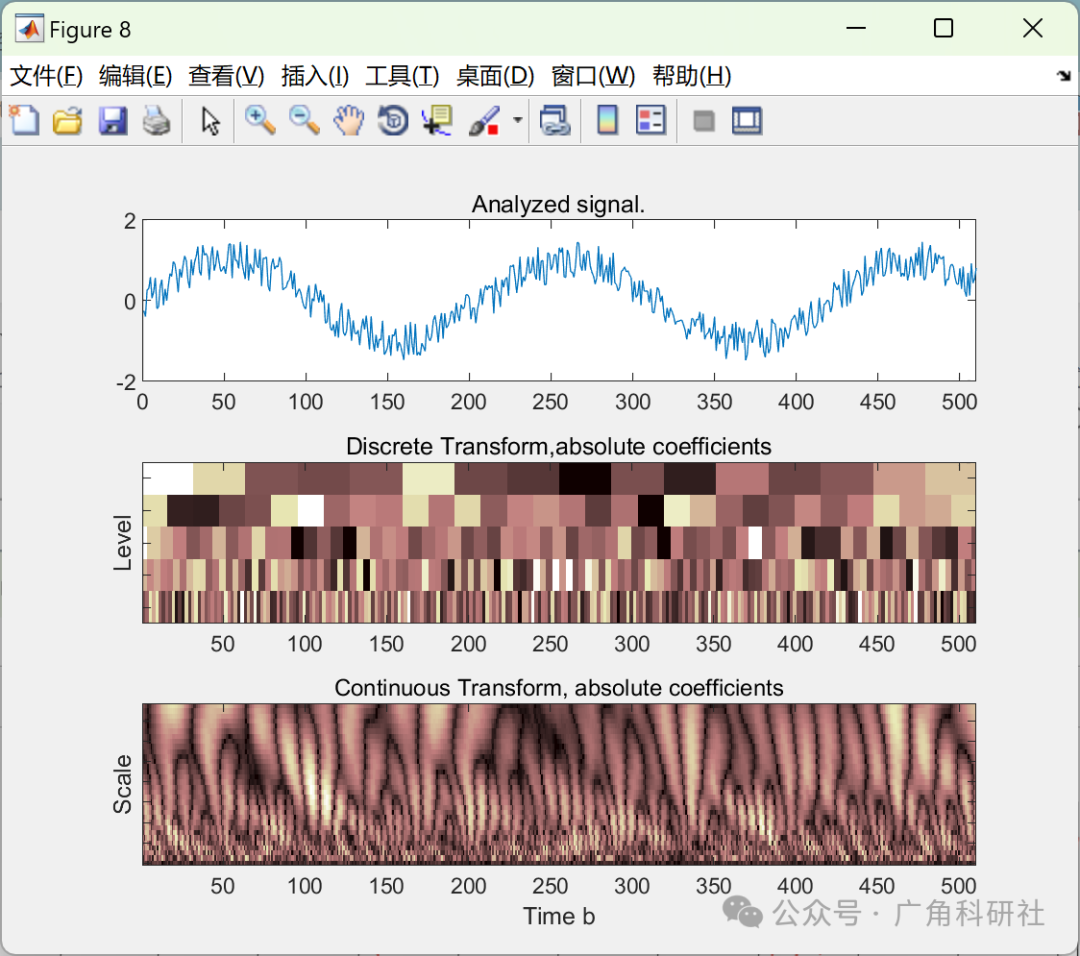

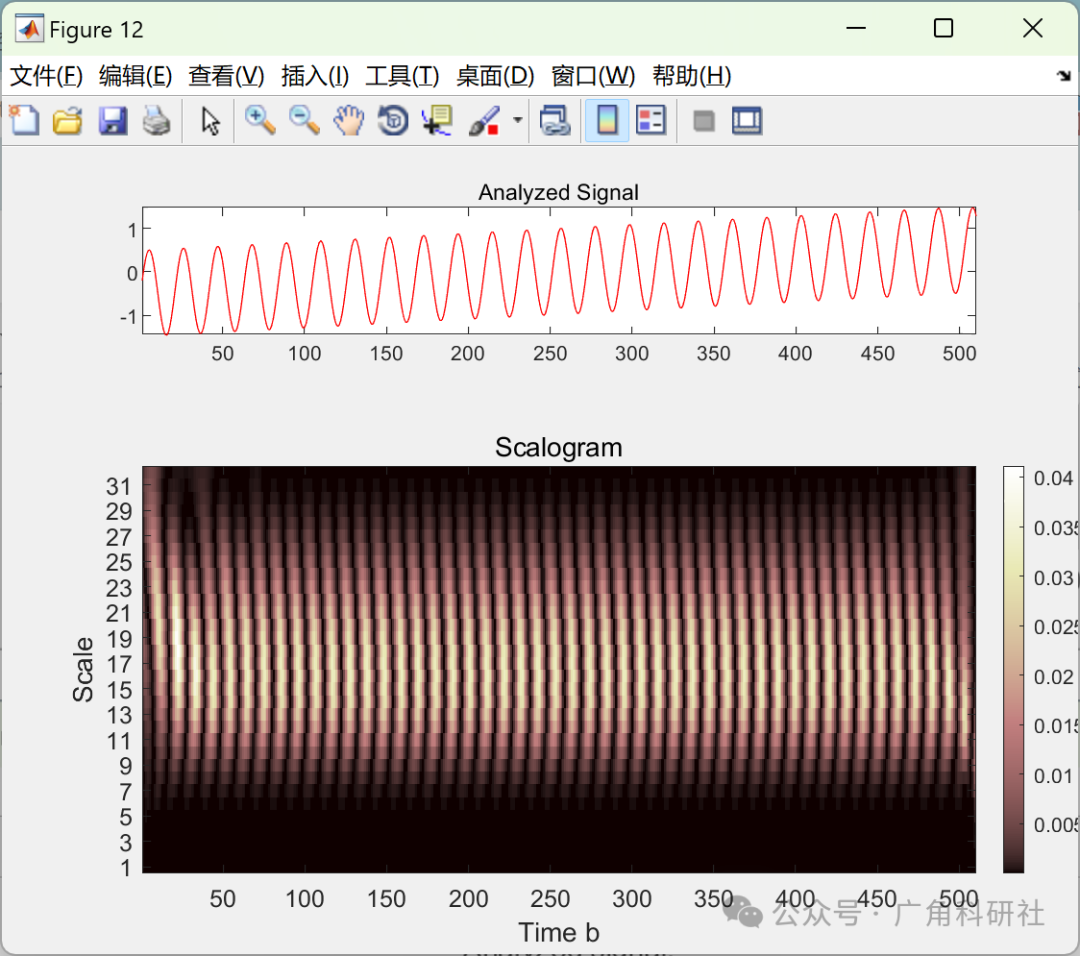

Main function code:
%haar waveletfigure(1)i=20;wav = ‘haar’;[phi,g1,xval] = wavefun(wav,i);subplot(1,2,1);plot(xval,g1,’-r’,’LineWidth’,1.5);grid on;xlabel(‘t’)title(‘haar Time Domain’);g2=fft(g1);g3=abs(g2);subplot(1,2,2);plot(g3);grid on;xlabel(‘f’);title(‘haar Frequency Domain’);%db4 waveletfigure(2)i=10;wname = ‘db4′;[phi,g1,xval] = wavefun(wname,i);subplot(1,2,1);plot(xval,g1,’-r’,’LineWidth’,1.5);grid on;xlabel(‘t’)title(‘db4 Time Domain’);g2=fft(g1);g3=abs(g2);subplot(1,2,2);plot(g3,’LineWidth’,1.5);grid on;xlabel(‘f’);title(‘db4 Frequency Domain’);

🎉3 References
Some content in this article is sourced from the internet, and references will be noted. If there are any inaccuracies, please feel free to contact for removal.
[1] Guan Tao, Li Yuanqing, Guo Fangliang, et al. Method for predicting mechanical properties of short fiber reinforced polymer-based composites based on fiber orientation distribution image processing technology [J/OL]. Journal of Composite Materials: 1-13 [20240422]. https://doi.org/10.13801/j.cnki.fhclxb.20240417.001.
[2] Zhang Jie, Chang Tianqing, Guo Libin, et al. Visible light-infrared armored vehicle detection method based on feature alignment and region image quality guided fusion [J/OL]. Acta Optica Sinica: 1-22 [2024-04-22]. http://kns.cnki.net/kcms/detail/31.1252.O4.20240412.1650.152.html.
🌈4 MATLAB Code Implementation
Reply in the public account: Program download