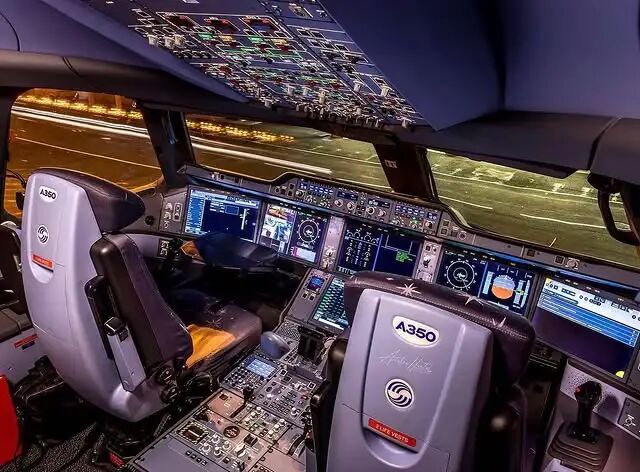
Cover image at the end
On December 19, 2019, Airbus announced that the A350 officially began delivering aircraft equipped with touchscreen cockpit displays. This change has been referred to by many industry insiders as a “cockpit revolution,” as it is the world’s first true application of touchscreen technology in commercial wide-body aircraft.
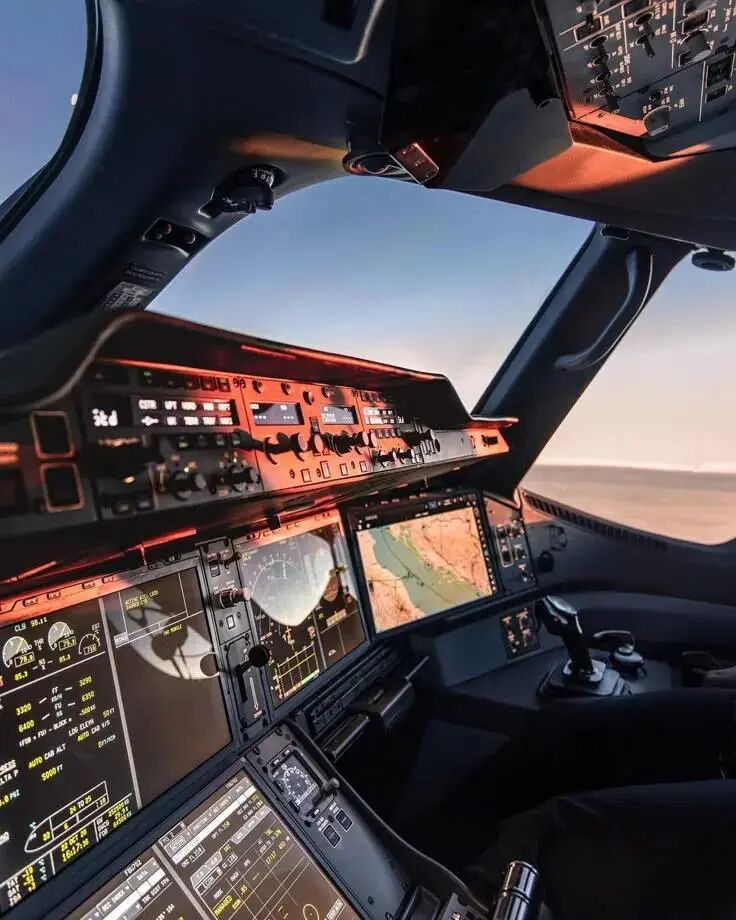
Six Large Screens, Three Touch-capable
The new cockpit features a total of six large LCD screens, of which three support touch operations:
- The outer displays in front of the pilots on both sides;
- The central control display in the middle lower section.
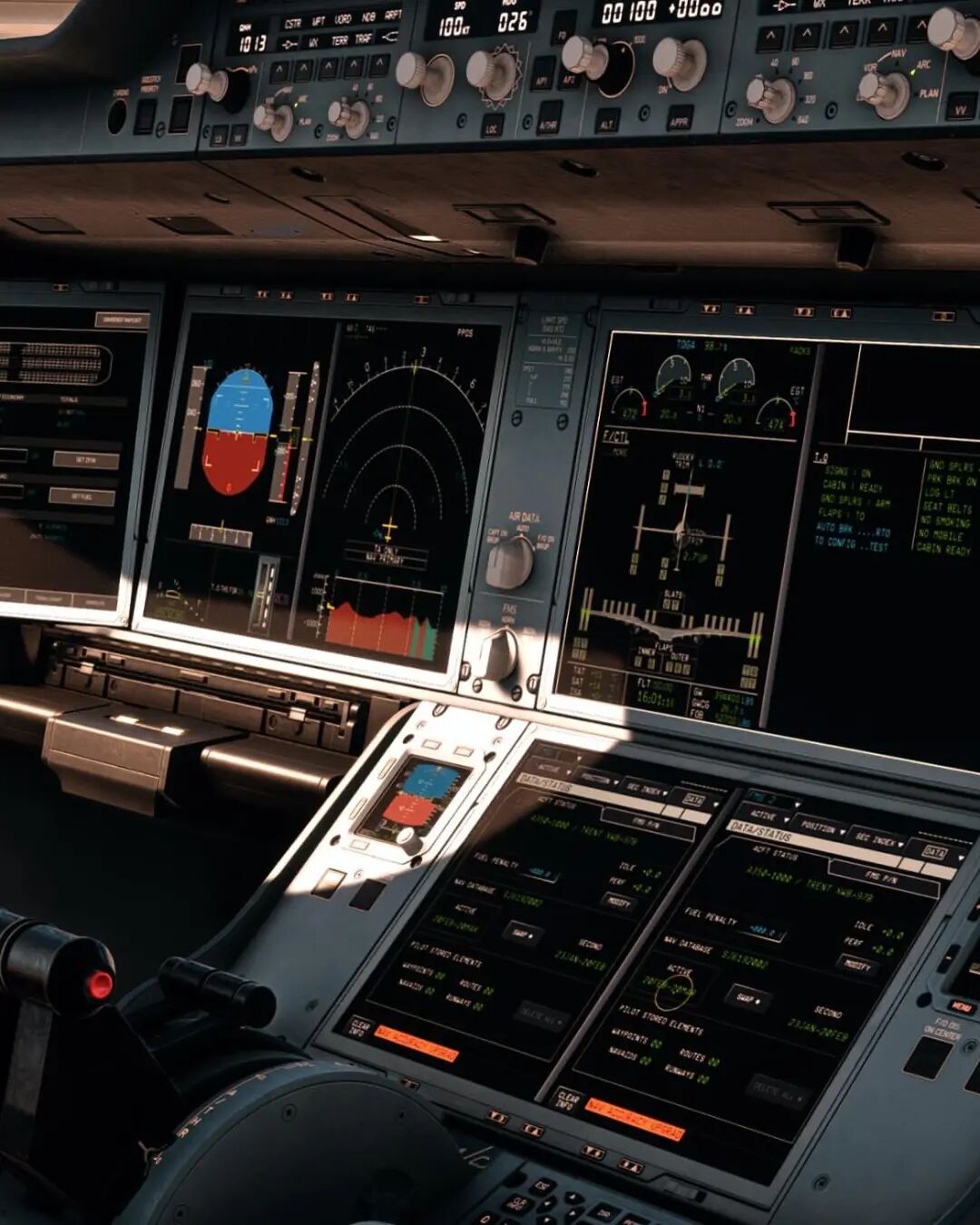
These touchscreens work in conjunction with the existing keyboard and trackball-style “Cursor Control Unit” (KCCU), allowing pilots to input data as precisely as on a computer, while also enabling intuitive zooming, panning, and clicking similar to using a smartphone.
Airbus emphasizes that the touchscreen supports pinch-to-zoom and drag-to-pan, significantly enhancing operational efficiency in critical scenarios:
- Pre-takeoff: Quickly calculating takeoff performance and inputting data into the Flight Management System (FMS);
- Cruise phase: Viewing navigation charts is more intuitive than before;
- Approach preparation: Checking terminal charts before entering FMS data;
- High workload scenarios: Touchscreens are faster than mouse/cursor input, reducing unnecessary switching.
Certification and Delivery: China Eastern Airlines Takes the Lead
This touchscreen system received EASA certification in November 2019. Just one month later, China Eastern Airlines took delivery of the first A350 equipped with a touchscreen in Toulouse (on December 18, 2019).
At that time, 20 airlines had already chosen this configuration, indicating strong market interest.
The touchscreen is not just a “gimmick”; it brings several practical benefits:
- All six screens are fully interchangeable: Hardware and software can be swapped, making maintenance easier;
- Spare parts costs reduced by 80%: No need to prepare a variety of different spare parts;
- Redundant safety: Even if two screens fail simultaneously, the aircraft can still operate.
Additionally, the A350 cockpit is standardly equipped with dual Head-Up Displays (HUD), projecting flight paths and energy symbols directly in front of the pilots, further enhancing situational awareness.
Pilot Training: Clear Advantages of CCQ
The highly family-oriented design allows for very short cross-crew qualification (CCQ) training times between different Airbus models:
| Aircraft Type | Required Training Days |
|---|---|
| A320 → A350 | 11 days |
| A340 → A350 | 10 days |
| A380 → A350 | 5 days |
| A330ceo/neo → A350 | 8 days (no full-motion simulator required) |
A pilot with an A330 license can transition to flying the A350 in just 8 days. Many airlines are eager to order the A350, as it reduces training costs and allows for rapid fleet expansion.
Airline Feedback: Singapore Airlines’ “Aha Moment”
In 2014, Airbus invited the captain of Singapore Airlines to experience the new cockpit. The then Vice President and Head of Pilot Training, Captain Quay Chew Eng, commented after the test flight:
“Compared to the A330 we are about to replace, the A350 cockpit is a completely different experience.”
Singapore Airlines ultimately became the launch customer for the A350-900ULR and has continued to place additional orders. As of July 2025, Singapore Airlines is the world’s largest operator of the A350, with a fleet size of 65 aircraft.
Another Singapore Airlines executive, Captain Gerard Yeap, also remarked:
“Walking into the A350 cockpit feels like stepping into another Airbus aircraft, it is very familiar. The controls, feel, and interface are all very natural.”
Technical Specifications (A350-941 XWB)
- Seating Capacity: 315
- Range: 8,100 nautical miles (15,000 kilometers)
- Maximum Speed: 513 knots (950 kilometers/hour)
- Service Ceiling: 43,100 feet
- Maximum Takeoff Weight: 623,908 pounds
- Fuel Capacity: 37,194 US gallons
- Powerplant: 2 Rolls-Royce Trent XWB-84 engines (thrust of 84,200 pounds each)
Pilot Controversy: Useful or Distracting?
From a safety perspective, the touchscreen is not just a gimmick. Pilots can use it to simulate single-engine failures, depressurization, and other scenarios, and assess the aircraft’s performance; during complex airspace operations, they can quickly zoom and adjust flight paths.
Younger generations of pilots are more accepting of this technology, as they have grown up accustomed to touchscreen devices and find operating in the A350 cockpit intuitive.
Although touchscreens have been used in fighter jets since the 1990s, it took nearly thirty years for them to enter commercial aviation. The A350 is the first model to truly implement touchscreen technology in civil aviation.
Six years later, the A350 cockpit remains one of the most advanced in the industry. Perhaps one day, the aircraft cockpit will be as intuitive as the tablets we hold in our hands.