1 Issues in IoT Comprehensive Internship Course Teaching
The Internet of Things (IoT), as a typical major in the new engineering disciplines, is an important component of the new generation of information technology [1]. The so-called Internet of Things refers to the “internet that connects everything,” which can combine various information sensing devices with the internet to form a vast network, achieving interconnectivity between the human world and the electronic world [2-3].
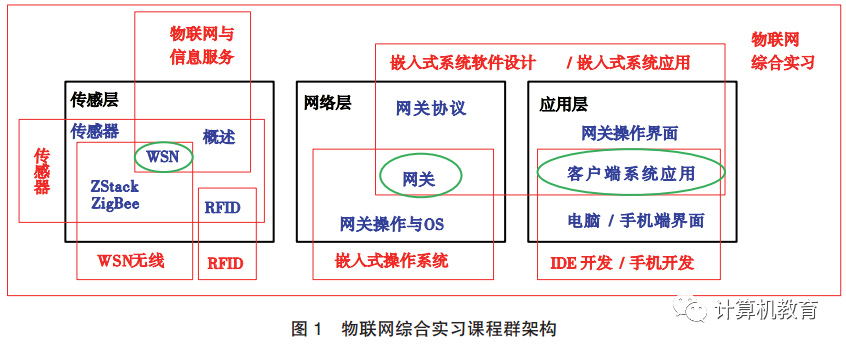
The IoT comprehensive internship serves as a comprehensive practical teaching course in IoT education [4], reflecting the characteristics of “integration, application, and innovation” in IoT. The course requires students to complete their specialized courses and then develop comprehensive practical application projects through the teacher’s summarization of all IoT knowledge. The IoT comprehensive internship is the culmination of the application of IoT teaching knowledge, technology integration, and application development, and its importance is self-evident. The structure of the IoT comprehensive internship course group is shown in Figure 1.
After three consecutive years of teaching the IoT comprehensive internship, a relatively mature teaching plan has been established, accumulating dozens of cases in three areas: IoT production, IoT life, and IoT ecology. Although rich results have been obtained, some issues have also been identified.
(1) Although the case library is rich, its utilization rate is low. After years of internship guidance and over a decade of competition guidance, dozens of systems have been developed and accumulated, enriching the case library [5]. However, the case library is currently just a simple accumulation of many operational cases, making it difficult for students to understand these resources in a short time. The content that can be referenced during the internship phase is even less, thus requiring the case library to be organized, classified, and enhanced to form a “resource supermarket” to fully support students’ internships.
(2) The openness of the comprehensive internship is not comprehensive enough. Currently, the openness of the internship is limited to students forming teams and autonomously determining open topics, after which the traditional internship teaching model is still used for practical operations. As a result, students are often highly motivated at the beginning of the topic selection, but their enthusiasm significantly declines as the internship progresses due to limitations in topic ideas and environment. The root cause is the insufficient openness of the internship, which cannot adhere to the teaching philosophy of “student-centered, guiding their free development” throughout the entire process [6].
(3) The integration of system modules lacks independence. Since the completed comprehensive systems are based on a multi-layer architecture that integrates knowledge from over ten courses, different modules are combined through a unified protocol. Due to the three-layer architecture of IoT, it is necessary to combine multiple layers of modules to realize the function of a system. The problem is that if the system context is removed, individual modules cannot run independently, which is not conducive to self-validation and application coupling of single modules.
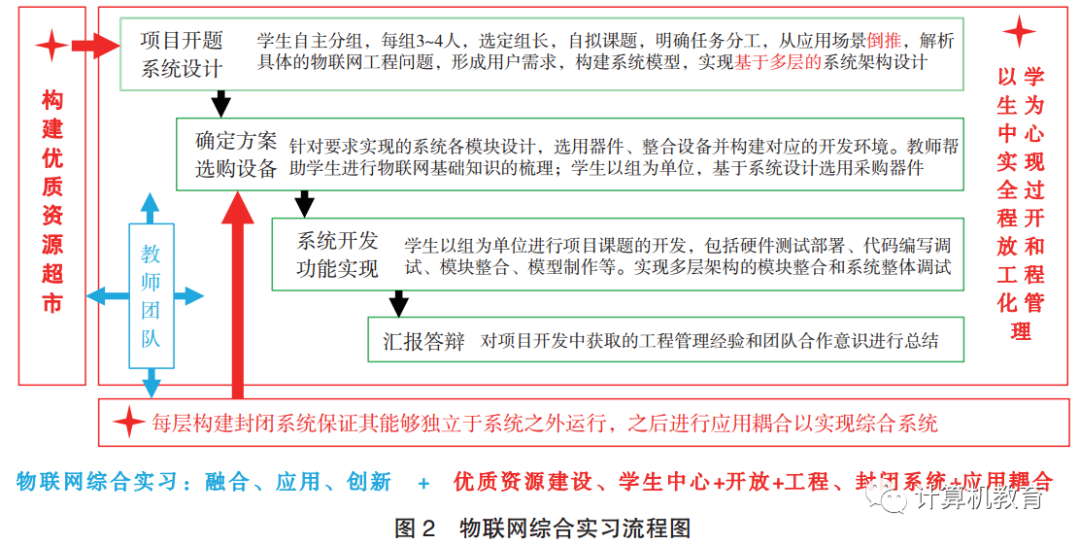
To effectively address the above issues, reforms can be considered in the three dimensions mentioned: in the construction of the case library, benchmark against the high-level, innovative, and challenging requirements of the “golden course” [7] to build a high-quality “resource supermarket.” Ensure that students can quickly know what technology is used and what functions are available in the cases they see, and then freely choose the required technology, equipment, and concepts based on their topics, thereby improving the utilization rate of the case library; in management, require a student-centered approach to achieve full-process openness and engineering management [6,8], including autonomous topic selection, independent research and selection of equipment, self-construction of topics/models, and inter-group evaluation discussions during defense presentations. Expand the internship’s scope to include students’ technical exchanges, competitions, papers, etc., in the assessment criteria, introduce innovation laboratories, small meeting rooms, and rest areas, and ensure that laboratories are open 24/7; on topics, abandon the modular thinking and require each layer to construct a closed system to ensure it can run independently of the system, while coupling its applications to achieve a comprehensive system overall, thus further enriching the content of the “resource supermarket.” The entire comprehensive internship flowchart is shown in Figure 2.
2 Resource Construction as a Golden Course: Benchmarking the Construction of the “Resource Supermarket of Case Library”
The main purpose of constructing the “Resource Supermarket of Case Library” is to improve students’ utilization of past cases and quickly enhance their experience. Three measures are implemented in terms of support, expressiveness, and user service to organize, classify, and enhance the case library and form a “resource supermarket” to fully support students’ internships.
In terms of support for cases, consider benchmarking against the high-level, innovative, and challenging standards to construct a “total-part-total” IoT comprehensive case library, analyzing and classifying the large number of previously accumulated cases, labeling technology applications, applicable scopes, and service functions. The high-level aspect focuses on the organic integration of students’ knowledge, abilities, and qualities, directly translating relevant training indicators into specific cases to determine overall goals; the innovative aspect involves fragmenting each case into a closed system to determine the decomposability of the case; and in terms of challenge, students are allowed to freely express themselves in an open topic environment, striving to integrate other computer-related knowledge with relevant modules, and then perform application coupling to determine the re-integration of cases.
In terms of expressiveness of cases, consider providing detailed block diagram analyses for each case, striving for each case to achieve a level of detail at the function, API call, and transmission protocol level through detailed block diagrams, so that students can understand the relevant technical details and development ideas of the case in the shortest time, and then consider whether to reference it.
From the perspective of service users of cases, consider having various roles submit numerous materials, allowing “customers” to obtain what they want. For developers, the required materials include development documents, source code, executable programs, and defense PPTs; for users, case usage manuals and demonstration videos are needed; and for teaching departments, internship manuals and transcripts are required.
3 Implementation Process Openness: Achieving Full Process Openness and Engineering Management Centered on Students
The IoT comprehensive internship requires achieving full-process openness and engineering management centered on students. This course allows students to develop IoT comprehensive application projects based on the premise that they have completed the basic courses in IoT-related majors. The course adopts an open-topic approach, requiring the implementation of the three-layer architecture of IoT, covering but not limited to the fields of IoT, artificial intelligence, pattern recognition, application system integration, and ubiquitous system development. The technologies used include but are not limited to WiFi, ZigBee, NBIoT, LoRa, Raspberry Pi, etc.
Through this course, students are required to understand the ideas, methods, and steps of IoT system design based on mastering core IoT technologies; experience the entire process of designing and developing an actual IoT application system, including user needs, design ideas, team development, system testing, etc.; train and improve their ability to solve practical engineering problems, further consolidating the professional knowledge learned; and develop in groups based on the three-layer architecture of IoT, ultimately integrating to produce an innovative and practical IoT comprehensive system.
1) Topic Selection Phase.
Students freely form groups, with each group consisting of 3-5 students and electing a group leader. The experimental process adopts a group leader responsibility system.
The experimental plan includes considerations of open application scenarios and the realization of user needs, selection of various devices, design of system structure, and testing plans. These contents are considered and reviewed by the teacher, and the group writes and submits a topic selection form for archiving. The topic selection form includes the title, group leader, members, introduction, system structure diagram, and a list of involved technologies and equipment.
The topic selection phase mainly reflects the open-topic proposition, reverse engineering of application scenarios, and the concept of a device supermarket. The autonomous selection of application scenarios and discussion of plans can greatly enhance students’ autonomy; the reverse engineering of scenarios determines the system structure and device selection, reflecting engineering management; and finally forming the topic selection form can serve as proof of process management assessment and provide materials for the overall internship’s system structure, technical equipment, and cost.
2) Implementation Phase.
In form, students are responsible for project implementation, fully leveraging their enthusiasm, and based on the preliminary design in the topic selection form, refining the functions of each module to form detailed block diagrams. In content, students are free to explore, first ensuring the system functions are completed quickly and can run independently, while also freely expressing themselves by introducing databases, machine learning, visual development, etc.; the device construction adopts the pocket laboratory concept, ensuring that all devices (except PCs) are portable, allowing experiments to be conducted anytime and anywhere; in model making, students design and purchase materials independently, with the only limitation being cost, while other aspects are left to their creativity.
The implementation phase mainly reflects the characteristics of teamwork and self-management, integration of closed systems, and the pocket laboratory concept. The teacher team only needs to express satisfaction or dissatisfaction with the students’ work in a supervisory role and assign work periods according to project milestones for inspection and discussion; expand the internship’s scope to include students’ technical exchanges, competitions, papers, etc., in the assessment criteria, aiming to ensure that students are not limited to the internship itself, but also strive to achieve results outside of class during the internship; introduce other laboratories, including innovation laboratories as model-making rooms, preparation rooms as small meeting rooms, and provide rest areas while ensuring that relevant functional laboratories are open 24/7.
3) Assessment Phase.
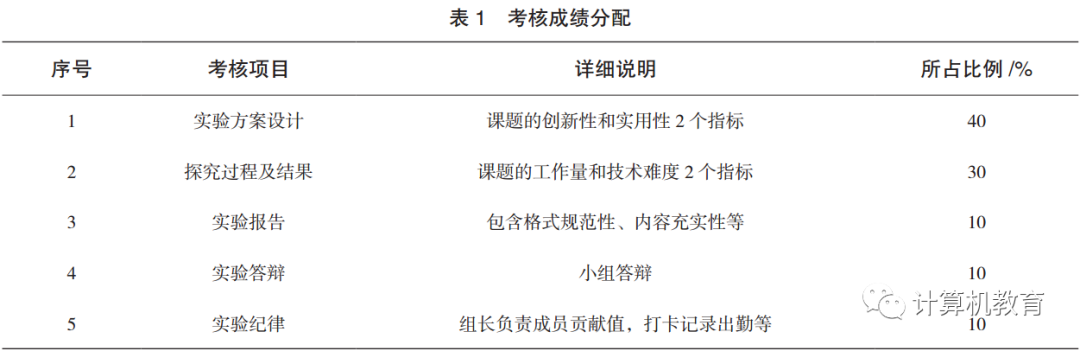
The assessment phase mainly reflects participation in assessment and mutual teaching, as well as corresponding teaching syllabus indicators. During the introduction and demonstration of works, other students participate as judges in evaluating, exchanging, and discussing the group’s works. The demonstration requires the overall model of the system to run correctly, conducting live demonstrations and defenses. Finally, students submit reports, development documents, user manuals, source code, executable programs, demonstration videos, and defense PPTs. Students freely form groups based on interest and needs, with each group consisting of 4-5 students and electing a group leader, implementing a group leader responsibility system, and clearly defining the division of labor among group members.
The works are mainly assessed based on innovation points, practicality, workload, and technical difficulty, with other content also included in the assessment. The distribution of assessment scores is shown in Table 1.
4 Forming a Closed System Application Set Based on the IoT Teaching System Course Group in Topic Architecture
A closed system is the most basic hardware environment that allows the system to operate. Previously, when integrating systems, different modules were combined through a unified protocol, leading to the issue that modules could not run independently, resulting in the entire project being treated as a new product of the “Resource Supermarket of Case Library,” rather than treating each module as a separate product. For example, the fire warning model system is very complete and can be divided into three parts: sensing layer, gateway layer, and application layer, but each part cannot run independently when removed from the system.
If we abandon modular thinking and combine multiple independently operating closed systems (hardware and middleware are independent of each other, and applications are loosely coupled), forming a comprehensive system of “multi-layer architecture, hardware independence, and application coupling,” we can fully leverage the strengths of each module, allowing each student to achieve “enhancement and compensation,” cultivating overall architectural capabilities.
Specific operations include constructing data and web visualization applications based on the sensing layer, building a fire recognition deep model based on cameras, and constructing fire level assessment applications based on the gateway layer, which can then be coupled with the original application layer, greatly enhancing the model’s comprehensiveness, applicability, and innovation, aligning more with the training philosophy of “new engineering”; at the same time, students responsible for the sensing layer and gateway layer can also engage in application development, preventing them from developing knowledge gaps.
5 Conclusion
The open IoT comprehensive internship teaching reform based on the “Resource Supermarket of Case Library” has the following innovations.
(1) A student-centered approach reflects the exploratory and design nature of experiments. Students learn, design, and implement independently, with no limits on the case system plan, and no limits on additional optional actions, undoubtedly allowing for free expression.
(2) The construction of the resource supermarket reflects high-level and resource support. The case library is constructed according to the golden course standards, providing strong support for students’ internship training.
(3) The application coupling of closed systems reflects systemic and comprehensive characteristics. By not being limited by modular thinking, independently constructing closed systems allows students to directly engage in interactive applications of closed systems, facilitating the introduction of knowledge from other fields and forming comprehensive intersections.
(4) The reverse engineering of application scenarios reflects applicability and engineering. Students first consider what applications need to be developed before considering devices, rather than thinking about what applications to develop based on available tools, fully exercising students’ open application and user needs thinking abilities.
Although this model is effective, it also needs to overcome certain difficulties, the biggest of which is the requirement for a high-level teaching team [9]. Since the IoT comprehensive internship integrates multiple specialized courses, it requires the teaching scope of the faculty to cover these specialized courses, ensuring that the knowledge used in each course can be applied and coupled. Therefore, this project covers all courses included in the internship, and even combines the internship with these courses to construct an IoT teaching system course group; secondly, each group’s topic is different, and the algorithms, devices, and models used vary greatly, so evaluating each group’s topic on the same scale requires greater flexibility.
These issues have gradually been resolved. The IoT major has undergone multiple adjustments and integrations, and a teaching team capable of meeting the teaching needs of the IoT curriculum system has been formed. In terms of evaluation, it is proposed to include evaluations between groups in the total score, and during defenses, organize mentor defense groups for assessment. In summary, practical teaching needs to be improved based on actual conditions.
References:
[1] Sun Qibo, Liu Jie, Li Shan, et al. Internet of Things: A Review of Concepts, Architectures, and Key Technologies [J]. Journal of Beijing University of Posts and Telecommunications, 2010, 33(3): 1-9.
[2] Qian Zhihong, Wang Yijun. A Review of Wireless Sensor Networks for the Internet of Things [J]. Journal of Electronics and Information Technology, 2013, 35(1): 215-227.
[3] Liu Qiang, Cui Li, Chen Haiming. Key Technologies and Applications of the Internet of Things [J]. Computer Science, 2010, 37(6): 1-4, 10.
[4] Liu Chen, Jing Xinghong, Dong Gang. A Brief Discussion on the Technical Characteristics and Wide Applications of the Internet of Things [J]. Science Consulting (Technology and Management), 2011(9): 86.
[5] Wang Hongbin. Research on the Application of Intelligent Sand Table in IoT Professional Teaching [J]. Computer Knowledge and Technology, 2018, 14(30): 267-268.
[6] An Jian, Cheng Jindong, Gui Xiaolin, et al. An Open Practical Teaching Model for IoT Majors [J]. Computer Education, 2020(7): 124-127, 133.
[7] Lu Guodong. Governance of “Water Courses” to Build “Golden Courses” [J]. China University Teaching, 2018(9): 23-25.
[8] Li Zequan. The Application of Group Collaborative Learning in IoT Teaching [J]. Modern Vocational Education, 2018(35): 152-153.
[9] Shen Guanlin, Ling Lu. Research on Teaching of IoT Project Expansion Courses Based on IoT Engineering Training Expert Systems [J]. Electronic Components and Information Technology, 2021, 5(10): 99-100.
Funding Project: The University-Level Practical Teaching Reform Project of China University of Petroleum (East China) “Open IoT Comprehensive Internship Teaching Reform Based on ‘Resource Supermarket of Case Library'” (SJ-202030); Shandong Province Undergraduate Teaching Reform Research Project “Research on the Deep Integration of ‘Ocean + Information’ for the Characteristic Construction and Reform of Electronic Information Majors” (M2020008); University-Level Professional Construction and Reform Project of China University of Petroleum (East China) “Building a First-Class Major of ‘Communication + Computing + Ocean’ and Exploring a Broad-Caliber First-Class Talent Training Model” (ZY-202024).
First Author Information: Li Yong, Male, Senior Experimentalist at China University of Petroleum (East China), research interests include intelligent computing, embedded systems, IoT, and visualization, [email protected].
Citation Format: Li Yong, Sun Bing, Meng Honghong. Open IoT Comprehensive Internship Teaching Model Based on ‘Resource Supermarket of Case Library’[J]. Computer Education, 2022(11): 156-159, 164.
(WeChat Editor: Shi Zhiwei)
(End)
More Exciting:
Yan Shi│Reflections and Suggestions on the “Predicament” of Young Teachers in Higher Education
【Directory】”Computer Education” 2022 Issue 10
【Directory】”Computer Education” 2022 Issue 9
【Directory】”Computer Education” 2022 Issue 8
【Directory】”Computer Education” 2022 Issue 7
【Editorial Board Message】Professor Li Xiaoming from Peking University: Thoughts from the “Year of Classroom Teaching Improvement”…
Professor Chen Daoxu from Nanjing University: Teaching students to ask questions and teaching students to answer questions, which is more important?
【Yan Shi Series】: Trends in Computer Discipline Development and Their Impact on Computer Education
Professor Li Xiaoming from Peking University: From Interesting Mathematics to Interesting Algorithms to Interesting Programming—A Path for Non-Majors to Experience Computational Thinking?
Reflections on Several Issues in Building a First-Class Computer Discipline
New Engineering and Big Data Major Construction
Learning from Others—Compilation of Research Articles on Computer Education at Home and Abroad