Arduino, ESP32, and FastLED represent a classic learning path that progresses from beginner to advanced, culminating in the creation of stunning artistic effects. They are not isolated technologies but rather a complementary and progressively layered ecosystem.
Now, please take a seat as we meticulously analyze these three “old friends” from both theoretical and engineering perspectives.
Chapter 1: Arduino – The Enlightener and Foundation of the Embedded World
Imagine how people conveyed complex thoughts in the ancient times without written language. It was very difficult. The emergence of Arduino is akin to inventing a simple and elegant “language” and “syntax” for the interaction between the physical and digital worlds.
1. What exactly is Arduino?
It is far more than just a blue development board. Arduino is an ecosystem, a paradigm consisting of three core components:
- Hardware (The Board): An open-source, simply designed microcontroller development board. At its core is a microcontroller (MCU), such as the ATmega328P on the classic Arduino UNO. This MCU is the brain of the board, containing a computational core (CPU), memory (RAM and Flash), and pins (I/O Pins) for interaction with the outside world. Its design philosophy is “good enough“, stripping away all unnecessary complexity, allowing you to focus on implementing core functionalities.
- Software (The IDE): The Arduino Integrated Development Environment. It provides a minimalist code editor and one-click code upload functionality. More importantly, it is backed by a C++ function library called “Wiring”. This library encapsulates complex low-level register operations into extremely intuitive functions, such as
<span>digitalWrite(pin, HIGH)</span>and<span>analogRead(pin)</span>. This is a great abstraction, allowing you to quickly “tell” the hardware what you want it to do without immediately diving into the MCU’s datasheet. The two functions<span>setup()</span>and<span>loop()</span>create a clear program structure:<span>setup()</span>is responsible for initialization and runs only once;<span>loop()</span>is an eternal loop that continuously senses, computes, and acts. - Community and Culture (The Community): This may be Arduino’s most valuable asset. A vast array of libraries, shields, tutorials, and open-source projects form a massive knowledge base. Whenever you encounter a problem, you can almost always find a solution left by predecessors. This spirit of open-source sharing greatly lowers the barriers to learning and creation.
Viewing Arduino from a Mathematical and Engineering Perspective:
- Physical Level:
<span>digitalWrite(13, HIGH)</span>essentially raises the voltage of pin 13 to 5V (or 3.3V) through internal transistors (MOSFET) in the MCU. This is the most basic digital circuit switch.<span>analogRead(A0)</span>activates the MCU’s internal Analog-to-Digital Converter (ADC), quantifying a continuously varying analog voltage (like a sensor feedback of 0-5V) into a discrete digital value (like 0-1023). This is based on the theory of sampling and quantization in signal processing. - Computer Architecture: The Arduino’s MCU is a miniature von Neumann (or Harvard) architecture computer. Your code is compiled into machine code and burned into Flash (non-volatile storage); during program execution, variables are stored in SRAM (volatile storage); the CPU controls I/O and reads/writes SRAM based on the instructions in Flash.
Summary: Arduino is your first mentor. It is reliable and forgiving, teaching you the basic conversational rules of the electronic world in the simplest way: how to light up a lamp, how to read a button, and how to drive a motor. It is a solid stepping stone to a broader embedded universe.
Chapter 2: ESP32 – A Leap in Performance and Connectivity
If Arduino opened the door to embedded systems, then ESP32 directly leads you into the hall of the Internet of Things (IoT) era. It is not a replacement for Arduino but rather a huge leap in performance and dimensions.
1. Why is ESP32 so powerful?
Designed by Espressif, ESP32 addresses two core pain points on top of Arduino: computational performance and network connectivity.
- Powerful “Heart” – Dual-Core Processor: ESP32 features a dual-core Tensilica Xtensa LX6 processor with a clock speed of up to 240MHz. In contrast, the Arduino UNO’s ATmega328P is a single-core 8-bit processor with a clock speed of only 16MHz. What does this mean? It is like the speed difference between a bicycle and a high-speed train! Dual-core means you can process tasks “in parallel”: one core can handle time-sensitive Wi-Fi and Bluetooth protocol stacks, while the other core can run your application logic smoothly. This is crucial for projects that require simultaneous network communication and complex data processing.
- Innate “Social Skills” – Wi-Fi & Bluetooth: This is ESP32’s “trump card”. It integrates complete Wi-Fi (802.11 b/g/n) and dual-mode Bluetooth (classic Bluetooth and low-energy BLE). This means your device is no longer an information island. It can connect to your home router, retrieve weather information from the internet, send sensor data to cloud servers, or be wirelessly controlled via a mobile app. This is the cornerstone for building modern smart homes, wearable devices, and industrial IoT sensors.
- Rich “Senses” and “Limbs”: ESP32 has far more general-purpose input/output pins (GPIO) than Arduino UNO, along with more and stronger on-chip peripherals. For example: capacitive touch sensors, Hall sensors, digital-to-analog converters (DACs that can output true analog voltage waveforms), and faster SPI and I2C interfaces.
2. How to Harness ESP32?
The wonderful part is that you can continue to use your familiar Arduino IDE to program the ESP32! By installing the ESP32 “board support package” in the IDE, you can call functions like <span>digitalWrite</span> just as you would with Arduino. At the same time, you can use powerful ESP32-specific libraries, such as <span>WiFi.h</span> and <span>BluetoothSerial.h</span>, to easily achieve network connectivity with just a few lines of code.
For developers pursuing extreme performance, Espressif also provides the official ESP-IDF (IoT Development Framework). This is a professional development environment based on the FreeRTOS real-time operating system, allowing you to extract every bit of performance from the ESP32.
Summary: ESP32 is your “Swiss Army Knife”. It retains the ease of use of Arduino while empowering you with the ability to connect to the world and handle complex tasks. From a simple LED blink to a networked weather station, to a complex robot, ESP32 can handle it all.
Chapter 3: FastLED – The Digital Magician of Light and Shadow
When we have a powerful brain like the ESP32, we yearn to create more stunning and artistic outputs. The FastLED library is born for this light and shadow magic.
1. What Core Problem Does FastLED Solve?
You may have used <span>digitalWrite</span> to light up an LED. But what if you want to independently control hundreds or thousands of LEDs, allowing them to display different colors and smoothly transition through effects like flames, rainbows, and shooting stars? In that case, traditional <span>digitalWrite</span> falls short.
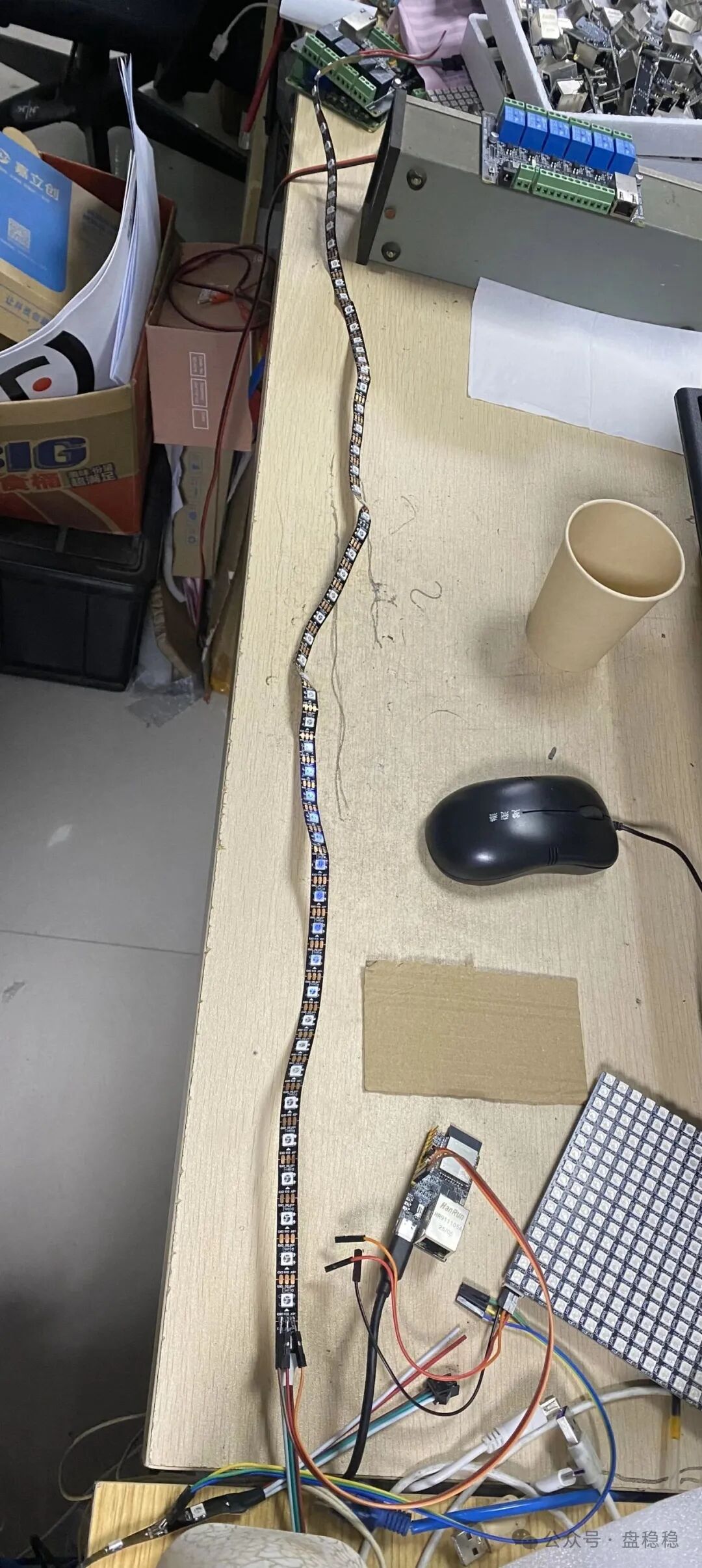
The star of the show here is the addressable LED strip (WS2812B being the most common model). Each LED on this strip has a built-in microchip. You only need one data line to connect all the LEDs in series. By sending a long string of precisely timed digital pulse signals, you can sequentially tell the first LED what color it should be, then the second, the third…
This “precise timing” is key. The signals of “0” and “1” are not determined by high and low levels but by the duration of the high level (a variant of pulse-width modulation, PWM). This timing requirement is extremely stringent, usually at the nanosecond level. Using a regular <span>delay</span> function to simulate this would greatly occupy the CPU, making it nearly impossible for the program to perform any other tasks.
2. What is the Magic of FastLED?
FastLED is a highly optimized C++ library that elegantly solves all the aforementioned challenges like a skilled artist.
- Hardware Abstraction and Protocol Handling: You don’t need to worry about whether you’re using WS2812B, APA102, or other chips, nor do you need to deal with the headache of nanosecond-level timing. You just need to tell FastLED your LED type, data pin, and quantity during initialization, and it will generate precise control signals in the most efficient way (even utilizing DMA – Direct Memory Access, which does not occupy the CPU at all).
- The Art of Color Mathematics: This is the soul of FastLED! It has powerful color processing and mathematical functions built-in.
- Color Space: In addition to RGB (Red, Green, Blue), it natively supports HSV (Hue, Saturation, Value) color space. HSV aligns more closely with human perception of color, making it very convenient for creating smooth rainbow gradients, breathing lights, and other effects.
- Palettes: You can define a beautiful color combination (like the reds, oranges, and yellows of flames) and let animations occur within this palette, creating harmonious and unified visual effects.
- Mathematical Tools: It provides functions like
<span>sin</span>,<span>cos</span>,<span>beat</span>(beat), and<span>noise</span>(noise). You can use sine functions to create smooth oscillations, and the Perlin noise algorithm to generate extremely natural, random yet continuous effects like flames or clouds. Behind this is the mathematical beauty of Fourier analysis and stochastic processes. - Performance and Efficiency: FastLED has been optimized for memory usage and computational speed. It uses an LED color array (like
<span>CRGB leds[NUM_LEDS];</span>) to “draw” the next frame in memory before calling<span>FastLED.show()</span>to efficiently push it to the LED strip all at once. This ensures that even on less powerful Arduinos, a considerable number of LEDs can be driven while achieving smooth animations.
Summary: FastLED is neither hardware nor a platform. It is the most splendid bridge connecting your logic (algorithms) with physical (light). It encapsulates the tedious low-level engineering details and hands you powerful color mathematics and animation algorithms, allowing you to focus on the creation of “light” as a digital artist.
Integration: A Summer Imagination
Now, let us connect these three elements and imagine a project: an interactive light and shadow sculpture driven by music and controllable via Wi-Fi.
- Brain:ESP32. Its powerful dual-core processor is capable of:
- Running Wi-Fi services on one core, creating a webpage or receiving commands from a mobile app, allowing you to switch light themes, colors, and brightness at any time.
- Using the other core to connect to a microphone module via the ADC pin, capturing ambient music in real-time.
- Perform a simple Fast Fourier Transform (FFT) on the captured audio signal (the ESP32 is capable of this), analyzing the intensity of the bass, midrange, and treble parts of the music.
- Map this intensity information through FastLED’s mathematical functions to create stunning light effects. For example, the bass drum beats trigger a red flash, the frequency range of vocals controls the speed of the rainbow flow, and the high-frequency cymbals evoke bursts of white “starlight”.
Arduino lays the foundation for understanding hardware interaction; ESP32 provides a powerful platform for implementing complex logic and world connectivity; while FastLED allows you to present all this internal computation in the most artistically impactful way.