Upon the release of Gemini 3, it has overwhelmingly crushed its competitors.
This once again proves how crucial end-to-end design is for reducing costs and dimensions in AI.
Musk certainly understands this principle, as evidenced by SpaceX’s success, which is a result of faithfully implementing this philosophy.
Now, Musk is more determined than ever to pursue end-to-end design. He posted a hero poster on X:
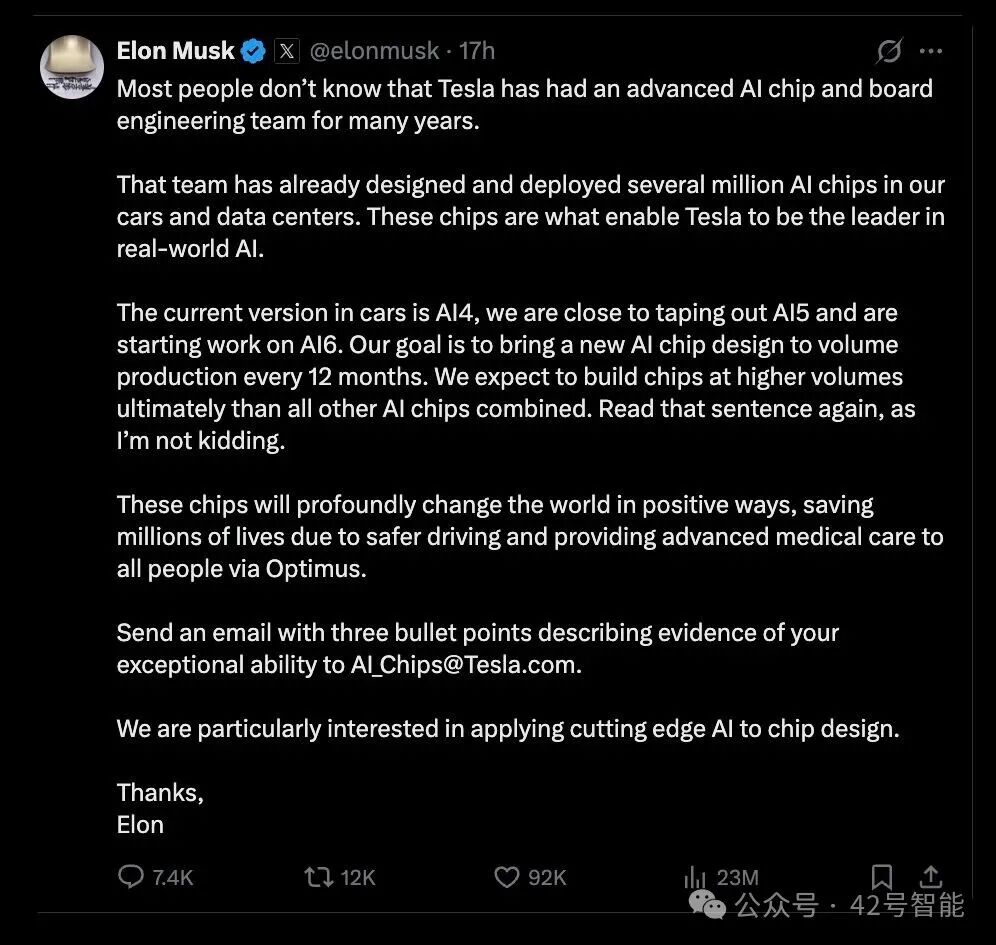
Translation: Most people do not know that Tesla has had an advanced AI chip and circuit board engineering team for many years.
This team has designed and deployed millions of AI chips in our cars and data centers. It is these chips that enable Tesla to lead in the field of real-world AI.
The version currently used in cars is AI4, and we are about to complete the tape-out of AI5 and have begun R&D on AI6. Our goal is to launch a new AI chip design into mass production every 12 months. We expect that ultimately the production of these chips will exceed the total production of all other AI chips combined. Read that sentence again; I am not joking.
These chips will profoundly change the world in a positive way, saving millions of lives through safer driving and providing advanced medical services for everyone with Optimus.
Please send an email containing three points to [email protected], outlining evidence that demonstrates your exceptional abilities.
We are particularly interested in applying cutting-edge AI to chip design.
This hero poster typically showcases Musk’s management style, technical vision, and his definition of top talent.
Pragmatic and Unconventional Recruitment Process
-
Simplified: The recruitment method is extremely straightforward—just send an email to
<span><span>[email protected]</span></span>. No complicated online application system, no headhunter screening. -
Results-Oriented: The email content only needs three points describing the applicant’s “exceptional ability”.
This is a special forces style of recruitment. He does not need to see where you studied or what your GPA is; he only looks at the most persuasive actual results you can present.
Radical R&D Iteration Cycle
-
Breaking Hardware Development Norms: The conventional development cycle in the chip industry is usually 18-24 months, while Musk’s goal is to push a new chip design into mass production every “12 months”.
This presents a hellish level of difficulty in the chip industry. It is not just about design speed; it involves extreme compression of all aspects including supply chain, validation, and testing. This means that joining the team will face extremely high work intensity and pressure, but it also means a high sense of technical achievement.
Core Shift in Technical Strategy: Using AI to Design AI
-
The last sentence of the hero poster carries significant information: “We are particularly interested in applying cutting-edge AI to chip design.”
This is a very keen technical trend. Musk is not just recruiting chip designers; he is looking for those who can revolutionize EDA (Electronic Design Automation) tools with AI. He hopes to use AI algorithms to accelerate routing, layout, and logic synthesis, thereby achieving the aforementioned crazy 12-month iteration cycle. This is one of the most cutting-edge research directions in the field of chip design today.
Massive Scale Effects
-
The hero poster states that the production of Tesla chips will ultimately exceed “the total of all other AI chips.”
This statement may seem exaggerated, but it is possible on the inference side. Unlike NVIDIA’s dominant data center training chips, Tesla’s chips are primarily used on the edge—namely, in millions of cars and future Optimus robots.
From this hero poster, we can conclude that this is not a normal recruitment drive, but a signal that Tesla is trying to establish an absolute moat in computing hardware.Recommended ReadingThe only AI focused on pursuing the truthHow FSD uploads data to TeslaMusk with brain-computer interface staff“Toppling” NVIDIA with an 8-bit floating-point format?