

Introduction
News Today
While everyone focuses on whether robots can replace human labor in harvesting, a type of “versatile” robot is quietly generating income in orchards: they perform inspections, pruning, and fruit layer management; these services are recalculating the value of “each tree”. This article systematically addresses a question from the perspectives of technology stack, business model, empirical data, and economics: How can orchard robots create income directly or indirectly beyond just harvesting fruits?
01
Orchard robots are not single robots, but a “service fleet”
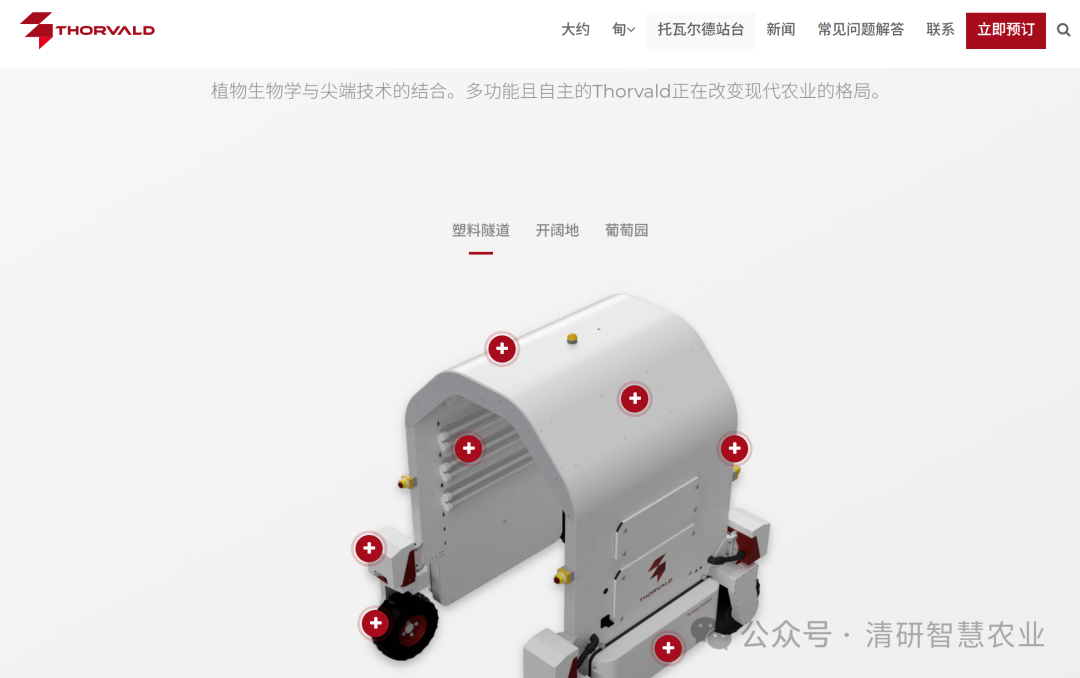
Traditionally, orchard robots are seen as “just for harvesting”. However, research and industrial practice show that a mobile platform combined with modular tools (sensors, nozzles, scissors, UV/optical processing, etc.) can perform multiple tasks on the same vehicle, including inspections, yield estimation, precise spraying, pruning, and even fruit layering and transportation. A representative of modular platforms is the Thorvald series, which commercializes the concept of “the same chassis + different tools”, transforming one-time capital expenditure into multiple service revenue sources.
Combining these functions into an operational package has two direct revenue logic layers: First, spreading the “hour/day” equipment usage fee across more operations (increasing equipment utilization); second, breaking down “one-time services” into repeatable subscription services (e.g., seasonal inspections + per-spray + annual pruning).In the long run, equipment utilization and service combinations determine the economic output ceiling of a single machine.
Image from Thorvald
02
Inspection and Monitoring—”Seeing Problems” Equals Creating Value
Drones, ground robots, and fixed sensors can work together to achieve high-frequency monitoring of trees and plots: chlorophyll index, early signs of pests and diseases, irrigation deficiencies, and uneven nutrient areas—these are all entry points for “early intervention and reducing losses”. Numerous studies have shown that high-frequency monitoring based on UAVs and ground vision can significantly improve the sensitivity and accuracy of disease detection, providing a basis for precise medication and targeted interventions. In practice, the commercialization path for monitoring services is clear: charging per inspection, per alert, or through data subscriptions.
The more direct economic benefits are reflected in “loss reduction” and “quality premiums”. Early detection of diseases can reduce yield losses caused by disease spread; precise irrigation/nutrient compensation can improve fruit coloring and sugar content, allowing for premium pricing when entering high-end channels.
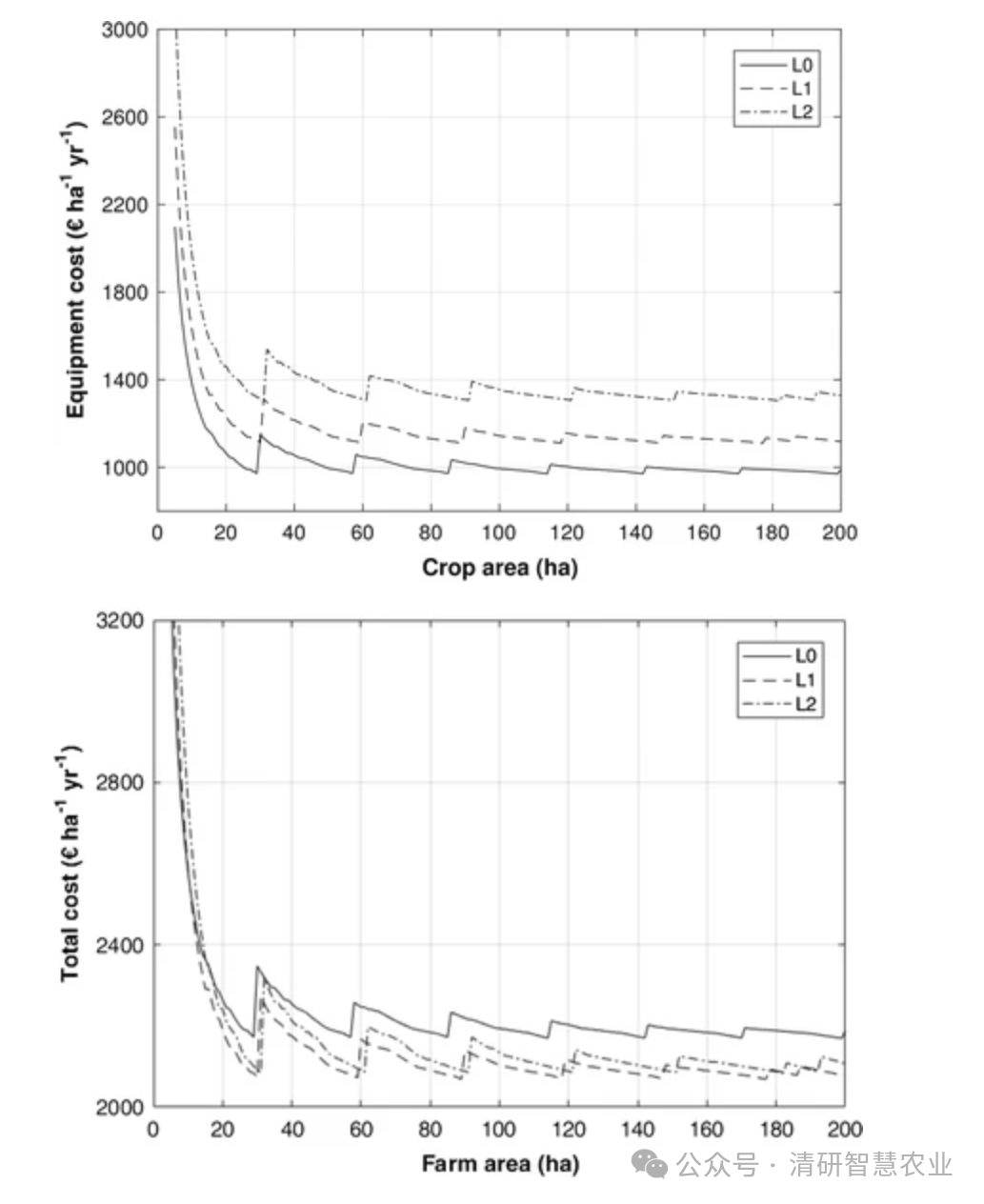
The image shows the annual equipment cost per hectare calculated at different technology levels in an apple orchard scenario. As the orchard area increases, the hyperbolic trend of the cost curve is confirmed; source: SPRINGER NATURE Link “Economic Analysis of Precision Spraying for Specialty Crops: Technical Economic Analysis of Protecting Equipment Under Improved Technology Levels”
03
Mechanization is not crude,
but an amplifier for “fine management” observation
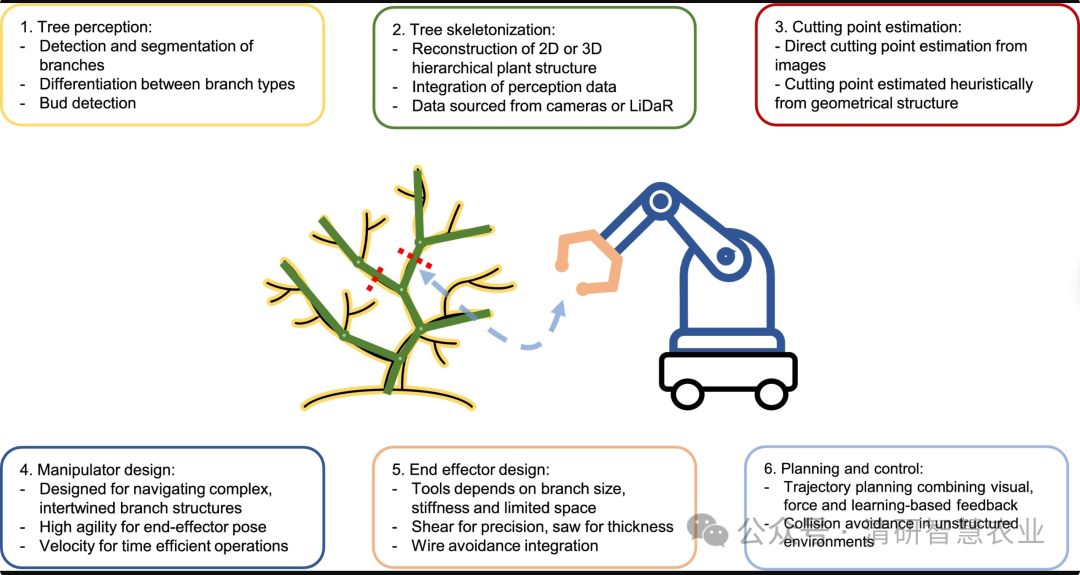
Pruning and thinning are labor-intensive and technical aspects of orchard management: appropriate pruning can improve light and ventilation, affecting next year’s yield and fruit quality; reasonable thinning can enhance individual fruit size and reduce the risk of splitting or disease. In recent years, research and prototypes for automated pruning and thinning have emerged, with academic reviews pointing out that the technical challenges lie in “reliable tree shape recognition” and “safe and effective cutting execution”. However, once these technologies mature, robots can transform pruning from a seasonal major task into more frequent, targeted operations, thereby increasing average annual output over the years.
Experimental data shows: appropriate mechanical pruning can maintain or slightly increase yield while reducing labor intensity. For operational models, pruning can be sold as a high-priced seasonal service—combined with inspections/spraying, it can also enhance the overall annual revenue contribution of a single machine.
Image from sciencedirect “Autonomous Robot Pruning in Orchards and Vineyards: A Review”
04
Precision Spraying and Alternative Application
Transforming spraying from “blanket spraying” to “targeted/strip spraying” directly brings dual benefits of reduced chemical costs and lower compliance risks for residues. Technically, ground robots combined with onboard/near-ground vision can achieve high-precision disease spot recognition and targeted spraying; research and economic analysis indicate that precision spraying significantly saves chemical usage and is easily understood by customers (fruit farmers or distributors) as “measurable savings”.
Additionally, some platforms are piloting “induction + physical” control (such as light/information pheromones/attractants) beyond spraying, which can reduce chemical inputs while monetizing as value-added services (e.g., green certification, export compliance documents).
05
Yield Estimation and Supply Chain Integration
—Selling “Yield Forecasts” to Downstream
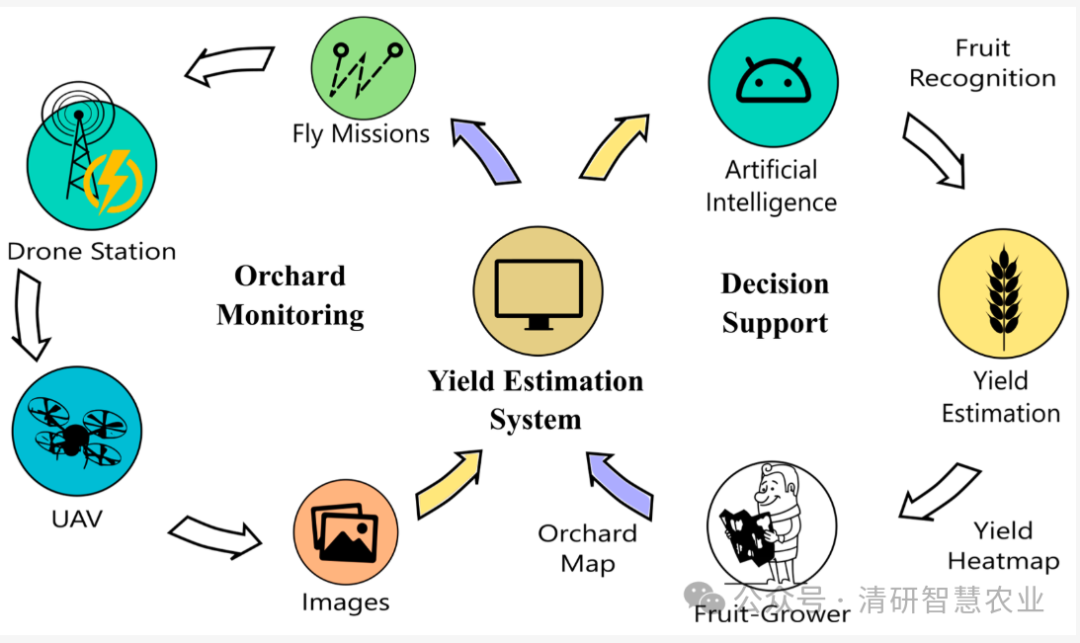
Accurate yield estimation allows fruit farmers to negotiate prices and logistics with buyers, cold chain, and packers earlier, reducing unsold goods and waste. Yield estimation systems combining drones and ground robots have already demonstrated near real-time usability in small-scale commercial trials (e.g., using computer vision to count fruit numbers and estimate total yield based on average fruit weight). This data directly impacts cold chain arrangements, sorting plans, and bargaining power with supermarkets—meaning yield information itself is a tradable commodity.
Commercially, yield forecasting services have three monetization paths: first, subscription-based data services; second, per-instance charges based on alerts (e.g., yield decline alerts); third, packaging forecast data into “fulfillment contracts” (locking in supply volume and price in advance). In the market, orchards that can provide reliable yield information to downstream are more likely to secure stable procurement contracts or better premiums.
Image source MDPI “Concept of Yield Estimation System Supported by Drones and AI for Decision Making”
06
Other “Bonus” Services
—From UV Sterilization to Shelf Traceability
Some orchard robots also undertake non-traditional but high-value functions: for example, using UV-C sterilization lamps for low-dose pathogen control; serving as mobile stations for on-site sorting/pre-cooling in the post-harvest chain; and using embedded sensors to write each fruit’s “growth profile” into traceability systems (which is very valuable for exports, brand premiums, and traceability compliance). By binding these “value-added services” with basic operations, multifunctional platforms often open up new revenue streams—especially in high-end markets that pursue high quality and traceability.
07
Quantifying Technology into Money: Economic Scale and Sample Data
Recent economic studies on robotic harvesting and field automation provide comparable scales: in open-field crops, some studies show that the average cost per acre using robots can be comparable to or slightly higher than manual labor, but long-term ROI and equipment utilization are highly correlated (the higher the utilization, the lower the unit cost). For orchard scenarios, key parameters for economic feasibility include: equipment utilization, single service pricing, maintenance/spare parts costs, and wage levels for replacing human labor.
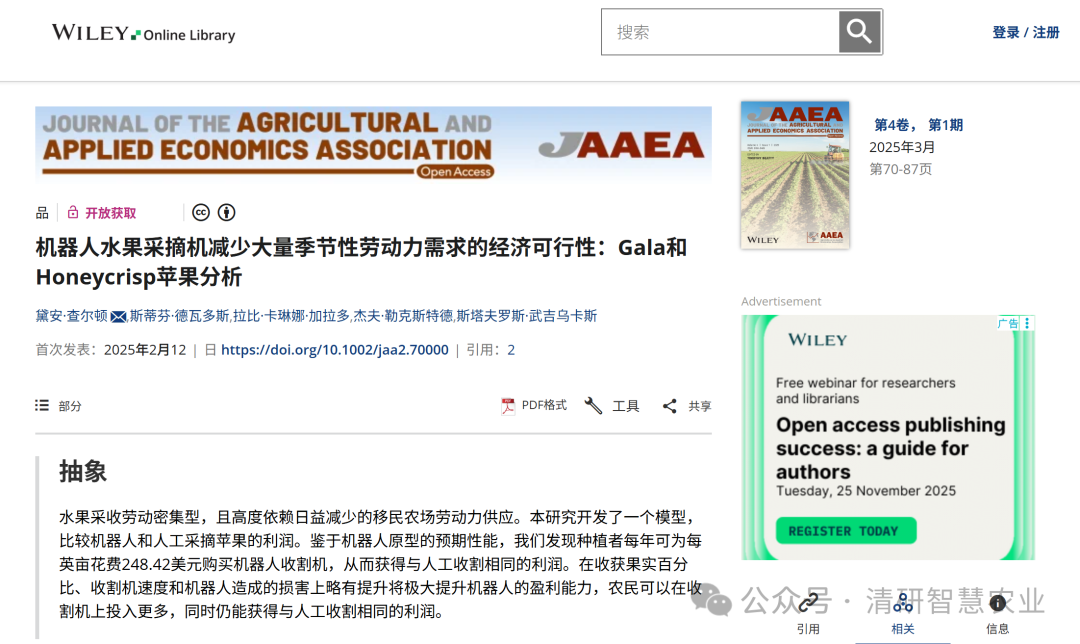
Example data: a 2025 study estimates that if a harvesting machine’s annual utilization can reach 800–1,000 hours, its total cost of ownership for a medium-sized orchard within a four-year depreciation cycle is competitive; however, if annual utilization is below 300 hours, commercial recovery will be very difficult. This critical value illustrates why multitasking (inspections, spraying, pruning, etc.) is crucial for improving equipment economics.
Image from wiley onlinelibrary
08
Real Barriers and Academic Consensus:
Why Has Income Not Exploded Yet?
Academic reviews and field trials repeatedly point out several bottlenecks: the stability of perception under complex leaf cover, the reliability of end-effectors/grippers, the MTBF and spare parts supply for on-site operations, and the steep cost drop from prototype to mass production. These engineering issues directly affect equipment availability and maintenance costs, which in turn affect whether they can be monetized. In other words, technology must first “run through” enough tasks to turn theoretical multiple incomes into real cash flow.
Moreover, commercialization is also influenced by market structure: in regions where orchards are dispersed and small farmers dominate, the market radius for a single device is small, requiring service-oriented operations (equipment leasing, RaaS) to achieve scaled income; while large-scale corporate orchards are more likely to benefit directly from equipment purchases. The parallel paths of these two market structures determine the regional differences in income structure.
Monetizing orchard robots is not solely reliant on a single “capable” function, but rather on integrating multiple services (monitoring, pruning, spraying, yield forecasting, post-harvest processing, etc.) into a stable operational model. The maturity of technology determines service quality, service quality determines equipment utilization, and utilization determines unit costs and profitability. Currently, both research and industry are focusing on “improving perception robustness”, “reducing end damage”, and “enhancing modularity and maintenance convenience”; as these engineering challenges are gradually overcome, the economics created by orchard robots “under the trees” will shift from “imaginable” to “accountable”.
Tsinghua University Equipment Research Institute Intelligent Systems and Big Data Analysis Research Center
We focus deeply on the integration of “Intelligent Equipment + Big Data Analysis” technology, having formed a complete solution in the field of smart agriculture:
-
In the intelligent navigation field, our developed agricultural robot navigation control system is compatible with Beidou and GPS dual-mode positioning, achieving centimeter-level accuracy, and has been applied to various mobile platforms such as fruit and vegetable harvesting and field inspections.
-
In the operation monitoring aspect, our independently developed agricultural machinery operation quality monitoring terminal can collect key data in real-time, such as deep loosening depth, sowing quantity, and fertilization amount, and analyze and visualize operation quality through a cloud platform.
-
In the precision operation segment, our variable fertilization and precision spraying system can adjust operational parameters in real-time based on multi-source remote sensing data and onboard sensor information, truly achieving “one strategy for each location” fine management.
These equipment have been applied in multiple agricultural demonstration parks, significantly improving agricultural production efficiency and resource utilization.
If you are planning a smart agriculture project and facing technical challenges in upgrading agricultural machinery intelligence, please feel free to contact us. Our technical team will provide you with:
-
Comprehensive technical consulting for smart agriculture
-
Customized R&D of intelligent agricultural machinery
-
Agricultural big data platform construction
-
Intelligent transformation solutions for existing production lines
#Agricultural Robots #Smart Agriculture #Agricultural Robot R&D #Harvesting Robots #Yield Estimation Robots #Tsinghua Agriculture
Tsinghua Smart Agriculture
○
○

Chen Hao
Smart Agriculture Project Leader
Director of the Intelligent Systems and Big Data Analysis Center, Tsinghua Equipment Institute

Special Note

Some content of this article (including but not limited to text, images, data, etc.) is sourced from publicly available information on the internet, aimed at conveying more information for learning and communication purposes only. All copyrights belong to the original authors or sources.
To support originality, this public account will try to mark sources. If you find any content in this public account that infringes your legitimate rights and interests, please contact us immediately through the backend message or by adding customer service WeChat, and we will handle it as soon as possible after verification.
Without explicit authorization from this public account, no individual or organization may use the content of this article for commercial reproduction or excerpting. Please contact the backend for authorization; any disputes, consequences, and legal responsibilities arising from reproducing this article to other platforms shall be borne by the reproducing party, and this platform shall not be responsible.
 *Selected Past Articles*Feasibility and Scheduling Algorithms of Drone Swarm Operations in Large Field Plant ProtectionUnderstanding Agricultural Robots: A Comprehensive Scan of 18 Major Applications from Harvesting to Laser WeedingCan Farmers Afford Robots Priced in Hundreds of Thousands?—The Road to the “Popularization” of Smart AgricultureAgricultural Robots No Longer Depend on Weather: Detailed Explanation of 7×24 Hour All-Weather Sensing Solutions