In today’s industrial production, injection molding technology has become an important method for manufacturing various plastic products. Especially in the field of precision parts manufacturing, the requirements for position and speed control accuracy are becoming increasingly stringent. Traditional displacement sensors, while structurally simple and cost-effective, are easily affected by electromagnetic interference, voltage fluctuations, and other factors in practical applications, making it difficult to meet the high standards required for modern precision injection molding. In recent years, new displacement sensors based on the principle of magnetostriction have gradually emerged in industrial sites, becoming an indispensable key component in precision injection control systems due to their excellent measurement accuracy, outstanding stability, and unique advantages of non-contact measurement. This article will delve into the principles, characteristics, system architecture, and practical application effects of this advanced sensor based on the research results published by Wang Zhiqiang and other researchers from the School of Electrical Engineering at Zhejiang University in the 2010 issue of “Sensors and Microsystems”.
(If you are interested in this article and want to learn more about the technical details or need the original text, please contact the author for communication.)
1. Why Does Precision Injection Molding Require High-Precision Displacement Measurement?
In the injection molding process, plastic raw materials are heated and melted, then injected into the mold cavity through a screw, and finally cooled and solidified to form the final product. During this process, the precision of the screw’s displacement control directly determines the injection amount and speed of the molten material, which in turn has a decisive impact on the product’s dimensional accuracy, internal density, stress distribution, and even surface quality.
Specifically, during the injection phase, if the injection speed is too slow, it will lead to prolonged filling time, which can cause defects such as uneven cooling and increased internal stress; conversely, if the injection speed is too fast, it may cause irregular flow in the runner, leading to air entrapment and poor venting, severely affecting the product’s appearance quality. Additionally, the accuracy of the mold opening position is also crucial; if the closing position is inaccurate, it can not only affect the quality of the molded product but may also lead to severe consequences such as mold damage.
Traditional injection molding machines typically use “electronic rulers” (a type of sensor based on potentiometer principles) for displacement detection. Although this type of sensor is simple in structure and easy to implement, its output signal is easily affected by power fluctuations and electromagnetic interference, and signal attenuation is significant in long-distance measurements, making it difficult to achieve the high precision control requirements of 0.01mm. Furthermore, electronic rulers have inherent defects such as mechanical wear, poor repeatability, and complex installation, which to some extent limit the development of precision injection molding technology.
2. Working Principle of Magnetostrictive Displacement Sensors
Magnetostrictive displacement sensors are non-contact measuring devices based on the physical effect of magnetostriction. Their core principle is to utilize the strain pulse signal generated when two different magnetic fields intersect to perform precise position calculations.
The specific working process is as follows: the sensor’s electronic components generate a current pulse, creating an instantaneous magnetic field; simultaneously, a permanent magnet mounted on the moving part also generates a constant magnetic field. When these two magnetic fields meet in the waveguide, a strain pulse is generated due to the magnetostrictive effect, which travels back to the sensor’s induction coil at a fixed sound speed. By accurately measuring the time difference between the emission of the current pulse and the return of the strain pulse, combined with the speed of sound in the waveguide, the real-time position of the permanent magnet can be accurately calculated.
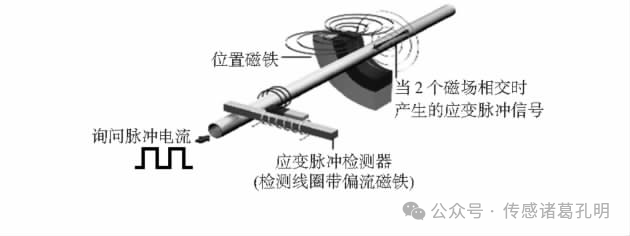
Figure 1: Magnetostrictive Principle
This unique measurement mechanism brings multiple technical advantages:
Absolute Position Measurement: Directly outputs absolute position values without the need for repeated calibration and without signal drift;
Non-Contact Measurement: Avoids mechanical wear issues, has a long service life, and low maintenance costs;
High Precision and High Performance: Typical measurement error does not exceed 50 microns, linearity better than 10 microns;
Strong Anti-Interference Capability: Particularly suitable for stable operation in harsh industrial environments with high pressure and strong vibrations;
Digital Interface Support: Directly outputs digital signals, effectively reducing precision loss during signal transmission;
Multi-Functional Integration: Simultaneously possesses position and speed measurement functions, providing complete information for motion control.
3. System Architecture Design and Implementation
In the precision injection molding machine control system, the research team innovatively adopted a “ARM + DSP” dual-core processor architecture. The ARM processor serves as the host computer, mainly responsible for managing the user-friendly human-machine interaction interface; while the DSP serves as the lower machine, focusing on real-time control tasks at the bottom level. The displacement sensor is connected to the DSP controller via an industrial-grade CAN bus, constructing a stable and reliable multi-node digital network that achieves synchronous sampling and precise control of multiple key displacement points during the injection molding process.
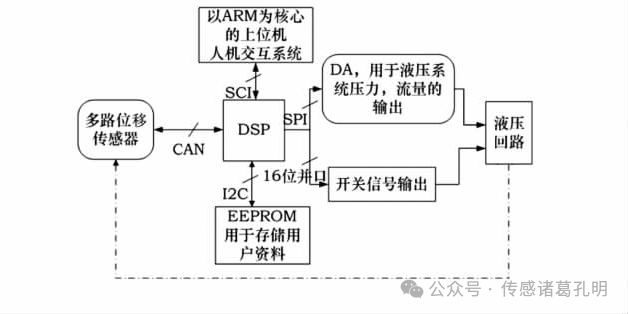
Figure 2: Injection Molding Machine Position Control System
This system can real-time collect various key process parameters, including mold opening position, injection position, and motion speed, and based on this real-time data, accurately control the actions of hydraulic valves, thus achieving precise adjustment of position and speed during the injection molding process. Additionally, the system is equipped with an EEPROM memory based on the I2C interface, used to reliably store important parameters such as sensor zero points and range, allowing users to flexibly adjust and optimize according to different production process requirements.
4. CAN Bus Communication Technology
In complex industrial environments, strong electromagnetic interference often makes traditional analog signal transmission unreliable, leading to increased measurement errors or even system failures. To address this issue, the control system adopts CAN bus as the core communication method between the sensor and the controller.
CAN (Controller Area Network) is a mature and reliable multi-master serial communication protocol with excellent anti-interference capability and real-time performance, with a maximum communication rate of up to 1Mbps. The sensor connects to the DSP controller via a standard CAN interface, and data transmission uses a standard frame format with an 11-bit identifier, containing a complete data field and CRC check mechanism, ensuring high accuracy and integrity of data transmission.
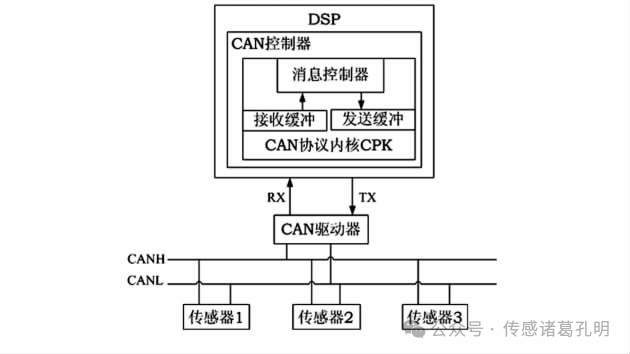
Figure 3: Sensor Connection Diagram Based on CAN Bus
In the system, three different types of communication data objects are precisely defined, each performing specific functions:
NMT (Network Management): Used to implement basic control functions such as system startup, stop, or reset;
SDO (Service Data Object): Responsible for configuring the working parameters of the sensor, such as zero point setting and node ID allocation;
PDO (Process Data Object): Specifically used for real-time transmission of key measurement values such as position and speed.
This refined communication protocol design ensures both the flexibility of system control and the high-speed reliable transmission of real-time data.
5. Software System and Sampling Strategy
To meet the precise sampling requirements of high-speed motion during injection molding (for example, mold opening speeds can reach up to 1m/s), the system carefully configures the sensor to operate in asynchronous mode, sending PDO data to the DSP every 1ms. The DSP receives and processes this data in real-time through efficient interrupt methods, not only for complex control algorithm calculations but also to upload key position information to the host computer for real-time display and monitoring.
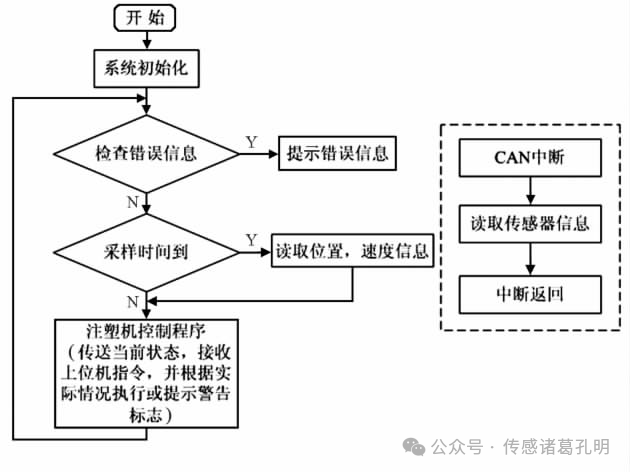
Figure 4: Software Flowchart
After powering on, the sensor will go through three distinct working states: initial state, pre-operational state, and normal working state. Only after correctly completing parameter configuration and receiving the start command will the sensor enter the normal working state, beginning to send data at preset time intervals or respond promptly to the host’s data requests. This strict state management mechanism ensures the reliability and stability of system operation.
6. Experimental Verification and Performance Analysis
To comprehensively verify the performance of the magnetostrictive sensor in practical applications, the research team conducted intensive sampling tests at fixed positions on the injection molding machine—continuously collecting 500 displacement data points at a 1ms sampling interval and performing a detailed comparative analysis of the measurement results with the performance of traditional electronic rulers.
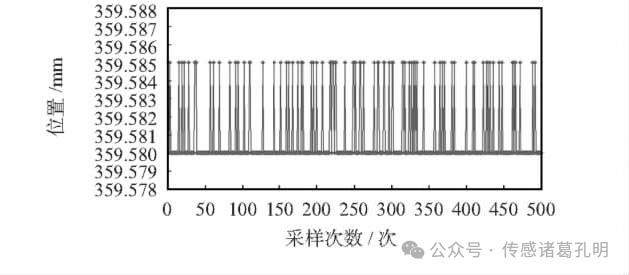
Figure 5: Sampling Results of Magnetostrictive Sensor
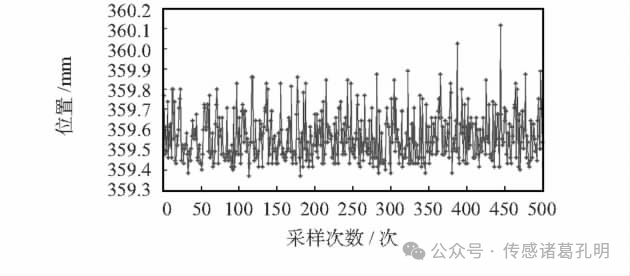
Figure 6: Sampling Results of Traditional Sensors
Experimental results show significant performance differences:
The traditional electronic ruler is affected by multiple factors such as circuit noise, amplifier offset, and AD sampling precision loss, with a maximum measurement error of up to 0.7mm and noticeable fluctuations;
The maximum measurement error of the magnetostrictive sensor is only 5μm (equivalent to one scale), with measurement accuracy improved by two orders of magnitude, and excellent repeatability and stability.
This comparative experiment fully demonstrates that the magnetostrictive sensor not only significantly outperforms traditional solutions in measurement accuracy but also excels in anti-interference capability and long-term stability, fully meeting the stringent requirements of high-precision injection control.
7. Application Prospects and Future Outlook
The successful introduction of magnetostrictive displacement sensors has effectively solved the technical bottlenecks of traditional sensors in terms of precision, stability, and anti-interference capability, while significantly simplifying the system structure due to their digital interface characteristics, reducing intermediate signal processing links, and fundamentally lowering the overall system error. The practical experience of the research team at Zhejiang University shows that this sensor performs excellently in precision injection molding machine control systems, providing a reliable hardware platform for high-speed, high-precision injection control.
With the advent of the Industrial 4.0 era and the deepening of intelligent manufacturing, high-precision sensors will undoubtedly become key infrastructure for achieving process digitization and intelligent control. Magnetostrictive measurement technology, as a mature and reliable solution, is continuously expanding its application scope—not only in the field of injection molding but also showing broad application prospects in CNC machine precise positioning, industrial robot motion control, hydraulic system status monitoring, and many other industrial scenarios.
In the future, with the continuous innovation of sensing technology and the ongoing enhancement of industrial demands, we look forward to seeing more high-performance sensors like this enter factory workshops, becoming important technical support for the transformation and upgrading of China’s manufacturing industry towards high-end and intelligent development. The successful application experience of magnetostrictive displacement sensors also provides valuable references for the technical selection of other industrial measurement scenarios, which will undoubtedly promote the overall improvement of industrial automation levels.
Follow me for more insights into cutting-edge sensor technologies!