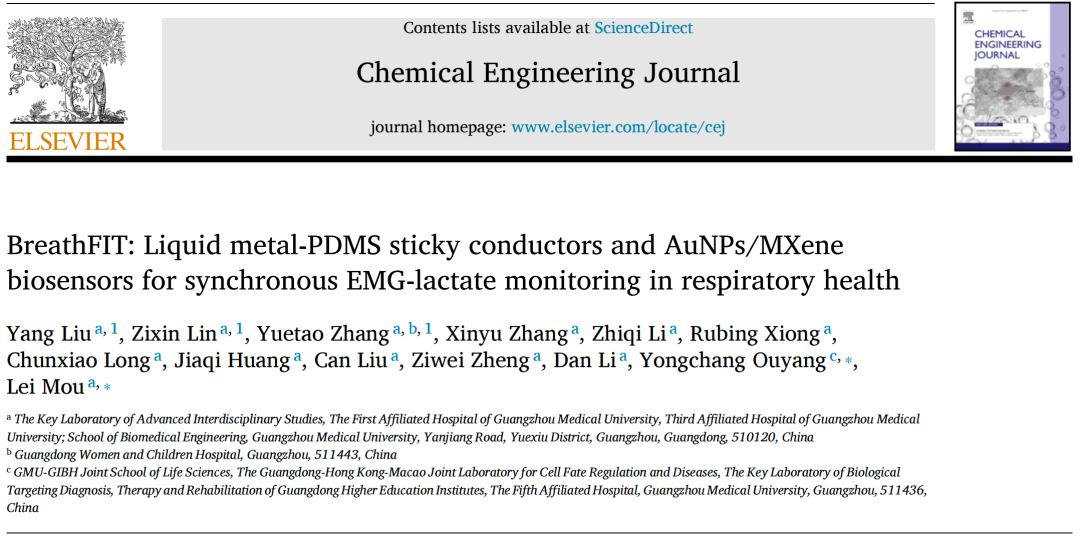
There are over 500 million patients worldwide suffering from chronic respiratory diseases, with respiratory muscle dysfunction being a key pathological feature of these conditions. However, traditional detection methods are limited to hospital settings, making it difficult to capture dynamic physiological changes. To address the need for real-time respiratory health monitoring, the team has innovatively developed the BreathFIT platform, which integrates liquid metal-polydimethylsiloxane (LM-PDMS) flexible adhesive conductors with lactate sensors to achieve synchronous collection of diaphragm electromyographic activity and metabolic lactate. This provides a new technical solution for respiratory health monitoring. The related results will be published in November 2025 in the Chemical Engineering Journal under the title “BreathFIT: Liquid metal-PDMS sticky conductors and AuNPs/MXene biosensors for synchronous EMG-lactate monitoring in respiratory health.”
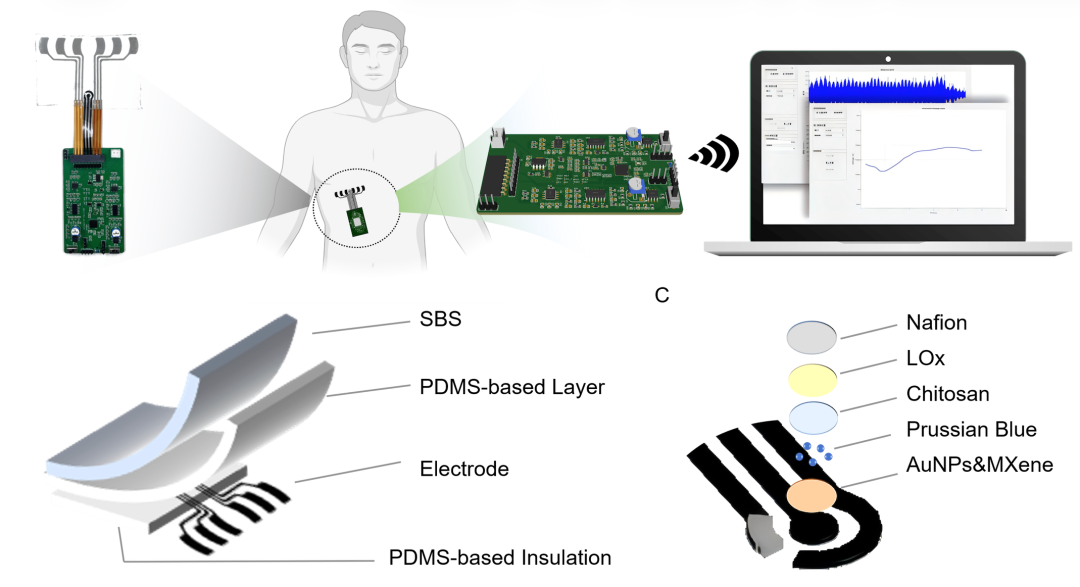
The BreathFIT platform demonstrates outstanding comprehensive performance: the LM-PDMS conductor has a 300% stretchability and a skin adhesion strength of 39 N・cm⁻¹, allowing it to closely fit the skin and be comfortable to wear; the AuNPs/MXene modified lactate sensor has a sensitivity of 148.2 nA/mM, with a detection limit as low as 0.219 mM, capable of accurately capturing changes in lactate concentration within physiological ranges. Through custom software, data can be collected and visualized in real-time, and combined with machine learning models such as random forests, it can intelligently classify diaphragm activity patterns during rest, exercise, and sleep states, achieving an accuracy of up to 92.19%. Clinical validation shows that this platform can effectively distinguish the respiratory physiological characteristics of patients with chronic obstructive pulmonary disease, asthma, and healthy individuals, providing strong support for early disease screening and home management.
Professors Mu Lei and Ouyang Yongchang from Guangzhou Medical University are the corresponding authors of the paper, with Liu Yang, Lin Zixin, and Zhang Yuetao as co-first authors. The first author, Lin Zixin, is an undergraduate student in the team who has won the national silver award and provincial silver award in the China International College Students Innovation and Entrepreneurship Competition, the provincial bronze award in the 14th “Challenge Cup” Guangdong College Students Entrepreneurship Competition, and the provincial second prize in the 2nd Guangdong College Students Biomedical Engineering Innovation Design Competition. He has one national-level college student innovation training project, four national invention patents, and four SCI papers.
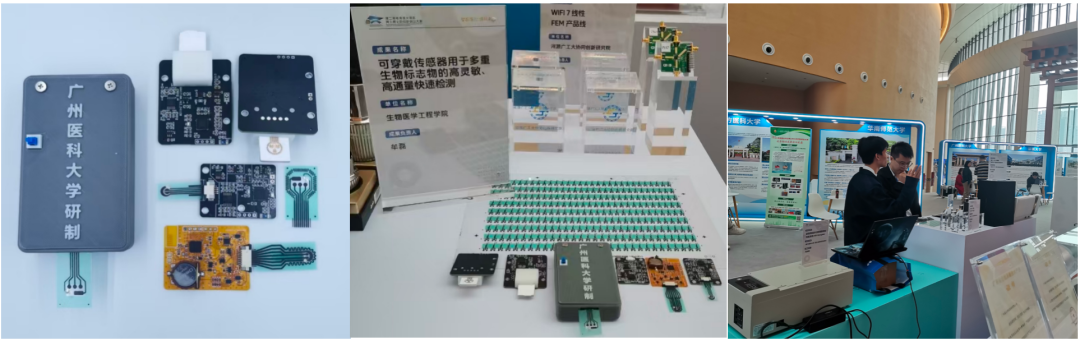
The team has long been engaged in the field of wearable biosensors, and this paper achieves the synergistic detection of electrophysiological signals and biochemical indicators, providing a new technical means for the management of chronic respiratory diseases, exercise health assessment, and sleep disorder diagnosis. Currently, the team has designed low-sample-consumption, high-reproducibility screen-printed electrodes for various practical clinical application scenarios. By nano-modifying the electrode surface and combining it with microfluidic chips and miniaturized electrochemical workstations, the complex processes that previously required large hospital platforms for detection have been simplified, achieving a series of breakthroughs in areas such as multi-virus antigen detection, non-invasive sweat multimodal detection, chronic disease management, and circRNA detection (ACS Nano, 2025, 19(17): 16980-16994, Biosensors and Bioelectronics, 2025, 289, 117916, Chemical Engineering Journal, 2025, 524, 169625, Bioelectrochemistry 2025, 163, 108907; Chem. Eng. J. 2025, 505, 159209; J. Mater. Chem. B, 2025, 13, 3906-3917; Microchem. J. 2024, 207, 112064; Biosens. Bioelectron. 2022, 197, 113765; Anal. Chem. 2022, 94 (5), 2510-2516; ACS Nano, 2021, 15 (8), 13077-13084).