
The team led by Ren Yonghua at the University of Hong Kong designed and synthesized a series of platinum(II) complexes containing histidine moieties or positively charged groups to explore the specific binding and sensing capabilities of platinum(II) complexes with analytes. These complexes are used to visualize changes in sialic acid within cells, distinguishing between normal and cancer cells.
Sialic acid is an important biomolecule typically located at the terminal ends of glycan chains on cell surfaces. It plays a critical role in cell signaling and immune responses. The level of sialic acid on the surface of cancer cells is often elevated, making it a potential biomarker for cancer diagnosis. However, existing methods for sialic acid detection, such as high-performance liquid chromatography, mass spectrometry, and colorimetric methods, fail to provide dynamic information in vivo, limiting their application in cancer diagnostics.
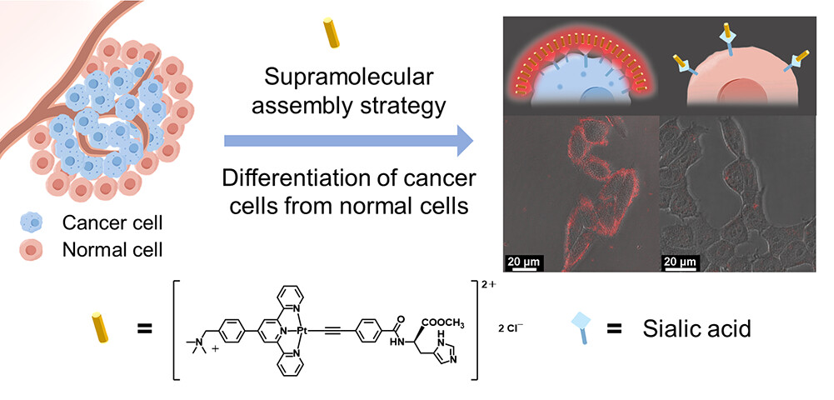
In this study, the researchers designed and synthesized a series of platinum(II) complexes containing histidine groups and/or positively charged groups (alkynyl platinum(II) tris-pyridine complex incorporated with histidine groups) for the detection and analysis of sialic acid, distinguishing cancer cells from normal cells. The specific hydrogen bonding between the histidine moiety in these complexes and sialic acid, along with the electrostatic interactions between the positively charged trimethylammonium groups of the platinum(II) complexes and the negatively charged carboxyl groups of sialic acid, enhance their binding affinity.
When the platinum(II) complex binds to the sialic acid highly expressed on the surface of tumor cells, supramolecular self-assembly occurs, leading to non-covalent Pt(II)···Pt(II) and π−π stacking interactions, thereby enabling the sensing and visualization of sialic acid. In contrast, the lower levels of sialic acid on normal cells do not trigger supramolecular self-assembly of the platinum(II) complexes, resulting in no signal and thus avoiding false-positive results.
This study provides a new strategy for the early diagnosis and treatment guidance of cancer cells, and it also reveals that platinum(II) complexes can be used to visualize changes in sialic acid in live cells, opening new avenues for screening novel anticancer drugs.
Original link:
https://pubs.acs.org/doi/10.1021/jacs.5c03210
Author: GPX
Proofreader: LYP
Editor: LYP