Hello, dear partners!
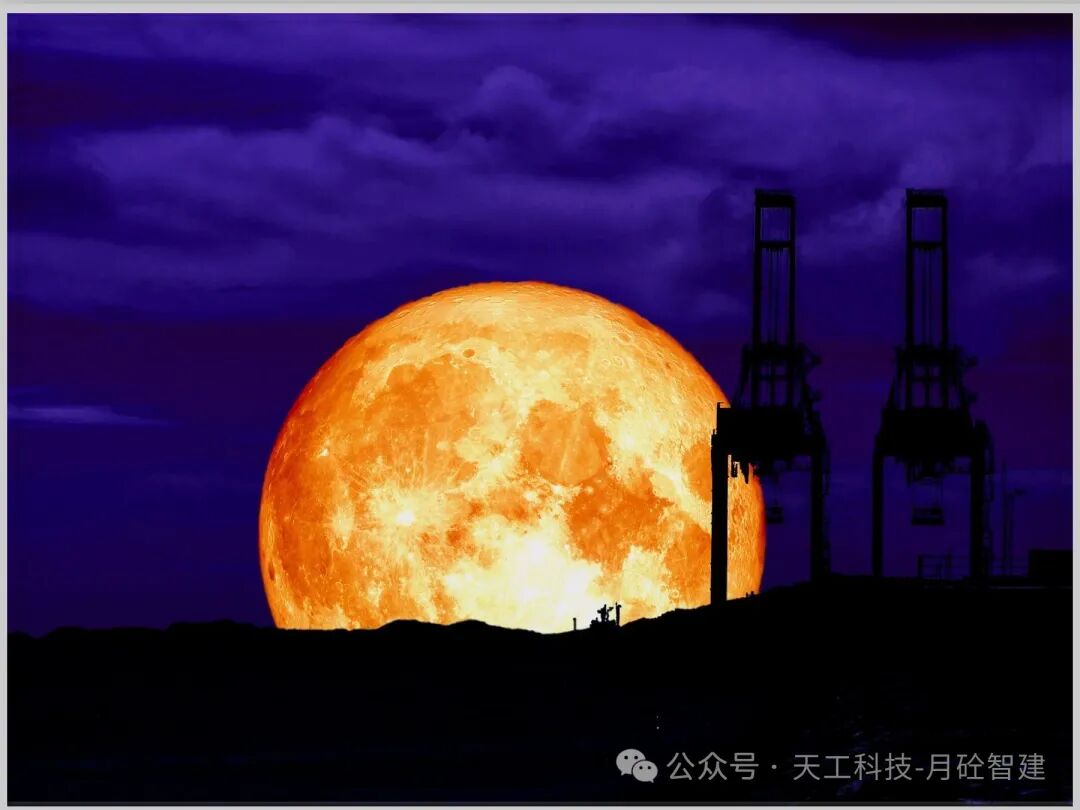
Gazing at the starry sky, that silvery silent place – the Moon, has carried humanity’s endless imagination since ancient times. From the ancient legend of Chang’e flying to the moon, to the footprints left by Apollo astronauts, and now with the continuous advancement of space programs from various countries, the Moon is gradually transitioning from poetic fantasy to real exploration.
Today, our Tian Gong Technology – Lunar Concrete Smart Construction team wants to discuss a more specific and cutting-edge topic: Is it really feasible to build a base on the Moon? If feasible, what “black technology” can we use to create this milestone in human history?
01
Why Build a Base?
Some may ask, “Building a base on the lunar surface is costly and risky, is it worth it?”
The answer is: It is worth it and imperative.
“Space Outpost”
Firstly, the Moon is the closest “space outpost” to us. Establishing a base here can serve as a springboard to help us explore the solar system more deeply, such as traveling to Mars and even further into the stars.
“Valuable Resources”
Secondly, the Moon is rich in valuable resources. In particular, Helium-3, a clean, efficient, and almost non-radioactive nuclear fusion fuel, is considered one of the hopes for solving Earth’s energy crisis in the future. There are also abundant resources of metals like titanium, aluminum, silicon, and water ice (found in the shadowed regions of the lunar poles), which are essential for maintaining base operations and future lunar industries.
“Cosmic Observation”
Furthermore, the Moon has no atmosphere, providing an excellent environment for cosmic observation, allowing for the construction of more powerful observatories; its unique geological environment also offers a natural laboratory for studying the early history of the solar system. It can be said that a lunar base is not only a symbol of technological strength but also a crucial step for human civilization towards the stars.
02
How Difficult is it to Build a “Home” on the Moon?

Extreme Temperature Differences
Temperatures range from over -180 degrees Celsius to over 120 degrees Celsius, with huge day-night temperature differences.
Strong Radiation
Lack of atmospheric and magnetic field protection exposes the surface to cosmic rays and solar winds. Microgravity: The physical environment is vastly different from Earth.
Resource Scarcity
Water, oxygen, building materials, etc., need to be transported from Earth, which is very costly.
Transportation Challenges
Transporting large quantities of materials to the Moon is itself a massive engineering challenge.
Faced with these “hard nuts to crack,” traditional construction methods are nearly impossible on the Moon. We urgently need a more efficient, more economical, and more adaptable construction solution for the lunar environment.
03
3D Printing Makes “Lunar Concrete Smart Construction” Possible!
Currently, a technology that is thriving on Earth has illuminated a beacon of hope for us – 3D printing construction technology!
Imagine, on the Moon, we can utilize the abundant lunar regolith as “raw material” or use materials transported from Earth, and through specially designed 3D printing equipment, “print” buildings, living modules, protective structures, etc., layer by layer, just like “printing” objects. This is the core concept of “Lunar Concrete Smart Construction.”
3D printing construction technology has unparalleled advantages in lunar base construction.

Remote Control, Safe and Beneficial
The lunar environment is hazardous, and prolonged exposure is detrimental to astronaut health. Remote control of 3D printing equipment can largely automate operations, reducing the necessity for astronauts to directly participate in high-risk construction work; we only need to conduct remote monitoring and necessary maintenance.
Flexible Design, Adapting to Complex Needs
3D printing can easily achieve complex and irregular structural designs. We can design optimized structures that are difficult to achieve with traditional methods, such as integrally formed domes and highly space-efficient honeycomb structures, based on the Moon’s unique environment.

Rapid Construction, Shortened Cycle
For large structures, although single-layer printing takes time, the overall construction process may be faster compared to traditional methods, allowing for quicker formation of usable facilities.
Adapting to Various Terrains
We have adopted a tracked drive instead of traditional wheels, which can adapt to the Moon’s extremely complex environment, making multi-terrain construction with 3D printing a reality.
END
The Moon, this silent wasteland, is waiting for humanity to bring it to life with wisdom and hands. 3D printing technology, like a “divine brush” from Earth, may be the key to unlocking the door to lunar habitation.
The future has arrived, just not evenly distributed yet. Let us remain curious and continue to follow “Tian Gong Technology – Lunar Concrete Smart Construction,” and witness the moment when humanity builds dreams and smartly constructs the future on the Moon!