This article continues from the previous piece titled “Key Developments in the Internet of Things (Part I): Seamless Connectivity andAI Integration as the Winning Focus!“, featuring an interview with Zhou Wei, General Manager of Silicon Labs (芯科科技) in China, and Chen Youyan, Senior Regional Sales Manager for South China. They continue to discuss the trends in wireless connectivity and the integration of artificial intelligence (AI) technologies, further sharing forward-looking insights on key areas such asEdgeAI and low-power green energy, IoT security, and innovative applications ofBluetooth6.0.
Low-Power Wireless Connectivity Technology – Advancing Edge AI Development, Aligning with Green Energy Trends
In the realm of low-power green energy, Silicon Labs has demonstrated significant innovation capabilities. Their product line emphasizes the “Green Energy” concept, aiming for sustainable development through optimized energy consumption. For instance, they launched the industry’s first Bluetooth SoC that supports energy harvesting, enabling self-powered operation without batteries by converting mechanical energy into electrical energy. This technology is particularly suitable for smart home sensors and wearable devices, extending device lifespan while reducing environmental impact. Through efficient energy management, these products significantly lower power consumption, aligning with global green energy trends.
AI is gaining attention in the IoT field, and Silicon Labs has adopted a pragmatic strategy focusing on the development of Edge AI. Edge AI exhibits advantages in several aspects: it reduces reliance on the cloud, lowers latency and bandwidth consumption; accelerates response speed through local processing; and mitigates security risks during data transmission by processing data on-device. Their latest product series, such as EFR32MG24, MG26, and FG28, all integrate AI/ML capabilities. These SoCs typically include three cores: an Arm Cortex-M33-based core for application processing, a hardware security core focused on security, and a dedicated AI accelerator core supporting efficient edge computing. This multi-core architecture provides high performance while maintaining low power consumption, suitable for a wide range of scenarios from smart homes to industrial sensors.
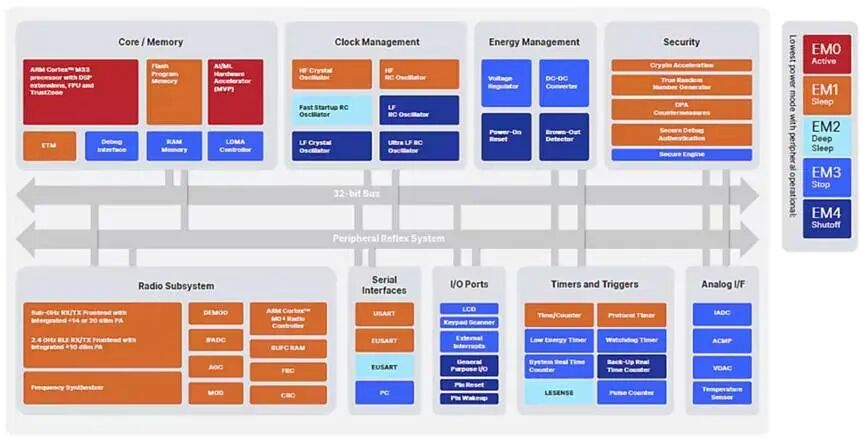
EFR32FG28 Block diagram
Leading in Security: The World’s First to Achieve PSA Level 4 Certification
Security has become an increasingly focal point in the IoT field in recent years, especially in the Chinese market. Silicon Labs is at the forefront of wireless SoC security technology, being the first to achieve Arm PSA certification, progressing from Level 2 to Level 3, and launching the world’s first SiXG301 SoC certified at PSA Level 4. These certifications indicate that their products can withstand complex attack methods such as side-channel analysis, laser fault injection, and physical tampering. In scenarios like smart cities, industrial automation, and medical devices, security is not only key to protecting user data but also helps manufacturers meet global regulatory requirements, such as the EU’s Radio Equipment Directive (RED) and the Cyber Resilience Act (CRA). Through dynamic security mechanisms like real-time monitoring and over-the-air firmware updates, Silicon Labs views security as a continuous lifecycle management process rather than a one-time feature.
With the rapid development of wireless connectivity technology, information security for devices has become a core issue. The choice between separating RF and security functions or integrating them into the SoC is a critical decision affecting security and reliability. Silicon Labs, through its integrated SoC solutions, reduces potential vulnerabilities between discrete components, enhancing the stability of data processing and communication. This demonstrates significant advantages in IoT security, providing robust support for building a safer and more efficient connected ecosystem.
It is reported that the European Union’s Radio Equipment Directive (RED) implemented on August 1 requires wireless products to pass strict security certifications and bear compliance labels to enter the market. The United States has also introduced similar security standards, particularly stringent for wireless medical devices (such as continuous glucose monitors) regulated by the FDA. Silicon Labs’ BG27 SoC is the only product recognized by the FDA, meeting these high standards. As global IoT standards drive device interconnectivity, the differences in low-power designs are gradually narrowing, but security will become a key differentiator for device manufacturers.
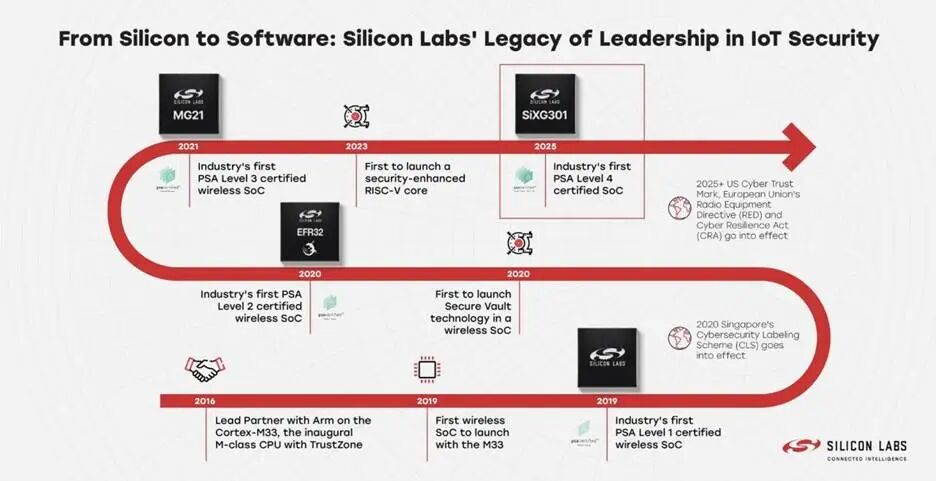
Notably, Silicon Labs’ SiXG301 SoC has become the world’s first chip to achieve Arm PSA Level 4 certification. Compared to many domestic competitors that only reach PSA Level 2, the SiXG301, meeting PSA Level 4, can defend against complex hacker threats such as laser fault injection, side-channel attacks, micro-probing, and voltage manipulation. Although these threats are currently rare in the market, they are crucial for the future security of devices. Silicon Labs, through its unique Secure Vault technology, implements a “dual-lock” protection based on PSA Level 3, while PSA Level 4 further upgrades to a “triple-lock,” significantly enhancing the device’s resistance to advanced attacks.
In contrast to discrete external security chips, integrated SoC solutions demonstrate greater advantages. Some competitors’ external security chips primarily target physical layer attacks, providing entry-level protection. In contrast, Silicon Labs’ integrated solutions, by combining edge computing and PSA Level 4 certification, can withstand up to 80% of potential threats. While hacking techniques are also evolving, this hardware-software combined strategy offers more comprehensive protection for devices. Additionally, Silicon Labs provides unique custom component manufacturing services (CPMS), further enhancing security. Each SoC is embedded with a unique identifier, similar to a digital ID card. If customers find that the chip is used for unauthorized purposes, Silicon Labs can remotely disable the chip upon customer request, ensuring supply chain security. This service significantly enhances customer trust.
Bluetooth: Two Major Technological Breakthroughs and Three Industry Layouts
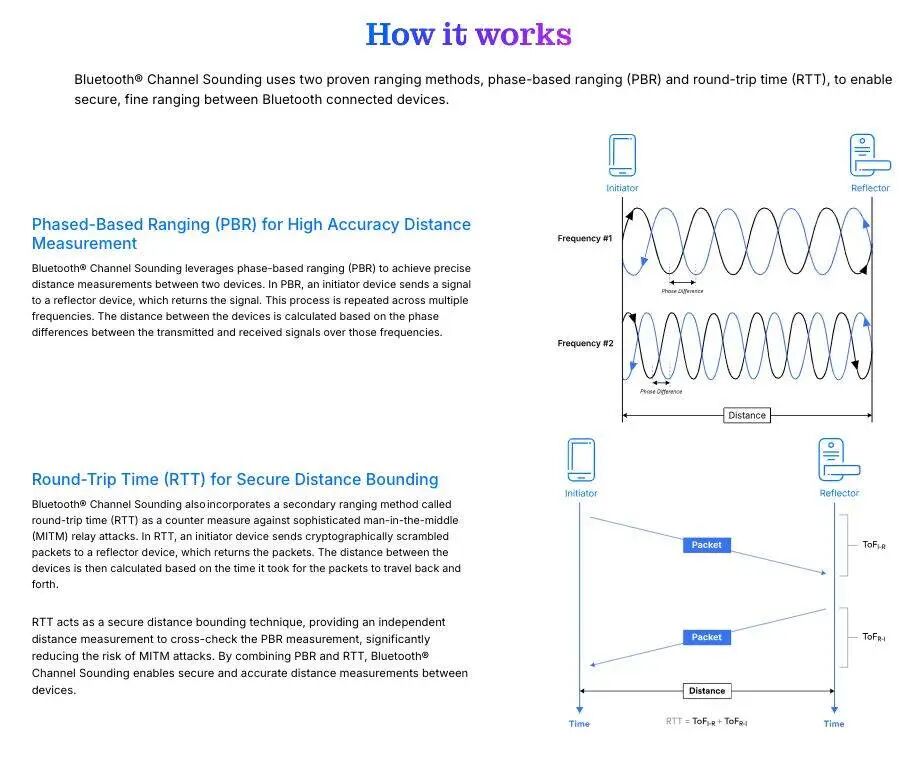
From audio to high-precision positioning, Bluetooth technology has also seen significant breakthroughs in recent years. The channel sounding technology introduced by Bluetooth 6.0 significantly enhances positioning accuracy through phase ranging (PBR) and round-trip time (RTT) algorithms, while Auracast technology opens new scenarios for audio applications. Bluetooth Mesh and Long range also enable larger-scale network communications. As a major member of the Bluetooth Alliance, Silicon Labs is actively promoting the implementation of these Bluetooth innovative technologies and strategically positioning itself in various industries such as automotive, industrial, and medical, injecting strong momentum into the next generation of smart connected devices.
According to Zhou Wei, among the many innovative technologies in Bluetooth, audio technology and high-precision positioning technology will be key directions. In the audio field, the launch of Auracast technology injects new vitality into Bluetooth audio applications. In terms of positioning technology, the channel sounding technology introduced by Bluetooth 6.0 significantly improves positioning accuracy by combining phase ranging and round-trip time algorithms. Silicon Labs was the first to launch the industry’s first dual-antenna version of the channel sounding solution, with demonstration devices achieving centimeter-level positioning accuracy within a distance of 50 meters. This high-precision positioning technology not only enhances user experience but also poses a potential competitive advantage over ultra-wideband (UWB) technology due to its lower power consumption and greater compatibility. Particularly in smart tag applications, the introduction of channel sounding technology effectively addresses the issues of low accuracy and poor user experience associated with traditional RSSI technology, providing better performance support for high-end smart tag products.
In specific application scenarios, Silicon Labs focuses Bluetooth technology on three core areas: automotive, healthcare, and new energy.
Firstly, in the automotive sector, Silicon Labs has a deep accumulation in keyless entry technology, evolving from early one-way remote keys to two-way communication keyless entry and start (PEPS) systems, and now to multi-point precise positioning technology based on channel sounding, with solutions widely applied in major global automotive manufacturers. For example, their Bluetooth chips are integrated into the rearview mirrors of well-known electric vehicle brands, supporting precise interaction between smartphones and vehicles. Additionally, their tire pressure monitoring system (TPMS) has been upgraded from traditional technology to a Bluetooth solution, widely used in major electric vehicle brands in North America. Furthermore, Silicon Labs actively responds to the “human-vehicle-home” ecosystem concept, using Bluetooth technology to achieve intelligent connections among multiple nodes in the vehicle (such as seats, refrigerators, etc.), promoting the integration of vehicle networking and smart homes.
Secondly, in the healthcare sector, Silicon Labs’ Bluetooth technology plays a significant role in continuous glucose monitoring (CGM) devices. Facing the challenges of a complex electromagnetic environment in the 2.4GHz frequency band, their Bluetooth solutions ensure data transmission reliability with high stability and low power consumption, meeting the high-precision monitoring needs of diabetes patients. Currently, many leading medical device manufacturers in China use their Bluetooth chips, with product shipments reaching tens of millions or even hundreds of millions.
Lastly, in the new energy sector, Silicon Labs has launched the industry’s first Sub-GHz and Bluetooth dual-mode SoC (FG28), widely used in scenarios such as charging pile management. Through Bluetooth technology, maintenance personnel can directly use their smartphones to scan error codes from charging piles, quickly locating issues and improving operational efficiency. Additionally, in the electronic shelf label (ESL) market, Silicon Labs holds approximately 80% of the global market share, with technology evolving from early proprietary Sub-GHz protocols to Bluetooth-based periodic advertising (PAwR) technology, supporting networking needs of up to 2000 nodes, aiding the digital transformation of the retail industry.
Zhou Wei emphasized that this does not mean Silicon Labs will no longer focus on Bluetooth applications in consumer electronics, but automotive, healthcare, and new energy will be their primary focus areas, considered “top priorities.”
This article is reproduced from the 21ic website, original link:https://www.21ic.com/a/992466.html
Scan the QR code below to follow Silicon Labs’ social media platforms