An AI-centered IoT platform, based on the renowned RuoYi framework, is user-friendly and has a commercially friendly open-source license.
Source Code
https://www.gitpp.com/japxin/gen-project008-iot
It builds an efficient access and management network for IoT devices (especially for massive numbers of cameras). We deeply integrate real-time streaming technology with cutting-edge artificial intelligence (AI) to create a core service. This solution not only enables interoperability among heterogeneous devices but also deeply integrates high-definition video streams with a powerful AI analysis engine, endowing the surveillance system with an “intelligent eye”—accurately achieving facial recognition, abnormal behavior analysis, risk personnel deployment, and perimeter intrusion detection.
Accurate implementation of facial recognition, abnormal behavior analysis, risk personnel deployment, and perimeter intrusion detection
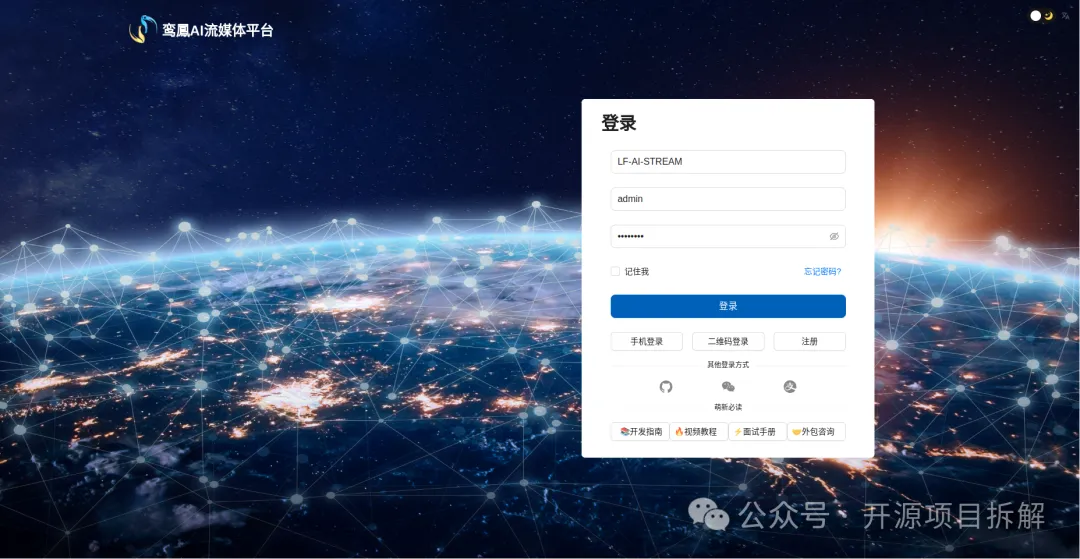
Screenshots
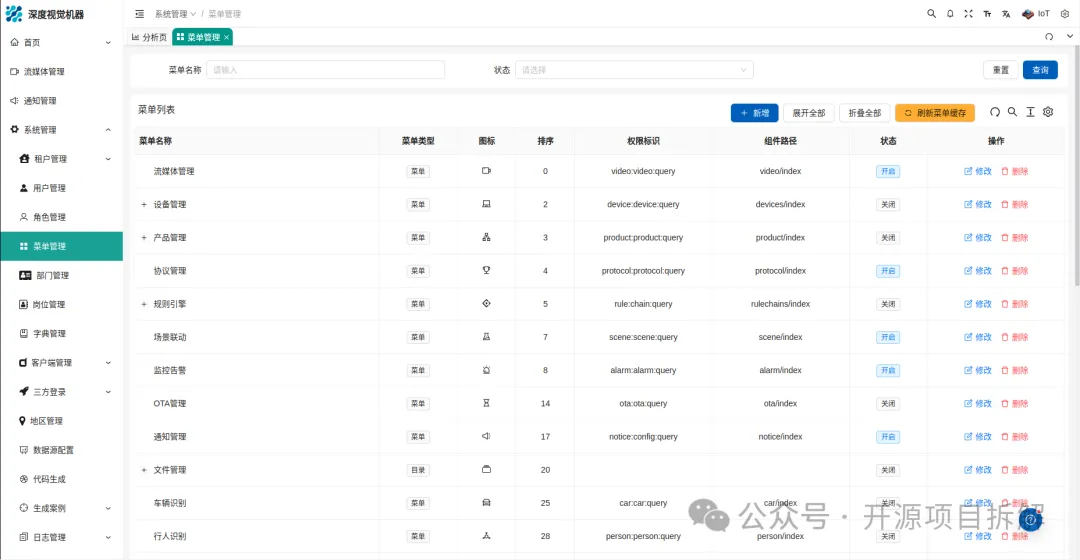
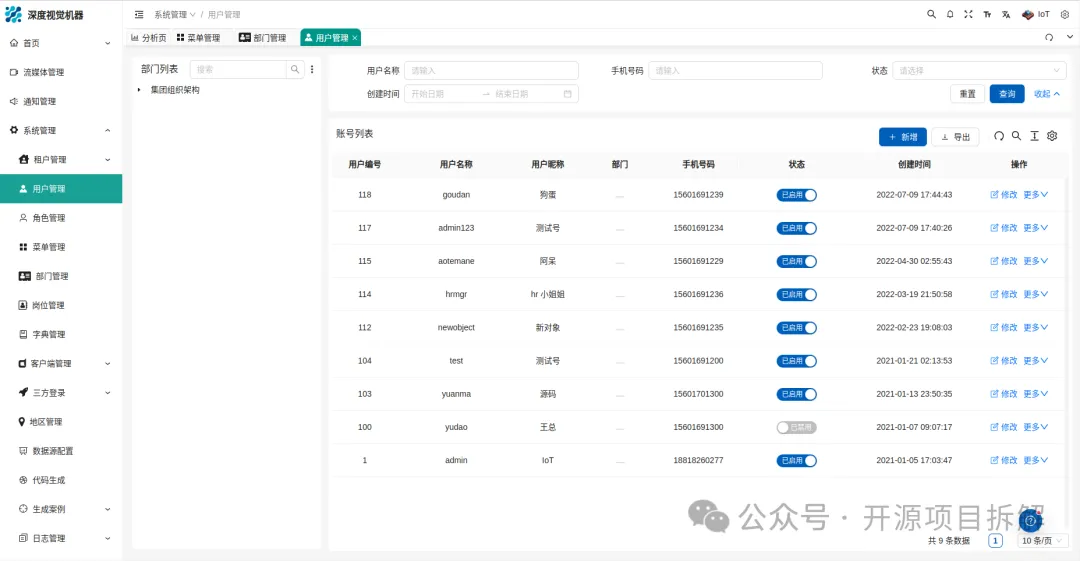
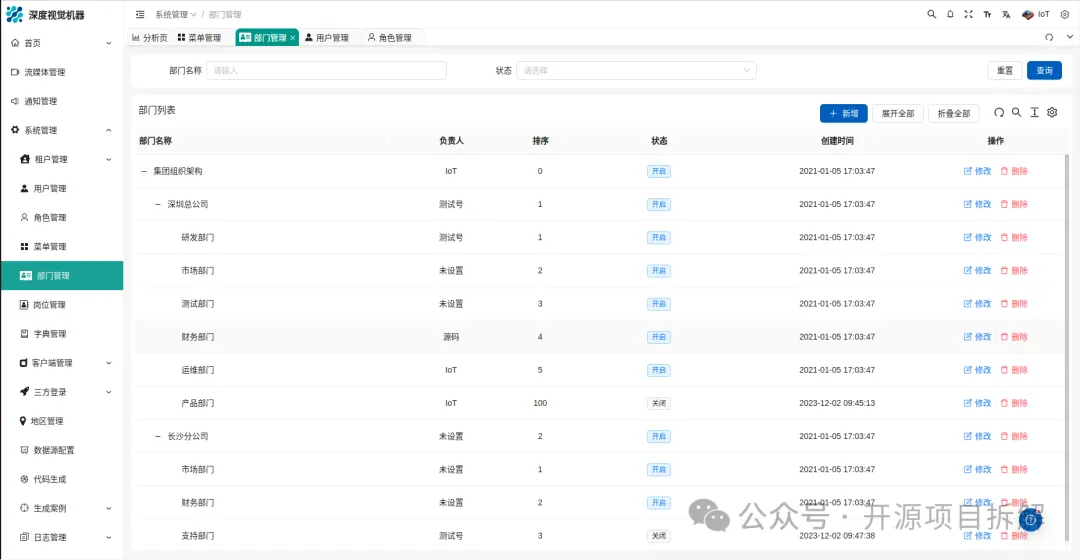
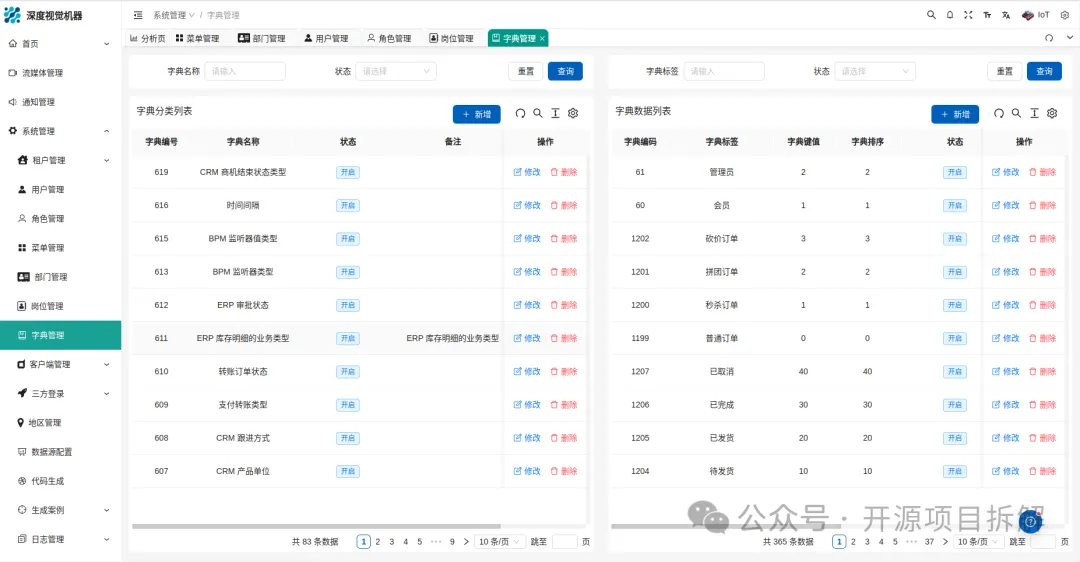
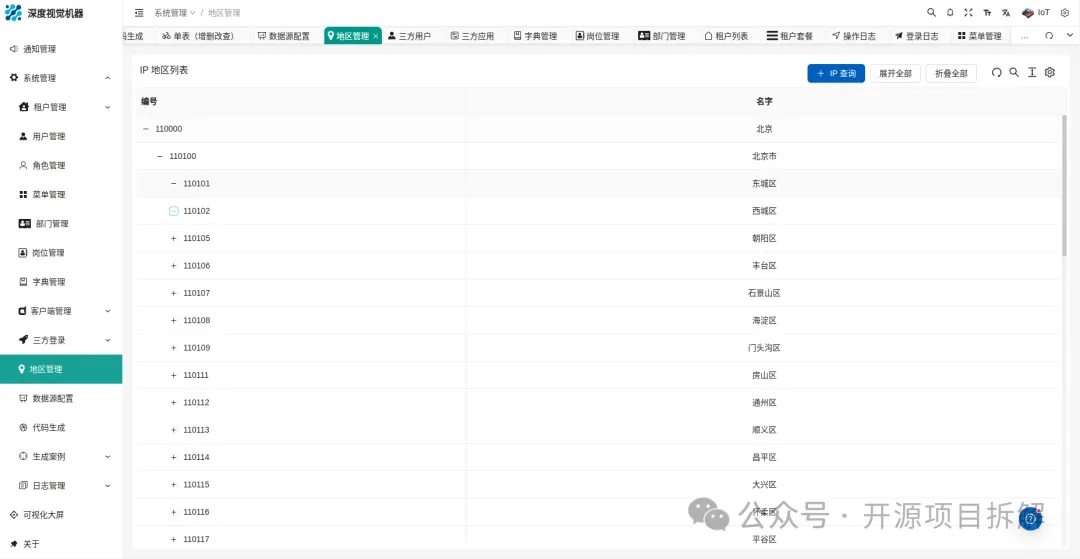
Detailed analysis of the AI-centered IoT platform (Gen-Project008-IoT) focuses on its technical architecture, core functions, usability design, and open-source value:
1. Project Positioning and Core Advantages
1. Platform Positioning
- Target Scenario: Intelligent management of massive cameras and IoT devices (such as sensors, access control, fire protection equipment), building a full-link platform for “device access – data transmission – AI analysis – business linkage”.
- Core Value:
- Cost Reduction and Efficiency Improvement: Replacing traditional NVR + manual inspection mode, automatically identifying risk events through AI, reducing labor input.
- Heterogeneous Compatibility: Supports protocols such as RTSP/GB28181/ONVIF, compatible with mainstream manufacturers like Hikvision, Dahua, and Uniview.
- Real-time Response: Millisecond-level video stream analysis and alarm push, meeting high timeliness requirements for security and industrial inspection.
2. Technical Fusion Highlights
- AI + IoT Dual Engine Drive:
- AI Layer: Integrates algorithms for facial recognition (ArcFace/RetinaFace), behavior analysis (SlowFast/I3D model), object detection (YOLOv8), and supports custom model deployment.
- IoT Layer: Extends the device management module based on the RuoYi framework, achieving device status monitoring, remote configuration, firmware upgrades, and more.
- Streaming Media Optimization:
- Adopts WebRTC + SRS (Simple Realtime Server) architecture, reducing video transmission latency to under 200ms.
- Supports H.265 encoding and dynamic bitrate adjustment, saving bandwidth by 30% to 50%.
2. Technical Architecture Analysis
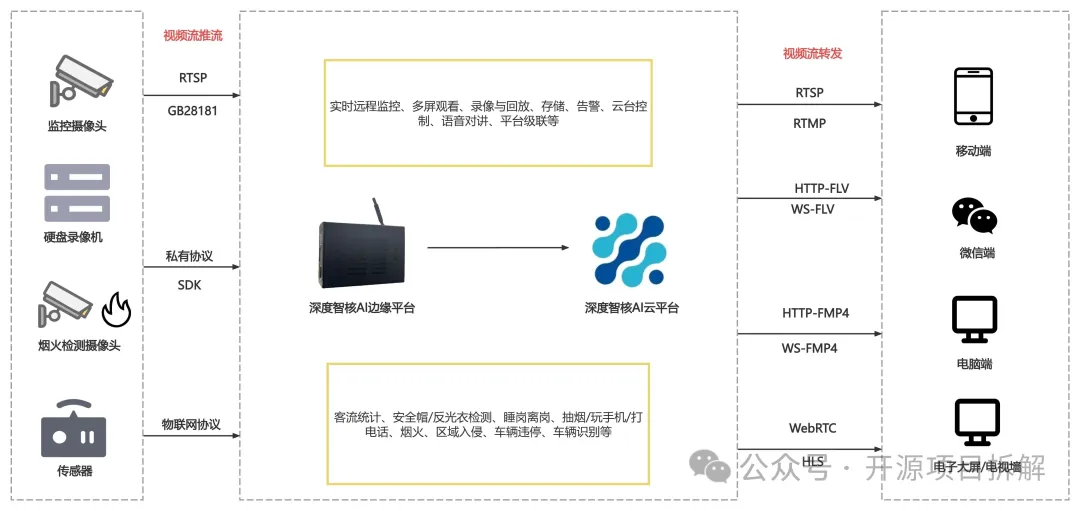
1. Overall Architecture Diagram
┌─────────────┐    ┌─────────────┐    ┌─────────────┐
│  Device Access Layer  │──→│  Streaming Media Service  │──→│  AI Analysis Engine  │
└─────────────┘    └─────────────┘    └─────────────┘
↑                   ↑                   ↓
┌─────────────┐    ┌─────────────┐    ┌─────────────┐
│  Device Management API │←──│  Business Middleware   │←──│  Alarm Center   │
└─────────────┘ └─────────────┘ └─────────────┘- Device Access Layer:
- Supports MQTT/CoAP/HTTP protocols, compatible with cameras, temperature and humidity sensors, smoke detectors, and other devices.
- Provides SDK for device manufacturers to integrate, simplifying the access process.
- Streaming Media Service:
- SRS is responsible for video stream forwarding, and WebRTC achieves low-latency playback on the browser side.
- Integrates FFmpeg for video transcoding and screenshot, supporting on-demand streaming to save resources.
- AI Analysis Engine:
- Deployed on GPU servers, interacting with the streaming media service via gRPC.
- Supports hot updates of models, allowing algorithm version switching without restarting the service.
- Business Middleware:
- Extended based on the RuoYi framework, providing backend functions such as device grouping, permission management, and log auditing.
- Integrates with WeChat/DingTalk to achieve alarm message push and automatic work order generation.
2. Key Technology Selection
| Module | Technology Stack | Advantages |
|---|---|---|
| Frontend | Vue3 + Element Plus + ECharts | Responsive layout, supports large screen visualization |
| Backend | Spring Boot + MyBatis-Plus | Rapid development, built-in code generator |
| Database | MySQL (device data) + Redis (cache) | High concurrency read/write optimization |
| AI Framework | PyTorch + ONNX Runtime | Supports multi-platform model deployment |
| Containerization | Docker + Kubernetes | Elastic scaling, ensuring high availability |
3. Core Functionality Detailed Explanation
1. Intelligent Security Applications
- Facial Recognition:
- Supports 1:N comparison (N≤100,000), recognition accuracy ≥99.5% (tested on LFW dataset).
- Application scenarios: access control attendance, blacklist deployment, stranger alerts.
- Abnormal Behavior Analysis:
- Detects behaviors such as falls, fights, and climbing, triggering alarms and recording event video clips.
- Model training dataset: custom collection + public dataset (UCF-Crime) mixed tuning.
- Perimeter Intrusion Detection:
- Defines monitoring areas through virtual fences, supporting polygon and irregular shape definitions.
- Interference-resistant design: filters out false alarm sources such as swaying leaves and small animals.
2. Device Management Capabilities
- Visual Topology:
- Automatically generates device network topology diagrams, displaying real-time device online status and signal strength.
- Batch Operations:
- Supports batch restarting and upgrading devices by region/model, reducing manual operation costs.
- Self-Healing:
- Automatically attempts to restart or switch to backup links when a device is detected offline.
3. Data Value Mining
- Traffic Flow Statistics:
- Analyzes pedestrian flow heat maps to optimize shopping mall store layouts or security checkpoint settings.
- Behavior Pattern Learning:
- Trains user behavior models based on historical data to predict device failures or security risks.
4. Usability Design
1. Developer-Friendly
- Quick Start:
- Provides
<span>docker-compose.yml</span>file for one-click deployment of the complete environment (including MySQL, Redis, SRS). - Example command:
bash git clone https://www.gitpp.com/japxin/gen-project008-iot.git cd gen-project008-iot docker-compose up -d - Low-Code Extension:
- Based on RuoYi’s code generator, it can automatically generate CRUD code for the device management module.
- AI model integration only requires implementing the
<span>IModelInterface</span>interface without modifying core logic.
2. User-Friendly
- Multi-Terminal Adaptation:
- Supports PC, mobile (developed with UniApp), and TV large screens (custom resolution adaptation).
- Interaction Optimization:
- Alarm information is displayed in levels according to priority, supporting one-click playback of associated videos.
- Provides a bilingual interface in Chinese and English for easy international deployment.
5. Open Source License and Ecosystem
1. License Selection
- Uses MIT License:
- Allows commercial use, modification, and distribution, only requiring the retention of the original author’s copyright notice.
- More lenient than the GPL license, lowering the threshold for enterprise adoption.
2. Ecosystem Development Direction
- Plugin Market:
- Plans to open AI algorithm plugin interfaces, encouraging developers to contribute custom models (such as license plate recognition, fire detection).
- Industry Solutions:
- Provides pre-configured templates for scenarios such as smart parks and smart retail to accelerate project implementation.
- Community Support:
- Establishes a discussion area on the GitPP platform, providing 7×12 hours of technical Q&A.
6. Typical Application Cases
1. Security Upgrade of a Chain Supermarket
- Pain Points:
- Previously relied on manual inspections, frequent theft incidents, and inability to trace the crime process.
- Solution:
- Deployed over 200 cameras to access the platform, enabling facial recognition and abnormal behavior analysis.
- Effect:
- Theft incidents decreased by 80%, and alarm response time reduced from 10 minutes to 10 seconds.
2. Equipment Monitoring in an Industrial Park
- Pain Points:
- Traditional sensors could only collect data and could not actively warn of equipment failures.
- Solution:
- Integrated vibration sensors and cameras, using AI to analyze equipment operating sounds and images to predict bearing wear.
- Effect:
- Unplanned equipment downtime reduced by 65%, saving over 2 million yuan in annual maintenance costs.
7. Summary and Outlook
Gen-Project008-IoT is an open-source IoT platform centered on AI and designed for usability, with value in:
- Technological Inclusiveness: Reducing the cost of intelligent transformation for small and medium-sized enterprises through the MIT license and low-code development.
- Wide Scenario Coverage: Providing replicable solutions from security monitoring to industrial predictive maintenance.
- Great Ecosystem Potential: Future expansion into smart cities, smart agriculture, and other fields to build an AIoT open ecosystem.
An AI-centered IoT platform, based on the renowned RuoYi framework, is user-friendly and has a commercially friendly open-source license.
Source Code
https://www.gitpp.com/japxin/gen-project008-iot
It builds an efficient access and management network for IoT devices (especially for massive numbers of cameras). We deeply integrate real-time streaming technology with cutting-edge artificial intelligence (AI) to create a core service. This solution not only enables interoperability among heterogeneous devices but also deeply integrates high-definition video streams with a powerful AI analysis engine, endowing the surveillance system with an “intelligent eye”—accurately achieving facial recognition, abnormal behavior analysis, risk personnel deployment, and perimeter intrusion detection.