0 IntroductionCurrently, the global digital economy is rapidly developing, and the new generation of information and communication technology is infiltrating various industries. On one hand, through the construction of smart cities, the use of information and communication technology effectively integrates various urban management systems, achieving information resource sharing and business collaboration among urban systems, promoting intelligent urban management and services, enhancing urban operational management and public service levels, and achieving sustainable development has become a consensus among urban construction managers[1]; on the other hand, the new industrial ecosystems such as the Internet of Vehicles and the Internet of Things are continuously growing, strongly promoting the digitalization, networking, and intelligence of traditional industries such as automobiles and transportation, and gradually evolving to form new industry clusters in digital economic development such as smart travel and digital traffic governance[2-4]. The Internet of Vehicles, as a new basic technical system and industrial field connecting intelligent connected vehicles and smart cities, is continuously developing and maturing, accelerating the integration and innovation among information technology, the automotive industry, urban governance, and transportation services, empowering the construction of new infrastructure for smart cities.1 Integration System Architecture of Internet of Vehicles and Smart CitiesAfter years of development, the Internet of Vehicles industry has formed two main development lines: “vehicle intelligence upgrade” and “new infrastructure construction of the Internet of Vehicles”. In the development route of vehicle intelligence upgrade, the new energy and intelligent networking of vehicles promote the transformation of the automotive value chain, and the construction of the automotive ecosystem is transforming towards a flat aggregation-type value structure. Automotive companies are no longer the single core of the entire ecosystem, but are collaboratively building a new ecosystem centered on user needs through cooperation between the traditional manufacturing end and the external service end. At the same time, electronic information, transportation services, information communication, and other enterprises are integrated into the automotive industry chain, the traditional automotive industry chain is beginning to expand and integrate, and the boundaries of the industry are gradually blurring. In the development route of new infrastructure construction of the Internet of Vehicles, China has clarified the technical route for the coordinated development of “smart vehicles” and “smart roads”, extending the intelligent connected vehicle industry ecosystem to roadside and cloud platform new infrastructure industries. Various regions have established demonstration areas and pilot areas to carry out the construction of new infrastructure for the Internet of Vehicles, demonstrating vehicle-road collaborative applications, promoting the maturity of applications such as high-level autonomous driving and in-vehicle information entertainment services, and gradually empowering the intelligent upgrade of travel services and traffic management, further expanding the scope of the Internet of Vehicles industry[5]. Against this background, the Internet of Vehicles has become an important part of empowering the construction of new infrastructure for smart cities. On one hand, relying on the Internet of Vehicles, with intelligent connected vehicles as the next generation of mobile terminals, it can help smart cities break down data barriers. In the smart traffic network, vehicles become new intelligent terminals connecting people to traffic and other urban facilities. Through intelligent vehicles widely collecting real-time dynamic information data of urban roads, traffic, and buildings, the data of smart cities becomes richer and smarter. At the same time, the Internet of Vehicles drives the deployment of smart infrastructure construction, prioritizing the construction of dedicated bus, taxi, sanitation, and logistics lanes, which are the most frequently used and urgently needed urban traffic key scenarios, to improve the utilization rate of smart city infrastructure. On the other hand, smart cities also provide intelligent infrastructure and application scenarios for the Internet of Vehicles. The Internet of Vehicles requires urban roads to provide dynamic and static perception information, forming an accurate and reliable perception system beyond visual range, enhancing the perception accuracy of intelligent connected vehicles, thereby achieving high-level autonomous driving. By deploying millimeter-wave radar, intelligent cameras, laser radars, and other intelligent perception devices at urban road intersections and along roadsides, the static and dynamic information of urban traffic can be accurately detected, perceived, and collected, refining the division of perception capabilities between vehicles and roads, filling in the blind spots of single-vehicle intelligent perception, and improving the driving efficiency and safety of intelligent connected vehicles. At the same time, smart cities also provide a platform for the Internet of Vehicles that can be implemented, tested, and demonstrated, gradually exploring the path of large-scale implementation of the Internet of Vehicles through closed testing, demonstration applications, and commercial operations in relatively mature areas[6]. From the perspective of smart cities, the Internet of Vehicles enhances multiple urban business types, creating new integrated business types, empowering smart city systems, as shown in Figure 1. For example, based on the intelligent control system of urban traffic signals, it enhances the data open management interaction platform and direct communication with the Internet of Vehicles (C-V2X), while enhancing multi-dimensional information fusion and real-time information broadcasting functions based on digital traffic signs, vehicle speeding warnings, and typical violation warning systems. For the Internet of Vehicles, various business applications require support from smart city perception, transmission devices, and basic data platforms, necessitating the addition of extra entities and functions in terms of perception, transmission devices, and basic data platforms, including the addition of C-V2X roadside communication units, intelligent roadside industrial control systems, and deployment of vehicle-road collaborative information collection and publishing functions, realizing the fusion empowerment of the Internet of Vehicles for smart cities.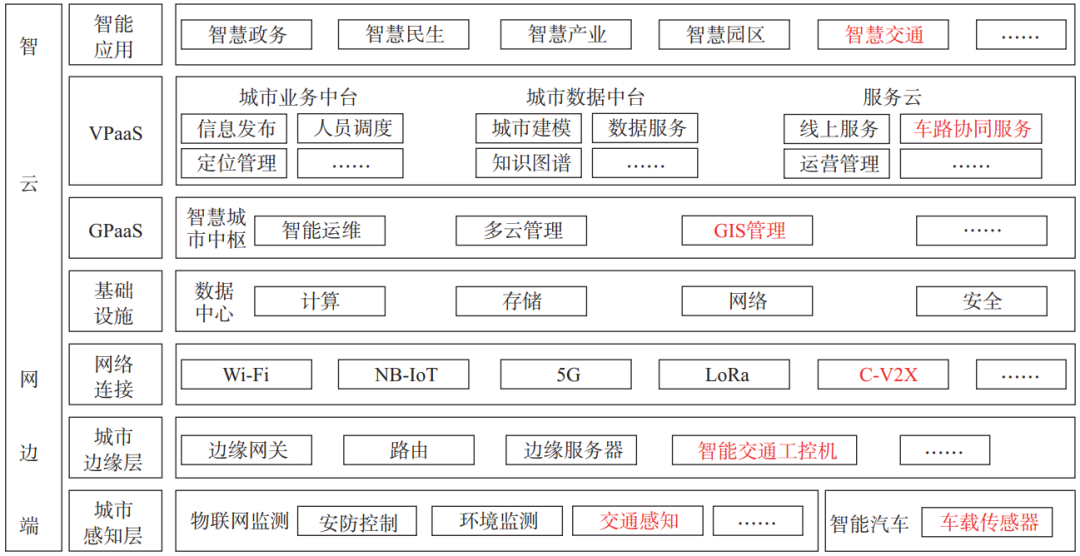 Figure 1 Integration System Architecture of Internet of Vehicles and Smart Cities2 Industrial Integration Development of Internet of Vehicles and Smart Cities2.1 Progress in Connected Communication FieldThe Internet of Vehicles organically combines wireless communication networks and wired backhaul networks to complete multi-dimensional information transmission between people, vehicles, roads, and clouds, empowering the interconnectivity of various elements in the transportation system of smart cities. Among them, the wireless communication network includes the direct communication network of the Internet of Vehicles (LTE-V2X) serving vehicles and vehicles, and the 5G cellular communication network serving vehicles and clouds, people and clouds, and some roads and clouds. The development of wireless communication for the Internet of Vehicles effectively assists interconnectivity, linking the vehicle, which impacts the efficiency of urban traffic operation, with intelligent roadside traffic facilities, enhancing the efficiency of traffic information release and collaborative guidance, while making it possible to transmit the massive operational data and sensing data generated by vehicles to urban smart traffic platforms at high speed. In addition, the wired communication network mainly refers to the backhaul network within roadside systems and some roads and clouds, which can realize information exchange between roadside systems and multi-level platforms. This part can effectively reuse the backhaul network deployed in smart cities for smart security and other systems, enhancing the application efficiency of smart city infrastructure. Specifically, regarding direct communication, LTE-V2X has formed a relatively complete technical standard system and industrial chain, while the NR-V2X technical standard is yet to be verified, and spectrum resources have not been allocated, with related products not yet mature. In terms of technology and standards, domestic LTE-V2X technology mainly focuses on further deepening and optimizing LTE-V2X applications, while the 3GPP NR-V2X standard is still evolving. The international standard organization 3GPP has completed the R17 version of the NR-V2X standard, further optimizing related technologies such as power control and resource scheduling[7]. In terms of industrial development, China’s LTE-V2X industry is thriving, with increasing international influence. Domestically, a complete industrial chain based on LTE-V2X technology has been established, with chips, modules, OBUs, RSUs, etc., having matured and undergone extensive testing, providing the basic conditions for commercial deployment. Internationally, traditional tier 1 automotive suppliers such as Continental, Bosch, Harman, Delphi, and LG have increased R&D investment in LTE-V2X vehicle terminals, with the importance of LTE-V2X continuously deepening. In relevant regions, roadside direct communication terminals based on LTE-V2X technology have become an important part of smart city new infrastructure, effectively enriching the service forms of roadside smart traffic. Regarding cellular communication, with the significant improvement of key performance indicators of 5G and the continuous expansion of coverage, 5G networks are gradually evolving from supporting diverse information and entertainment services such as vehicle AR/VR to supporting vehicle-road collaborative applications and remote-controlled driving. In terms of technical research, the international 5G Automotive Alliance and the European 5GCroCo project have conducted research on remote-controlled driving application scenarios and proposed corresponding requirements for communication system capabilities; domestically, the IMT-2020 (5G) promotion group C-V2X working group is exploring the technical architecture and performance indicators of Internet of Vehicles applications based on 5G networks. In terms of industrial development, mobile apps, mini-programs, smart rearview mirrors, and other aftermarket devices and applications with 5G communication capabilities are continuously emerging, actively exploring Internet of Vehicles services in urban and highway environments. Overall, the integration of LTE-V2X and 5G has become a new trend in applying the Internet of Vehicles to improve user reach and business service scope, using different communication methods to provide different application services, further enriching the means of reaching the transportation field of smart cities[8]. The roadside backhaul network is evolving from a primarily wired network-based architecture to a coexistence architecture of wired/wireless networks. Currently, the roadside systems of the Internet of Vehicles have diverse access device types, strong data heterogeneity, and large integration transmission demands. The high stability, high transmission rate, and strong anti-interference capability of fiber optic networks make them a key supporting network for data backhaul. However, in specific scenarios such as large bridges, tunnels, and elevated hubs on highways, the construction difficulty and deployment costs of laying fiber optic networks are high. Therefore, under the premise of meeting business scenario requirements, some cities are exploring the addition of 5G network backhaul solutions based on fiber optic backhaul. In relevant regions, the construction of backhaul networks using the method of reusing the overall backbone network of smart cities has improved the utilization efficiency of related infrastructure.2.2 Progress in Roadside Intelligent Perception FieldThe roadside integrated perception system, centered on perception, computation, and communication, is evolving towards integrated hardware functionality and agile construction deployment. On one hand, roadside sensors are continuously upgrading towards an integrated form of perception + computation functionality. Companies that already have products such as cameras, millimeter-wave radars, and laser radars have launched sensors with structured perception capabilities, such as intelligent ball cameras that integrate traditional cameras with edge-side perception recognition algorithms, and radar-vision fusion systems that achieve the integration and fusion of millimeter-wave radars and cameras. These sensors have been promoted and deployed in areas such as road perception and environmental monitoring. On the other hand, the trend of decoupling software and hardware in roadside integrated perception systems has begun to emerge, with roadside suppliers, algorithm providers, and overall solution providers spontaneously conducting relevant exploratory work, creating an open product system that decouples software and hardware[9]. Currently, the roadside integrated perception industry chain is in a rapid development stage, but the maturity of existing technologies and products still needs improvement. Influenced by various factors such as hardware performance bottlenecks, calibration and debugging, and fusion algorithm design, the current mainstream products still have room for improvement in system performance, stability, and matching with scene requirements under real working conditions. At the same time, the upstream supply chain of the roadside integrated perception system still faces high technical barriers, with issues such as insufficient generalization ability of fusion perception algorithms. In some cities, the practice of reusing roadside intelligent perception facilities with security and traffic perception devices currently faces technical issues such as inconsistent technical indicators and different installation point requirements, which need further practical refinement.2.3 Progress in Internet of Vehicles Service Platform FieldA consensus has basically formed on the multi-level platform architecture of the Internet of Vehicles, with core businesses gradually clarified. The multi-level platform of the Internet of Vehicles can be divided into three dimensions in terms of deployment levels: “edge”, “regional”, and “central”. Among them, the edge platform is built in edge data centers, providing micro-traffic services at the community level. The regional mobile edge computing (MEC) platform is deployed on top of the edge MEC platform and can interact with one or more edge MEC platforms to provide macro-traffic services at the regional level, achieving higher-level and more comprehensive user management, data aggregation, and business scheduling. The central platform is built on top of the regional MEC platform, serving as the top layer for business applications, providing macro-traffic services at the wide area level. In terms of service attributes, it can be decomposed into “business side” and “management side”. On the business side, platforms at all levels jointly carry the comprehensive data foundation of the Internet of Vehicles, vehicle-road collaborative events, and message services, supporting services such as vehicle-road collaborative assisted/automated driving applications, public transportation travel, and traffic management control. On the management side, platforms at all levels collaboratively handle roadside infrastructure operation and maintenance management, Internet of Vehicles user management, platform security management, and other management functions, providing basic support for sustainable operation of the industry. The interaction between the business and management sides of the platform supports the realization of vehicle-road collaborative scenarios. The development of the Internet of Vehicles service platform shows two characteristics in the integration with the overall platform of smart cities. First, internet companies and intelligent transportation integrators have rapidly developed and continuously iterated platform products integrating the Internet of Vehicles with smart cities and smart transportation, relying on their accumulation in urban brains and traditional intelligent transportation platforms. The maturity, usability, and display capabilities of such platforms are strong, and they can usually be deployed on regional or central platforms, enhancing the scheduling management capabilities and overall traffic efficiency of urban transportation. Second, edge platforms focused on intelligent connected driving safety and big data traffic are still in the verification phase. Telecom operators are actively collaborating with automotive and transportation industry companies to research and verify key technical indicators such as the network architecture of “vehicle-road-edge-cloud” collaboration, end-to-end latency, and application scenario reliability, promoting the integration of edge-side Internet of Vehicles services and high-real-time smart city services.3 Application Scenarios and Operation Models of Internet of Vehicles Based on Smart Cities3.1 Current Development Status of Application ScenariosBased on the integrated system of smart cities and the Internet of Vehicles, applications of the Internet of Vehicles are continuously innovating and developing. First, information service applications have become basically widespread, achieving innovative development under the empowerment of networking technology. Applications such as positioning and navigation, in-vehicle entertainment, etc., have matured considerably. At the same time, with the promotion of LTE-V2X technology, applications such as traffic signal light information dissemination are gradually being verified. Additionally, applications based on 5G for in-vehicle software OTA upgrades are also continuously emerging. Second, intelligent driving applications are accelerating penetration and gradually coupling with networking systems. The penetration rate of advanced driver assistance systems (ADAS) in new vehicles in China is increasingly rising, with the cumulative penetration rate of new vehicles in January-August 2021 approaching 10%. Simultaneously, the test mileage of autonomous driving in China is also continuously climbing; for example, in Beijing, the total mileage of autonomous vehicles safely driving on the road has exceeded 3 million kilometers (as of May 2021). Some enterprises have conducted verification of intelligent driving applications integrating LTE-V2X. For instance, Audi is promoting the verification and promotion of cooperative adaptive cruise control and speed control based on signal light information in the Wuxi pilot area. Third, smart transportation applications are continuously deepening, gradually generating new scenarios. Applications aimed at management departments for traffic governance and aimed at industry enterprises for optimizing transportation efficiency are continuously deepening, and new scenarios are emerging under the support of networking technology. For example, the Changsha pilot area has developed an application for priority passage of buses based on LTE-V2X, effectively shortening the operation cycle of buses during peak periods; the Changshu demonstration area has smartened and networked buses and their roadside infrastructure, innovatively setting up in-vehicle traffic guidance screens and rear light status information boards, achieving multiple functions such as alerts for vulnerable traffic participants (mainly pedestrians and non-motorized vehicles) and information release from the rear of buses, enhancing the safety and efficiency of bus operations[10]. 3.2 Functional Perspective of ScenariosIn the context of complex urban road networks, diverse traffic objects, and massive travel demands, the main value goals of the Internet of Vehicles in urban scene applications are improving traffic efficiency, ensuring traffic safety, and providing new transportation services. The excavation and application of traffic operation data have also become one of the popular directions. From the perspective of government departments, the application goals of the Internet of Vehicles mainly include optimizing urban traffic efficiency, improving traffic safety, and enhancing traffic management precision. From the perspective of urban transportation service enterprises, the Internet of Vehicles mainly serves to improve the operational efficiency of public transport systems, ensure operational safety, and flexibly allocate transportation resources. From the perspective of individual users, the Internet of Vehicles focuses on enhancing the travel experience and driving safety needs of drivers and passengers. The functional view of Internet of Vehicles applications in smart city scenarios is shown in Figure 2.
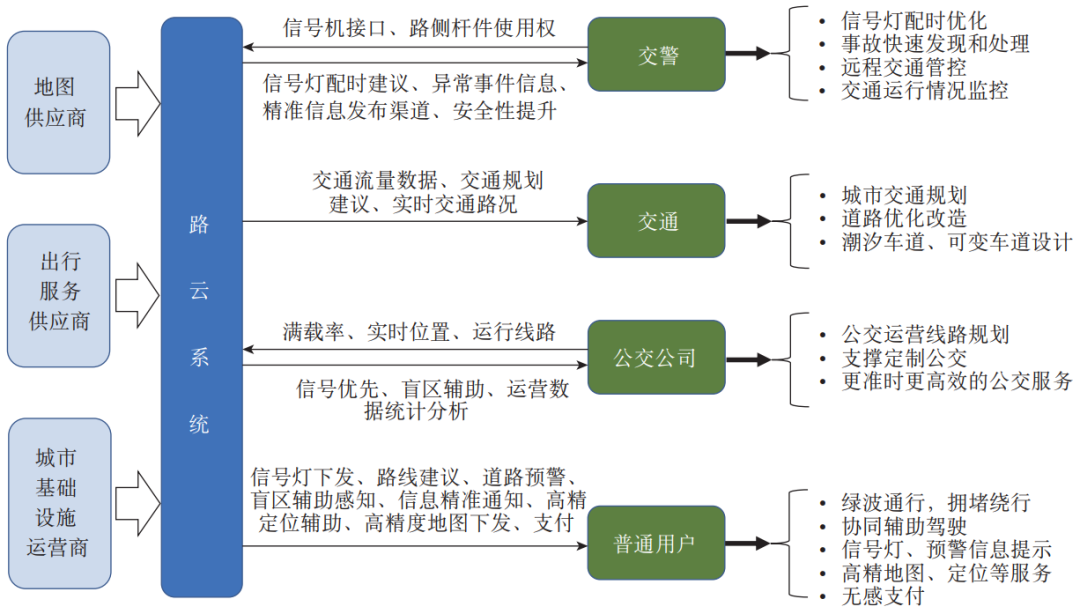 Figure 2 Functional View of Internet of Vehicles Applications in Smart City ScenariosIn smart city scenarios, the Internet of Vehicles can provide various service models for various stakeholders, meeting diverse needs. For traffic authorities, the Internet of Vehicles system can effectively improve urban traffic efficiency through applications such as signal timing optimization and green wave passage; enhance traffic safety through applications such as speeding warnings, red light warnings, and blind spot warnings; and improve traffic management precision through applications such as accident identification, abnormal behavior reporting, and priority passage for special vehicles. For traffic planning departments, the data resources aggregated by the Internet of Vehicles system, such as road operation data and vehicle trajectory data, can provide big data support for urban traffic planning decisions, scientifically carrying out road reconstruction and expansion, lane management, and new road planning. For urban public transport enterprises, the Internet of Vehicles system can achieve bus priority through signal timing strategy suggestions, enhancing the operational efficiency of buses; improve the operational safety of buses through applications such as shared perception and blind spot warnings; and through platform optimization, accurately dispatch buses, dynamically optimize and adjust departure frequency and even operation routes, realizing flexible allocation of transportation resources, creating precise and customized bus services. For individual users, the Internet of Vehicles system can support functions such as green wave passage and adaptive cruise control through applications such as signal light information dissemination and path suggestions; support functions such as collision warnings and automatic emergency braking through applications such as perception information sharing and blind spot warnings; support functions such as autonomous driving through high-precision positioning and high-precision map dissemination; and support parking without sensing payment through near-field payment applications.3.3 Scenario Operation Value ChainIn terms of business models, the urban scene of the Internet of Vehicles ecosystem includes the supply side, operation side, and user side, with the value chain unfolding sequentially. On the supply side, companies provide roadside facilities, cloud control platforms, high-precision positioning, high-definition maps, vehicle terminals, and other equipment and services around the construction of urban Internet of Vehicles systems to obtain commercial returns. On the operation side, the operating entities of urban Internet of Vehicles infrastructure provide various forms of services to various users to obtain service returns; related entities such as parking lots obtain parking revenue through platform traffic. On the user side, OEMs obtain vehicle premiums through Internet of Vehicles functions; public transport enterprises enhance service levels by improving bus operational efficiency. The value chain of the Internet of Vehicles in smart city scenarios is shown in Figure 3.
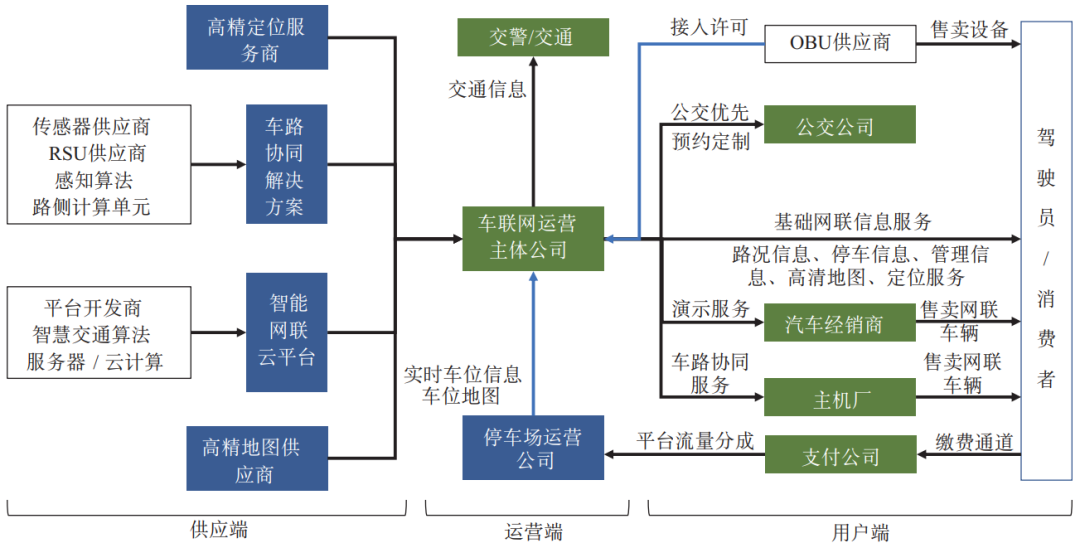 Figure 3 Value Chain of Internet of Vehicles in Smart City Scenarios4 Outlook on the Integration and Development of Internet of Vehicles and Smart CitiesCurrently, national policies actively encourage the collaborative innovation and integrated development of the Internet of Vehicles and smart cities. The Ministry of Housing and Urban-Rural Development and the Ministry of Industry and Information Technology jointly designated 16 cities, including Beijing, Shanghai, Guangzhou, and Wuhan, as pilot cities for the collaborative development of smart city infrastructure and intelligent connected vehicles, promoting the coordinated development of the intelligent connected vehicle industry and smart city construction, and exploring new paths for the transformation of the automotive industry and urban construction[11]. With the support of relevant policies, the collaboration between the Internet of Vehicles and smart cities is currently in a significant window period where infrastructure construction and application promotion are advancing side by side, and the application system is gradually becoming an important driving force for the development of industrial technology systems, product functions, and service models. In this process, various parties have basically verified the feasibility of technology and standards in the early stages, gradually promoting the deep integration of the Internet of Vehicles with the automotive and transportation industries, as well as with the overall construction of smart cities, verifying the usability and ease of use of various Internet of Vehicles functions in practical scenarios, and demonstrating the practical value of the overall system of the Internet of Vehicles for urban governance and public service. Furthermore, from a commercial perspective, various parties are gradually exploring scalable commercial paths, especially focusing on platforms, data, and public services, striving to gradually push the Internet of Vehicles towards a commercial closed loop, better empowering the development of smart cities, and serving citizens’ smart travel.5 ConclusionThis article analyzes the system architecture of the integration of the Internet of Vehicles and smart cities, focusing on the latest developments in the industrial and technological integration of the Internet of Vehicles and smart cities, extracting scenarios and operational models of the Internet of Vehicles in smart city scenarios from both functional and value chain perspectives, and analyzing the trend of integrated development of the Internet of Vehicles and smart cities under policy guidance. Regarding the empowerment of smart cities by the Internet of Vehicles through innovative development, further research and analysis of the specific situation of various cities conducting relevant pilot demonstrations are needed, combined with practical construction and operation, to provide future development recommendations.
Author Profiles
Kang Chen
Engineer at the Institute of Technology and Standards of the China Academy of Information and Communications Technology, mainly engaged in research on policies, technical standards, and industrial development related to the Internet of Vehicles and intelligent connected vehicles.
Ge Yuming
Senior Engineer at the Institute of Technology and Standards of the China Academy of Information and Communications Technology, mainly engaged in research on network connections, multi-access edge computing, and security in the fields of the Internet of Vehicles, autonomous driving, and industrial Internet.
Long Xiangyu
Engineer at the Institute of Technology and Standards of the China Academy of Information and Communications Technology, mainly engaged in research on policies and industrial planning related to the Internet of Vehicles and intelligent connected vehicles.
Wang Jing
Senior Business Supervisor at the Institute of Technology and Standards of the China Academy of Information and Communications Technology, primarily researching standards, testing, and intellectual property related to the Internet of Vehicles, smart education, and personal information protection.
Paper Citation Format:
Kang Chen, Ge Yuming, Long Xiangyu, et al. Thoughts on the Innovative Integration of the Internet of Vehicles Empowering Smart City New Infrastructure [J]. Information Communication Technology and Policy, 2022, 48(12): 18-24.
This article was published in “Information Communication Technology and Policy” 2022, Issue 12
Organizer: China Academy of Information and Communications Technology
“Information Communication Technology and Policy” is a professional academic journal supervised by the Ministry of Industry and Information Technology and hosted by the China Academy of Information and Communications Technology. This journal is positioned as “A Beacon of Information Communication Technology Frontiers, A Think Tank for Information Society Policy Exploration“, focusing on technological trends in the information communication field, public policies, national/industry/company strategies, publishing cutting-edge research results, analysis of focal issues, interpretation of hot policies, etc., promoting the innovation and development of technologies and industries such as 5G, industrial Internet, digital economy, artificial intelligence, blockchain, big data, and cloud computing, guiding national technology strategy choices and industrial policy formulation, and building a high-end academic exchange platform for production, learning, research, and application.
Submission Guidelines for “Information Communication Technology and Policy”!
To further improve the journal’s informatization construction level and provide better services for scholars, the official website of our journal has officially launched, and we welcome submissions!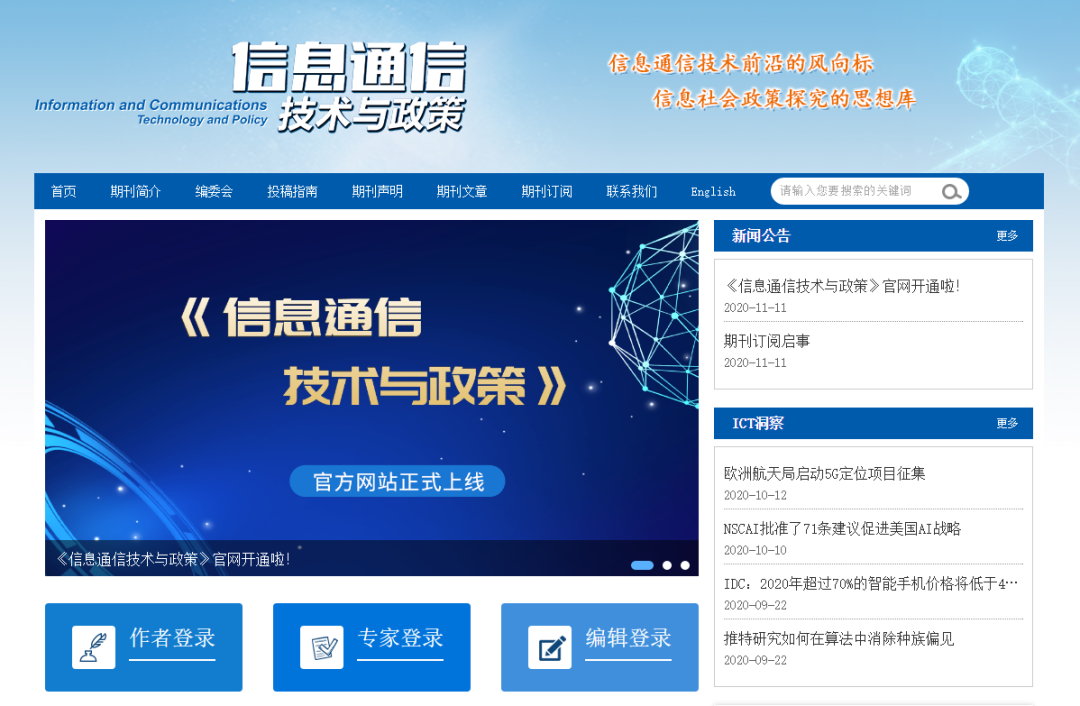
Proofread by | Chen Li, Shan Shan
Edited by | Ling Xiao