The Internet of Things (IoT) is an important part of the new generation of information technology and represents a significant stage in the era of “informationization.”
Download Links:
“Collection of IoT Industry Solutions (Part 1)”
1. A Brief History and Overview of IoT Development.pptx
2. IoT Industry Applications and Solutions.pptx
“Collection of IoT Industry Solutions (Part 2)”
1. Introduction to Industrial IoT Gateways.pdf
2. Introduction to IoT LPWA Communication Technology and Solutions.pdf
3. Overview of Common IoT Communication Technologies.pdf”
Through smart sensing, recognition technologies, and ubiquitous computing, IoT is widely applied in network integration, thus being referred to as the third wave of global information industry development after computers and the internet.
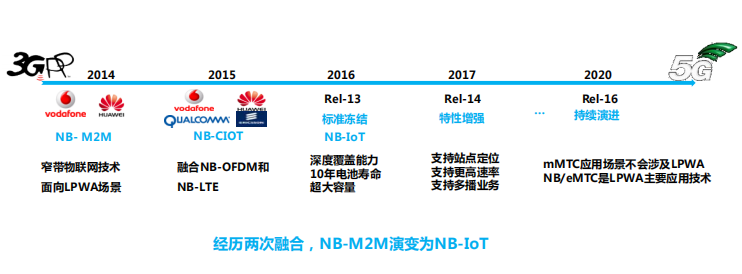
Major Event in IoT – Evolution of NB-IoT Standards
The Narrowband IoT (NB-IoT) communication technology standard was officially initiated in September 2015 and the core standard was frozen in June 2016.
Major Event in IoT – SoftBank Acquires ARM
On July 18, 2016, Japan’s SoftBank Group and Britain’s ARM Holdings jointly announced that they reached an agreement for SoftBank to acquire ARM for £24.3 billion (approximately ¥3.3 trillion).
The concept of the Internet of Things (IoT) was first proposed by MIT in 1999. Early IoT referred to the integration of RFID (Radio Frequency Identification) technology and devices with the internet according to agreed communication protocols, enabling intelligent identification and management of item information, thus forming a network of interconnected, exchangeable, and shareable item information.
By using information sensing devices such as QR code readers, RFID devices, infrared sensors, GPS, and laser scanners, any item can be connected to the internet according to agreed protocols for information exchange and communication, achieving intelligent identification, positioning, tracking, monitoring, and management.
The sensing layer is responsible for information collection and signal processing. Through sensing and identification technologies, items can “speak” and publish information, which is the most unique aspect that distinguishes IoT from other networks. The information generation devices in the sensing layer include automatic generation devices like RFID electronic tags, sensors, and positioning systems, as well as various smart devices such as smartphones, PDAs, multimedia players, and laptops that are manually generated. The sensing layer is at the bottom of the four-layer model of IoT and serves as the foundation for all upper structures.
This layer directly connects and transmits information from the sensing layer through existing internet, mobile communication networks, satellite communication networks, and other basic network facilities. In the four-layer model of IoT, the network construction layer acts as a strong link between the sensing layer and the platform management layer.
In a high-performance network computing environment, the platform management layer can integrate massive information resources within the network into a large intelligent network that can interconnect and communicate. This layer addresses issues such as how to store data (database and massive storage technology), how to retrieve it (search engines), how to use it (data mining and machine learning), and how to prevent misuse (data security and privacy protection). The platform management layer is situated above the sensing and network construction layers and below the comprehensive application layer, serving as the source of intelligence for IoT applications. IoT applications are often referred to as “smart” applications, such as smart grids, smart transportation, and smart logistics, with the intelligence stemming from this layer.
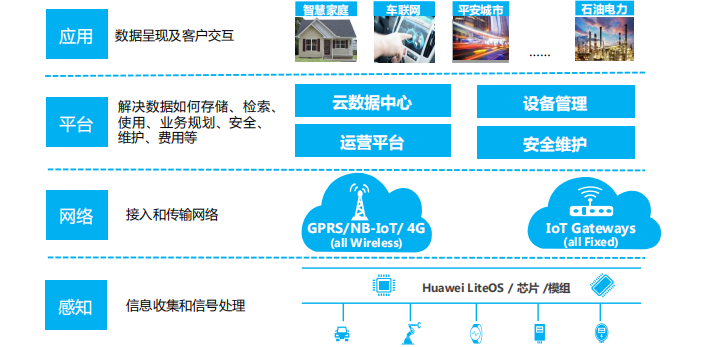 The comprehensive application layer is the user interface of the IoT system, providing users with rich specific services by analyzing and processing the sensed data. Specifically, the comprehensive application layer receives information from the network construction layer, processes and makes decisions on the information, and then sends information back through the network construction layer to control the devices and terminals in the sensing layer. IoT applications are centered around “things” or the physical world, covering areas such as item tracking, environmental sensing, smart logistics, smart transportation, and smart customs.
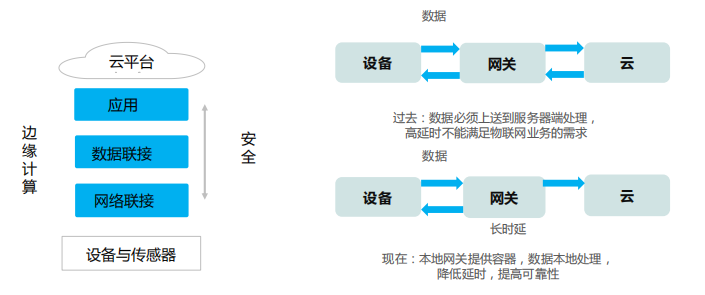
Edge computing provides connectivity, computing, storage, control, and application functions at network edge nodes close to endpoints, meeting user needs for real-time, intelligent, secure, and data aggregation. By leveraging mature communication technologies, distributed computing, storage, and security capabilities are deployed at edge nodes, alleviating the computation, storage, and communication pressure on central nodes while achieving low latency, high reliability, and low cost of services, effectively protecting user privacy at the edge and supporting the transition of networks from cost centers to business value centers.
At edge nodes close to endpoint devices or data sources, an open platform that integrates core capabilities such as connectivity, computing, storage, control, and applications meets user needs for real-time, intelligent, data aggregation, and security.
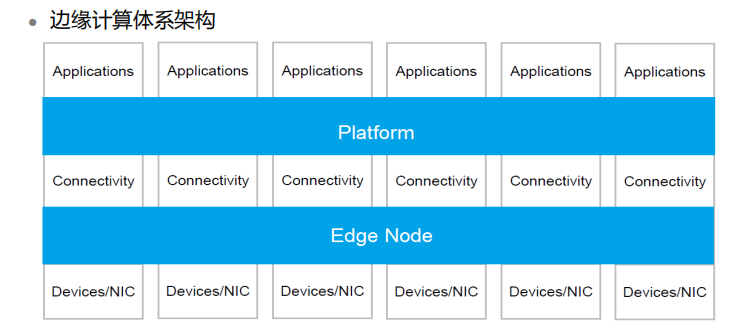
Edge Computing Architecture Layers
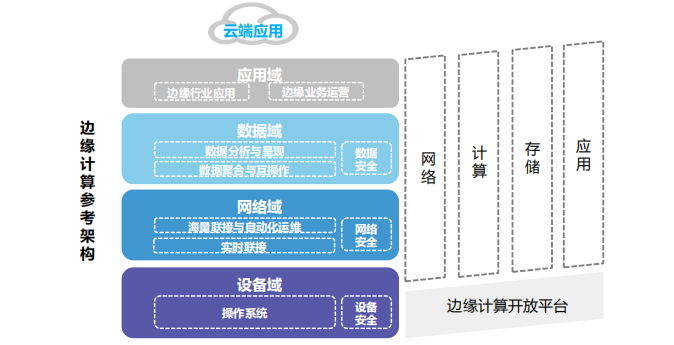
ECC divides the edge computing architecture into four domains: application domain, data domain, network domain, and device domain.
ECC proposed CROSS, which, based on agile connectivity, achieves real-time business, data optimization, application intelligence, and security and privacy protection, bringing value and opportunities to users at the network edge, which is the focus for alliance members.
The comprehensive application layer is the user interface of the IoT system, providing users with rich specific services by analyzing and processing the sensed data. Specifically, the comprehensive application layer receives information from the network construction layer, processes and makes decisions on the information, and then sends information back through the network construction layer to control the devices and terminals in the sensing layer. IoT applications are centered around “things” or the physical world, covering areas such as item tracking, environmental sensing, smart logistics, smart transportation, and smart customs.
Edge computing provides connectivity, computing, storage, control, and application functions at network edge nodes close to endpoints, meeting user needs for real-time, intelligent, secure, and data aggregation. By leveraging mature communication technologies, distributed computing, storage, and security capabilities are deployed at edge nodes, alleviating the computation, storage, and communication pressure on central nodes while achieving low latency, high reliability, and low cost of services, effectively protecting user privacy at the edge and supporting the transition of networks from cost centers to business value centers.
At edge nodes close to endpoint devices or data sources, an open platform that integrates core capabilities such as connectivity, computing, storage, control, and applications meets user needs for real-time, intelligent, data aggregation, and security.
Edge Computing Architecture Layers
ECC divides the edge computing architecture into four domains: application domain, data domain, network domain, and device domain.
ECC proposed CROSS, which, based on agile connectivity, achieves real-time business, data optimization, application intelligence, and security and privacy protection, bringing value and opportunities to users at the network edge, which is the focus for alliance members.
Network topology refers to the physical layout that interconnects various devices using transmission media. It specifies the specific physical (i.e., real) or logical (i.e., virtual) arrangement of network members. If two networks have the same connection structure, they have the same network topology, even though their internal physical wiring and distances between nodes may differ.
Star topology refers to a network where each node device is connected through a central networking device (such as a hub or switch), with nodes arranged in a star-like distribution.
It has the following characteristics: simple structure, easy to manage; simple control, easy to build a network; low network latency, and low transmission error. However, it also has clear disadvantages: high cost, lower reliability, and poorer resource sharing capability.
Ring topology is commonly used in LANs. In this structure, the transmission media connect one end user to another until all end users are connected in a ring. Data is transmitted in one direction along the loop from one node to another, eliminating the dependency on a central system for communication between end users.
Ring structure has the following characteristics: information flow in the network moves in a fixed direction, with only one path between two nodes, simplifying path selection control; each node on the ring is self-controlled, making control software simple; however, when there are too many nodes in the ring, it inevitably affects the information transmission rate, extending the network’s response time; the closed nature of the loop makes it inconvenient for expansion; low reliability, as the failure of one node can cause the entire network to fail; difficult maintenance, as it is challenging to locate faults in branch nodes.
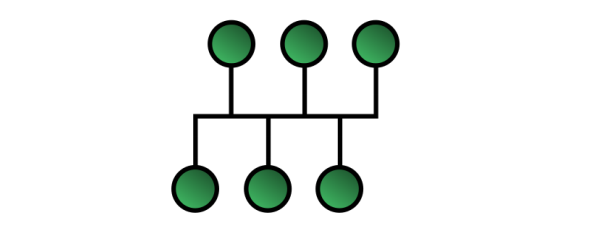
Bus topology, also known as bus network, connects nodes in a daisy chain via a linear bus sequence. Since this topology is connected by a main cable that links all computers or other network devices, it is also referred to as linear bus.
Characteristics of bus topology include: simple structure, good expandability. When a node needs to be added, it can simply connect to the main bus with a branch interface, and the bus can be expanded if the load permits; it uses less cabling and is easy to install; the devices used are relatively simple and reliable; however, maintenance is difficult, and locating faults in branch nodes can be challenging.
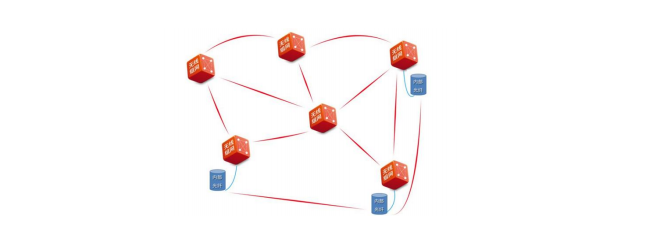
Wireless mesh networks, also known as “multi-hop” networks, are a new type of wireless network technology that is completely different from traditional wireless networks. They do not rely on a pre-set infrastructure and feature temporary networking, rapid deployment, no control center, and strong resilience.
In a wireless mesh network, a mesh topology is employed, which is a multi-point to multi-point network topology. In this mesh network structure, each network node connects to adjacent nodes via wireless multi-hop.
Download Links:
“Collection of IoT Industry Solutions (Part 1)”
1. A Brief History and Overview of IoT Development.pptx
2. IoT Industry Applications and Solutions.pptx
“Collection of IoT Industry Solutions (Part 2)”
1. Introduction to Industrial IoT Gateways.pdf
2. Introduction to IoT LPWA Communication Technology and Solutions.pdf
3. Overview of Common IoT Communication Technologies.pdf”
Introduction to IoT NB-IoT Solutions
IoT Research Framework: Everything Connected, Data-Driven Future
IoT Technology and Industry Situation
Complete Overview of the IoT Industry Chain
Collection of Enterprise Solutions Three
“Huawei Cloud Deep Learning in Text Classification Practice”
“Baidu’s Large-Scale Offline Hybrid System Architecture Evolution and Practice”
“Suning OLAP Engine Development Road”
“Tencent Cloud Data Security White Paper”
“Meituan Cluster Scheduling System HULK Technology Evolution”
“Tencent Cloud E-commerce Solution White Paper”
Collection of Enterprise Solutions Two
“Tencent Cloud Video Solutions”
“iQIYI CDN Operations Platform Practice”
“Tencent Real-Time Stream Computing Platform Evolution”
“Tencent Cloud Network and VPC Services Practice”
“Tencent’s Kubernetes-Based Enterprise Container Cloud Practice”
“Alibaba’s Next-Generation Interactive Analysis Engine Hologres”
“Core Issues and Algorithm Modeling of Alibaba 2B E-commerce”
Collection of Enterprise Solutions One
All technical materials from this account are uploaded to Knowledge Planet. Join Global Government and Enterprise Solutions (Knowledge Planet) to download all materials.
……………… End ……………
Content Disclaimer: This account focuses on sharing industry solutions, publishing content related to technical materials, white papers, reports, and solutions. If there are any copyright issues, please leave a message and provide relevant information to contact for deletion.
Friendly Reminder:Search and follow the “Global Government and Enterprise Solutions” WeChat public account, “Scan” or click “Read Original” to enter Knowledge Planet and obtain 1000+ technical solutions.