As humanoid robots transition from being “performance-oriented” to “practical,” six-dimensional force sensors, serving as the new generation of “nerve endings” for humanoid robots, are entering a period of value release. In this arms race, Keli Sensor has achieved comprehensive coverage from the robot body to the underlying key mechanical sensing components through technological accumulation and a series of strategic layouts, initially establishing a robotic sensing solution capability centered on six-dimensional force/moment sensors, integrating tactile, MEMS IMU, and other multimodal perception capabilities, laying a strong foundation for participating in the entire industrial chain competition of humanoid robots and reducing system costs.
Moreover, Keli Sensor has continuously increased its R&D investment, mastering key technologies such as structural decoupling, algorithm decoupling, high-speed sampling, and communication for six-dimensional force sensors. The newly acquired automated testing and machining equipment has been put into use, achieving fully automated calibration and testing, significantly improving product accuracy, consistency, and production efficiency, providing important assurance for subsequent mass deliveries.
The robotics business may open new growth avenues
Relying on the “Sensor Forest” strategy and the core industrial layout of robotic sensors, Keli Sensor has achieved growth in both revenue and net profit. According to Keli Sensor’s Q3 2025 report, the company’s revenue for the first three quarters reached 1.082 billion yuan, a year-on-year increase of 17.72%; the net profit attributable to the parent company was 254 million yuan, a year-on-year increase of 33.29%; the net profit excluding non-recurring items was 172 million yuan, a year-on-year increase of 8.00%. In terms of quarters, Q3 saw Keli Sensor achieve revenue of 396 million yuan, a year-on-year increase of 9.06%; the net profit attributable to the parent company was 81 million yuan, a year-on-year increase of 10.11%; the net profit excluding non-recurring items was 63 million yuan, a year-on-year increase of 7.02%.
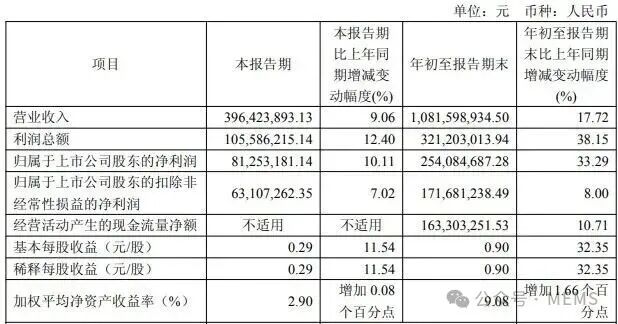
Keli Sensor’s Q3 2025 financial report
This performance growth is relatively stable, and profitability has improved. In the first three quarters of 2025, Keli Sensor’s gross margin and net margin were 44.12% and 26.93%, respectively, increasing by 0.80 and 3.25 percentage points compared to the same period in 2024, with an average return on net assets of 9.37%, an increase of 1.95 percentage points compared to the same period last year. Previously, Keli Sensor briefly pointed out in its 2025 semi-annual report that its performance growth was mainly due to the addition of consolidated subsidiaries.
Further analysis of Keli Sensor’s performance highlights includes focusing on the humanoid robot sector, completing strategic investments in multiple companies, achieving comprehensive coverage from the robot body to the underlying key mechanical sensing components; samples have been sent to over 50 robot companies, with nearly a thousand sets of six-dimensional force sensors shipped, and some have received small batch orders; new equipment has been put into use, and the development of MEMS silicon-based six-dimensional force/moment sensors is underway, enhancing product performance, accuracy, and production efficiency.
As a leading domestic strain gauge sensor company, Keli Sensor’s main business involves the research, production, and sales of strain gauge sensors, instruments, and other components, maintaining the number one market share for 15 consecutive years. Its products cover over 20 types of physical quantity sensors, including mechanics, temperature, humidity, and electrical quantity, forming a full-stack capability of “perception + algorithm + cloud platform.”
Now, with the rapid development of the humanoid robot field, Keli Sensor is implementing a systematic layout around this industrial chain, creating a “sensor + IoT” collaborative ecosystem. It has completed the development of product series for humanoid robot wrists, ankles, industrial arms, and collaborative arm ends, especially achieving a linear accuracy of 0.1% FS for six-dimensional force sensors, breaking international monopolies, and is expected to open new growth avenues through its robotics business.
It is understood that as the new generation of “nerve endings” for humanoid robots, six-dimensional force sensors are key components for solving motion control challenges. The term “six-dimensional” refers to the ability to simultaneously sense forces from the X, Y, and Z directions, as well as torques around three axes, which are essential perception dimensions for robots during actions such as grasping, twisting, and moving. For example, Tesla’s Optimus Gen 2 is equipped with four six-dimensional force sensors, 28 one-dimensional force sensors, and other tactile sensors; UBTECH’s Walker robot has four six-dimensional force sensors on its wrist and ankle.
According to a report by Bank of America global research analysts, the global shipment of humanoid robots may reach 18,000 units by 2025. Additionally, a report from CICC predicts that the penetration rate of six-dimensional force sensors in humanoid robots may exceed 30% in the future.
Despite the promising market outlook, high-precision six-dimensional force sensors have not yet become standard for robots. Amid a series of technical challenges and application hurdles, how to balance mass production capacity, cost control, and R&D investment has become an important new issue facing industry enterprises.
As Keli Sensor’s director, deputy general manager, and board secretary Ye Fangzhi stated at the Q3 2025 performance briefing, “The company will adjust production capacity in a timely manner according to industry development and customer needs.”
Currently, Keli Sensor’s automated testing and machining equipment for six-dimensional force sensors has been put into use, achieving fully automated calibration and testing, significantly improving product accuracy, consistency, and production efficiency, providing assurance for subsequent mass deliveries. Sample customers have passed testing, and orders have been completed, but there are currently no bulk orders.
Building Competitive Barriers through Systematic Layout
Although the humanoid robot market is entering a rapid growth phase, the industry has yet to form a unified standard, and customization, response speed, and platform development capabilities are becoming key competencies for related sensor companies. In the process of domestic six-dimensional force sensors approaching mass production, Keli Sensor has certain advantages due to its technological accumulation and early layout.
It is understood that in the field of six-dimensional force sensors, Keli Sensor has continuously increased R&D investment, mastering key technologies such as structural decoupling, algorithm decoupling, high-speed sampling, and communication, while actively promoting the development of MEMS silicon-based six-dimensional force/moment sensors, focusing on upgrading products towards miniaturization, high-frequency response, and embedded force control algorithm integration. Furthermore, the newly acquired automated testing and machining equipment in April 2025 has been put into use, which will provide important assurance for subsequent mass deliveries.
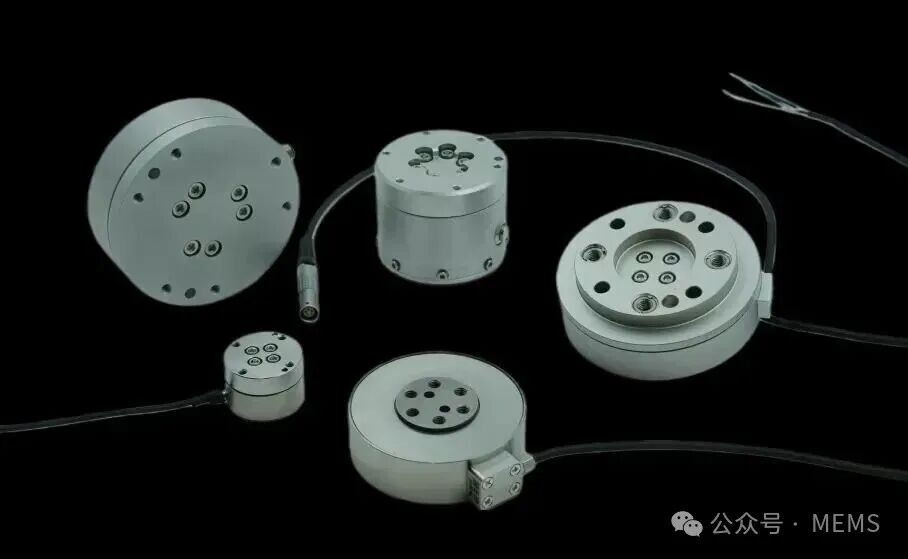
Keli Sensor’s six-dimensional force sensor
However, Keli Sensor also faces severe competitive challenges, as there are currently over a dozen A-share listed companies, including Hanwei Technology, Amperex Technology, Huapei Power, AVIC Electric Measurement, and Suochen Technology, engaged in an “arms race” in this field, and more participants are expected to enter the market.
Among them, Donghua Testing’s six-dimensional force sensors are in the small batch trial production stage; Minxin Co., Ltd. has initiated the R&D project for six-dimensional force sensors, MEMS IMUs for robots, and glove-type pressure and temperature sensors, actively promoting technical exchanges and product application with related manufacturers; Amperex and other manufacturers’ six-dimensional force sensors are still in the sample development stage, with relevant patents approved, and are expected to advance to the delivery process; AVIC Electric Measurement has made significant technological progress in the development of six-dimensional force sensors; Jiuding Investment has cross-industry acquired Nanjing Shenyuan, which has six-dimensional force sensor development capabilities.
Additionally, it is worth noting that Landian Touch recently completed a C-round financing of over 100 million yuan, focusing on product R&D, capacity enhancement, team building, and overseas market expansion. It is reported that Landian Touch’s six-dimensional force sensor shipments have exceeded 10,000 sets, accounting for 80% of the domestic humanoid robot shipment volume, with products widely used in humanoid robots, collaborative robots, and industrial robots across various scenarios.
However, even though domestic companies have made multi-dimensional breakthroughs in technology R&D, continuously improving precision, stability, and reliability, the total sales volume of six-dimensional force sensors remains low, with complex production processes and high costs, making cost reduction a pressing demand in the industry. The company that can lower the cost of six-dimensional force sensors may gain an advantage in the “arms race.”
It is understood that there is currently a significant price difference for six-dimensional force sensors. The unit price of imported brands typically ranges from 20,000 to 100,000 yuan, while domestic mid-to-high-end products are priced between 10,000 and 50,000 yuan. Given that the price level of six-dimensional force sensors will largely depend on the scale of production, Keli Sensor’s full-stack technological accumulation and mass production assurance layout will provide it with a certain competitive advantage.
However, some industry analysts have stated that the current force sensor sector has not yet entered a phase of price competition and market share grabbing, and core component manufacturers still have a certain degree of bargaining power, with the entire industry still in a “joint battle” phase. In this process, companies with R&D strength and rapid delivery capabilities will occupy a more favorable position in the future humanoid robot supply chain.
In this regard, Keli Sensor’s implementation of a systematic layout will also provide it with considerable competitiveness, having completed strategic investments in humanoid robot body companies—Kepler Humanoid Robots, tactile sensor companies—Tashan Technology, and leading MEMS inertial measurement unit (IMU) companies—Wuxi Beimi Sensor in the first half of the year, achieving comprehensive coverage from the robot body to the underlying key mechanical sensing components, initially establishing a robotic sensing solution capability centered on six-dimensional force/moment sensors, integrating tactile, IMU, and other multimodal perception capabilities, laying a strong foundation for participating in the entire industrial chain competition of humanoid robots and reducing system costs.
Further Reading:
“Robot Sensor Technology and Market – 2022 Edition”
“Sensor Technology and Market – 2024 Edition”
