According to reports from Electronic Enthusiasts (by Zhou Kaiyang), the growth rate of RISC-V in recent years is undeniable, as evidenced by the increasing number of manufacturers launching chips based on this architecture. At this year’s RISC-V Summit, RISC-V International CEO Calista Redmond announced the latest data from the end of 2022.Currently, RISC-V has attracted 3,180 members from over 70 countries, achieving a 26% growth in 2022, with two new members joining on the morning of the RISC-V Summit. RISC-V has also expanded into rapidly growing markets such as automotive and data centers, and even in Google’s Tensor smartphone SoC, there is a RISC-V security chip called Titan M2.However, a significant piece of news was revealed at this summit: Qualcomm has seized the initiative in the mobile market with RISC-V. The Snapdragon 865, released at the end of 2019, has already integrated a RISC-V MCU. The progress of RISC-V in the mobile market may exceed your expectations.
Qualcomm: Quietly Becoming a RISC-V Giant
Speaking of Qualcomm, the company has long had intricate ties with RISC-V behind the scenes. Firstly, Qualcomm is one of the founding members of RISC-V International and is also a top-tier platinum member of the foundation. In June 2019, Qualcomm participated in the D-round financing of the well-known RISC-V company SiFive. In 2020, SiFive recruited Qualcomm executive Patrick Little as its new CEO.So why would Qualcomm, which has been deeply entrenched in the processor market for many years, choose to use RISC-V? Qualcomm’s product management department head Manju Varma stated that Qualcomm needs customizable designs that meet specific requirements while also being compact, and existing traditional architectures can no longer meet these needs. This is why Qualcomm chose to introduce the RISC-V MCU.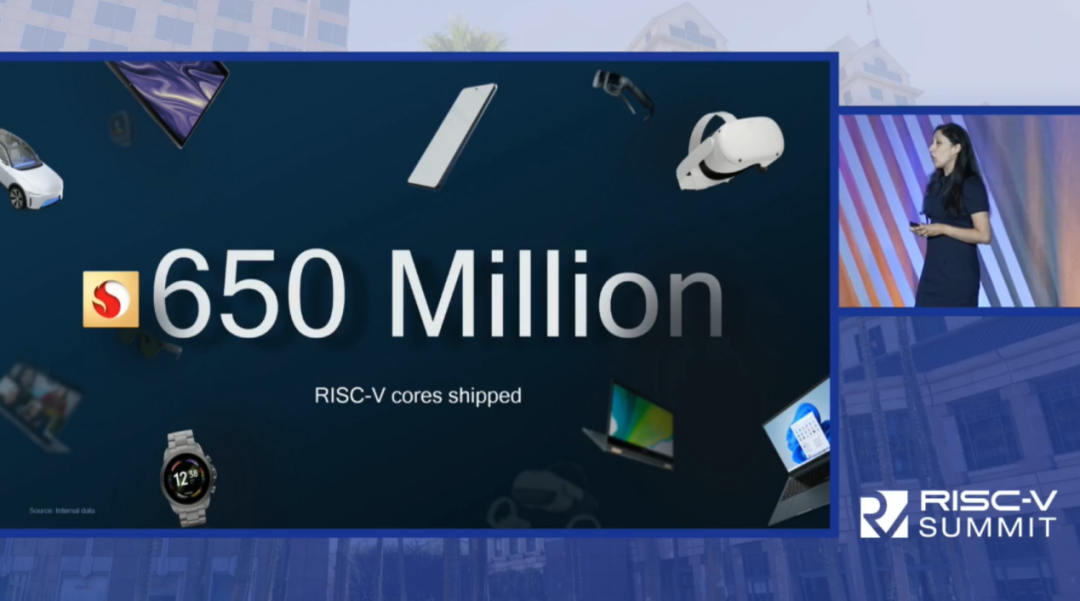 Qualcomm has made it clear that the Qualcomm SoCs equipped with RISC-V MCUs have not only entered the mobile market but have also appeared in PCs, automotive, AR/VR, and wearable markets. According to Qualcomm’s internal data, the number of RISC-V cores shipped has reached 650 million, and Qualcomm views RISC-V as one of its core technologies, planning to continue expanding this shipment number. Thus, Qualcomm has quietly become a RISC-V giant, making a significant contribution to the hundreds of millions of RISC-V core shipments.Among the members of RISC-V International, apart from investment institutions, almost all have participated in the development of RISC-V, whether in software or hardware. However, before this significant news was released, Qualcomm had been relatively silent in the RISC-V ecosystem, leading many to speculate that Qualcomm might be waiting for the RISC-V ecosystem to mature before entering the market.But the current reality proves that Qualcomm has taken the lead by integrating RISC-V cores into the mobile market, even extending to automotive, XR, and IoT markets. After all, Qualcomm’s XR2, QRB5165, and other SoC platforms are all based on the Snapdragon 865.This was not without warning; during one of the few RISC-V events Qualcomm participated in, information was revealed. At the 2020 RISC-V Summit, RISC-V International CEO Calista Redmond interviewed Qualcomm’s former senior product management director Travis Lanier, who stated, “RISC-V is Qualcomm’s second-largest CPU source, and RISC-V has been integrated into all of Qualcomm’s embedded use cases, and the first chip equipped with a RISC-V core has been launched,” which we now know is the Snapdragon 865. He also mentioned that in a few years, any chip purchased from Qualcomm and your smartphone would be equipped with a RISC-V processor, indicating that Qualcomm is still fulfilling this promise.However, Manju Varma also expressed some views on the current RISC-V ecosystem. Currently, RISC-V’s innovation capabilities in the application processor field are indeed rising, but to avoid ecosystem fragmentation, system IPs compatible with RISC-V, such as interrupt controllers, IOMMU, power management, and security, need a certain level of standardization.
Some Speculations
Although Qualcomm did not specify where the RISC-V core is used in the Snapdragon 865 SoC, it is unlikely to be in the CPU or GPU. Considering Qualcomm’s statement that “the Snapdragon 865 is the first Qualcomm SoC to use a RISC-V MCU,” we can compare the Snapdragon 865 with its predecessor, the Snapdragon 855, and it is likely that the RISC-V core is used in the Hexagon DSP within the Snapdragon SoC. After all, as an important component of its extensive SoC lineup’s AI engine, integrating a RISC-V core to achieve higher performance at lower power consumption is a foreseeable choice.Furthermore, whether this RISC-V core is developed in-house by Qualcomm or licensed from third-party IP vendors like SiFive is still uncertain. The author’s guess leans towards the latter, as Qualcomm and SiFive have such a close relationship, and SiFive mentioned collaborations with Qualcomm and Samsung during their presentation at the RISC-V Summit, clearly marking the Qualcomm Snapdragon logo. As for the IP used, it is unlikely to be SiFive’s high-performance P series processors; it is more likely to be the VI series, which focuses on low-power AI.
What is the Progress of Android Porting?
For RISC-V to expand into the mobile market, hardware support alone is far from sufficient; software must also keep pace, such as support for the Android system. In terms of Android porting development, the most notable demonstration has come from Alibaba’s T-head, which showcased an Android 12 demo on a RISC-V hardware platform in the first quarter of this year, achieving support for multimedia, camera, Wi-Fi/Bluetooth, and neural networks.In the demo, T-head successfully ran TensorFlow Lite on the Android 12 system based on the Xuantie C910 hardware platform, indicating that most of the system features of Android can now be enabled on RISC-V, and related software development work is still ongoing.However, there is still a difference between being usable and being user-friendly. According to T-head’s sharing, the progress of RISC-V in Android porting has reached the third stage after basic support from the RVB-ICE development board and the implementation of basic software features, which is upstream support for the Android source code.
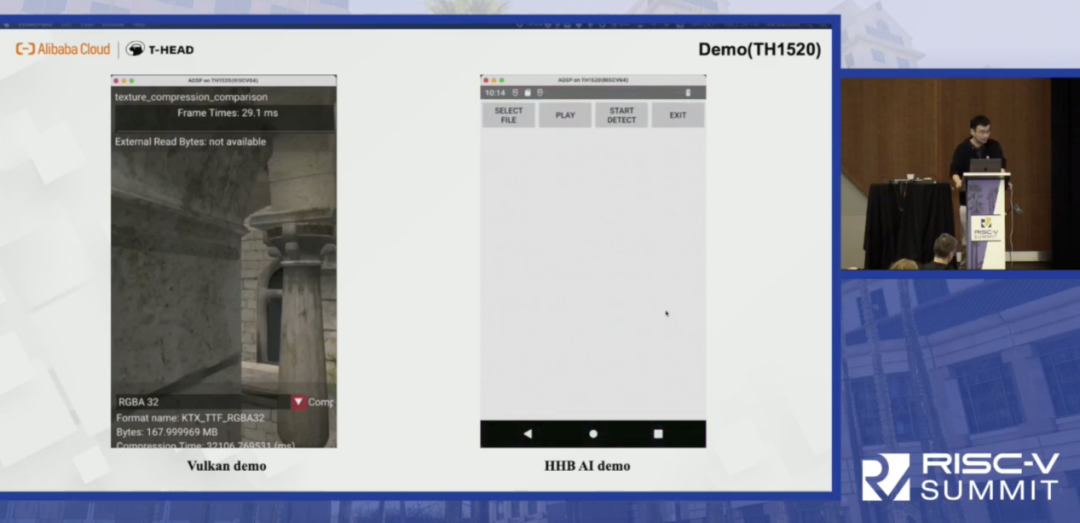
Vulkan and HHB AI demonstration on the Yiying 1520 SoC / T-headIn September of this year, AOSP’s upstream support for RISC-V has been initiated, with Google agreeing to incorporate the porting code submitted by T-head into the source code. However, RISC-V still faces significant challenges in Android porting, such as the need for substantial investment to support the vast number of third-party projects within the Android ecosystem, including third-party libraries like FFMPEG, OpenCV, third-party SDKs like JetPack, Unity, and third-party apps like Alipay and Douyin.To overcome this challenge, the best approach is to support popular third-party projects in an open-source manner, encouraging more developers to engage in RISC-V porting. In addition to T-head, companies like Jian Shi Technology, Entropy Core Technology, the Software Institute of the Chinese Academy of Sciences PLCT Laboratory, and Pengfeng Technology have also contributed their efforts. After all, for most commercial companies, it is unrealistic to allocate their limited software development resources entirely to RISC-V porting; leveraging the power of open source aligns well with the characteristics of RISC-V itself.The next stage will involve developing Android systems for different scenarios, such as smart homes, automotive, televisions, etc., which require support for customized launchers, IoT protocols, and more hardware abstraction layers. Finally, certified RISC-V Android products will be launched, and only by successfully running stability, performance verification, and optimization processes can a smooth Android system experience be provided.
Conclusion
Despite Qualcomm and Google’s investments in mobile SoCs, RISC-V has not yet become a major player in mobile computing. However, as the RISC-V ecosystem continues to grow, the range of workloads that RISC-V can handle will also increase, ultimately achieving more comprehensive application coverage. Integrating RISC-V cores into mobile SoCs is just the beginning. As for the software development project of Android porting, it still requires collective efforts to bring more manufacturers on board, which will accelerate the implementation process and keep pace with the existing Android development ecosystem.

Disclaimer: This article is originally from Electronic Enthusiasts, please indicate the source when reprinting. For group discussions, please add WeChat elecfans999, for submission, interview requests, please email [email protected].
More Hot Articles to Read
- Investing $90 billion! Tata Group’s semiconductor investment surpasses US and EU subsidies, will India’s semiconductor manufacturing become a reality?
- The world’s first C919 officially delivered, behind it is the rise of China’s manufacturing industry
- Chartering to sea to secure a $1 billion order! Face-to-face communication with enterprises may be more beneficial for electronic product exports!
- Can Arm, with its hundreds of billions of chip shipments, dominate the PC market?
- Taiwan Semiconductor Manufacturing Company and the expensive “Made in America”: $40 billion investment with less than 5% subsidy