Introduction to Four Common Pressure Sensor Chip Principles and Applications
Mainly includes:MEMS technology, oil-filled medium isolation, ceramic capacitive technology, and glass micro-fusion technology. These four solutions leverage their respective advantages for different ranges and application scenarios, forming a technical route that covers all application scenarios of Lingke pressure sensors.
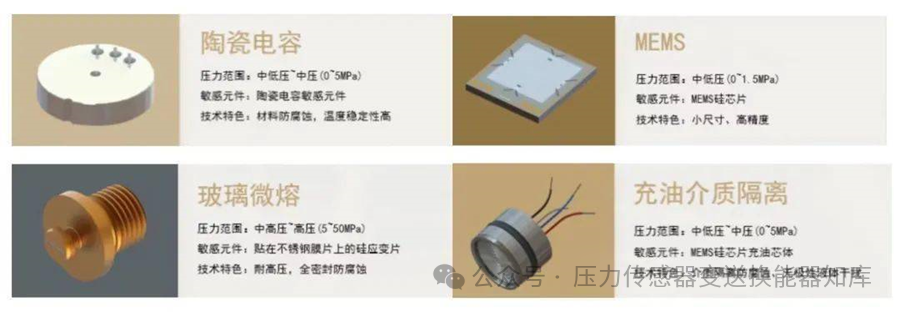
The MEMS pressure sensor chip is made using silicon MEMS technology. When pressure acts on the MEMS sensing diaphragm, the diaphragm deforms, causing a change in resistance in the piezoresistive strips placed on it, which generates an output from the Wheatstone bridge formed. This output is then processed through temperature compensation or conditioning circuits to provide the required electrical signal.
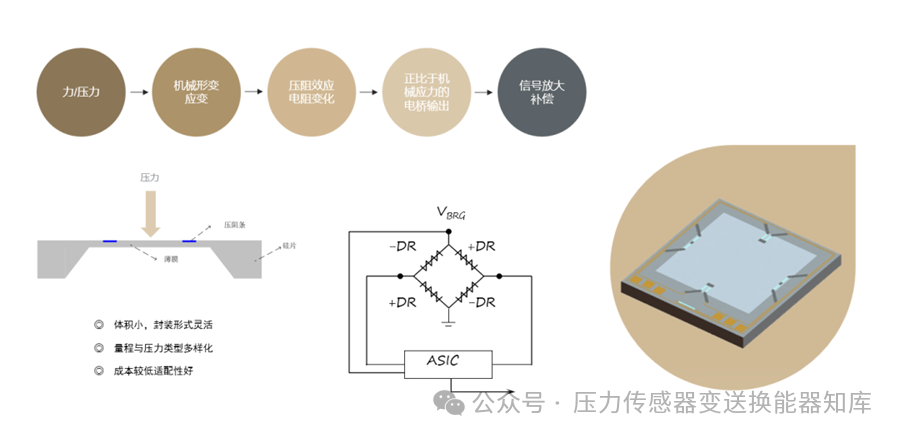
Principle of MEMS Pressure Sensors
The oil-filled medium isolation core adds comprehensive protective encapsulation based on the MEMS chip, forming a special packaging method that prevents the measuring medium from directly contacting the MEMS chip. Generally, we use a metal corrugated diaphragm as the pressure sensing diaphragm, utilizing silicone oil or fluorinated oil to transmit pressure and serve as the chip protection material. This type of core is commonly used in more complex or harsh measurement environments.
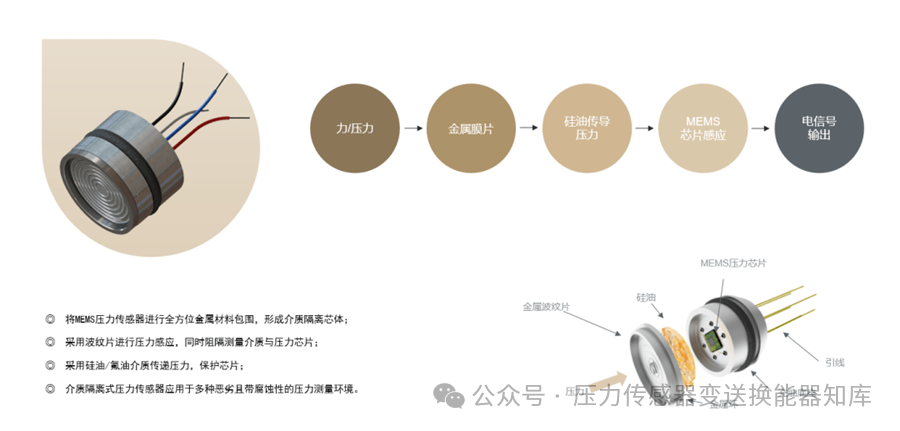
Principle of Oil-Filled Medium Isolation Pressure Sensors
The ceramic capacitive pressure sensor core differs from the aforementioned MEMS type sensors, using a ceramic diaphragm as the pressure sensing material. It forms a parallel plate capacitor with the metal layer on the substrate. When the sensing diaphragm is subjected to pressure, the capacitance changes, and after signal processing, outputs pressure-related signals. Ceramic capacitive pressure sensors have inherent medium compatibility and temperature stability.
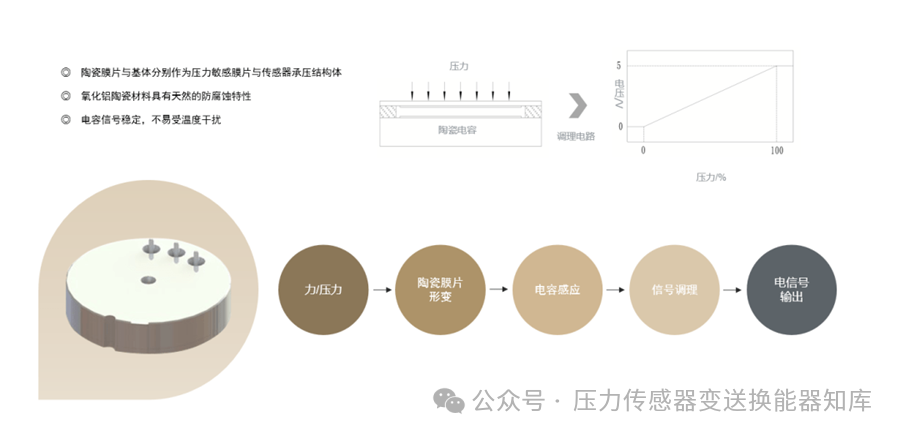
Ceramic Capacitive Pressure Sensors
The glass micro-fusion pressure sensor is a sensor core designed for high-pressure applications. Pressure causes deformation on the surface of the metal cup, which is transmitted through micro-fused glass to the silicon strain gauge at the top, generating an output similar to that of a MEMS sensor bridge. This technology can achieve measurements of over 200Mpa high pressure, and the all-metal sealed structure ensures there is no risk of leakage.
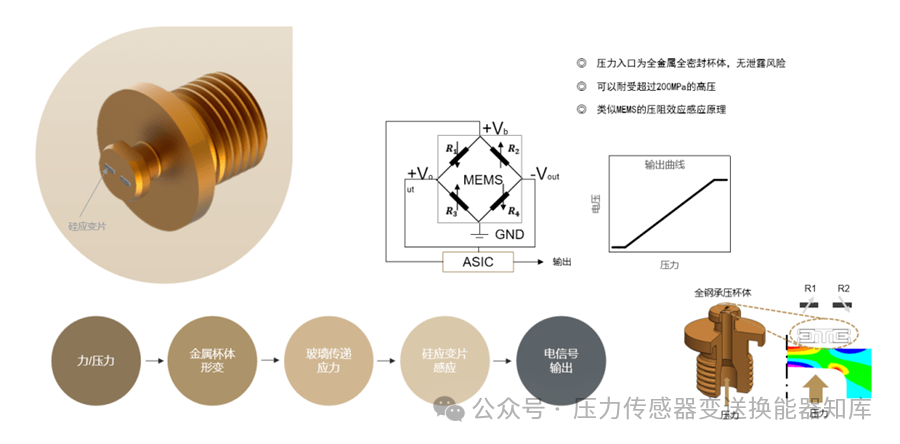
Glass Micro-Fusion Pressure Sensors