Click the blue text to follow us

Today’s Question
- In the last discussion on Bayesian methods Intelligent Connected Vehicles: Daily Question | Fundamentals of Multi-Sensor Fusion Algorithms (II): Multi-Bayesian Estimation, How to Quantify Fusion Decisions Under ‘Uncertainty’?, we mentioned that it must assign probabilities to explicit hypotheses (such as ‘there is a car’ or ‘there is no car’). But if the information provided by the sensors is itself ambiguous or even points to an ‘unknown’ answer, we needD-S evidence theory. So how does it handle this ‘uncertainty’ and ‘conflict’ in fusion?
-
A One-Sentence Answer
D-S evidence theory addresses this by introducing an ‘uncertain’ option and utilizing basic probability assignment, trust functions, and plausibility functions to describe evidence. It then uses the Dempster’s combination rule to proportionally convert conflicting evidence into support for consensus hypotheses, thus achieving more flexible and robust fusion decisions in the face of incomplete, imprecise, or even strongly conflicting information.
-
Detailed Interpretation
Unlike Bayesian theory, which must allocate 100% of the probability to explicit hypotheses, D-S evidence theory allows us to retain a portion of ‘trust’ for the ‘uncertain’ set. The core idea is: we do not always know the ‘exact state of the world’, but we can know ‘what we believe’ and ‘what we doubt’.Assume an autonomous vehicle’s millimeter-wave radar and visual camera perceive a blurry target ahead in foggy conditions. Now we need to use D-S evidence theory to determine what it is—
- Recognition Framework: A List of All Possible Answers
The recognition framework is the foundation of D-S, referring to the ‘set of all possible environmental states’—essentially defining the discussion scope for the ‘arguments’ of the sensors, avoiding meaningless divergence. For the above scenario, we define the recognition framework: Θ = {car, pedestrian, bicycle}.
- Basic Probability Assignment (BPA): Assigning ‘Trust Values’ to Each ‘Claim’, Summing to 1
BPA is the ‘trust allocation’ of each sensor for each proposition, assigning a probability mass to any subset of the recognition framework, indicating the degree to which the evidence directly supports that subset. The key is that we can assign mass to {car}, {car, pedestrian} (indicating ‘either a car or a pedestrian’), or even the entire framework Θ (indicating ‘completely unknown’). The sum must equal 1—equivalent to each sensor ‘voting’, not only for ‘which answer to support’ but also for the proportion of ‘uncertainty’.Millimeter-wave radar (based on motion characteristics): It determines that the target is moving very fast and has a strong metallic reflection signal, ruling out pedestrians or bicycles, and considers it a car. m₁({car}) = 0.9 (90% trust in the car option), m₁(Θ) = 0.1 (10% uncertainty).Visual camera (foggy imaging distortion and misjudgment): It analyzes the blurry outline and determines that the target has an elongated shape, considering it a pedestrian. m₂({pedestrian})=0.8 (80% trust in the pedestrian option), m₂(Θ)=0.2 (20% uncertainty).
- Dempster’s Combination Rule: The Core ‘Conflict Resolution Formula’
When multiple sensors (i.e., multiple pieces of evidence) arrive, D-S theory fuses them using Dempster’s combination rule. The core idea is: to find consensus among the evidence and proportionally redistribute the conflicting parts to the hypotheses that achieve consensus. For the probabilities given by the two sensors, we create a fusion table, multiplying the probability masses of the two sensors pairwise: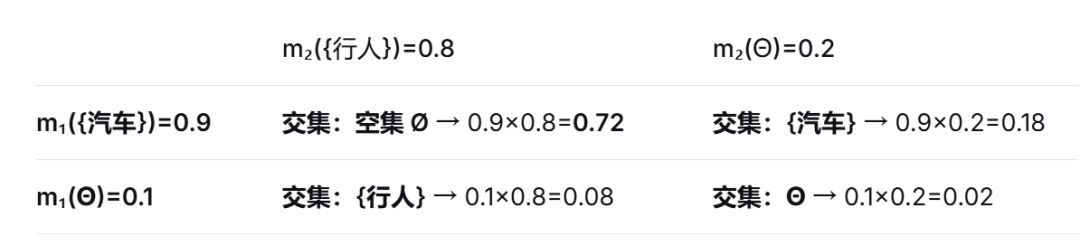 (Table Probability Fusion Table)Identifying Conflicts: When the radar strongly supports {car} and the camera strongly supports {pedestrian}, their intersection is the empty set Ø. This 0.72 mass is the conflict part, i.e., calculating the conflict coefficient K=0.72. Apart from the conflict of 0.72, the remaining mass is the part where the sensors reach consensus or are not in conflict.Calculating the Consensus Part: The total consensus mass = consensus supporting {car} 0.18 + consensus supporting {pedestrian} 0.08 + consensus supporting Θ (completely unknown) 0.02 = 0.18 + 0.08 + 0.02 = 0.28Redistributing Conflict Mass (Normalization): Each consensus mass is divided by (1-K), thus proportionally distributing the 0.72 conflict mass according to their respective consensus.m({car}) = 0.18/(1-0.72) = 0.18/0.28 ≈ 64.3%m({pedestrian}) = 0.08/(1-0.72) = 0.08/0.28 ≈ 28.6%m(Θ) = 0.02/(1-0.72) = 0.02/0.28 ≈ 7.1%
- Trust Functions and Plausibility Functions: Quantifying ‘Certainty’ and ‘Possibility’
Based on the fused basic probability assignment, we calculate the trust function (the minimum trust level for a certain hypothesis) and plausibility function (the maximum possible trust level for a certain hypothesis) for key hypotheses, both forming a trust interval. The larger the interval, the higher the uncertainty.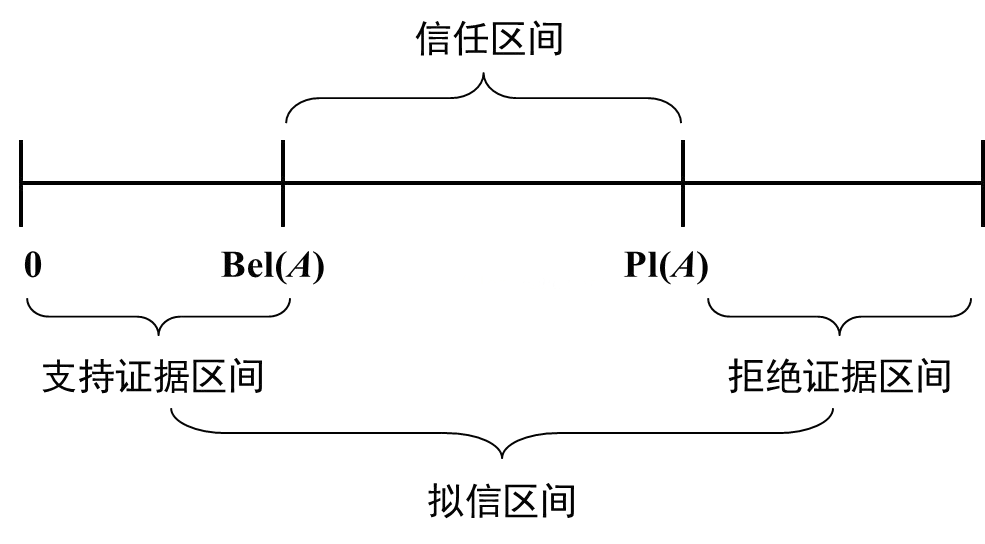 (Figure Trust Interval Diagram)For the hypothesis {car}:Trust function Bel({car}): This is the minimum certainty that ‘the target is a car’. It equals the sum of the masses directly supporting {car} and its subsets. Since {car} itself has no smaller subsets, we have: Bel({car}) = m({car}) = 0.643Plausibility function Pl({car}): This is the maximum possibility that ‘the target is a car’. It equals the sum of the masses that are not in conflict with {car}. Which sets are not in conflict with {car}? {car} itself, {car, pedestrian}, {car, bicycle}, and Θ. In our results, only {car} and Θ are not in conflict with {car} (because sets like {car, pedestrian} have not been directly assigned mass). Therefore, Pl({car}) = m({car}) + m(Θ) = 0.643 + 0.071 = 0.714For the hypothesis {pedestrian}:Bel({pedestrian}) = m({pedestrian}) = 0.286Pl({pedestrian}) = m({pedestrian}) + m(Θ) = 0.286 + 0.071 = 0.357Thus, we obtain two key trust intervals:Car: [0.643, 0.714]Pedestrian: [0.286, 0.357]This means the system is at least 64.3% confident that the target is a car (Bel). At the same time, it is at least 28.6% confident that the target is a pedestrian. This ‘at least’ comes from the direct support of the evidence. The possibility that the target is a car can reach a maximum of 71.4% (Pl), while the possibility that the target is a pedestrian can only reach 35.7%. This ‘maximum possibility’ is due to the 7.1% ‘unknown’ mass (m(Θ)) potentially falling on either side.Although the two sensors are in severe conflict, the fusion tends to ‘the front is a car (64.3%)’, while retaining the low trust in ‘pedestrian (28.6%)’ and the risk of ‘unknown (7.1%)’—not blindly trusting the millimeter-wave radar nor being misled by the camera’s misjudgment, while also reserving safety redundancy for decision-making. When the uncertain probability exceeds a certain threshold, the system will take defensive measures, such as degrading, slowing down, or activating redundant perception.This result reveals the wisdom of D-S theory in the face of conflict: (1) Effectively handling conflicts: Despite the significant direct conflict (72%) between sensors, the combination rule does not simply discard this information. (2) ‘Winner Takes All’ Effect: In conflict distribution, hypotheses with higher consensus quality originally will receive more conflict distribution. The radar’s belief (and the consensus with the camera’s uncertainty) itself carries more weight, thus winning in conflict. (3) Flexibly expressing uncertainty: It can directly handle ambiguous information of ‘unknown’ and ‘could be A or B’, and the fusion process itself will reduce the overall confusion of the system. (4) Quantifying belief ranges: Providing a more comprehensive decision basis through trust intervals than a single probability.D-S evidence theory provides a powerful mathematical tool for autonomous driving in scenarios of ‘unknown’ and ‘conflict’, such as extreme weather, limited sensor performance, or encountering unprecedented objects, allowing the system to more honestly and robustly assess environmental threats. However, D-S evidence theory has high computational complexity, as the number of subsets grows exponentially with the increase in elements in the recognition framework. Additionally, if one sensor is very unreliable and overly confident, while the consensus quality provided by other sensors is very small, the normalized result may be dominated by that unreliable sensor, posing a ‘veto risk’.
Next Issue Preview
In the next issue, we will explore:《Fundamentals of Multi-Sensor Fusion Algorithms (IV): Fuzzy Logic Reasoning, How to Handle Fusion Decisions of ‘Fuzzy Information’? Stay tuned!
Feel free to leave comments:
- In the high-conflict case just mentioned, if the camera’s uncertainty m₂(Θ) increases to 0.5 due to lens contamination, how do you think the fusion result will change?
- Which do you think is more important in autonomous driving decision-making: ‘acknowledging ignorance’ or ‘forcing a judgment’?
- Can you think of daily decision-making scenarios that would also be suitable for using D-S theory (considering multiple possibilities and uncertainties) to assist judgment?
If you find this article helpful, please like, bookmark, and share to help more people understand how autonomous driving navigates ‘unknowns’ and ‘conflicts’!
END
Editor | Li Meifang
Reviewer | Zheng Yanlin