Apple Inc. has recently obtained a patent for a wearable health sensor, which proposes a system designed to enhance the accuracy of health monitoring data by filtering out environmental noise. This addresses the issue of data collection interference that wearable devices face in complex daily environments, such as during exercise or commuting.
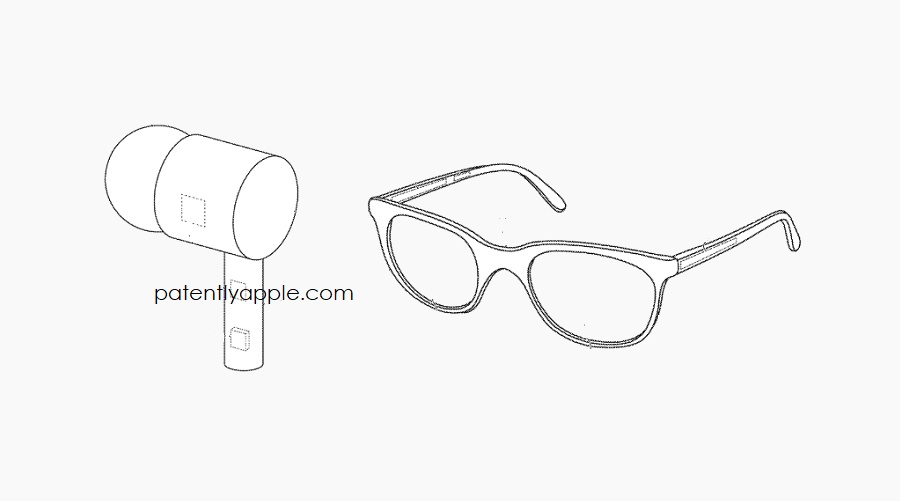
Image Source: Patently Apple
According to the patent document, the key to the system lies in its dual sensor design, which operates as follows:
-
First Sensor (Physiological Signal Sensor): This sensor is designed for direct contact with the user’s skin to detect physiological signals such as heart rate, respiratory rate, and blood oxygen levels.
-
Second Sensor (Environmental Noise Sensor): This sensor is used to monitor mechanical waves in the external environment, specifically vibrations and interferences caused by user activity or external surroundings.
The system’s controller processes data from both sensors simultaneously. The design concept is to separate or subtract the environmental noise data captured by the second sensor from the mixed signals (physiological signals + noise) collected by the first sensor, thereby extracting a purer physiological signal. This method aims to enhance the reliability of health monitoring results when the device is in a non-static state.
The patent document outlines potential applications of this technology across various Apple devices, including:
-
Apple Watch: The sensors could be designed into the back of the watch and the strap, working together to distinguish between interference caused by wrist movements and genuine physiological signals.
-
AirPods: The concept includes integrating sensors into the headphones, allowing them to monitor some physiological information while playing audio, filtering out noise interference from walking or head movements.
-
iPhone & iPad: The patent also mentions the possibility of embedding sensors within the device casing or screen for opportunistic monitoring while the user holds or uses the device.
-
Future Smart Glasses: The concept envisions placing sensors in the frame or temples to track biometric features by contacting the skin at the user’s temples and behind the ears, while maintaining a stylish and lightweight appearance.
The document mentions that various types of sensors, such as piezoelectric, polyvinylidene fluoride (PVDF), and acoustic sensors, may be utilized to achieve the aforementioned functions.
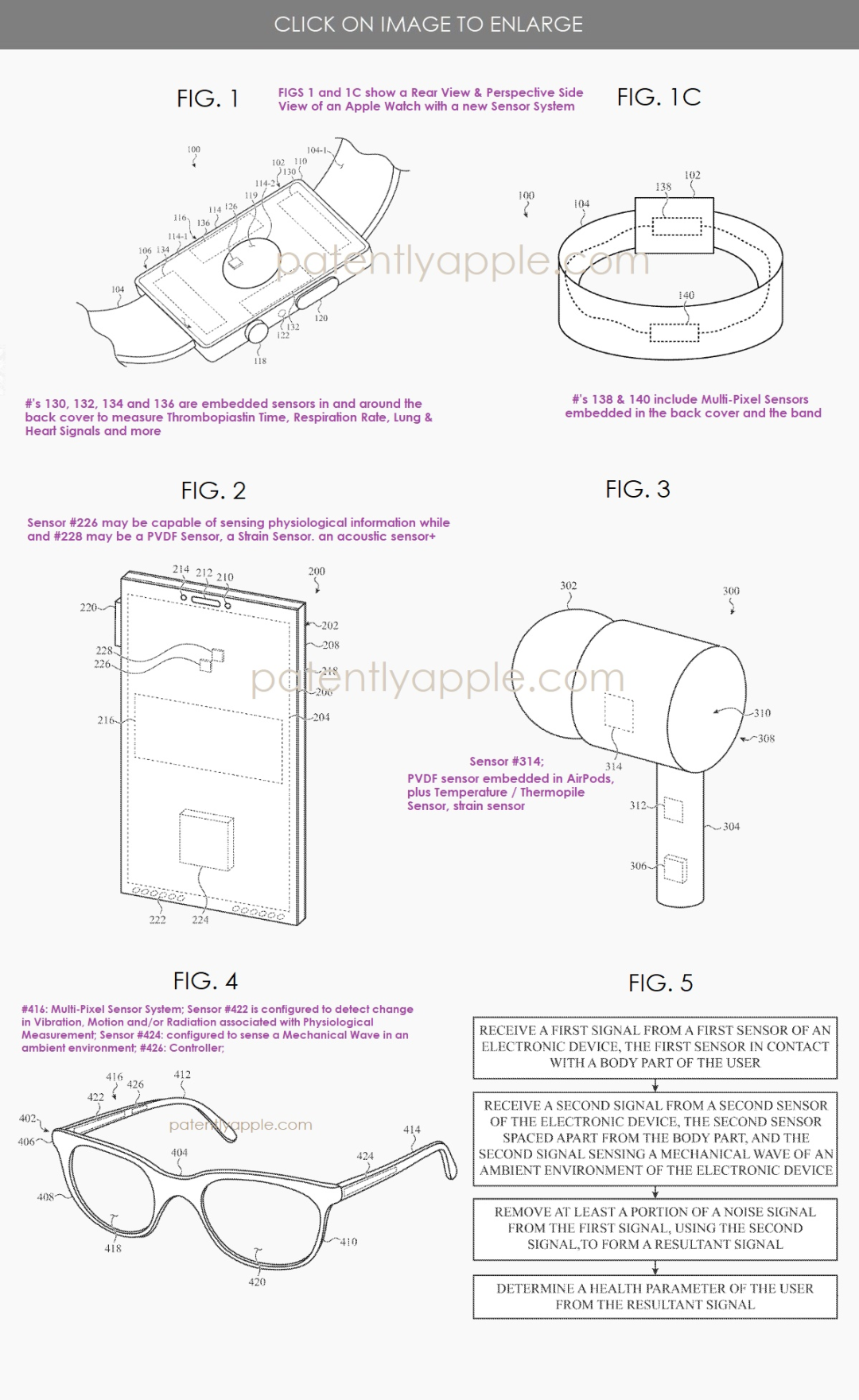
Image Source: Patently Apple
By improving signal quality, this patent envisions the possibility of monitoring various health parameters. In addition to conventional metrics such as heart rate, respiratory rate, and blood oxygen saturation, the document also mentions indicators like Ballistocardiography (BCG) and Seismocardiography (SCG) for assessing cardiovascular function, and explores the potential for more complex metrics like blood glucose levels.
The patent also considers power consumption and privacy issues in real-world applications. It notes that using non-optical sensors like PVDF can help reduce power consumption, making them more suitable for scenarios requiring long-term continuous operation. The patent content also includes clauses regarding data processing and user privacy protection, aligning with Apple’s existing privacy protection strategies.
Overall, this patent describes a technical solution aimed at addressing the “signal noise” problem in wearable devices. Its core value lies in the combination of hardware (dual sensors) and algorithms, attempting to enhance the purity of signals at the source of data collection.
If this technology can be successfully implemented and applied, it will provide technical insights for Apple to integrate more reliable health monitoring features across multiple devices in the future.
It is important to note that obtaining a patent does not mean that the technology will be immediately or necessarily applied to future products. It more so indicates the company’s investment in research and development in a particular technological direction and future planning. A technology must overcome numerous engineering, cost, and user experience challenges before it can transition from patent to mature commercial application.
About Us
China Science and Technology Intellectual Property was established in 2021 and is a knowledge property service company under the Suzhou Industrialization Base of the Institute of Acoustics, Chinese Academy of Sciences. It is dedicated to providing sustainable intellectual property services that create commercial value for clients from a business perspective. The team consists of intellectual property consultants, patent agents, and high-end talents from various fields, familiar with intellectual property laws and practices in regions such as China, the US, Europe, Japan, and South Korea, with a technical knowledge reserve in acoustics and an average of over 10 years of industry experience, providing comprehensive intellectual property strategy consulting and solutions for innovative teams.
Business Cooperation
Copyright Statement
All images and text in this article are copyrighted by China Science and Technology Intellectual Property.
For reprints or media cooperation, please contact us. Scan or email us to contactChina Science and Technology Intellectual Property[email protected]