
As the construction industry transitions towards sustainability, automation, and digitalization, polymer composites (PCs) combined with 3D printing technology are becoming a significant driving force for innovation in civil engineering. This technology not only enables the efficient manufacturing of complex engineering structures but also significantly reduces material waste, providing new possibilities for future infrastructure development. This article systematically explores the current applications, practical cases, and future development trends of polymer composites in 3D printing, based on the latest research published in the journal “Automation in Construction,” and analyzes the current technical bottlenecks and solutions.
1.Material Systems and Printing Technologies
1. Classification of Polymer Matrices
In terms of material selection, polymer composites are mainly divided into thermoplastic and thermosetting categories. Thermoplastic polymers such asPLA, ABS, PEEK, etc., are preferred materials for 3D printing due to their recyclability and ease of processing. Among them, PLA, as a biodegradable material, has environmental advantages but exhibits poor heat resistance and impact resistance, necessitating performance enhancement through modification techniques. In contrast, ABS, with its excellent impact resistance and higher glass transition temperature, is more suitable for outdoor structural components. High-performance materials like PEEK and ULTEM are widely used in infrastructure projects under extreme conditions due to their outstanding high-temperature resistance, mechanical strength, and chemical stability. Thermosetting polymers are formed through photopolymerization techniques (such as SLA/DLP), which, while possessing excellent heat resistance and dimensional stability, are difficult to recycle due to their irreversible cross-linked structure, limiting their application in sustainable construction. Additionally, the introduction of recycled polymers such as PET and HDPE further reduces environmental burdens, but the performance degradation issues caused by multiple processing still need to be addressed.
2. Reinforced Composites
In terms of reinforcement materials, fiber-reinforced polymer (FRP) composites stand out. Glass fiber (GFRP) is an ideal choice for cyclic load structures due to its high cost-performance ratio and excellent fatigue resistance. Carbon fiber (CFRP), with its extremely high strength-to-weight ratio and low thermal expansion coefficient, occupies an important position in precision structural components. Meanwhile, the introduction of natural fibers (such as bamboo and hemp) endows composites with biodegradable characteristics, but issues of moisture resistance and weather resistance still need to be overcome. The addition of particle-reinforced materials such as silica and alumina further enhances the stiffness and wear resistance of composites, while the introduction of carbon-based materials improves electrical conductivity, providing possibilities for the development of multifunctional structures.
3. Large Component Printing Technologies
In the field of large component manufacturing,3D printing technology demonstrates unique advantages. Extrusion-based printing (E3DP) is currently the most widely used technology in civil engineering applications, capable of processing concrete, ceramics, and various thermoplastics to meet the manufacturing needs of large-scale structures. Binder jetting technology effectively avoids thermal deformation issues by layer-bonding powder materials (such as gypsum and cement). The introduction of robotic manufacturing systems (RLFAM) enables support-free printing of complex geometries through multi-axis robotic arms and supports continuous fiber reinforcement, opening new avenues for the manufacturing of high-performance structures.
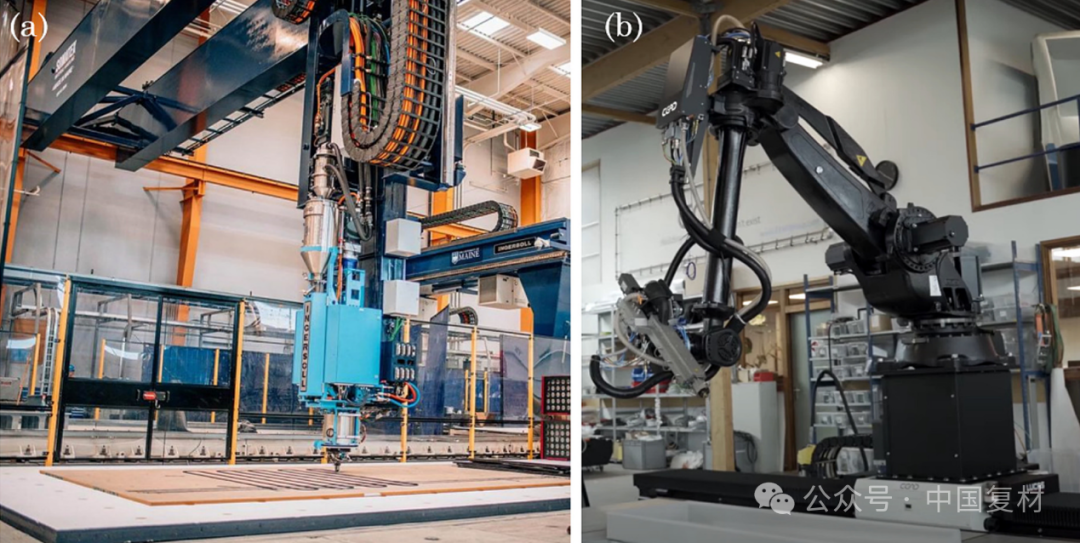
Figure1 (a) The world’s largest polymer 3D printer developed by the Advanced Structures and Composites Center at the University of Maine, (b) CEAD’s Flexbot large robotic 3D printing and milling system
2. Innovative Application Cases
1. Bridge Engineering
Practical engineering cases fully demonstrate the immense potential of this technology. In bridge construction, a 6.5-meter span pedestrian bridge in Rotterdam, Netherlands, was printed using glass fiber-reinforced PET material, achieving a 50% reduction in carbon footprint while exhibiting excellent durability. The Liuyun Bridge project in China used ASA-3012 material to complete the printing of a 17.5-meter long bridge in just 35 days, withstanding severe environmental tests.
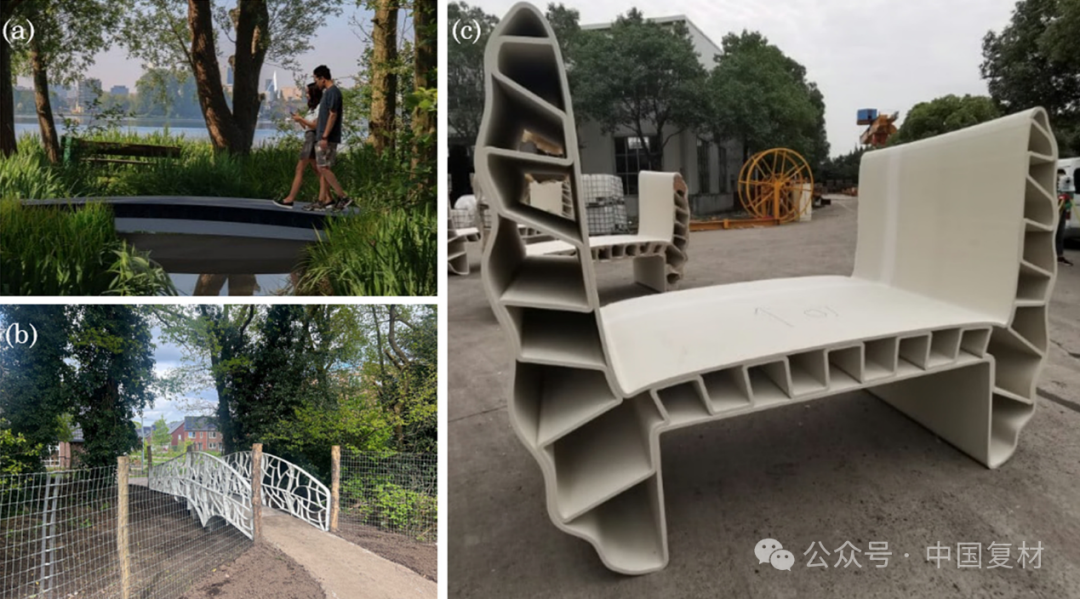
Figure2 3D printed fiber-reinforced composite cases: (a) Rotterdam pedestrian bridge, (b) Limburg pedestrian bridge in the Netherlands, (c) 3D printed FRP components of the Liuyun Bridge in China
2. Architectural Structures
In the architectural field, the BioHome 3D project in the United States printed using 100% wood fiber and bio-resin, completing the entire construction in just 48 hours, with all materials being recyclable. The Jindi modular housing project in Australia innovatively used recycled plastics as core materials, coated with cement, addressing plastic pollution while meeting fire safety requirements. The 3D printed tiny houses developed by Azure in Los Angeles can be completed in just 24 hours per 200 square feet module, while recycling 150,000 discarded plastic bottles, providing a new approach to urban waste management.
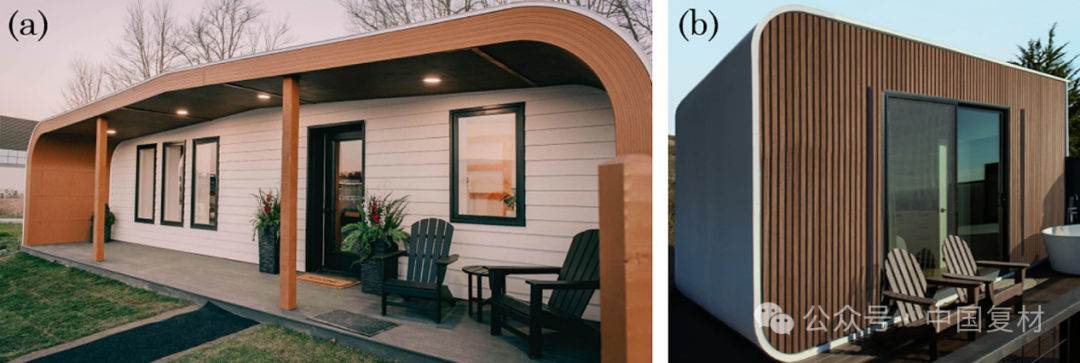
Figure3 3D printed fiber-reinforced composite buildings: (a) BioHome 3D house developed by the Advanced Structures and Composites Center at the University of Maine, (b) Azure micro-housing in the United States
3. Reinforcement and Seismic Resistance
In the field of structural reinforcement,3D printing technology also shines. The application of carbon fiber reinforced PLA rebar has improved the energy dissipation capacity of concrete beam-column joints after high-temperature damage by 40%. Meanwhile, 3D printed continuous carbon fiber/polyamide mesh reinforced concrete slabs have shown significant improvements in shear modulus, providing new solutions for seismic reinforcement of building structures.
3. Core Challenges
However, this technology still faces numerous challenges. Firstly, the layer-by-layer deposition manufacturing method leads to anisotropic mechanical properties of materials, and insufficient interlayer bonding strength directly affects the overall structural load-bearing capacity. Secondly, environmental durability issues are prominent, as UV radiation and moisture erosion can accelerate the aging of natural fiber composites, while the fire ratings of most polymer materials often fail to meet building safety standards. Furthermore, there are bottlenecks in large-scale production; large printing equipment requires significant space and has low production efficiency, as a5800 kg bridge requires continuous printing for 30 days to complete. Additionally, the lack of industry standards results in a lack of unified specifications for the design, certification, and quality control of 3D printed structures. Finally, the issue of material recycling urgently needs to be addressed, especially as closed-loop recycling technologies for thermosetting polymers and fiber-reinforced composites are not yet mature.
4. Future Directions
Looking ahead, breakthroughs are needed in several areas. Process optimization is a primary task; developing multi-axis printing and in-situ consolidation technologies is expected to improve interlayer bonding strength, while combining additive manufacturing with traditional subtractive processes can enhance forming accuracy. The integration of smart materials will endow structures with new functionalities, such as embedding sensors for health monitoring or using self-healing polymers to extend service life. The development of sustainable materials is also crucial, as the promotion of bio-based polymers and natural fiber composites will significantly reduce carbon emissions in the industry. Customized solutions resistant to corrosion and flooding need to be developed for specific application scenarios, such as maritime engineering. Finally, policy-level support is indispensable; establishing a comprehensive performance database and lifecycle assessment standards will provide institutional guarantees for technology promotion.
5. Conclusion
In summary, polymer composite 3D printing technology, with its unique capabilities for customized design, lightweight advantages, and rapid construction characteristics, is reshaping the field of civil engineering. Although challenges remain in performance consistency, environmental durability, and large-scale production, with material innovations, process improvements, and the establishment of standard systems, this technology is expected to play an increasingly important role in future infrastructure construction, providing key technical support for achieving sustainable and high-performance building environments. From practical cases, CFRP composites can achieve tensile strengths above 500 MPa, GFRP’s flexural strength can reach 200 MPa, and the use of recycled PET materials can reduce primary plastic consumption by 70%, while the production process of bio-based PLA can lower energy consumption by 60%. Although robotic printing can reduce the cost of complex components by 30%, the current material costs still exceed those of traditional concrete, which will be a key area for future breakthroughs.
Exciting Recommendations【Special Review】16 Missiles Launching Together: New Breakthroughs in China’s Anti-Missile Testing and Composite Material Applications【Special Review】From Stone to Magical Fiber: Opening the Material Revolution【Special Review】Thermal Performance and Mechanical Behavior Study of Hot-Pressed PEEK/Graphite Layered Composites
【Special Review】Technical Breakthroughs and Industry Standardization Path Exploration of Basalt Fiber Reinforced Composite Pipes
【Special Review】Global High-Temperature Composite Technology Breakthroughs Supporting Innovations in Aerospace and National Defense
【Special Review】Prepreg Compression Molding Meets Higher Speed Propeller Manufacturing
【Special Review】Bionic Composite Structures: Overview of Natural Materials, Manufacturing Methods, and Applications
【Special Review】Applications of Glass Fiber in Marine Engineering
【Special Review】Expanding the New Blue Ocean in South Asia: The China Composite Materials Industry Association Assists in Exploring Opportunities in the Indian Market
【Special Review】Composite Material End Markets: Energy (2025)
【Special Review】Interpretation of the Global Energy Assessment Report: Composites Driving the Renewable Energy Revolution
【Special Review】The Future Battlefield Revolution of China’s 815A Electronic Reconnaissance Ship Led by Composites
We sincerely invite new and old members to the association for a brief stay, to share moments, and to discuss friendships and heartfelt conversations
Welcome

Navigation 
China Composite Materials Industry Association
 China Composite Materials Industry Association
The China Composite Materials Industry Association (CCIA) was established in August 1984 and is a social organization registered with the Ministry of Civil Affairs of the People’s Republic of China, with independent legal status (Social Certificate No. 3258). The CCIA is one of the first-level industry associations established after the opening up of New China.1st-level industry association.
Member Service Department: 010-88875799
Industry Research Department: 010-88385905
Email: [email protected]
Address: Building 2, 19A, No. 48, West Third Ring Road, Haidian District, Beijing Forward, like, and see? Arrange it?