Long press the QR code to follow
Introduction
How can humanoid robots master force like humans? How do they determine posture to avoid falling? How do they see the shape and position of objects?
These capabilities rely on a key hardware component: sensors. Without sensors, robots are merely mechanical shells without touch, balance, or vision, making it impossible to achieve the leap from simple execution to “intelligent interaction.”
This article interprets the logic behind humanoid robots achieving intelligent leaps from the aspects of basic sensor concepts, mainstream types, technical details, market scale, and domestic progress.
Continuing from the previous article…
4
Tactile Sensors
1
Types and Differences
◽ Rigid Tactile Sensors
Made from hard materials such as silicon, ceramics, or metals, their main characteristics are high precision and strong stability, but poor flexibility, making them suitable only for flat or simple curved surfaces.
They are widely used in industrial scenarios; for example, when industrial robots grasp metal parts, rigid tactile sensors can accurately measure pressure to ensure a secure grip.
However, the application of rigid sensors in humanoid robots is limited because the hands and bodies of robots have complex curved surfaces that require conformable sensors.
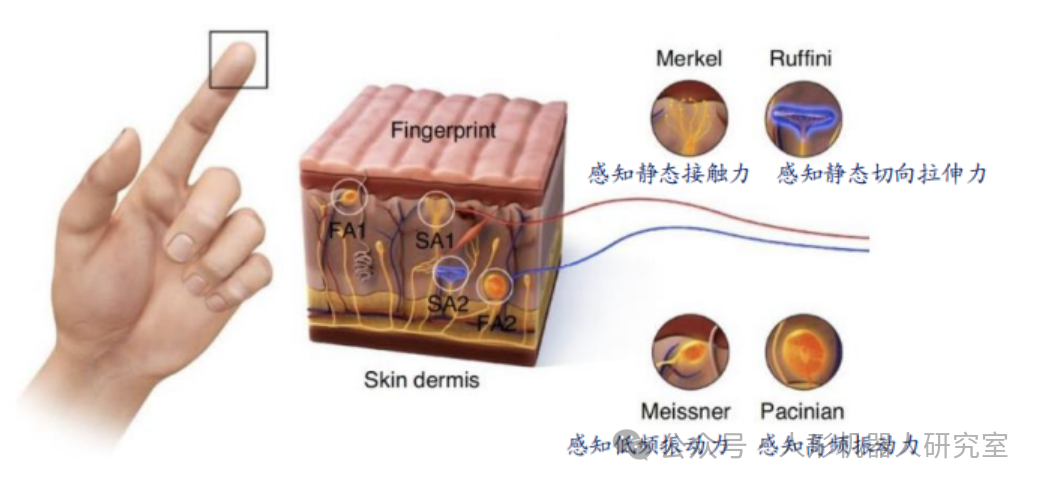
◽ Flexible Tactile Sensors
Made from flexible materials, they have good flexibility, can conform to complex curved surfaces, and can even stretch, known as electronic skin. Their advantage is that they can simulate the sensory capabilities of human skin, perceiving the texture, hardness, and temperature of objects, which is key for humanoid robots to achieve complex interactions.
Currently, mainstream humanoid robots use flexible tactile sensors, mainly installed on fingertips and palms, typically requiring about 10 units per robot, with a unit price of approximately 600 yuan, leading to a total value of around 6000 yuan per robot.
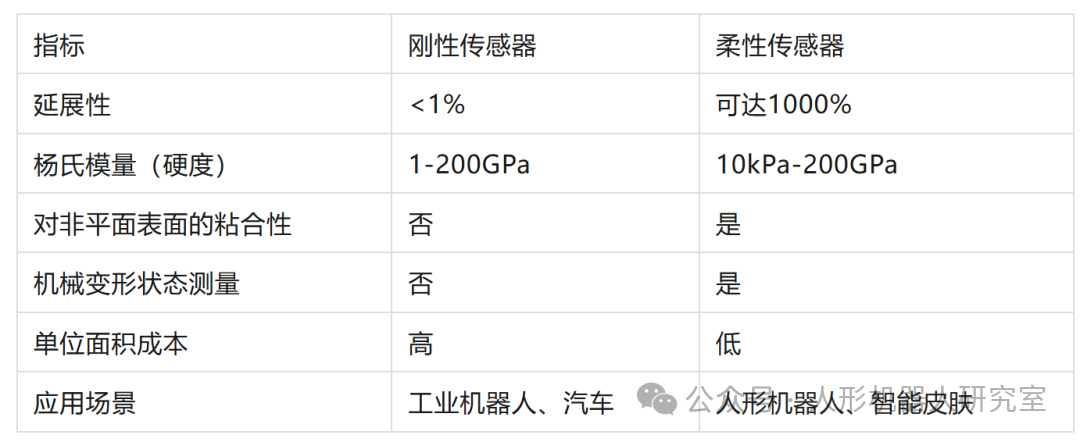
Comparison of Rigid and Flexible Tactile Sensors
2
Flexible Tactile Sensors
◽ Resistive
The principle is that pressure changes resistance; conductive particles such as carbon nanotubes are embedded in flexible materials. When pressure is applied, the contact area of the conductive particles changes, resulting in a change in resistance, and the sensor calculates pressure based on the resistance change.
The advantages are simple structure, low production cost, and a wide dynamic range, capable of measuring both very small and large pressures; the disadvantages include susceptibility to temperature interference, as temperature changes can lead to resistance changes;
There is significant hysteresis, and the resistance recovers slowly after pressure is removed, affecting real-time performance. Currently, domestic manufacturers such as Hanwei Technology mainly adopt this route, with relatively mature technology.
◽ Capacitive
The principle is that pressure changes capacitance; two flexible electrodes sandwich an insulating layer, and when pressure is applied, the distance between the electrodes decreases, changing the capacitance value, allowing the sensor to calculate pressure based on capacitance changes.
The advantages are high sensitivity, fast response speed, and ease of arraying; the disadvantages include susceptibility to interference from surrounding conductive objects and non-linear response. This route is suitable for scenarios requiring high sensitivity, such as grasping soft objects.
◽Piezoelectric
The principle is that pressure generates charge; made from piezoelectric materials, they produce charge when pressure is applied, with the charge magnitude proportional to the pressure.
The advantages are high sensitivity, fast response speed, and good response to high-frequency forces; the disadvantages are that they cannot measure static forces and are greatly affected by temperature. They are mainly used in scenarios requiring vibration sensing, such as robots detecting the flatness of object surfaces.
◽ Electromagnetic
The principle is that pressure changes the magnetic field, based on the Hall effect; when pressure is applied, the distance between the magnet and the Hall element changes, leading to a change in magnetic field strength, which also changes the voltage output from the Hall element.
The advantages are a wide dynamic range and good robustness; the disadvantages are larger size and susceptibility to external magnetic field interference. Currently, applications are limited, mainly in heavy industrial scenarios.
◽Optoelectronic
The principle is that pressure changes light signals; integrating a light source and photodetector within flexible materials, when pressure is applied, the deformation of the material changes the light propagation path, altering the light signal received by the photodetector.
The advantages are that signals are less susceptible to interference, with high resolution and fast response speed; the disadvantages include higher power consumption (requiring continuous illumination, complex light paths, and inability to fully integrate flexibly). Currently, this technology is still in the research and development stage and has not been widely applied.
3
Technical Challenges
◽Poor Environmental Adaptability
Flexible tactile sensors experience significant accuracy degradation in different environments. For example, when the temperature rises, the flexible material expands, leading to changes in resistance or capacitance values, which in turn affects the accuracy of pressure measurements;
When humidity is high, the material absorbs moisture, which also interferes with signals. Currently, there is no mature technology that can completely eliminate the influence of environmental factors; calibration through algorithms can only mitigate the effects, but the results are limited.
◽Material Aging
The core materials of flexible tactile sensors (such as flexible electrodes and insulating layers) will age after long-term use, leading to performance degradation. Repeated stretching or pressing may cause conductive particles to fall off, increasing resistance;
Insulating layers may develop cracks, leading to abnormal capacitance values. Currently, the best products have a lifespan of only a few thousand cycles, far below the “tens of thousands” of usage requirements for humanoid robots.
◽Difficulty in Mass Production
The production process for flexible tactile sensors is complex; for example, capacitive sensors require high-precision electrode patterns, currently relying mainly on printing processes, but with low yield;
The uneven dispersion of conductive particles in resistive sensors also affects yield. Low yield leads to high costs; currently, the unit price of domestic flexible tactile sensors is about 600 yuan, and to achieve large-scale application, it needs to drop below 200 yuan, indicating significant cost reduction potential.
4
Market Scale and Domestic Progress
◽Market Scale
Under neutral estimates, the global market scale for tactile sensors in humanoid robots is only 124 million yuan in 2025, reaching 6.024 billion yuan in 2030, and 13.388 billion yuan in 2035, with a CAGR of 59.7% from 2025 to 2035, making it one of the fastest-growing sensor categories.
The core driving force for growth is the explosion in demand for humanoid robots; as robots transition from industrial to consumer scenarios, the demand for tactile sensing will significantly increase.
◽ Domestic Progress
Currently, the global market for flexible tactile sensors is mainly dominated by foreign brands, with the top five manufacturers (Novasentis, Tekscan, JDI, Baumer, Fraba) accounting for 57.1% of the market share, while domestic manufacturers have a low market share.
In 2022, the domestic production rate of flexible tactile sensors in China was only 32.5%, but progress has accelerated in recent years:
-Technical breakthroughs: Domestic manufacturers such as Hanwei Technology and Fulei New Materials have mastered the core technologies of resistive and capacitive sensors, capable of producing products that meet the needs of humanoid robots;
-Customer expansion: Hanwei Technology has provided samples to several robot manufacturers for research and development; Fulei New Materials has released the second generation of flexible tactile sensors capable of detecting three-dimensional forces;
-
Policy support: The national support for critical technologies has also promoted investment in the research and development of flexible tactile sensors.
5
IMU
1
Basic Definition of IMU
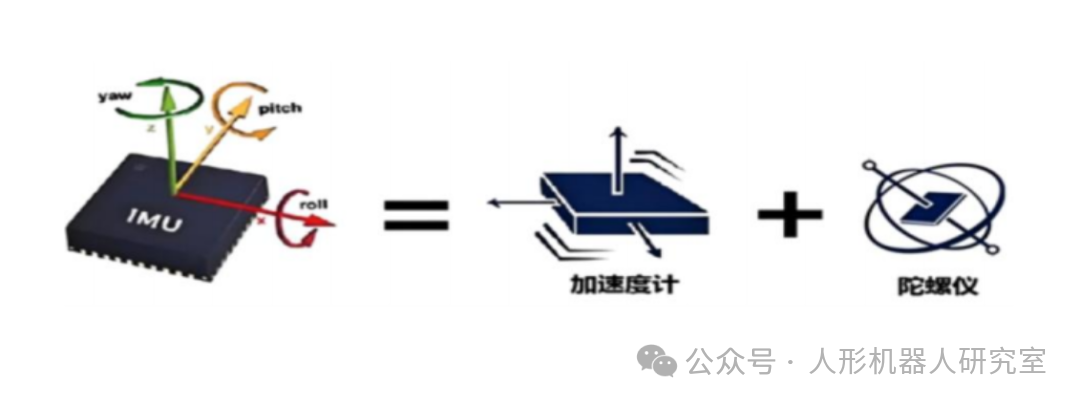
IMU (Inertial Measurement Unit) is a posture measurement device composed of accelerometers and gyroscopes, equivalent to the inner ear of a robot.
Humans perceive balance through the vestibular system in the inner ear, while robots rely on IMUs to sense their posture and motion state.
The core function of IMU is to measure and calculate posture: accelerometers measure the linear acceleration of the robot in three-dimensional space, such as acceleration or deceleration in the up-down, left-right, and front-back directions.
Gyroscopes measure the angular velocity of the robot around three axes, such as the speed of head rotation and body tilt; combining the data from both allows for real-time calculation of the robot’s posture, such as whether the body is leaning forward or the angle of joint rotation.
In humanoid robots, IMUs are key for balance control: when the robot walks, the IMU can sense the tilt angle of the body in real-time; if it detects a forward lean, it immediately communicates with the control system to adjust leg movements to avoid falling;
When the robot goes up and down stairs, the IMU can sense changes in body height, assisting in adjusting stride length. Currently, mainstream humanoid robots require two IMUs, installed in the torso and hip, with a total value of 2400 yuan per robot.
2
Classification of IMUs
◽Consumer-grade IMUs
-Main parameters: Zero bias stability >15°/h (the lower the zero bias stability, the higher the accuracy), scale factor accuracy >1000ppm (the lower the scale factor accuracy, the smaller the error);
-Technical route: Mainly MEMS (Micro-Electro-Mechanical Systems), small size (millimeter level), lightweight, and low cost (unit price 10-50 yuan);
-Scenes: Consumer electronics, such as step counting in smartphones and posture tracking in VR devices; rarely used in humanoid robots due to insufficient accuracy.
◽ Industrial-grade IMUs
-Main parameters: Zero bias stability 0.15-15°/h, scale factor accuracy 100-1000ppm;
-Technical route: Mainly MEMS, with some using fiber optic technology;
-Scenes: Industrial robots, drones, humanoid robots; currently the mainstream choice for humanoid robots, such as the industrial-grade IMU from Xindong Lianke, which can meet the balance control needs of robots, with a unit price of about 1200 yuan.
◽ Tactical-grade IMUs
-Main parameters: Zero bias stability 0.01-0.15°/h, scale factor accuracy 1-100ppm;
-Technical route: Mainly fiber optic or laser technology;
-Scenes: Military (such as missiles, fighter jets), high-end drones; humanoid robots currently do not require such high precision, but may use them in the future for high-precision tasks (such as surgery), with a unit price of about 10,000 to 100,000 yuan.
◽Strategic-grade IMUs
-Main parameters: Zero bias stability <0.01°/h, scale factor accuracy <1ppm;
-Technical route: Mainly laser or dynamic tuning technology;
-Scenes: Aerospace (such as satellites, spacecraft); unrelated to humanoid robots, with prices reaching hundreds of thousands of yuan.
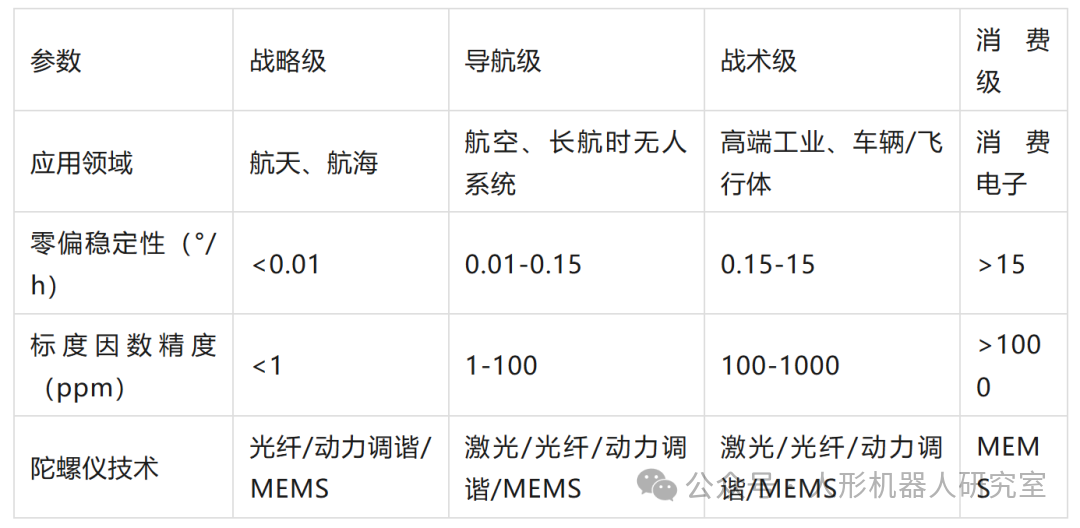
Main Application Areas of Each Category of IMUs
3
Barriers and Market Landscape
◽ Technical Barriers
-Miniaturization: The core structure of MEMS gyroscopes and accelerometers is at the micron level, requiring high-precision photolithography and etching processes, with errors controlled at the nanometer level;
-Stability: Performance must not be affected by factors such as temperature and vibration during long-term use; the vibration frequency of MEMS resonators must be stable, or it will lead to errors in angular velocity measurements;
-Consistency: During mass production, the performance of each IMU must be consistent; otherwise, there will be discrepancies in the robot’s posture control. This requires strict production control and calibration processes, which are very challenging.
◽Market Landscape
The global MEMS IMU market is highly concentrated, with a CR5 (market share of the top five manufacturers) reaching 93%. Major manufacturers include Bosch (33%), STMicroelectronics (25%), TDK (21%), Honeywell (7%), and Analog Devices (7%), with domestic manufacturers holding a very low market share.
Foreign manufacturers have advantages mainly in technology accumulation and brand recognition: for example, Bosch’s MEMS technology has decades of history, with strong product stability; Honeywell’s tactical-grade IMUs have deep accumulations in the military field.
Domestic manufacturers such as Xindong Lianke and Meitai Technology have achieved breakthroughs in industrial-grade IMUs, reaching internationally advanced levels, but still lag behind foreign companies in market share and customer expansion.
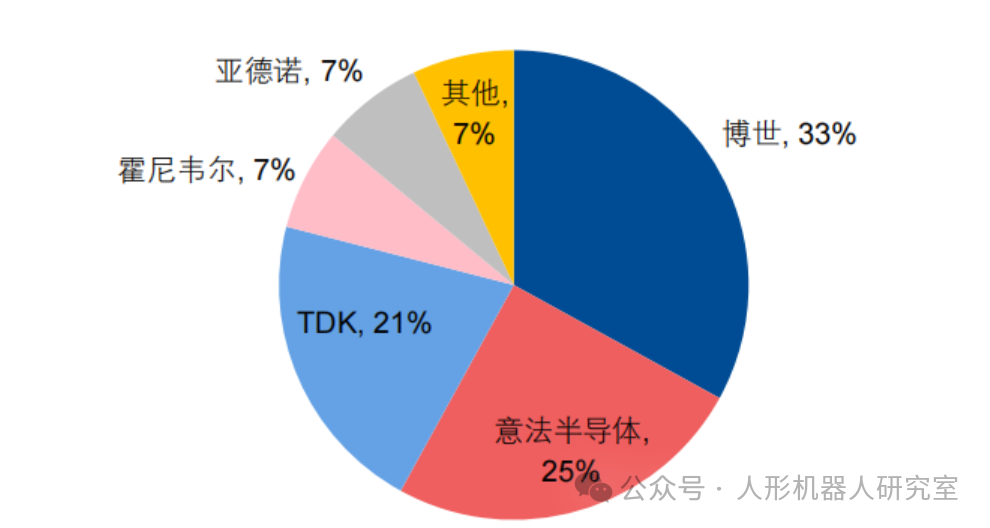
Global MEMS IMU Industry Landscape
4
Scale and Trends
◽ Market Scale
The global market scale for IMUs in humanoid robots is only 50 million yuan in 2025, reaching 2.51 billion yuan in 2030, and 7.438 billion yuan in 2035, with a CAGR of 65.0% from 2025 to 2035, making it one of the fastest-growing sensor categories. The core reason for growth is:
-The explosive demand for humanoid robots: By 2035, the global demand for humanoid robots is expected to reach 3.719 million units, 180 times that of 2025;
-Stable number of IMUs per robot: Currently, two IMUs are required per robot, and even with technological upgrades, the number is unlikely to decrease significantly, as the torso and hips are key positions for posture control.
◽Future Trends
Future developments in IMUs will have two core trends:
-Improved accuracy: As the application scenarios for humanoid robots become more complex (such as walking on uneven surfaces and performing delicate operations), the accuracy requirements for IMUs will increase; the zero bias stability of industrial-grade IMUs may improve from the current 0.15-15°/h to 0.05-5°/h, approaching tactical-grade levels;
-Cost reduction: The large-scale application of MEMS technology will lower costs; currently, the unit price of industrial-grade IMUs is about 1200 yuan, which may drop below 1000 yuan by 2035, further promoting cost reduction for humanoid robots.
6
Visual Sensors
1
Basic Definition
Visual sensors are the eyes of robots, converting light signals into image signals, which are then processed by algorithms to recognize information.
◽2D Visual Sensors
They can only capture planar image information, such as the color, shape, and text of objects, but cannot determine the distance and height of objects. The technical route mainly involves ordinary cameras, with lower unit prices, and application scenarios include:
-Object recognition: such as recognizing QR codes and part numbers;
-Appearance inspection: such as checking for scratches or stains on parts;
-Positioning: such as determining the position of an object on a plane.
However, 2D vision has obvious drawbacks: for example, two objects of different sizes may appear the same size in a 2D image if they are at different distances from the lens, making it impossible for the robot to distinguish between them;
When grasping objects, it cannot determine the distance to the hand, leading to missed grabs or collisions.
◽3D Visual Sensors
They can simultaneously capture planar images and depth information, i.e., the distance between the object and the sensor, effectively giving the robot stereoscopic vision and solving the drawbacks of 2D vision.
The technical routes are diverse, including structured light, iToF, dToF, stereo vision, and LiDAR, with higher unit prices. Application scenarios include:
-Precise grasping: such as determining the position and height of a cup for accurate reaching;
-Obstacle avoidance: such as detecting obstacles ahead and their distances;
-Environment mapping: such as scanning the three-dimensional structure of a room and planning walking routes.
2
3D Visual Sensors
There are five technical routes for 3D visual sensors.
◽Structured Light
-Principle: Emit light with a specific pattern onto the object’s surface; the light deforms due to the object’s shape, and the camera captures the deformed pattern, calculating depth information through algorithms.
-Advantages: High measurement accuracy (millimeter level) and resolution at close range (<5m), with relatively low costs;
-Disadvantages: Accuracy decreases at medium to long distances (>5m) and is easily affected by ambient light;
-Scenes: Hand grasping and facial recognition in humanoid robots; representative manufacturers include Orbbec and Intel RealSense.
◽iToF (Indirect Time of Flight)
-Principle: Emit modulated infrared light; when the light hits an object and reflects back, the sensor measures the phase change of the light, calculating the time of flight to obtain distance.
-Advantages: High accuracy at medium distances (<3.5m), fast response speed (millisecond level), and strong resistance to ambient light interference;
-Disadvantages: Lower accuracy at close range compared to structured light, with medium resolution;
-Scenes: Indoor obstacle avoidance and environment mapping in humanoid robots; representative manufacturers include Sony and Microsoft.
◽dToF (Direct Time of Flight)
-Principle: Emit short pulse infrared light, directly measuring the time from emission to reflection to calculate distance.
-Advantages: High accuracy at long distances (<5m) and strong resistance to interference;
-Disadvantages: Lower accuracy and resolution at close range;
-Application scenarios: Outdoor walking for humanoid robots; representative manufacturers include Apple and Huawei.
◽Stereo Vision
-Principle: Mimicking human eyes, two cameras with a fixed distance capture images of objects simultaneously, calculating depth information through the differences between the two images (disparity).
-Advantages: Low cost (two ordinary cameras suffice), good performance at long distances (<15m), and strong resistance to bright light interference;
-Disadvantages: Lower accuracy at close range, high computational complexity, and poor recognition of objects with little texture;
-Application scenarios: Outdoor walking and large-scale environment mapping for humanoid robots; representative manufacturers include DJI and Stereo Vision.
◽LiDAR
-Principle: Emit laser beams to scan objects, measuring the time of flight or phase difference of the laser to calculate distance while recording the angle of the laser to generate a three-dimensional point cloud of the object.
-Advantages: High accuracy at long distances (<200m), strong resistance to interference, and ability to recognize small objects;
-Disadvantages: High cost, slow scanning speed, and low resolution;
-Application scenarios: Outdoor complex environment obstacle avoidance for high-end humanoid robots; representative manufacturers include Hesai Technology and SUTENG.
3
Visual Sensor Industry Chain
◽Industry Chain Structure
-Upstream: Core hardware suppliers, including laser emitters, photosensitive chips, diffractive optical elements, and depth engine chips. This part has high technical barriers and is mainly dominated by foreign companies, such as Sony’s photosensitive chips and Texas Instruments’ depth engine chips.
-Midstream: 3D visual solution providers, responsible for integrating upstream hardware, designing sensor products, and developing supporting algorithms. Domestic manufacturers mainly focus on this segment, such as Orbbec and Megvii, which can provide complete sensor solutions.
-Downstream: Application scenarios, including humanoid robots, consumer electronics, automotive, and industrial automation. Humanoid robots are the fastest-growing downstream scenario in the future.
◽Market Landscape
-Upstream: Foreign companies dominate, with Sony holding over 40% of the global CMOS image sensor market, and VCSEL lasers mainly provided by US II-VI and Germany’s AMS. Domestic manufacturers have made breakthroughs in the mid-to-low-end market but still rely on imports for high-end products.
-Midstream: Domestic manufacturers are rising, such as Orbbec’s structured light sensors being applied in robot manufacturers like UBTECH and XPeng, gradually increasing market share;
Foreign manufacturers have advantages in consumer electronics, but in the humanoid robot field, domestic manufacturers respond faster and better meet customization needs.
—————-END——————
Disclaimer: We organize and reproduce this article for the purpose of disseminating more information and do not represent the views of this account, nor do they constitute any investment opinions. Investment decisions made based on this article are unrelated to the author! The video, images, and text used in this article are for educational and sharing purposes only, and copyright belongs to the original author. If there are any copyright issues, please contact the editor immediately, and we will delete it without any commercial use!Disclaimer: Article source: All Industry Chain Research; for learning and sharing purposes only, copyright belongs to the original author. If there is any infringement, please contact us for deletion.Join the knowledge community to continuously receive the latest reports in the robot industry for free!