✅ Author Profile: A MATLAB simulation developer passionate about research, skilled in data processing, modeling simulation, program design, complete code acquisition, paper reproduction, and scientific simulation.
🍎 Previous Review: Follow my personal homepage:MATLAB Research Studio
🍊 Personal Motto: Seek knowledge through investigation; complete MATLAB code and simulation consultation available via private message.
🔥 Content Introduction
Wireless Sensor Networks (WSN) play a critical role in the Internet of Things (IoT) and various monitoring applications. In WSNs, efficient routing protocols are essential for data transmission. The AODV (Ad hoc On-Demand Distance Vector) routing protocol has been widely studied in mobile ad hoc networks (MANET) and WSNs due to its on-demand routing establishment feature. This article aims to explore how to implement the AODV routing protocol in the MATLAB environment using a graphical user interface (GUI) and study its application in WSNs.
The AODV protocol is a reactive routing protocol that establishes routes only when needed. When a source node needs to send data to a destination node, it initiates a route discovery process. This process is completed by broadcasting a Route Request (RREQ) message. The RREQ message contains information such as the source node address, destination node address, source node sequence number, and broadcast ID. When the RREQ message reaches an intermediate node, if that node does not have a valid route to the destination node, it forwards the RREQ message to its neighboring nodes. If the intermediate node has a valid route to the destination node, it sends a Route Reply (RREP) message back to the source node. The RREP message includes the destination node address, destination node sequence number, hop count, and validity time. Upon receiving the RREP message, the source node selects the route with the shortest hop count to the destination node.
Implementing the AODV routing protocol in MATLAB can fully utilize MATLAB’s powerful numerical computation and simulation capabilities. First, the node model in the WSN can be defined, including attributes such as node coordinates, communication range, and energy. Next, mechanisms for generating, sending, and receiving messages such as RREQ, RREP, and RERR (Route Error) need to be implemented. The transmission of these messages can be simulated through wireless channels, for example, using a distance attenuation model to simulate signal strength decay with distance. During the route establishment and maintenance process, a routing table must be maintained, which contains information such as the next hop to the destination node, hop count, and sequence number. When a route breaks, an RERR message must be sent to notify relevant nodes to update their routing tables.
To enhance user understanding of the AODV protocol’s operation, a user-friendly simulation platform can be designed using MATLAB GUI. The GUI can include the following main functional modules:
- Network Topology Generation Module: Allows users to customize parameters such as the number of nodes, node distribution, and communication range in the WSN, and visually display the network topology. Users can drag nodes to change their positions or randomly generate node distributions by setting parameters.
- AODV Protocol Parameter Setting Module: Allows users to set parameters related to the AODV protocol, such as RREQ broadcast interval, routing timeout, and maximum hop count. These settings will directly affect the performance of the protocol.
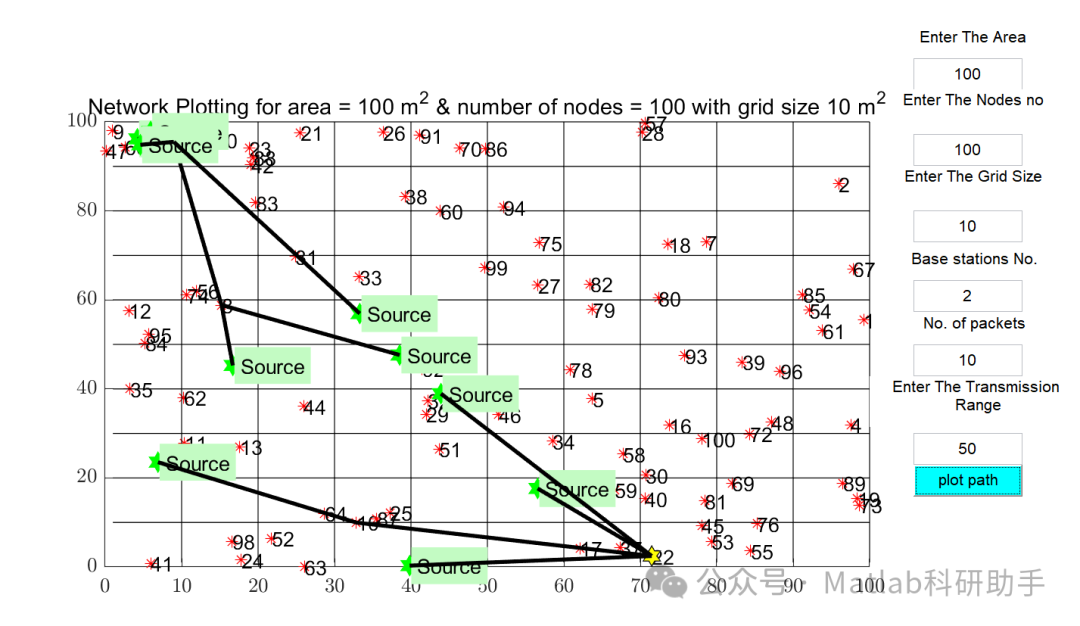
- Data Transmission Simulation Module: Users can specify source and destination nodes to simulate the data packet transmission process from the source node to the destination node. The GUI can display real-time information such as the packet path, hop count, and transmission delay.
- Routing Table Display Module: Displays the routing table contents of each node in real-time, including destination node, next hop, hop count, and sequence number, helping users understand the route establishment and maintenance process.
- Performance Evaluation Module: After the simulation ends, the GUI can calculate and display performance metrics of the AODV protocol, such as packet delivery rate, average end-to-end delay, and routing overhead. These metrics can help users evaluate the protocol’s performance.
By simulating the AODV routing protocol using MATLAB GUI, various scenarios can be tested and analyzed conveniently. For example, the impact of factors such as node mobility, network density, and communication range on the performance of the AODV protocol can be studied. Additionally, improvements and optimizations to the AODV protocol can be made, such as introducing energy-aware routing mechanisms to extend the lifespan of the WSN.
The AODV routing protocol simulation platform implemented based on MATLAB GUI not only deepens the understanding of the principles and working mechanisms of the AODV protocol but also provides a powerful tool for performance evaluation and optimization of WSN routing protocols. This will help promote the application and development of WSN technology in various fields.
⛳️ Results
🔗 References
[1] Wang Shan, Wei Jibo, Deng Shulin, et al. A New Cross-Layer Power Control Routing Protocol for Wireless Sensor Networks [J]. Journal of Sensor Technology, 2008, 21(8):4. DOI:10.3969/j.issn.1004-1699.2008.08.023.
[2] Zhang Dehai. Research on Routing Protocols for Wireless Multimedia Sensor Networks [D]. Xi’an University of Electronic Science and Technology [2025-09-20]. DOI:CNKI:CDMD:2.1015.429254.
[3] Xu Ming. Research on Secure Routing Protocols for Wireless Sensor Networks [D]. Xi’an University of Electronic Science and Technology [2025-09-20]. DOI:10.7666/d.y1668671.
📣 Sample Code
🎈 Some theoretical references are from network literature; please contact the author for removal if there is any infringement.
👇 Follow me to receive a wealth of MATLAB e-books and mathematical modeling materials.
🏆 Our team specializes in guiding customized MATLAB simulations in various research fields to support your research dreams:
🌈 Various intelligent optimization algorithm improvements and applications
Production scheduling, economic scheduling, assembly line scheduling, charging optimization, workshop scheduling, departure optimization, reservoir scheduling, three-dimensional packing, logistics site selection, cargo location optimization, bus scheduling optimization, charging station layout optimization, workshop layout optimization, container ship loading optimization, pump combination optimization, medical resource allocation optimization, facility layout optimization, visual domain base station and drone site selection optimization, knapsack problem, wind farm layout, time slot allocation optimization, optimal distributed generation unit allocation, multi-stage pipeline maintenance, factory-center-demand point three-level site selection problem, emergency supply distribution center site selection, base station site selection, road lamp post arrangement, hub node deployment, transmission line typhoon monitoring devices, container scheduling, unit optimization, investment optimization portfolio, cloud server combination optimization, antenna linear array distribution optimization, CVRP problem, VRPPD problem, multi-center VRP problem, multi-center multi-vehicle VRP problem, dynamic VRP problem, two-layer vehicle routing planning (2E-VRP), electric vehicle routing planning (EVRP), hybrid vehicle routing planning, mixed flow shop problem, order splitting scheduling problem, bus scheduling optimization problem, flight shuttle vehicle scheduling problem, site selection path planning problem, port scheduling, port bridge scheduling, parking space allocation, airport flight scheduling, leak source localization.
🌈 Time series, regression, classification, clustering, and dimensionality reduction in machine learning and deep learning
2.1 BP time series, regression prediction, and classification
2.2 ENS voice neural network time series, regression prediction, and classification
2.3 SVM/CNN-SVM/LSSVM/RVM support vector machine series time series, regression prediction, and classification
2.4 CNN|TCN|GCN convolutional neural network series time series, regression prediction, and classification
2.5 ELM/KELM/RELM/DELM extreme learning machine series time series, regression prediction, and classification
2.6 GRU/Bi-GRU/CNN-GRU/CNN-BiGRU gated neural network time series, regression prediction, and classification
2.7 Elman recurrent neural network time series, regression prediction, and classification
2.8 LSTM/BiLSTM/CNN-LSTM/CNN-BiLSTM long short-term memory neural network series time series, regression prediction, and classification
2.9 RBF radial basis function neural network time series, regression prediction, and classification
2.10 DBN deep belief network time series, regression prediction, and classification
2.11 FNN fuzzy neural network time series, regression prediction
2.12 RF random forest time series, regression prediction, and classification
2.13 BLS broad learning system time series, regression prediction, and classification
2.14 PNN pulse neural network classification
2.15 fuzzy wavelet neural network prediction and classification
2.16 Time series, regression prediction, and classification
2.17 Time series, regression prediction, and classification
2.18 XGBOOST ensemble learning time series, regression prediction, and classification
2.19 Transform various combinations of time series, regression prediction, and classification
Directions cover wind power prediction, photovoltaic prediction, battery life prediction, radiation source identification, traffic flow prediction, load forecasting, stock price prediction, PM2.5 concentration prediction, battery health state prediction, electricity consumption prediction, water body optical parameter inversion, NLOS signal identification, precise prediction of subway stops, transformer fault diagnosis.
🌈 Image processing aspects
Image recognition, image segmentation, image detection, image hiding, image registration, image stitching, image fusion, image enhancement, image compressed sensing.
🌈 Path planning aspects
Traveling salesman problem (TSP), vehicle routing problem (VRP, MVRP, CVRP, VRPTW, etc.), three-dimensional path planning for drones, drone collaboration, drone formation, robot path planning, grid map path planning, multimodal transport problems, electric vehicle routing planning (EVRP), two-layer vehicle routing planning (2E-VRP), hybrid vehicle routing planning, ship trajectory planning, full path planning, warehouse patrol.
🌈 Drone application aspects
Drone path planning, drone control, drone formation, drone collaboration, drone task allocation, drone secure communication trajectory online optimization, vehicle collaborative drone path planning.
🌈 Communication aspects
Sensor deployment optimization, communication protocol optimization, routing optimization, target localization optimization, Dv-Hop localization optimization, Leach protocol optimization, WSN coverage optimization, multicast optimization, RSSI localization optimization, underwater communication, communication upload and download allocation.
🌈 Signal processing aspects
Signal recognition, signal encryption, signal denoising, signal enhancement, radar signal processing, signal watermark embedding and extraction, electromyography signals, electroencephalography signals, signal timing optimization, electrocardiogram signals, DOA estimation, encoding and decoding, variational mode decomposition, pipeline leakage, filters, digital signal processing + transmission + analysis + denoising, digital signal modulation, bit error rate, signal estimation, DTMF, signal detection.
🌈 Power system aspects
Microgrid optimization, reactive power optimization, distribution network reconstruction, energy storage configuration, orderly charging, MPPT optimization, household electricity.
🌈 Cellular automata aspects
Traffic flow, crowd evacuation, virus spread, crystal growth, metal corrosion.
🌈 Radar aspects
Kalman filter tracking, trajectory association, trajectory fusion, SOC estimation, array optimization, NLOS identification.
🌈 Workshop scheduling
Zero-wait flow shop scheduling problem (NWFSP), permutation flow shop scheduling problem (PFSP), hybrid flow shop scheduling problem (HFSP), zero idle flow shop scheduling problem (NIFSP), distributed permutation flow shop scheduling problem (DPFSP), blocking flow shop scheduling problem (BFSP).
👇