Authors: Wu Ruirui, Liu Jielin, Source: Longyan Robotics

Wireless Sensor Networks (WSN) are self-organizing networks composed of a large number of sensor nodes. These sensor nodes not only can perceive environmental information within the network but also have simple computing capabilities, allowing them to transmit relevant information after sensing and processing. Sensor nodes are the most important nodes in WSN, forming the foundation of the entire WSN, with functions of sensing data, processing data, storing data, and transmitting data. Sensor nodes are responsible for perceiving environmental information within the network, collecting monitoring data, and reporting it to user nodes through aggregation nodes.
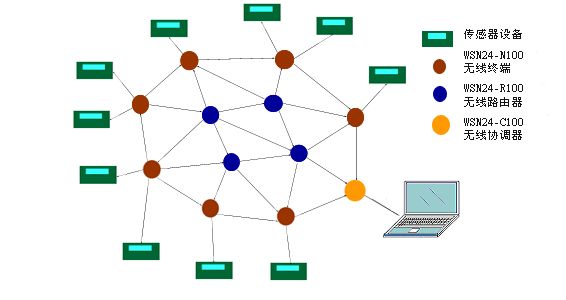
Compared to other wireless communication networks, WSN has its own significant characteristics.
Large Scale: The large scale of sensor networks has two meanings. One is to deploy sensor nodes in large monitoring areas, such as forests and mountainous regions, to monitor fires or conduct other environmental monitoring activities; the other is to deploy a high density of sensor nodes in limited areas.
Self-organization: WSN is a distributed self-organizing wireless network without central control management, composed of peer nodes. This distributed structure can better adapt to changes in the network, automatically configuring and managing itself when changes occur, offering strong flexibility and practicality.
Multi-hop Routing: Due to the large monitoring range of WSN, the data transmission distance between sensor nodes can be very long, thus multi-hop routing forwarding is commonly used in WSN, allowing each node to have routing forwarding capabilities. This can reduce the transmission power of nodes and lower network energy consumption.
Robustness: WSN is often applied in harsh outdoor environments such as mountainous areas and forests, where maintaining sensor nodes is challenging. Therefore, the network needs to have a certain degree of robustness, allowing other nodes in the network to automatically adjust to ensure the normal operation of WSN when some nodes cannot function due to environmental interference or depleted batteries.
1 Applications of Wireless Sensor Networks
As one of the three pillars of information technology, WSN has been widely applied in the industrial market due to its low cost, low power consumption, and high applicability. Its main application areas are concentrated in the following aspects.
1.1 Military Reconnaissance
WSN can meet the real-time and accuracy requirements for information acquisition in various military scenarios, sensing battlefield situations. In military applications, a large number of sensor nodes are deployed over battlefield areas via aircraft to form a self-organizing network, where each node senses battlefield information, collects, and transmits this data to provide intelligence for combat troops. Due to the dense and random distribution characteristics of WSN, it plays a significant role in monitoring friendly troop strength, equipment supplies, ammunition allocation, and war damage assessment; monitoring battlefield conditions, scouting enemy forces, and target tracking; detecting and scouting for biochemical attacks, etc.
The United States was the first to conduct research on WSN, beginning with the “Tropical Tree” sensor used to detect supply transport vehicles in the Vietnam War. The U.S. has invested heavily in manpower, material resources, and funding for WSN research and has successfully applied it in the military field. Additionally, WSN can also be applied in homeland security and border monitoring.
1.2 Environmental Monitoring
With increasing attention to environmental issues, environmental monitoring has become one of the important application fields for wireless sensor networks. Currently, traditional environmental monitoring methods can no longer meet human needs due to societal development and changes in nature, making the use of sensor nodes for data collection, analysis, and monitoring of indoor and outdoor environments particularly important.
Due to the characteristics of sensor networks, they provide convenience for monitoring outdoor environments. Collecting vibration and infrasound information through WSN can monitor volcanic eruptions and issue early warnings; WSN can also be used for animal tracking and migratory bird studies, observing animal behavior for population research; deploying wireless sensor networks on plants can monitor tree growth and collect information on photosynthesis, providing relevant data for plant research; scattering sensor nodes in unattended areas can enable continuous monitoring, filling monitoring blind spots to obtain more comprehensive environmental data.
With the vigorous development of science and technology, monitoring indoor environments is also necessary. The deployment of wireless sensor systems can monitor real-time temperature, humidity, and air quality indoors to improve the indoor environment.
1.3 Smart Homes
Smart homes connect security systems, lighting systems, air conditioning systems, and other household appliances in the living environment through IoT technology to achieve automated and intelligent management. By embedding sensor nodes in household appliances, remote control of appliances can be achieved through wireless networks combined with the Internet, while also allowing real-time monitoring of household safety, making life more comfortable and convenient.
Microsoft’s “Future Home” is a representative of the most advanced smart home, integrating access control systems that not only monitor the home environment but also detect the owner’s physical condition through touch and provide corresponding health alerts. Fudan University, University of Electronic Science and Technology, and other institutions have also developed a WSN-based smart building system, which can monitor household conditions through internet terminals.
1.4 Healthcare
Currently, WSN has many applications in medical systems and healthcare. Installing sensor nodes that can monitor heart rate or blood pressure on hospitalized patients allows doctors to understand the physical condition and activity of monitored patients in a timely manner, enabling rapid rescue in case of abnormalities. Sensor network-based care systems can monitor elderly health issues in real-time, sense various activities of the elderly, record their status, ensuring their safety and health, while also reducing the burden on caregivers and improving care quality.
2 Key Technologies of Wireless Sensor Networks
2.1 Topology Control
The main function of topology control technology is data forwarding, while also controlling power or neighbor nodes to achieve network coverage and connectivity. A good network topology can improve routing efficiency, reduce network energy consumption, and extend the network’s lifespan. As a core issue in WSN, topology control can provide technical support for data fusion, routing protocols, and target localization.
Existing topology control algorithms can be divided into two categories: node power control and hierarchical topology control. Power control adjusts the transmission power of sensor nodes to minimize power usage while ensuring network coverage and connectivity. When the power of each node changes, the network’s topology also changes, reducing interference between nodes and ultimately achieving optimal connectivity. Hierarchical topology control utilizes a clustering mechanism to form cluster head nodes, with each cluster head node becoming a backbone network that divides the network into multiple clusters, allowing non-backbone nodes to temporarily stop communication to reduce network energy consumption, with only the backbone network allowed to forward data.
2.2 Routing Protocols
In wireless sensor networks, network connections need to be established based on actual conditions, requiring the integration of suitable and specific algorithms and system software to create real-time dynamic connections, rather than using a pre-arranged connection method. Factors such as network bandwidth and processing power consumption are important considerations during network operation. Therefore, when unexpected situations arise, the network must be able to reconstruct or update the network system in real time based on actual conditions. The reliability of communication connections between nodes is limited, and shadow fading can also be one of the factors affecting network connectivity. Thus, careful consideration of communication reliability is necessary when designing routing software to meet network demands.
2.3 Data Fusion
In WSN, data fusion technology can process the data collected by sensor nodes, removing redundant information, saving network energy, and extending the network’s lifespan. Additionally, data fusion technology can analyze and synthesize multiple data points perceived within the network to improve information accuracy. However, data fusion processing can increase network operation time, causing delays.
2.4 Time Synchronization
Time synchronization is a key mechanism for sensor network systems that need to work together. In WSN, nodes usually need to cooperate to complete sensing and monitoring functions, requiring all nodes to maintain the same clock. Existing time synchronization protocols include RBS (Reference Broadcast Synchronization), Tiny/miniSync, and TPSN (Time-Synchronized Protocol for Sensor Networks).
2.5 Localization Technology
In practical applications of WSN, users are not only concerned about the sensing data from sensor nodes in the monitoring area but also wish to obtain the location information of these nodes. Therefore, localization technology holds a very important position as a key technology in WSN.
In WSN, there are two types of localization methods for sensor nodes: distance-based localization and non-distance-based localization. Distance-based localization determines the coordinates of the node to be located by measuring the distances and angles between nodes, requiring higher hardware specifications for accuracy. Non-distance-based localization obtains the final coordinates of the node to be located through connectivity between nodes within the network, which lowers hardware requirements and reduces network costs, but with lower localization accuracy.
3 Conclusion
Through in-depth research on WSN, people’s understanding of it has deepened, and significant progress has been made in related technologies, leading to widespread applications of WSN. WSN is currently a research hotspot in various fields both domestically and internationally, and it is expected to become a widely applied network in future society, possessing great research value and development prospects.