Click the top left corner “MDPI Engineering Science” to follow us for more latest research updates.

Research Background
Geological disasters, such as rockfalls and landslides, pose a serious threat to human life and property. Timely and effective monitoring is crucial for preventing and mitigating the impacts of these disasters. However, traditional monitoring methods are often costly, complex to deploy, and difficult to implement in remote areas. Therefore, there is an urgent need for a low-cost, easy-to-deploy, and efficient monitoring solution. A team led by Professor Vincenzo Stornelli from the Department of Industrial and Information Engineering at the University of L’Aquila, Italy, published an article in the Journal of Low Power Electronics and Applications (JLPEA), proposing a wireless sensor network constructed using LoRa technology for monitoring geological disasters such as rockfalls and landslides.
Research Content and Methods
LoRa (Long Range) is a low-power wide-area network (LPWAN) communication technology characterized by long transmission distances, low power consumption, and low costs, making it suitable for Internet of Things (IoT) applications. LoRaWAN is the network protocol for LoRa, supporting large-scale device connectivity, making it ideal for building wireless sensor networks. The application prospects of LoRa technology in geological disaster monitoring are vast.
The research team selected an area prone to rockfalls and landslides on Pantelleria Island, Italy, to deploy a LoRa-based wireless sensor network. This network consists of multiple sensing nodes, a portable LoRaWAN gateway, and a data processing center.
-
Sensing Nodes: Each node is equipped with accelerometers and tilt sensors to detect surface movements and tilt changes. Nodes communicate with the gateway via LoRa modules, designed for low power consumption to ensure long-term operation.
-
Portable LoRaWAN Gateway: The gateway is responsible for collecting data from the sensing nodes and transmitting it to a remote server via cellular networks. Its portable design makes it easy to deploy in different locations, adapting to complex terrains.
-
Data Processing Center: The server receives and stores sensor data, using algorithms to analyze surface movement characteristics and identify potential rockfall and landslide risks.
The system architecture is shown in the figure below:
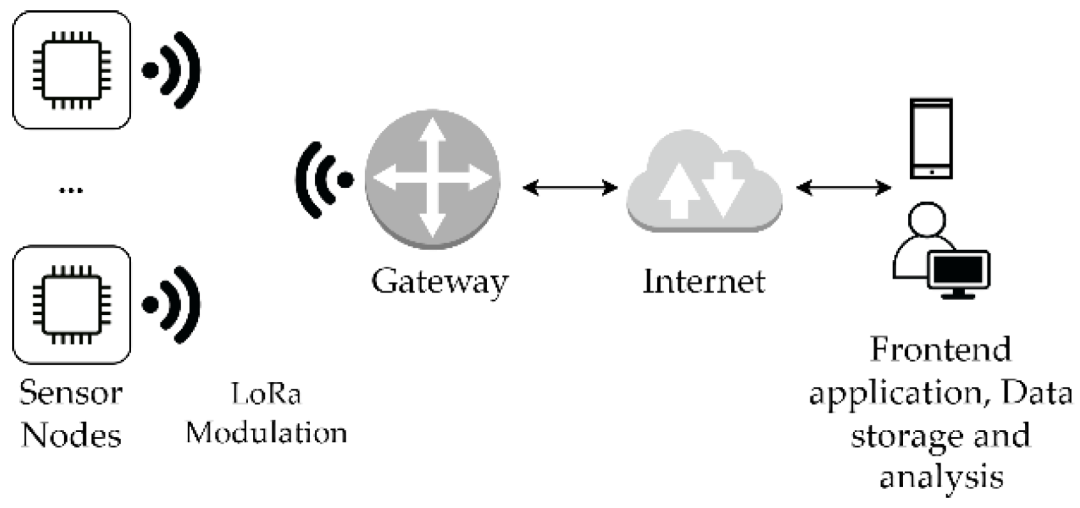
The figure illustrates a general LoRaWAN network architecture scheme.
After a period of monitoring, the system successfully detected multiple surface movement events. The data from the sensing nodes accurately reflected the acceleration and tilt changes of the surface, validating the effectiveness of the system. Furthermore, the stability and coverage of LoRa communication met the needs of the monitoring area, and the low-power design ensured the long-term operation of the devices. The research also found that the flexible deployment of the portable LoRaWAN gateway improved the adaptability of the system, allowing adjustments to the coverage area based on monitoring needs. Compared to traditional methods, this system has the following advantages:
-
Low Cost: The equipment and communication costs are low, making it suitable for large-scale deployment.
-
Easy to Deploy: The portable design and wireless communication reduce the need for wiring and infrastructure construction.
-
Efficient Monitoring: Real-time data collection and analysis improve the timeliness and accuracy of monitoring.
-
High Adaptability: The system can be adjusted according to different terrains and monitoring needs, suitable for various environments.
Research Summary
The successful application of the LoRa-based wireless sensor network on Pantelleria Island demonstrates its feasibility and effectiveness in geological disaster monitoring. In the future, the research team will further optimize system performance, including improving sensor accuracy, enhancing data analysis algorithms, and expanding the monitoring range. Additionally, applying this technology to other types of geological disaster monitoring, such as debris flows and earthquakes, will also be a future research direction. Through continuous research and practice, the LoRa-based wireless sensor network is expected to become an important tool for geological disaster monitoring, playing a key role in protecting human life and property safety.

Scan the QR code
Read the original English text
Original article from JLPEA journal
Ragnoli, M.; Leoni, A.; Barile, G.; Ferri, G.; Stornelli, V. LoRa-Based Wireless Sensors Network for Rockfall and Landslide Monitoring: A Case Study in Pantelleria Island with Portable LoRaWAN Access. J. Low Power Electron. Appl. 2022, 12, 47.

JLPEA Journal Introduction
Editor-in-Chief:Davide Bertozzi, University of Manchester, UK
The journal aims to publish innovative research and significant results in the field of low-power electronics. Topics covered by the journal include but are not limited to emerging electronic devices and process technologies, analog, digital, and mixed-signal VLSI circuits, architecture and system design, SoC and embedded systems, energy harvesting and battery-free systems, integration and optimization tools, and CAD tools and methods for low-power design. Currently indexed by databases such as Scopus and ESCI.
|
2023 Impact Factor |
1.6 |
|
2023 CiteScore |
3.6 |
|
Time to First Decision |
20 Days |
|
Acceptance to Publication |
2.7 Days |

Scan the QR code,
Subscribe to the latest news from JLPEA journal.
Featured Videos
Past Reviews
Review on Energy Sustainability Analysis in Wireless Sensor Networks | MDPI JLPEA
Copyright Notice:
*This article is edited by the MDPI China office, please refer to the English version for detailed content. For reprints, please leave a message in the background of the public account.
Due to the updated rules of WeChat subscription account pushes, you can set “MDPI Engineering Science” as a star to easily find us in the message bar and stay updated on the latest open publishing dynamics!
Click the bottom left “Read the original text” to read the original English text for free.

Like today’s content? Give us a thumbs up!