
Industrial Internet of Things Phenomenon
Over the past 15 years, the internet revolution has redefined B2C (business-to-consumer) industries such as media, retail, and financial services. In the next 10 years, the Internet of Things (IoT) revolution is expected to completely disrupt manufacturing, energy, agriculture, transportation, and parts of the industrial sector, which account for nearly two-thirds of global GDP.
The Industrial Internet of Things (also known as IIoT or Industry 4.0) has spawned new business models and workflow innovations across almost all industrial fields, including smart cities, factories, transportation, monitoring, energy management, building management, healthcare, and retail. It is predicted that over 20 billion new smart IoT devices will be deployed in these markets over the next 10 years to achieve this transformation.
Hardware Devices Play a Key Role
In the use cases of the Industrial Internet of Things, hardware devices are merely used to facilitate sales services and profit from the data and analytics provided by the products. To achieve this, companies must make reasonable investments in the design process of devices and solutions upfront. For example, to spend one dollar on industrial equipment, one must spend ten dollars on software development and related business services. The best devices will help businesses operate more efficiently while minimizing maintenance costs and downtime.
Addressing Challenges Brought by Mobility Effects
As mobile and consumer platforms rapidly penetrate the industrial sector, many companies are competing to manufacture lower-cost, faster devices. However, most Industrial Internet of Things devices require long-term reliability, production time, and availability to ensure business success, unlike general mobile devices. This creates a contradiction for the demands of rapid connectivity and customization. Therefore, designers of Industrial IoT products need to consider the total cost of ownership (TCO) for end users throughout the product lifecycle, rather than just the initial bill of materials (BOM) for the device.
IoT Design Requires a New “IQ”
Several security incidents that occurred in 2016 are worth our deep reflection. For example, the security vulnerability of the Hangzhou Xiongmai surveillance camera module was exploited, triggering the largest DDoS attack in history, resulting in a 25% reduction in internet traffic in the United States; the GoPro Karma drone was recalled due to the risk of losing power during flight, which could lead to personal injury or property damage; the “Dieselgate” incident impacted the Volkswagen brand and its market value.
These cases are enough to make us deeply aware that design decisions have far-reaching impacts on product lines and even on the company or brand itself. Micron Technology firmly believes that to develop and deliver successful Industrial IoT products that drive the new economy, a new IQ (Industry Quotient) is required, which we call “Industrial Quotient.” As a mindset, Industrial Quotient can help you make informed choices in industrial product design that not only meet functional requirements in various harsh environments or industrial use cases but also ensure long-term quality and reliability of the product while simplifying product lifecycle management.
Industrial Quotient: The Key to IIoT Design
The industry often vaguely assumes that components meeting industrial temperature requirements (-40℃ to 85℃) can fulfill all the requirements of industrial product design. However, this is not the case, as temperature is only one of many factors to consider in industrial use cases. The industrial temperature label on a supplier’s product does not indicate that the product possesses industrial-grade quality/reliability/durability/lifespan to meet specific application needs. In fact, many industrial applications, such as medical devices and in-flight entertainment systems, do not require industrial temperatures because their operating environments are controlled, but these devices require very high levels of reliability/durability and must meet stringent standards regarding vibration/shock/thermal cycling.
Memory and storage solutions play a crucial role in the BOM of these devices, and pre-selecting suitable smart components/vendors can prevent business interruptions caused by hardware failures or lifecycle issues, allowing customers to achieve a more satisfactory total cost of ownership. Therefore, designers should no longer focus solely on industrial temperatures but should start thinking about the Industrial Quotient (IQ) required for success.
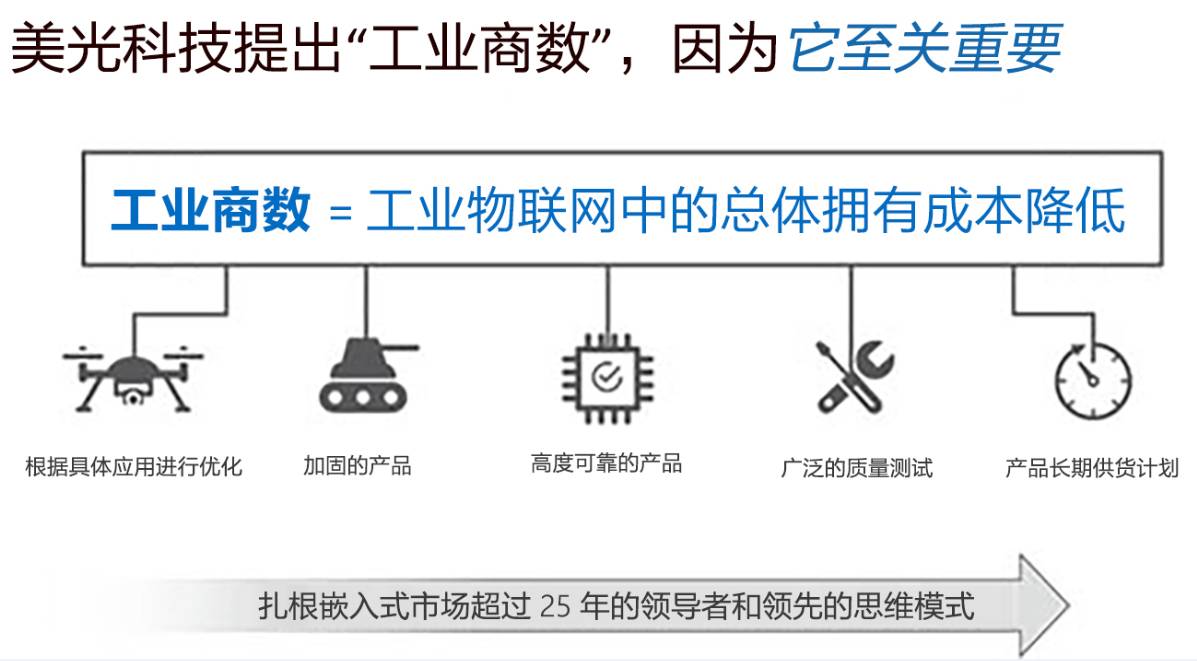
For 25 years, Micron Technology has closely collaborated with industrial customers, providing them with mindsets and product portfolios that deliver sustainable value. The chart above and the descriptions below illustrate how Micron achieves this and the critical elements we believe are essential for Industrial IoT design:
-
Application-Specific Product Adjustments: Extensive collaboration with global customers to gain insights into specific application use cases and deliver products and functionalities that meet these specific application requirements.
-
Robust Products: Products are comprehensively improved to ensure consistent performance even in various extreme environments (including wide temperature ranges, thermal cycling, vibration, humidity, etc.).
-
High Reliability: Design and testing processes ensure that our devices maintain high levels of reliability and durability throughout their lifetime, suitable for customers’ long-lasting embedded applications.
-
Extensive Quality Testing: Rigorous testing guarantees consistent performance across various products and processes, which is essential for embedded and critical applications.
-
Long-Term Product Supply: Our Product Long-Term Supply Plan (PLP) provides standard lifecycle support and extended support for qualified products, further aligning with the needs of long-term applications.
As a global leader in the semiconductor industry, Micron Technology has a rich portfolio of technical products and strong manufacturing capabilities. We are the global leader in the automotive and industrial storage markets, with the industry’s most comprehensive product portfolio covering various memory and storage products required for the Industrial Internet of Things. Micron collaborates with ecosystem partners worldwide to deliver advanced solutions and proven compatibility for our mutual customers, helping their products reach the market faster. Micron’s sales operations are distributed globally, providing or facilitating technical support for embedded application businesses through global distribution channel partners in all major countries/regions.
Most importantly, we have introduced a mindset of “delivering sustainable value to customers” in the market, as we firmly believe that the Industrial Quotient (IQ) is crucial for customers’ success in the Industrial Internet of Things.
For more information, case studies, and white papers, please click Read More to visit the “IQ Matters” page for related topics.