
Wireless networks can be divided into two types. One type is infrastructure-based networks, which require fixed base stations, such as mobile communication networks that need tall antennas and high-power base stations for support; the other type is infrastructure-less networks, including mobile Ad Hoc networks and wireless sensor networks (WSN), where the nodes are distributed without a fixed base station. Note that it still has base stations, but they are not dedicated fixed base stations. Ad Hoc networks refer to wireless self-organizing networks, where the terminals of mobile Ad Hoc networks move rapidly.
In contrast, the nodes of wireless sensor networks are stationary or move very slowly. The official definition of wireless sensor networks is that they are wireless networks composed of a large number of stationary or mobile sensors that are self-organized and multi-hop.
From this, we can see that sensor networks mainly perform three functions: data collection, processing, and transmission, corresponding to sensor technology, computer processing technology, and wireless communication technology. Since the communication method of sensor network nodes generally uses wireless communication, the sensor network represents the wireless sensor network.
Some or all nodes in the sensor network can move slowly, and the topology will dynamically change as the nodes move.
Nodes communicate in an Ad Hoc manner, where each node can act as a router and possesses the ability to dynamically search, locate, and restore connections. From the user’s perspective, the structure of a wireless sensor network system consists of sensor nodes, aggregation nodes (similar to gateways), and management nodes. In terms of network functionality, each sensor node has dual functions of information collection and routing. It not only collects local information and processes data but also stores, manages, and integrates data forwarded from other nodes while collaborating with other nodes to complete certain functions.
The following diagram is a system schematic of the sensor network, where a large number of sensor nodes are distributed in the monitoring area, forming a network through self-organization. After the sensor nodes perform preliminary processing of the detected information, they will transmit it to the aggregation node via multi-hop relaying, and then through satellites, the internet, etc., transmit the information to the management node, which is the end user. The end user can also manage and configure the sensor network through the management node, such as publishing monitoring tasks.
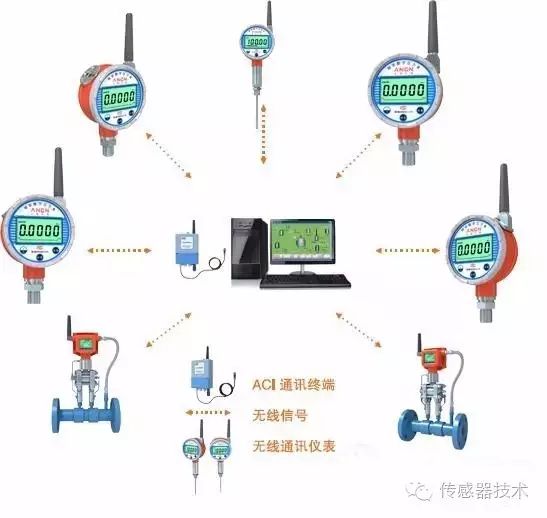
Some or all nodes in the sensor network can move slowly, and the topology will dynamically change as the nodes move. Nodes communicate in an Ad Hoc manner, where each node can act as a router and possesses the ability to dynamically search, locate, and restore connections. From the user’s perspective, the structure of a wireless sensor network system consists of sensor nodes, aggregation nodes (similar to gateways), and management nodes. In terms of network functionality, each sensor node has dual functions of information collection and routing. It not only collects local information and processes data but also stores, manages, and integrates data forwarded from other nodes while collaborating with other nodes to complete certain functions.
The following diagram is a system schematic of the sensor network, where a large number of sensor nodes are distributed in the monitoring area, forming a network through self-organization. After the sensor nodes perform preliminary processing of the detected information, they will transmit it to the aggregation node via multi-hop relaying, and then through satellites, the internet, etc., transmit the information to the management node, which is the end user. The end user can also manage and configure the sensor network through the management node, such as publishing monitoring tasks.
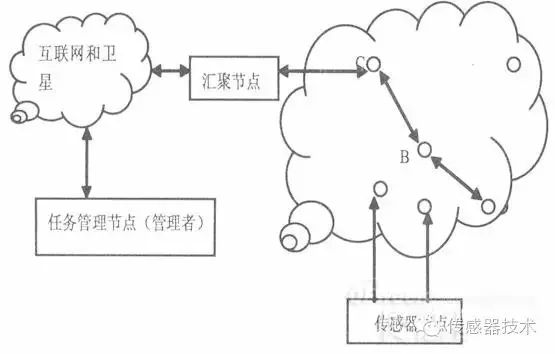
Sensor nodes consist of a processor, radio frequency part, and detection part. The processor completes computation and control functions, the radio frequency part completes wireless communication transmission functions, and the detection part completes data collection functions. The aggregation node does not require a detection part; it only needs a processor module and a radio frequency module. However, aggregation nodes usually have stronger processor modules, including enhanced computation, storage processing, and communication capabilities. It can be an enhanced sensor node with sufficient energy supply and more memory resources and computing power, or it can be a gateway device with a wireless communication interface (responsible only for data conversion). It completes the data exchange between the sensor network and external networks.