✅ Author’s Introduction: A Matlab simulation developer passionate about scientific research, improving both mind and technology simultaneously.
For code acquisition, paper reproduction, and research simulation collaboration, feel free to DM me.
🍎 Personal Homepage: Matlab King Assistant
🍊 Personal Motto: Walk every day, fear not the distance.
🍊 Code Acquisition Method: QQ: 2307468664
🔥 Content Introduction
Wireless Sensor Networks (WSN) play an increasingly important role in environmental monitoring, smart agriculture, smart homes, and other fields as a crucial part of the Internet of Things. However, the energy supply issue of WSN has always been a key bottleneck limiting its widespread application. Traditional disposable battery power supply methods are not only costly and difficult to maintain but also cause environmental pollution. Therefore, wireless charging technology has emerged, providing new possibilities for the sustainable operation of WSN. Drones (UAV) are viewed as one of the most promising energy supply carriers for Wireless Charging Sensor Networks (WCRSN). However, efficiently scheduling drones, optimizing charging paths, and ensuring the sustainable operation of WCRSN still face many challenges. This article will delve into an innovative solution, namely, a bus network-assisted drone scheduling strategy, aimed at enhancing the sustainable charging efficiency of WCRSN.
First, we need to understand the limitations of traditional drone scheduling strategies. Traditional drone scheduling strategies typically rely on two methods: global optimization methods, such as linear programming and genetic algorithms, which attempt to find the optimal charging path to maximize network lifetime. However, these methods often require mastering the global information of the entire network, resulting in high computational complexity and difficulty adapting to large-scale, dynamically changing WSN. The second is local optimization methods, such as greedy algorithms and shortest path algorithms, which select charging targets one by one or locally based on the needs and locations of nodes. While these methods are computationally efficient, they often fall into local optimal solutions and cannot guarantee overall energy supply efficiency. Additionally, traditional methods typically overlook the network structure of WSN, failing to fully utilize network information to guide drone scheduling.
The bus network-assisted drone scheduling strategy effectively compensates for the shortcomings of traditional methods by introducing the concept of a bus network. The core idea of this strategy is to deploy one or more physical or logical “buses” in the WSN, where sensor nodes transmit their energy demand information to the drones via the bus, and the drones schedule and charge based on the information on the bus. The advantages of this strategy mainly manifest in the following aspects:
1. Reducing Information Collection Costs and Improving Scheduling Efficiency: Traditional drone scheduling requires drones to actively probe or query the energy status of sensor nodes, consuming a significant amount of drone energy and time. By using a bus network, sensor nodes can actively broadcast their energy demand information onto the bus, allowing drones to quickly understand the energy status of the entire network simply by listening to the information on the bus. This passive information collection method greatly reduces the energy consumption of drones, shortens scheduling cycles, and enhances scheduling efficiency.
2. Reducing Computational Complexity and Adapting to Dynamic Changes: Since the bus network provides global energy demand information, drones can use this information to employ simpler scheduling algorithms, such as energy threshold-based scheduling strategies, prioritizing charging nodes below the threshold. This simple and effective algorithm can significantly reduce computational complexity, adapt to the dynamic changes of WSN, and ensure the stable operation of WCRSN.
3. Optimizing Charging Paths and Enhancing Energy Utilization: The bus network can provide the connection relationships between nodes, allowing drones to utilize these connections to plan more efficient charging paths. For instance, drones can fly along the bus and charge nodes near the bus sequentially, thereby reducing unnecessary flight distances and enhancing energy utilization. Moreover, through the bus network, drones can also understand the geographical location information of nodes, combining the distances and energy demands between nodes to formulate more reasonable charging plans.
4. Achieving Energy Fairness and Extending Network Lifespan: Through the bus network, drones can more accurately understand the energy status of each node, allowing for a fairer energy distribution. For instance, drones can employ fairness-based scheduling algorithms, prioritizing charging for nodes with lower energy, thereby avoiding premature failure of certain nodes due to energy depletion and extending the lifespan of the entire network.
To further enhance the performance of bus network-assisted drone scheduling, the following optimization aspects can also be considered:
- Bus Network Topology Optimization: The topology structure of the bus network directly affects the efficiency and reliability of information transmission. Appropriate bus network topology structures, such as linear topology, star topology, tree topology, etc., should be selected based on the deployment environment and node distribution of WSN. Additionally, redundant designs, such as multiple buses or multiple relay nodes, can be adopted to improve the reliability of the bus network.
- Optimization of Drone Scheduling Algorithms: More efficient drone scheduling algorithms can be designed by combining the specific application scenarios and energy demands of WSN. For instance, predictive scheduling strategies can be employed based on historical energy consumption data of nodes to predict future energy demands and charge in advance to avoid node energy depletion.
- Energy-Aware Bus Network: Energy awareness technology can be integrated into the bus network, allowing the bus network to not only transmit energy demand information but also sense the energy status of nodes, providing drones with more accurate energy information.
- Multi-Drone Cooperative Scheduling: For large-scale WSN, the charging capacity of a single drone may be insufficient to meet demands. Multi-drone cooperative scheduling strategies can be adopted, where multiple drones collaborate to charge different areas or nodes simultaneously, thus improving charging efficiency and shortening charging cycles.
In summary, the bus network-assisted drone scheduling strategy provides an innovative solution for the sustainable charging of WCRSN. This strategy introduces a bus network, reducing information collection costs, enhancing scheduling efficiency, optimizing charging paths, achieving energy fairness, and effectively extending the lifespan of WSN. Future research directions should focus on bus network topology optimization, drone scheduling algorithm optimization, energy-aware bus networks, and multi-drone cooperative scheduling, further enhancing the performance of bus network-assisted drone scheduling strategies and promoting the widespread application of WCRSN in various fields.
It is important to note that the construction and maintenance of the bus network will also incur certain costs, which need to be considered comprehensively in practical applications. However, compared to traditional disposable battery power supply methods, the bus network-assisted drone scheduling strategy can reduce operational costs, improve energy utilization, and is more environmentally friendly in the long run. Therefore, this strategy has broad application prospects and is worth further in-depth research and promotion.
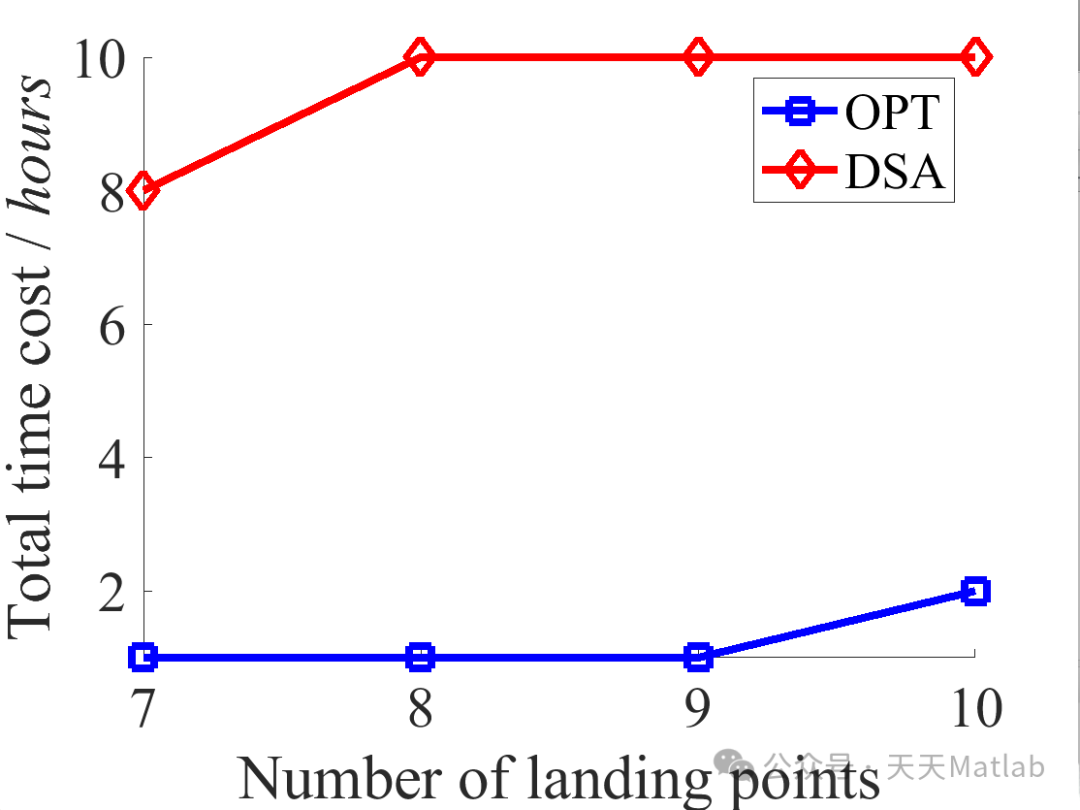
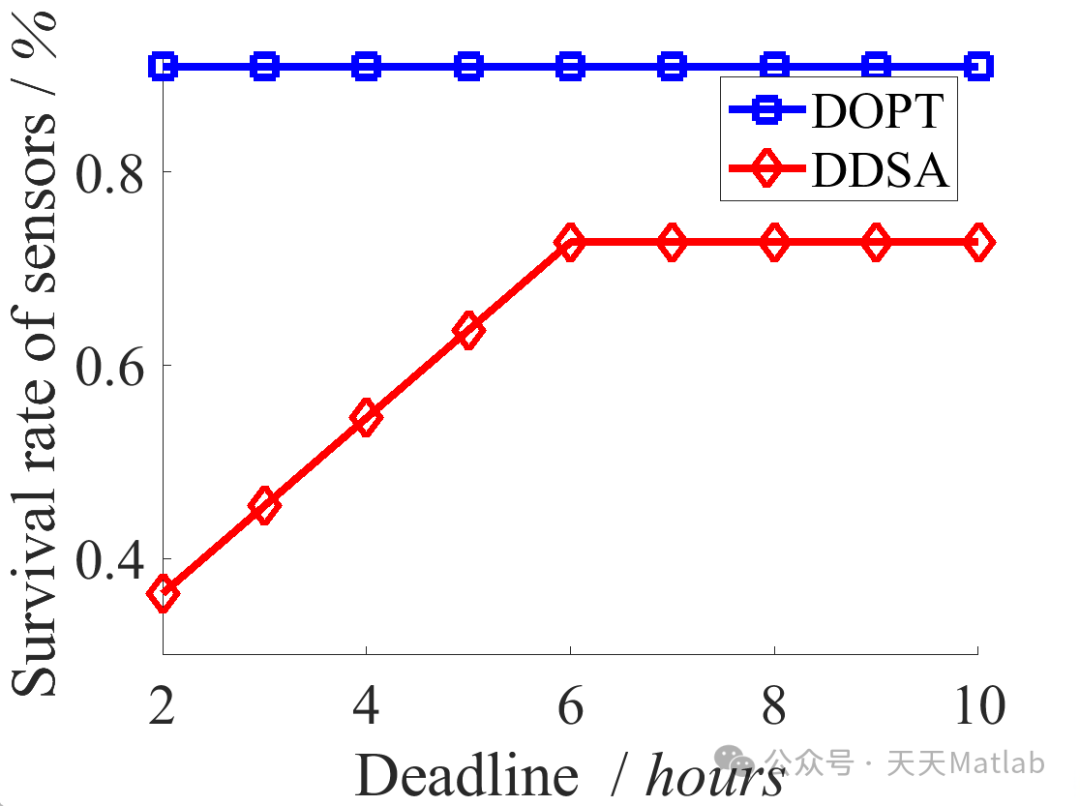
⛳️ Operating Results
🔗 References
[1] Zhou Fuhui, Zhang Xiang, Chen Liangbing, et al. Resource allocation method for drone-assisted wireless charging edge computing networks. CN201810762122.2 [2025-02-24].
📣 Partial Code
🎈 Some theoretical references to network literature, please contact the author for removal if there is any infringement.
👇 Follow me to receive a wealth of Matlab e-books and mathematical modeling materials.
🏆 Our team specializes in guiding customized Matlab simulations in various research fields, aiding in research dreams:
🌈 Various intelligent optimization algorithm improvements and applications
Production scheduling, economic scheduling, assembly line scheduling, charging optimization, workshop scheduling, departure optimization, reservoir scheduling, three-dimensional packing, logistics site selection, cargo location optimization, bus scheduling optimization, charging station layout optimization, workshop layout optimization, container ship loading optimization, pump combination optimization, medical resource allocation optimization, facility layout optimization, visual domain base station and drone site selection optimization, knapsack problem, wind farm layout, time slot allocation optimization, optimal distributed generation unit allocation, multi-stage pipeline maintenance, factory-center-demand point three-level site selection problem, emergency supply distribution center site selection, base station site selection, road lamp post arrangement, hub node deployment, power transmission line typhoon monitoring devices, container scheduling, unit optimization, investment optimization portfolio, cloud server combination optimization, antenna linear array distribution optimization, CVRP problem, VRPPD problem, multi-center VRP problem, multi-layer network VRP problem, multi-center multi-vehicle VRP problem, dynamic VRP problem, two-layer vehicle routing planning (2E-VRP), electric vehicle routing planning (EVRP), oil-electric hybrid vehicle routing planning, hybrid flow shop problem, order splitting scheduling problem, bus scheduling optimization problem, flight ferry vehicle scheduling problem, site selection path planning problem, port scheduling, port shore bridge scheduling, parking space allocation, airport flight scheduling, leak source location.
🌈 In the field of machine learning and deep learning: time series, regression, classification, clustering, and dimensionality reduction.
2.1 BP time series, regression prediction, and classification
2.2 ENS voice neural network time series, regression prediction, and classification
2.3 SVM/CNN-SVM/LSSVM/RVM support vector machine series time series, regression prediction, and classification
2.4 CNN|TCN|GCN convolutional neural network series time series, regression prediction, and classification
2.5 ELM/KELM/RELM/DELM extreme learning machine series time series, regression prediction, and classification
2.6 GRU/Bi-GRU/CNN-GRU/CNN-BiGRU gated neural network time series, regression prediction, and classification
2.7 Elman recurrent neural network time series, regression prediction, and classification
2.8 LSTM/BiLSTM/CNN-LSTM/CNN-BiLSTM/long short-term memory neural network series time series, regression prediction, and classification
2.9 RBF radial basis function neural network time series, regression prediction, and classification
2.10 DBN deep belief network time series, regression prediction, and classification
2.11 FNN fuzzy neural network time series, regression prediction
2.12 RF random forest time series, regression prediction, and classification
2.13 BLS broad learning system time series, regression prediction, and classification
2.14 PNN pulse neural network classification
2.15 Fuzzy wavelet neural network prediction and classification
2.16 Time series, regression prediction, and classification
2.17 Time series, regression prediction, and classification
2.18 XGBOOST ensemble learning time series, regression prediction, and classification
2.19 Transform various combinations of time series, regression prediction, and classification
Direction covers wind power prediction, photovoltaic prediction, battery life prediction, radiation source identification, traffic flow prediction, load forecasting, stock price prediction, PM2.5 concentration prediction, battery health state prediction, electricity consumption prediction, water optical parameter inversion, NLOS signal identification, precise subway parking prediction, transformer fault diagnosis.
🌈 In the field of image processing:
Image recognition, image segmentation, image detection, image hiding, image registration, image stitching, image fusion, image enhancement, image compressed sensing.
🌈 In the field of path planning:
Traveling salesman problem (TSP), vehicle routing problem (VRP, MVRP, CVRP, VRPTW, etc.), three-dimensional path planning for drones, drone cooperation, drone formation, robot path planning, grid map path planning, multimodal transport problems, electric vehicle routing planning (EVRP), two-layer vehicle routing planning (2E-VRP), oil-electric hybrid vehicle routing planning, ship trajectory planning, full path planning, warehouse patrol.
🌈 In the field of drone applications:
Drone path planning, drone control, drone formation, drone cooperation, drone task allocation, online optimization of drone safe communication trajectories, vehicle cooperative drone path planning.
🌈 In the field of communication:
Sensor deployment optimization, communication protocol optimization, routing optimization, target location optimization, Dv-Hop location optimization, Leach protocol optimization, WSN coverage optimization, multicast optimization, RSSI location optimization, underwater communication, communication upload and download allocation.
🌈 In the field of signal processing:
Signal recognition, signal encryption, signal denoising, signal enhancement, radar signal processing, signal watermark embedding and extraction, electromyography signals, electroencephalography signals, signal timing optimization, electrocardiography signals, DOA estimation, encoding and decoding, variational mode decomposition, pipeline leakage, filters, digital signal processing + transmission + analysis + denoising, digital signal modulation, bit error rate, signal estimation, DTMF, signal detection.
🌈 In the field of power systems:
Microgrid optimization, reactive power optimization, distribution network reconstruction, energy storage configuration, orderly charging, MPPT optimization, household electricity.
🌈 In the field of cellular automata:
Traffic flow, crowd evacuation, virus spread, crystal growth, metal corrosion.
🌈 In the field of radar:
Kalman filtering tracking, trajectory association, trajectory fusion, SOC estimation, array optimization, NLOS identification.
🌈 In workshop scheduling:
Zero-wait flow shop scheduling problem (NWFSP), Permutation flow shop scheduling problem (PFSP), Hybrid flow shop scheduling problem (HFSP), zero-idle flow shop scheduling problem (NIFSP), distributed permutation flow shop scheduling problem (DPFSP), blocking flow shop scheduling problem (BFSP).
👇