Hello everyone, I am your Pentagon Lady.
Today, I will continue to share some basic industry information about humanoid robots.
1. Industry Demand Forecast
Global Market: The sales volume is expected to reach 12,400 units by 2025, with a market size of $6.339 billion; by 2030, it will reach 340,000 units and $64 billion; and by 2035, it will exceed 5 million units and $400 billion, with a compound annual growth rate exceeding 60%.
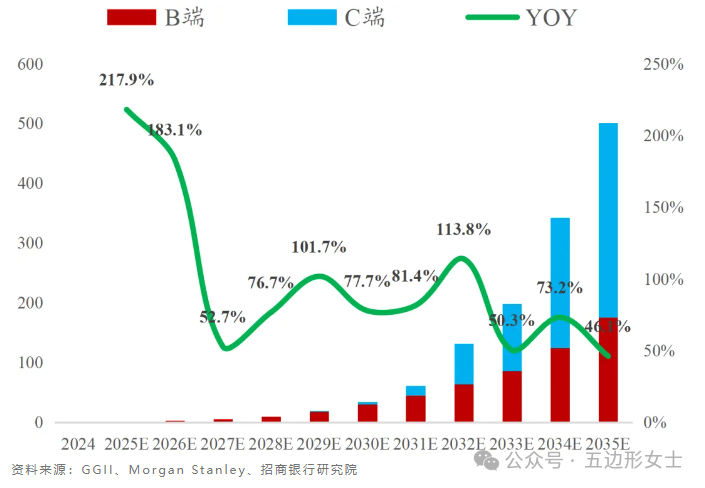
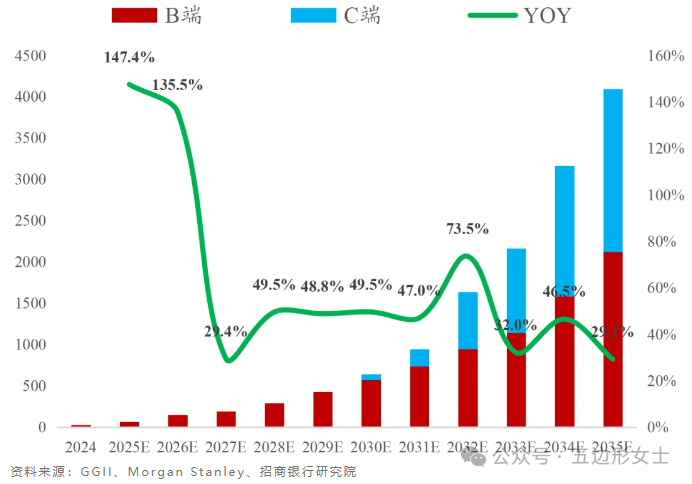
Chinese Market: The market size is expected to reach $8.239 billion by 2025, accounting for 50% of the global market; by 2035, the sales volume of humanoid robots in China is expected to reach 2 million units, with a market size close to 140 billion yuan.
2. Humanoid Robot Industry Chain
It mainly includes three major links: upstream components, midstream complete machines, and downstream applications.
1. Upstream Components:
Global Market: The market size of core components is expected to reach 180 billion yuan by 2025, with a year-on-year growth of 68%, accounting for 72% of the hardware value of the entire industry chain. Future forecast: by 2030, the global core components market will exceed 1.2 trillion yuan, with a compound annual growth rate of 58%.
Chinese Market: Contributes 35% of the global share (63 billion yuan), with the sensor field growing the fastest (year-on-year +92%), and the growth rates of reducers and servo motors reaching 75% and 61%, respectively. The localization rate is expected to increase from the current 42% to 65% by 2030.
Upstream core components: With the launch of 2025 as the “Year of Mass Production,” the procurement demand for components from main engine manufacturers is expected to grow exponentially, driving the component market to expand first.
2. Midstream Complete Machine Manufacturing:
The global market size is only 2-5 billion yuan, still in the “transition from technology validation to small batch delivery” stage. Even leading companies like UBTECH, Tesla, and Yush are yet to achieve large-scale external sales.
3. Downstream Scenario Applications:
Driven by both “Industry” and “Service,” but large-scale procurement has not yet formed.
Summary: At the current stage, components are the first to benefit and represent the largest part of the value chain.
3. Internal Components:
Core components are divided into four major categories based on function: motion execution, perception interaction, decision control, and structural support, with the first three being the technical core, accounting for over 65% of hardware costs:
1. Motion Execution: Reducers (harmonic / planetary), servo motors, joint modules (integrated reducer + motor + controller)
By 2025, the global market size for joint modules will reach 64.8 billion yuan, with reducers (45 billion yuan) and servo motors (36 billion yuan).
Future growth is highly certain: it is expected that by 2030, domestic demand for joint modules will rise from 2.2417 million sets in 2024 to 4.8201 million sets, with the market size exceeding 68.927 billion yuan, and a compound annual growth rate exceeding 17%, continuously consolidating its position as the “largest scale.”
2. Perception Interaction: 3D vision sensors, six-dimensional force sensors, torque sensors, voice interaction modules
3. Decision Control: AI chips, motion controllers, algorithm models (embodied intelligent large models)
4. Structural Support: Lightweight body materials (aluminum alloy / carbon fiber), bionic hand actuators
|
Component Category |
Subcomponents |
Proportion of Total Machine Cost |
Cost Reduction Bottleneck |
|
Motion Execution |
Joint Module |
36% |
High-precision torque sensor prices are high |
|
Independent Reducer |
25% |
Domestic lifespan is only 50% of foreign products |
|
|
Servo Motor |
20% |
High-end models rely on imports |
|
|
Perception Interaction |
3D Vision Sensor |
8% |
Industrial-grade accuracy still has gaps |
|
Force Sensor |
6% |
Insufficient production scale leads to difficulty in cost reduction |
|
|
Decision Control |
AI Chip + Controller |
15% |
Localization rate of dedicated chips < 10% |
|
Structural Support and Others |
Body Materials + Hand Actuators |
10% |
Bionic hand design complexity is high |
Disclaimer: All content above is for personal research reference only and does not constitute any recommendations or guarantees.
Previous Reviews:
Can the robotics industry take over? Investment opportunities await!
CATL sets a new historical high! What drives this wave of market?
Understanding the underlying logic of tenfold stocks: ordinary people can also grasp the wealth code
9 years of financial industry experience teaching everyone how to “make money”!