
Reporter Lu Xiao from Huaxia Times reports from Jingzhou
With the rapid iteration of technologies such as AI, embodied intelligence, and 5G, the transformation speed of the manufacturing industry is also unexpectedly fast.
On August 26, reporters from Huaxia Times visited Midea’s washing machine factory in Jingzhou. The reporters observed that in this intelligent factory, which has 14 intelligent agents covering 38 core production business scenarios, in addition to the KUKA “iico collaborative robot” that can “screw” the back covers of different models of dryers, and the Yutu-AI inspection robot working in the laboratory, the increasingly popular humanoid robots have also transitioned from the competition arena to the factory for employment.
Behind this, artificial intelligence and the larger B-end market are becoming key forces driving the transformation and upgrading of the manufacturing industry. On that day, several relevant personnel from Midea also accepted interviews from media such as Huaxia Times, discussing Midea’s layout and thoughts in the fields of intelligent factories and specific intelligence.

Humanoid Robots on Duty
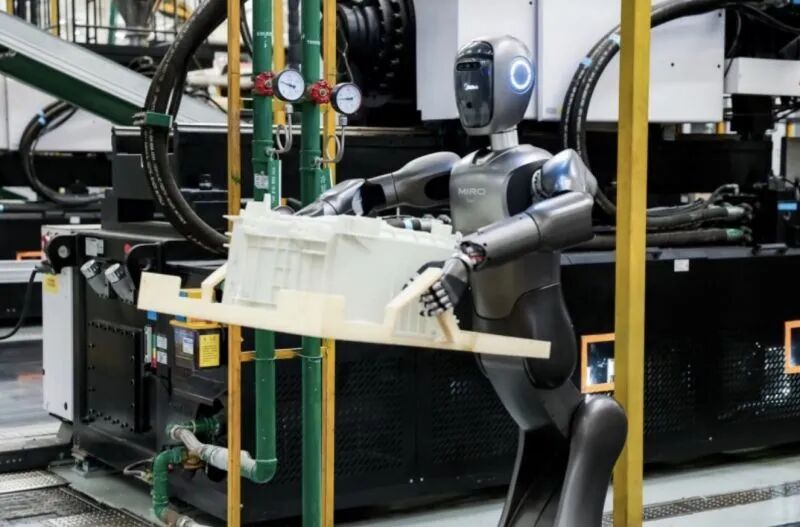
Midea’s self-developed humanoid robot, Meiluo, has become one of the many employees at Midea’s washing machine factory in Jingzhou.
According to our reporter, the Meiluo robot, which adopts a wheeled leg design and uses heavy-duty AGV technology for its chassis, started working in the injection molding workshop in May this year, performing initial inspection and delivery tasks. It transports the injection-molded rear barrels to the intelligent initial inspection station, where an integrated high-precision self-developed 3D camera autonomously conducts dimensional and appearance inspections. Once the system confirms that the components are qualified, it dispatches the robot to return for the next item. Midea’s relevant personnel communicated with reporters, stating that the single-arm load design of the Meiluo robot initially only supported three kilograms, but it can now stably handle tasks of up to nine kilograms.
“We believe that humanoid products, specifically wheeled leg types, should be the first to enter factories because we already have KUKA robots and many mobile robots, including robotic arms, that are already in use in factories,” said Xi Wei, director of Midea Group’s Humanoid Robot Innovation Center, to reporters from Huaxia Times on August 26. He introduced that Midea began planning related technologies for humanoid robots in 2023, always driven by application, and besides handling scenarios, loading and unloading, screwing, terminal connection, panel assembly, and welding are also scenes that humanoid robots need to break through.
Unlike humanoid robot startups like Yushu and Zhiyuan, Midea acquired the German industrial robot company KUKA back in 2017. Xi Wei also stated that after acquiring KUKA, Midea has full-chain R&D capabilities in the humanoid robot field, from core components to complete machine production and application scenarios, but he also emphasized that humanoid robots are not the same as industrial robots.
He cited the complex structure of humanoid robots as an example, “Traditional industrial robotic arms mainly have six joints, while industrial mobile robots have about two to three joints, generally two wheels plus one embodiment, whereas humanoid robots can have over 40 joints if including the hands. This complex multi-joint structure poses significant challenges to the entire technology stack from design to production to final application.” It is reported that in the field of humanoid robots, Midea has achieved self-research on key components such as core modules, core sensors, six-dimensional force sensors, tactile sensors, and 3D cameras.
Regarding the future form of humanoid robot products, Xi Wei also revealed that general-purpose bipedal humanoid robots will have broader applications in some cross-terrain and cross-scenario fields in the future. Midea is also planning related products, but he also mentioned that current humanoid robots still have some shortcomings, with the biggest issue being that general-purpose robots have a certain trade-off in efficiency and versatility. “We are also planning the next generation of new product configurations, which we call super humanoid robots, which are still in the laboratory for research and development.”
Intelligent Factories Will Be Rapidly Replicated
Robots are just one of the intelligent terminals in Midea’s washing machine factory in Jingzhou. In this factory, in addition to intelligent terminals, there are also intelligent agents covering various factory processes such as planning, procurement, production manufacturing, quality, and logistics, as well as a factory brain that coordinates multiple intelligent agents. Recently, this factory was certified by the World Record Certification Agency (WRCA) based in London as the “World’s First Multi-Scenario Covered Intelligent Factory,” marking the official landing of the industry’s first intelligent factory.
Regarding the difference between intelligent factories and intelligent agent factories, Midea’s washing machine factory general manager, Lv Hongzhi, told reporters from Huaxia Times that intelligent factories are mostly upgrades of traditional digital factories, focusing more on automation, digitalization, networking, and customization. “We hope that the intelligent agent factory is a ‘living factory’ with a brain, intelligent agents, and intelligent terminals, with autonomy at its core.”
The opportunity for Midea to build intelligent agent factories originated from an internal report last July. Midea Group’s Digital Platform Application Center Director Zhou Xiaoling told reporters from Huaxia Times that during a report on AIGC strategic project planning to the Group Executive Committee, two directions were identified that the group could pursue: one is Home Agent, and the other is Factory Agent. “Because we have so many intelligent manufacturing factories, if we have large models and AIGC support, it could form a more efficient and intelligent factory.”
In addition to forming a joint project team with KUKA, the Central Research Institute, and the AI Research Institute, Midea’s washing machine factory in Jingzhou was selected as a pilot. According to reports, Midea’s washing machine factory in Jingzhou officially completed construction and production in 2022, making it the third washing machine production base in China after Wuxi and Hefei, mainly responsible for producing Midea’s domestic brands, Little Swan and Midea washing machines and dryers. More importantly, it is also the world’s first fully connected 5G factory in the home appliance manufacturing field.
According to Lv Hongzhi, after using the planning intelligent agent, the efficiency of responding to planned orders in Midea’s washing machine factory in Jingzhou has improved by at least 90%. “What used to take several hours of manual operation can now be completed automatically and intelligently in just a few minutes.” In the quality inspection process, with the support of the “Midea Factory Brain,” the initial inspection efficiency of AI glasses has also been reduced from 15 minutes to 30 seconds.
As the large models and embodied intelligence are driving the latest technological wave in the AI industry, intelligent agent factories are also increasingly being implemented in more scenarios and industries.
Midea Group’s Chief Digital Officer Zhang Xiaoyi also revealed that Midea Group will take the recognition of the washing machine factory in Jingzhou as the “World’s First Multi-Scenario Covered Intelligent Factory” as a new starting point to further expand the number of scenarios covered by intelligent agents, adding more embodied intelligent terminal devices, and continuously promoting the evolution of the factory brain. At the same time, the intelligent agent factory solution will be rapidly replicated to other factories globally within the group, helping Chinese manufacturing occupy a more advantageous position in the global industrial competition landscape.

This issue was edited by Li Yunpeng
Browse more exciting content
Welcome to follow Huaxia Times video account
Recommended Reading

Another Old Mall in Beijing Closes

Deposit Rates Have Dropped Again!
 2025 Graduates’ Employment: Millions of Youths Moving in Multiple Directions