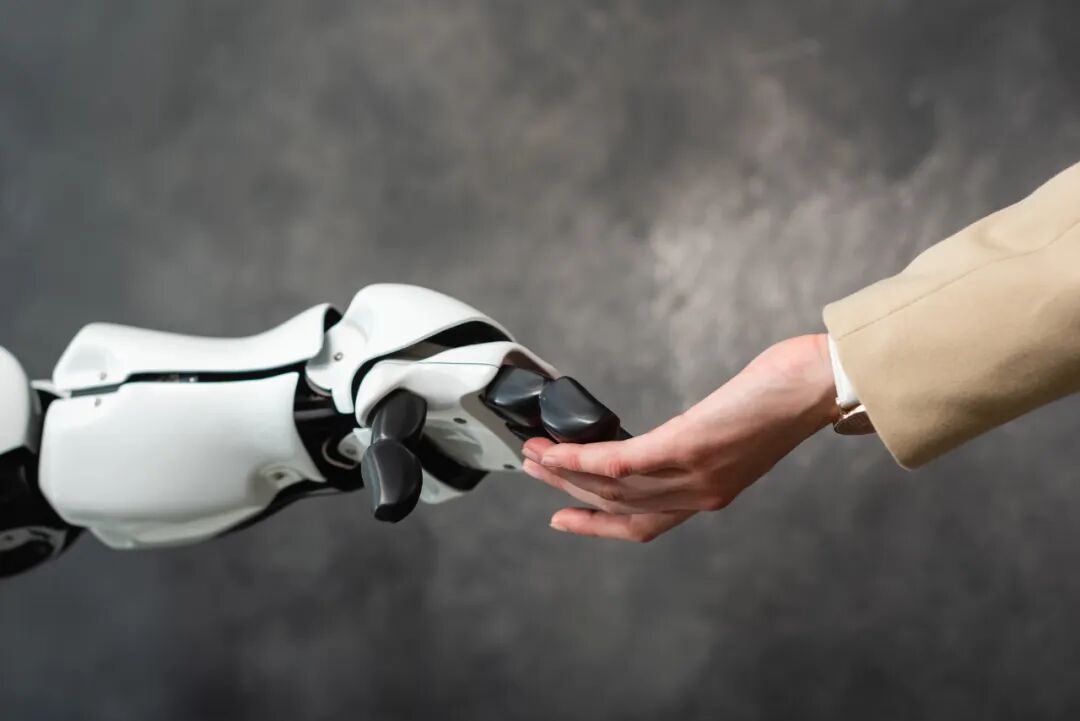
 Currently, the AI smart hardware industry is experiencing rapid development, with the market scale continuously expanding and application scenarios extending into multiple fields.Among them, robots, as a highly representative category, are receiving increasing attention. In the future, the development of AI hardware will redefine hardware from the ground up. With the analytical power of large models, hardware will truly begin to “understand” human language, perceive emotions, and comprehend scenarios.
01
The Booming AI Smart Hardware Market
According to a report from the Research Institute of Industry, the AI smart hardware industry refers to the field of hardware devices that integrate artificial intelligence technology, enabling these devices to perform complex computational tasks, learn user behavior, and provide intelligent services. Currently, the AI smart hardware industry is undergoing rapid development, with the market scale continuously expanding, and application scenarios extending from initial image and voice recognition to multiple fields such as autonomous driving, smart homes, and healthcare.
The AI smart hardware industry can be divided into three phases: the embryonic stage (2007-2013), where smart hardware products had relatively simple functions but already showed a trend of enhancing user experience through the combination of software and hardware; the startup phase (2014-2022), where, with technological advancements and market maturity, the AI smart hardware industry exhibited high innovation vitality and development momentum; and the rapid development phase (2023 to present), where, with continuous advancements in AI technology, the security and privacy protection of smart hardware have also received significant attention, ensuring the effective protection of user data security and privacy.
The 3C product market, especially in the smartphone and personal computer sectors, is showing a stable recovery trend, further promoting the expansion of the AI smart hardware market. From 2018 to 2023, the market scale of China’s AI smart hardware industry grew from 1.52 trillion yuan to 2.18 trillion yuan, with a compound annual growth rate of 7.51%; it is expected that from 2024 to 2028, the market scale of China’s AI smart hardware industry will grow from 2.49 trillion yuan to 4.26 trillion yuan, with a compound annual growth rate of 14.35%.
According to Zhiyan Consulting, in the future, several major development trends will emerge in AI smart hardware:
1. Hardware Upgrades and the Popularization of Edge AI
In the coming years, AI smart hardware will develop towards higher computing power and lower power consumption. The popularization of edge AI will enable smart hardware devices to possess stronger local processing capabilities, reducing dependence on the cloud. For example, devices such as smartphones and smart PCs will integrate more powerful AI chips to support the local operation of more complex AI models. At the same time, hardware upgrades will encompass multiple aspects such as storage, batteries, and heat dissipation to meet the demands of long-term operation of large AI models.
2. Multimodal Interaction and Intelligent Applications
Multimodal interaction technology will become an important development direction for AI smart hardware. In the future, smart hardware will integrate various interaction methods such as voice, image, and gesture to provide a more natural and intelligent user experience. For example, devices like smart glasses will achieve more convenient operations through voice interaction, gesture control, and projection display. Additionally, AI technology will be implemented in more fields such as smart homes, intelligent transportation, and healthcare, promoting full-scenario intelligence.
3. Cross-Industry Integration and Ecosystem Building
The AI smart hardware industry will accelerate its deep integration with various industries, forming a broader ecosystem. For instance, AI technology will enable intelligent material research and flexible production in manufacturing, assist precision planting in agriculture, and promote intelligent customer service and personalized recommendations in the service industry. At the same time, companies will place greater emphasis on ecosystem building, promoting collaborative development along the industrial chain through open platforms and cooperative research and development. This cross-industry integration will not only expand the application scenarios of AI smart hardware but also enhance the overall value of the industry.
02
The Acceleration of Robot Applications in the Wave of Intelligence
In recent years, the development momentum of AI smart hardware has been rapid, with robots, as a highly representative category, receiving increasing attention.
With the rapid development of artificial intelligence technology, the robotics industry has entered a fast track of development. In recent years, China’s robotics industry has grown from small to large, consistently maintaining its leading position in global robot production and consumption, with a comprehensive, systematic, and complete industrial chain that is globally leading. According to CCID Consulting, during the 14th Five-Year Plan period (2026 to 2030), China’s robotics industry will rapidly develop in terms of innovation capability, development foundation, application fields, ecological support, and carrier construction, with the industry scale expected to grow to around 400 billion yuan, and the market scale will remain the largest in the world.
Service robots, as an important branch of the robotics field, are increasingly integrating into daily life with their intelligent, efficient, and multifunctional characteristics.
According to the “2025 China Service Robot Industry Market Outlook Research Report” by the China Business Industry Research Institute, service robots are semi-autonomous or fully autonomous robots that can perform service tasks beneficial to humans. According to functional classification, service robots include household service robots, commercial service robots, professional service robots, and public service robots. With the continuous development of the silver economy in China, the application prospects of service robots in the elderly care sector are broad.
The “2025-2030 China Service Robot Industry Development Outlook and Investment Strategy Planning Analysis Report” released by the China Business Industry Research Institute shows that in 2023, the market scale of China’s service robots reached approximately 60 billion yuan, with an average annual compound growth rate of 32.41% over the past five years. It is predicted that the market scale of China’s service robots will reach 73.8 billion yuan in 2024 and 85 billion yuan in 2025.
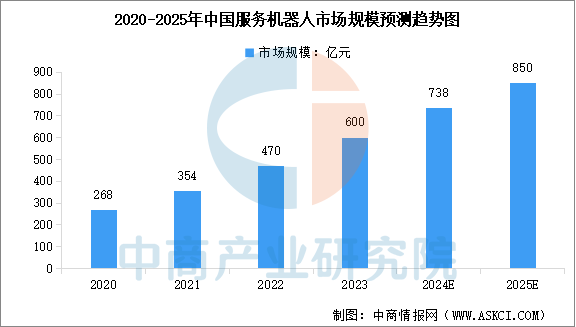 Data Source: China Electronics Society, organized by the China Business Industry Research Institute
Service robots mainly include two categories: personal/home service robots and public service robots. Personal/home service robots include household robots, educational robots, elderly care assistance robots, and home safety monitoring robots, while public service robots include dining robots, guide robots, public entertainment robots, and public mobility robots. From the perspective of market segmentation, currently, the largest market share in China’s service robot market is held by floor cleaning and cleaning robots, followed by logistics and mobile robots.
Currently, with the deep integration of robots and new generation information technology, the autonomy and adaptability of service robots in China have significantly improved, and their application boundaries are continuously expanding, penetrating all aspects of people’s lives, indicating a very broad development prospect for domestic service robots.
03
Creating AI Robots That Truly “Understand” Human Language
China has a vast market for robot applications. With the steady implementation of the “Robot+” initiative, the application fields of robots are accelerating their expansion, continuously deepening and solidifying their applications in areas such as dining, healthcare, hospitality, elderly care, logistics, firefighting, housekeeping, and security, effectively supporting the digital transformation and intelligent upgrade of the industry.Currently, there are many types of hardware in the market based on the concept of AI companionship, with diverse forms, but their principles are usually similar—based on the hardware product itself, equipped with third-party collaborations or proprietary large models to achieve “preliminary AI” functions, but it is difficult to achieve truly smooth human-machine emotional interaction.Consumer-grade AI robot company X-ORIGIN-AI focuses on the research and development of consumer-grade AI robot products, aiming to break the shackles of AI technology’s tool attributes and promote the upgrade of human-machine interaction from “tool-based” to “emotion-based”. Addressing the “full lifecycle” needs from children to adults to the elderly, X-ORIGIN-AI is building an intelligent companion ecosystem driven by personalized AI models, allowing everyone to have a digital partner that “understands them best”.
Li Yunzhao, the founder of X-ORIGIN-AI, believes that the development direction of AI hardware is not to simply apply a large language model “shell” to traditional devices, but to redefine hardware from the ground up. The breakthroughs in the “dynamic memory system” and “multimodal emotional collaboration” technologies enable X-ORIGIN-AI to explore different possibilities—leveraging the analytical power of large models to allow hardware to truly “understand” human language, perceive emotions, and comprehend scenarios, and then achieve functional feedback through the model’s translation system.
Interactive hardware will become an important component in the development process from AI to AGI, reshaping the evolutionary paradigm of AI, and the embodied data ecosystem it constructs will become the “cognitive singularity” for AGI breakthroughs.
From the system data layer to the terminal technology layer to the application layer, X-ORIGIN-AI has spent two years building a technology architecture suitable for the AI era. Based on this technology architecture, this year, X-ORIGIN-AI will create multiple differentiated interactive products according to market demand and gradually launch them into the market.
Source: Lenovo Star