An AI server surprisingly requires a PCB worth tens of thousands? This overlooked sector has seen material companies rush to position themselves.
The value of a PCB (Printed Circuit Board) for an AI server is more than five times that of a traditional server, with a single unit priced as high as $10,000!
If we compare an AI server to a “smart brain,” then the PCB is the “neural network” connecting the brain’s neurons, and the core materials supporting this “network” are experiencing unprecedented explosive opportunities.
Today, the smartphones we use daily, the computers we work on, and the servers we watch videos on all rely on PCBs. But have you ever wondered why, amid the AI boom, PCBs have suddenly become so “valuable”?
What new opportunities are the material companies hidden behind PCBs quietly seizing?
1. AI Ignites the PCB Industry: Behind the Surge in Volume and Price, Two Product Types Emerge as Major Winners
First, let’s look at some shocking data: The global PCB market value reached $73.565 billion in 2024, a year-on-year increase of 5.8%;
It is expected that by 2029, this figure will soar to $94.661 billion, with a compound annual growth rate of 5.2% over five years.
As the world’s largest PCB production base, China contributed $41.213 billion in value in 2024, accounting for 56% of the global total, meaning one in every two PCBs is produced in China.
The reason AI has caused the “value of PCBs to skyrocket” lies in the upgrade of technical requirements. Traditional server PCBs are mostly 12-16 layers, while the core modules of AI servers (such as NVIDIA’s UBB and OAM acceleration boards) require high-layer boards of 20-28 layers. The more layers, the higher the technical difficulty and value.Among them, two types of PCB products are particularly noteworthy: first, HDI (High-Density Interconnect) boards, mainly used in 5G smartphones and satellite communications, with a projected compound annual growth rate of 6.4% from 2024 to 2029; second, 18+ layer multilayer boards, specifically designed for AI servers and high-speed switches, with their value and output expected to surge by 25.2% and 35.4% year-on-year in 2024, respectively, and a staggering compound annual growth rate of 15.7% over the next five years, making them the “speed king” of the PCB sector.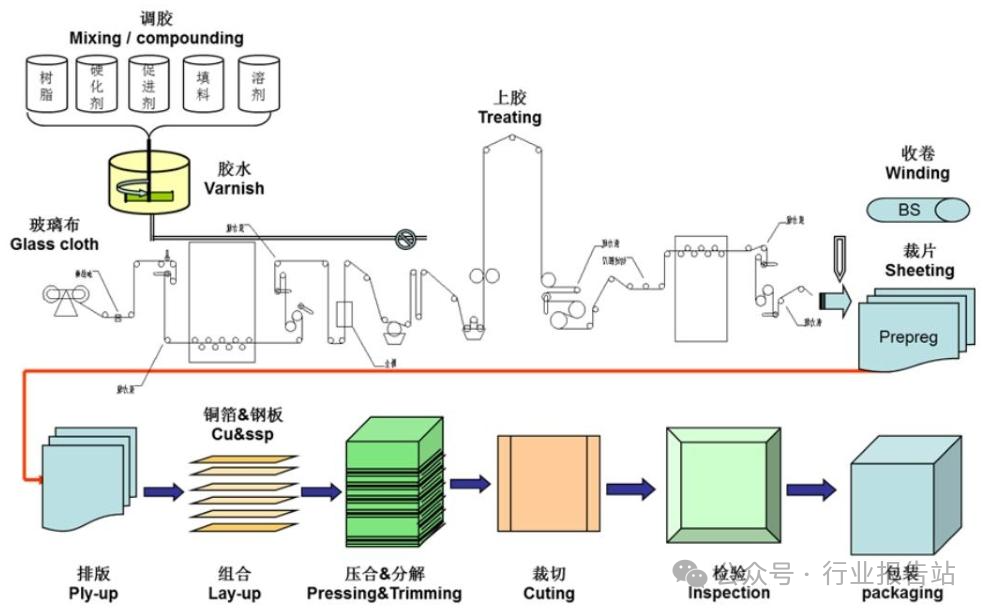
2. The “Heart” of PCBs is Copper Clad Laminate, Three Key Materials Determine Performance Limits
If PCBs are the “neural network,” then copper clad laminate (CCL) is the “heart” of the PCB—accounting for 27.3% of the cost structure of PCBs, far exceeding labor, gold salt, and other costs.
In 2024, China’s sales of copper clad laminates are expected to grow by 24%, with sales revenue exceeding 82.3 billion yuan, setting a new high in recent years.
The performance of copper clad laminates is entirely determined by three core materials: copper foil, resin, and fiberglass cloth.
Copper foil is responsible for signal transmission, with the market size of China’s composite copper foil expected to reach 9.28 billion yuan in 2023, projected to reach 29.15 billion yuan by 2025, tripling in two years;
Fiberglass cloth serves as the “skeleton” supporting the structure of the copper clad laminate; while resin is the “soul,” directly affecting the signal transmission speed and stability of the copper clad laminate.
As AI servers demand increasingly high signal transmission standards, ordinary copper clad laminates are no longer sufficient, and “high-frequency, high-speed copper clad laminates” have become a new trend.
These types of copper clad laminates can achieve high-speed signal transmission of 10-50Gbps, with extremely low dielectric loss, making them essential for AI servers and 5G base stations.
The global market size for high-frequency, high-speed copper clad laminates was $2.63 billion in 2023, expected to grow to $2.8 billion in 2024, and will continue to expand with the development of smart driving and satellite communications.
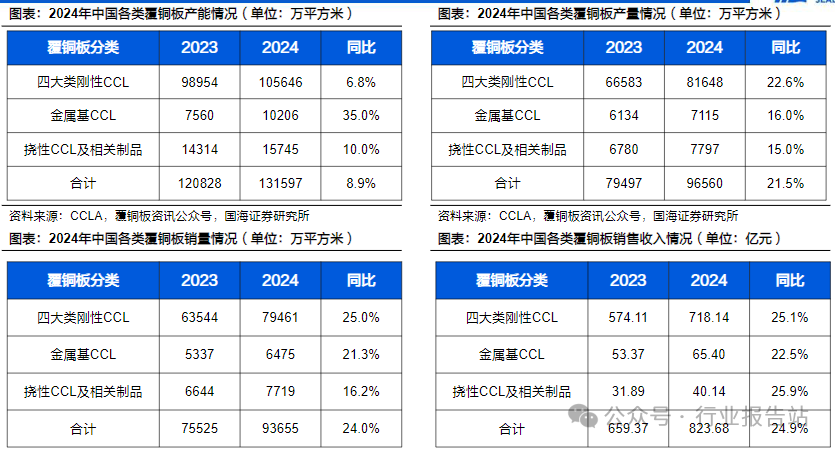
Data Source: CCLA, Copper Clad Laminate Information WeChat Official Account, Guohai Securities Research Institute
3. Electronic Resins: From “Conventional” to “Ultra-Low Loss,” Domestic Companies Break Foreign Monopolies
Among the core materials for high-frequency, high-speed copper clad laminates, the technological upgrade of electronic resins is the most critical. Previously, ordinary epoxy resins could meet the requirements, but the AI era demands “ultra-low loss” resins.
— For example, polytetrafluoroethylene (PTFE) resin, which has the lowest dielectric constant and loss, is considered the “performance ceiling” among resins.
Currently, the mainstream high-performance electronic resins can be categorized into four types: bismaleimide resin (BMI), which has strong heat resistance and can withstand high temperatures of 250-290°C; polyphenylene oxide resin (PPO), with global demand of only 1,000 tons in 2022, expected to surge to 8,000 tons by 2026, with a compound annual growth rate of 68.2% over four years;
hydrocarbon resin (PCH), which accounts for 30% of the cost of 5G copper clad laminates, with demand expected to reach 12,000-15,000 tons by 2025; and PTFE resin, with demand corresponding to global AI servers expected to be 476 tons in 2025, increasing to 714 tons in 2026.
It is worth noting that these high-end resins were previously monopolized by foreign companies, but domestic companies have now made breakthroughs.
For instance, Shengquan Group has achieved mass production of PPO and hydrocarbon resins, entering the leading supply chain;
Dongcai Technology’s bismaleimide resin occupies a significant share of the niche market, with products supplied to companies like NVIDIA and Huawei; and Tongyu New Materials’ benzoxazine resin has also begun small-scale supply, accelerating domestic substitution.
A summary table of various electronic resin characteristics and production companies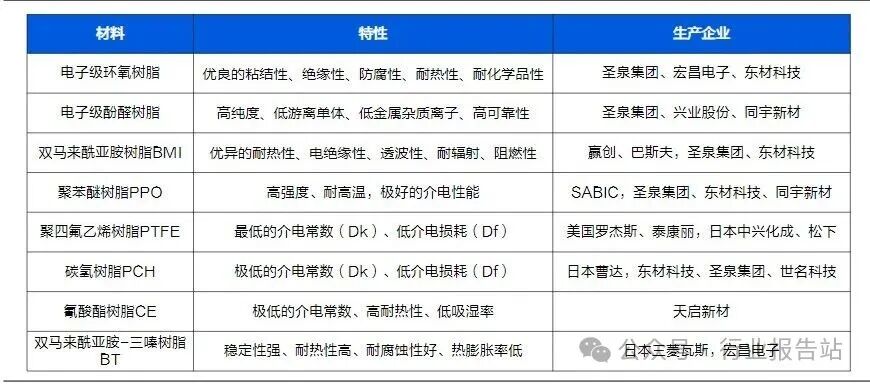
4. Silica Powder: The Unassuming “Filler” Supporting the Heat Dissipation and Stability of AI Servers
In addition to resins, another unassuming material that is rapidly growing is silica powder.
It serves as a “functional filler” in copper clad laminates, reducing signal loss and enhancing heat dissipation. The requirements for AI servers are much higher than for ordinary electronic products—requiring spherical silica powder with a median particle size of less than 3μm and surface modification.
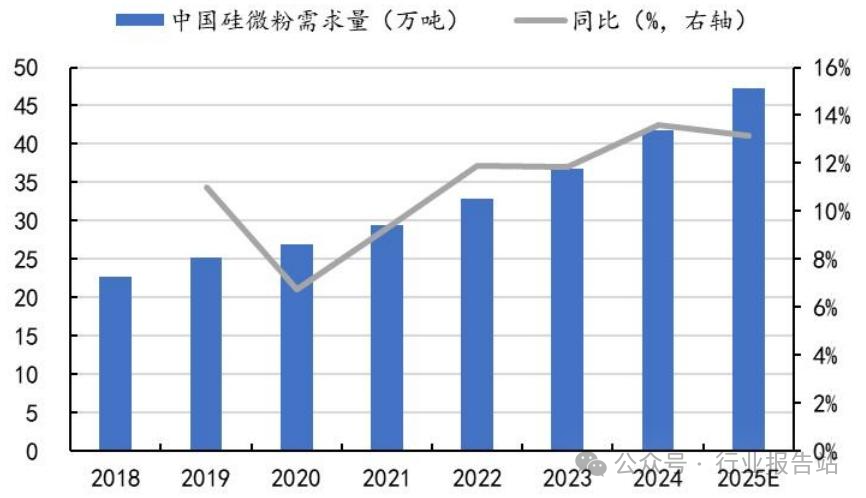
In 2024, China’s demand for silica powder is expected to reach 418,000 tons, projected to reach 473,000 tons by 2025, with a year-on-year growth of 13.2%. Among them, the high-performance spherical silica powder used in copper clad laminates is growing the fastest, with its market share expected to exceed 60% by 2027.
Previously, high-end silica powder relied on imports, but domestic companies have now caught up: Lianrui New Materials’ Low Df ultra-fine spherical silica powder has received overseas certification; Yake Technology has a production capacity of 20,000 tons of spherical silica powder and is building an additional 39,000 tons of new capacity; Lingwei Technology’s nano-silica has also begun to be used in PCB inks.
The layouts of these companies not only fill domestic gaps but also seize the material upgrade opportunities brought by AI. After all, AI servers generate a lot of heat during computation, and the heat dissipation performance of silica powder directly determines the stable operation of the servers, and future demand will only continue to grow.“2018-2025E China Silica Powder Demand and Year-on-Year Growth Chart”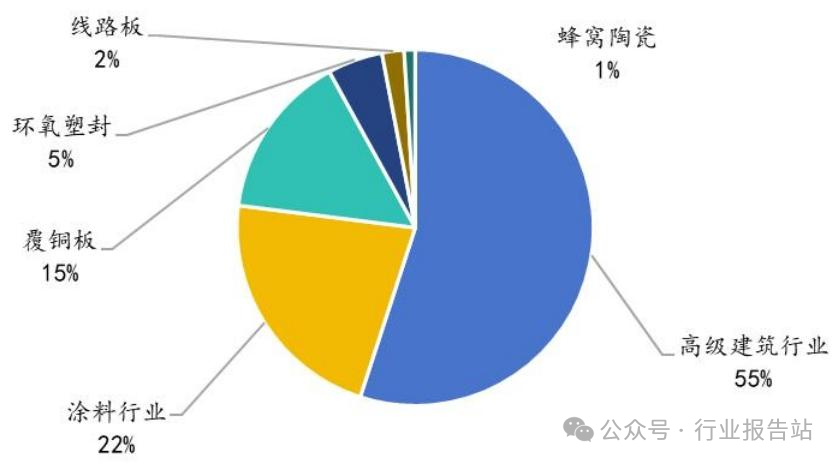
The wave of AI materials has just begun
From the simultaneous increase in volume and price of PCBs, to the technological upgrades of copper clad laminates, and the domestic substitution of electronic resins and silica powder, this seemingly traditional material sector is entering a “golden development period” amid the AI wave. It is estimated that from 2024 to 2029, the entire PCB material industry chain will grow by over $20 billion, and companies that first break through technology and achieve mass production have already seized the initiative.
Finally, I would like to ask you about the electronic devices you use daily, which may be hiding these “AI materials”. What other unassuming materials do you think will become new opportunities due to technological upgrades in the future? Feel free to share your thoughts in the comments!
END
Related PCB optical modules, optical chips, and corporate research (including more detailed data and extended analysis) are continuously updated in our systematic research database. Welcome to join.