(Report produced by Huatai Securities)
Large Model Application #1: From Chatbot to AI Agent, Personal Assistants Reshape the Mobile Application Ecosystem
The advancements in AI large models have driven Chatbots to widely “break out” in the consumer market. Chatbots, through automation, handle and respond to user inputs, simulating human conversation and interacting with users in real-time via text or voice. In the 2010s, with the development of technologies like NLP, Chatbots have been widely used in customer service, marketing, and enterprise information services. However, due to limited language understanding and generation capabilities, the deployment of Chatbots has been restricted to specific service scenarios in the B-end, and no widely influential C-end products have emerged. In December 2022, ChatGPT demonstrated significant advancements in text generation, code generation and modification, and multi-turn dialogue, marking the entry of the Chatbot industry into the era of AI large models. Subsequently, Chatbots, as the lowest threshold product for C-end user experience, became a “standard configuration” for large model vendors, with products like Google Bard, Baidu Wenxin Yiyan, and Alibaba Tongyi Qianwen being launched in 2023.
Beyond text dialogue capabilities, the functions of Chatbots have rapidly expanded with the development of AI large model capabilities. Over the past year, we have seen that major model vendors’ Chatbot products have generally added image understanding, text-to-image capabilities, and new application plugin stores to enhance Chatbot functionalities. For example, in September 2023, OpenAI integrated DALL-E 3 into ChatGPT, enabling text-to-image functionality. In January 2024, OpenAI officially launched the GPT Store application store, at which point users had already created over 3 million GPTs, covering seven main categories: image generation, writing, research, programming/software development, education, productivity tools, and daily life. The GPT Store replaced the previous plugin store (closed in March 2024), allowing users to share their created GPTs on the platform and obtain various GPTs from others, forming a rich GPT ecosystem. Customized versions of the GPT Store can be optimized for specific tasks or industries, allowing users to interact seamlessly with external data (such as databases and emails). In May 2024, with the update of the GPT-4o model, ChatGPT will be able to recognize the emotions in users’ voices and output voice responses, achieving an immersive experience akin to conversing with a real person.
Chatbots are gradually evolving into AI Agents. An AI Agent refers to an intelligent entity empowered by large models, capable of planning, memory, tools, and action. We believe that the evolution of Chatbots is towards increasing intelligence and automation, with decreasing human involvement, gradually transitioning to a human-AI collaborative Copilot, and ultimately becoming an AI Agent. The Agent only requires initial human instructions and feedback on results, possessing autonomous memory, reasoning, planning, and execution capabilities, executing tasks without human intervention. During the evolution from Chatbot to AI Agent, the mobile application ecosystem may undergo changes. We believe that mobile devices are likely to be the first hardware carriers to evolve into AI Agents, serving as AI personal assistants. AI personal assistants can remember various information in daily life and work, such as next week’s dinner plans or the content of work meetings, and automatically organize and index this information; they can assist users in completing various tasks such as scheduling appointments, booking travel, ordering food, playing music, and answering questions. In the implementation process, the mobile application ecosystem may shift from the current app store + APP model to an Agent Store + Agent model, with mobile manufacturers likely to launch their own Agent Stores.
AI Mobile Phones: AI Large Models Drive Software and Hardware Upgrades
Mobile phones are high-frequency interaction terminals in people’s daily lives, characterized by high penetration and usage rates. Considering factors such as terminal computing power, storage, and customer application needs, mobile phones have become important devices for the deployment of AI large models in the C-end. Since the end of last year, with the launch of significant products like the Samsung Galaxy S24 and Google Pixel 8, as well as Apple’s WWDC introducing Apple Intelligence, the functions of mobile AI have gradually become clearer. Currently, voice assistants, photo editing, and writing assistants have become mainstream. For example, the Samsung Galaxy S24, released in January this year, is equipped with the self-developed large model Samsung Gauss, featuring real-time translation, image selection search, generative editing, and note-taking assistant functions. In terms of software, based on the OneUI 6.1 system, the virtual assistant Bixby has been enhanced to provide users with a rich variety of application services. According to Techweb, Google is expected to launch the Pixel 9 series in October, which is anticipated to be equipped with an AI assistant based on the latest Gemini model, capable of executing complex multimodal tasks. In terms of chips, the Snapdragon 8 Gen 4, to be released in the second half of the year, is expected to further support AI applications.
At the Apple WWDC 2024 conference held in June 2024, a new personalized intelligent system, Apple Intelligence, was introduced, composed of Apple’s edge large model, cloud large model, and ChatGPT. Under sufficient computing power, it relies on the terminal for complex scenarios while using private cloud computing or ChatGPT for others. It can 1) enhance Siri’s understanding capabilities, equipped with multi-turn dialogue, information summarization, screen content awareness, and intelligent application interaction; 2) provide intelligent email replies, notification organization, memo and call recording/writing/summarization functions; 3) support image generation/intelligent photo editing; 4) integrate ChatGPT4o into Siri and writing tools as a cloud backup model. We see that the core capabilities of Apple Intelligence include text-to-text, text-to-image, cross-App interaction, and personal context understanding, requiring OpenAI ChatGPT4o as a cloud backup model, equipped with most existing AI functions. Apple uses Siri as a tool for connecting different Apps on the phone, rather than focusing on having AI complete a single specific task like Samsung and Google’s AI applications. Apple aims to make Siri the entry point for application distribution and traffic, providing good product solutions to over 1.3 billion users.
According to IDC, the next generation of AI smartphones needs to have at least 30 TOPS performance NPU, capable of running LLMs on smartphones. Standard SoCs include Apple A17 Pro, MediaTek Dimensity 9300, Qualcomm Snapdragon 8 Gen 3, etc. Such smartphones are expected to enter the market in the second half of 2023. In terms of hardware, we see: 1) SoC: AI engine upgrades, NPU computing power improvements, and further upgrades of SoCs with strong determinism; 2) Storage: smartphone RAM upgraded to 24GB LPDDR5X, compared to the current mainstream 8GB LPDDR4X, with a cost increase of 300%; 3) Power: battery/power management chip upgrades, but with relatively small elasticity; 4) Optics: AI drives breakthroughs in under-display camera applications. In terms of software, the new generation of AI smartphones is more aligned with personalized and scenario-based service needs in system architecture and applications. Compared to feature phones and previous generation smartphones, the new generation of AI smartphones places greater emphasis on scenario-based service capabilities. Previous generation smartphones added mobile OS and embedded voice assistants on the basis of feature phones and launched independent apps to respond to different user needs. The new generation of AI smartphones, based on large models and native service component libraries, provides users with a customizable intelligent agent development platform and exclusive intelligent agents, achieving AI text/AI image/AI voice/AI video functions to meet users’ scenario-based needs in health management, life services, role-playing, efficient office work, and gaming assistance.
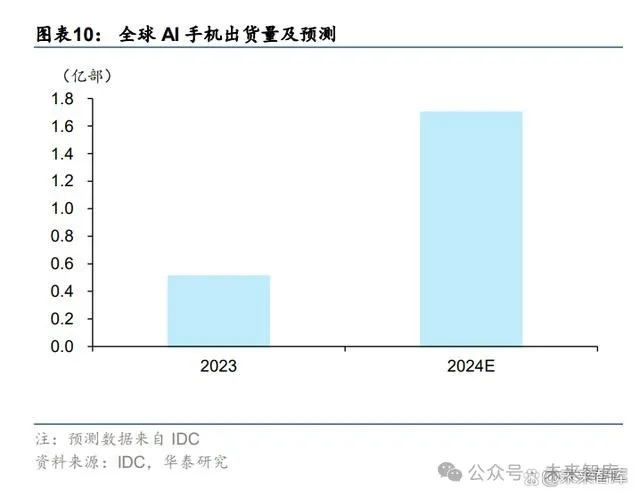
According to IDC, global AI smartphone shipments are expected to grow by 233% year-on-year to 170 million units in 2024. The share of AI smartphones in China is expected to grow rapidly after 2024, with an estimated shipment of 40 million AI smartphones in the Chinese market in 2024, reaching 150 million by 2027, and the penetration rate of AI smartphones expected to exceed 50% by 2027. We believe that AI smartphones, with their intelligent and personalized characteristics, are likely to attract more users to upgrade their devices, leading to a new wave of device replacement.
According to the “April Mobile Observation: Huawei’s Share Continues to Rise, Focus on the Release of New Models like P70” released on April 7, 2024, according to IDC data, Apple sold 234 million units in 2023, and Huatai predicts that Apple’s sales will decline by 8.2% to 215 million units in 2024. According to BankMyCell data, there are 1.46 billion active Apple users in 2024, corresponding to the current replacement cycle of 6.23 years. If Apple Intelligence can shorten the replacement cycle by 3 months, it could drive approximately 10 million new device sales. This is beneficial for the performance growth of Apple’s supply chain companies (Luxshare, Pegatron, ASE, Crystal Optoelectronics, Lens Technology, Dongshan Precision, Byd, Hontai, Ruisheng, Changdian, etc.).
AR/VR: AI Large Model Interaction Capabilities, Optimistic About the Development Opportunities of Lightweight AR Glasses
AI large models are expected to enhance AR/VR interaction capabilities, accelerating their entry into the mainstream market. According to IDC, in 2023, global AR/VR product shipments reached 6.75 million units, down 23% year-on-year. With the release of Apple’s VisionPro, AR/VR/MR shipments are expected to recover moderately in 2024. The emergence of AI large models drives the empowerment of functions such as voice assistants, object recognition, and life assistants in AR/VR devices, improving the quality of user interaction with virtual environments. According to VR TuoLuo (June 5, 2024), Meta’s Ray-Ban smart glasses have shipped over one million pairs, and the emergence of AI large models is expected to accelerate the pace of AR/VR technology entering the mainstream market. AI functions such as voice assistants, object recognition, and life assistants have been widely integrated into AR/VR products. Voice assistant functions allow AR glasses to communicate more naturally with users through contextual semantic understanding, such as Meta Lens S3 providing casual conversation and suggestions through a large language model AI system. Object recognition technology enables AR glasses to identify objects in the real world, such as Meta’s Ray-Ban smart glasses introducing building recognition and menu translation functions. Additionally, life assistant functions are deeply integrated with users’ social lives, providing personalized services such as chat replies, email organization, and shopping suggestions. The integration of these AI functions not only enhances user experience but also indicates that AR/VR products will become more intelligent, providing users with more convenient and personalized services. With continuous technological advancements, it is expected that future AR/VR devices will achieve more complex multimodal AI applications, further enhancing their potential as the next generation of computing platforms.
Large Model Application #2: The AI Transformation of Productivity Tools is Expected to Drive a New Wave of PC Replacement Cycles
Productivity tools, communication tools, and collaboration tools have evolved through the PC era and the mobile internet era, and are now entering the AI era. Companies like Microsoft, Google, and Kingsoft Office are upgrading their existing productivity tool applications with AI large models, typically providing document understanding, text generation, image generation, data analysis, and processing functions to enhance user productivity.
Office: Microsoft and Google Lead the Comprehensive AI Transformation of Product Matrix
Microsoft is the leading company in global productivity tools, having formed a complete product matrix around enterprise business and management processes, and is currently leading the AI transformation of productivity tools. Microsoft’s product matrix covers enterprise office, customer relationship management, resource management, employee management, low-code development, and other business segments. Microsoft has launched corresponding Copilot products around these business segments, empowering existing products with AI large models. From the perspective of Copilot rollout, Microsoft first launched Copilot in its flagship Office suite, and then gradually rolled it out in the Dynamics suite for enterprise business and management processes, the Power Platform for development, and the Viva suite for employee management. We believe that Copilot is reshaping Microsoft’s productivity tool matrix with a “universal assistant” approach, moving towards data collaboration and functional interactivity. Currently, the Copilot products in the Office and Dynamics business process scenarios have clearly defined pricing standards. Microsoft’s Copilot products are divided into two major scenarios: for work and for home. In the work scenario: 1) Copilot for Microsoft 365 is launched for enterprise office scenarios, and according to Microsoft’s FY3Q24 (corresponding to calendar quarter 1Q24) earnings call, nearly 60% of Fortune 100 companies are using it. 2) Copilot for Finance/Sales/Service is launched for financial, sales, and customer service scenarios in enterprise processes; 3) Copilot for Azure is launched for cloud operation and management scenarios; 4) Copilot for Security is launched for IT security scenarios; 5) Additionally, Microsoft has launched Copilot Studio to support users in customizing Copilot, with 30,000 users already using it according to the 1Q24 earnings call. In the home application scenario: 1) Copilot Pro is launched for C-end user office scenarios; 2) Copilot for Windows is launched for Windows 11 and some Windows 10 users, supporting quick access via the Copilot button on the taskbar or keyboard; 3) Copilot is launched in Bing search and Edge browser.
Google has integrated the Gemini large model into its 2B cloud office suite, Workspace. Google defines the functions of Gemini for Workspace as: 1) Writing, such as generating project plans, proposals, briefs, and optimizing text; 2) Organizing, such as creating project tracking tables from simple descriptions; 3) Creating images; 4) Contacting, such as creating custom backgrounds during video calls to improve sound and video quality; 5) No-code application creation. Kingsoft Office has successively launched WPS AI services in its main products. WPS AI has covered text, presentations, PDFs, spreadsheets, smart documents, smart tables, smart forms, and other products, encompassing Kingsoft Office’s main offerings. Additionally, Kingsoft Office has released the WPS AI Enterprise Edition, launching three major functions: AI Hub (intelligent base), AI Docs (intelligent document library), and Copilot Pro (enterprise intelligent assistant).
Programming: AI Assists in Programming Development, Improving Efficiency and Quality
AI programming tools have highly similar functions, mainly including automatic code generation, code analysis and error detection, and real-time programming suggestions. The application of AI tools greatly enhances development efficiency, automatically completing repetitive tasks such as writing boilerplate code, setting up environments, and debugging, allowing developers to free up time for creative development; real-time syntax and error checking functions help improve code quality, reduce debugging time, and accelerate the development process. According to survey data from Microsoft’s official website, after using AI tools for programming assistance, 74% of developers reported being able to focus on more satisfying work, 88% of users felt more productive, and 96% of developers were faster when handling repetitive tasks.
GitHub Copilot is the most representative AI tool in the field of AI programming, developed in collaboration between OpenAI and Microsoft. Copilot has powerful web search and reasoning decision-making capabilities, able to answer questions during the development process. For example, by describing requirements in natural language, Copilot can automatically generate code and provide deployment suggestions. According to Microsoft’s FY3Q24 (corresponding to calendar quarter 1Q24) earnings call, the number of paid users of GitHub Copilot has reached 1.8 million, with a quarter-on-quarter growth rate of over 35%, and revenue growth of over 45% year-on-year. In May 2024, at the Microsoft Build conference, GitHub Copilot was further upgraded, including 1) updated Extensions to enhance developer efficiency. Developers spend 75% of their time outside of writing code on tracking workflows and writing documentation. Extensions integrate all processes, allowing real-time work from various editors such as Neovim, JetBrains IDE, Visual Studio, and Visual Studio Code, reducing context switching, allowing developers to focus solely on core code. 2) Copilot Workspace was launched to improve team efficiency in managing projects with GitHub, providing a clear visual interface for code changes and enhancing project control. 3) Copilot connectors were launched to facilitate developers in customizing Copilot with third-party data and applications, improving development efficiency. For example, developers can ask Copilot to write code in Java using Spanish voice or inquire about the availability of Azure resources.
PC: AI PC Penetration Rate Expected to Continue to Rise in the Second Half of 2024
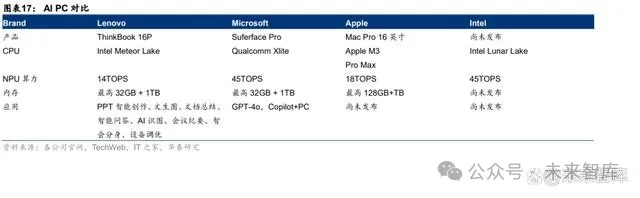
AI PC = Edge Computing Power + Built-in Large Model. Currently, there are many definitions of AI PCs, with chip manufacturers, PC brand manufacturers, and third-party organizations each having their own definitions. We believe that broadly speaking, a processor with edge computing capabilities provided by NPU and a built-in large model can be called an AI PC. Looking at Lenovo’s AI PC series products launched on April 18, the current mainstream functions of AI PCs can be divided into eight categories: intelligent PPT creation, text-to-image, document summarization, intelligent Q&A, AI image recognition, meeting minutes, intelligent meeting avatars, and device optimization. We believe this is the company’s initial attempt at AI PCs, and it is expected that a new generation of AI PCs will be launched by the end of 2024 with processor upgrades, leading to a faster increase in global AI PC penetration rates. IDC expects global PC shipments to grow steadily, with AI PC penetration rates continuing to rise, potentially reaching 60% by 2027. According to IDC data, global PC shipments in 2023 are approximately 250 million units, with AI-capable PC shipments at 25 million units, accounting for about 10% market share; in 2024, global PC shipments are expected to be 275 million units, with AI-capable PC market share at about 19%; by 2027, global PC shipments are expected to reach 293 million units, with AI-capable PC market share expected to reach 60%.
Under AI PCs, NPU and independent GPU solutions may coexist for a long time. The implementation of AI applications will place higher demands on PC computing power, and chip manufacturers such as Qualcomm, Intel, and AMD are actively laying out and launching chip products optimized for AI PC scenarios. On the PC side, using independent GPUs to run AI workloads has advantages in high performance and high throughput, but high power consumption; NPU solutions are more energy-efficient and low-power, but have limited support for high-performance AI workloads. Considering the different demands of AI tasks and user preferences, we believe that the AI PC market will use 1) CPU + NPU + GPU processors (such as Intel Meteor Lake/AMD 8040); 2) CPU + independent GPU; 3) CPU + NPU + GPU processors + independent GPU, etc., as the main computing architecture solutions for handling AI workloads may coexist for a long time. In 2022, according to IDC data, ARM architecture CPUs had a market share of about 11% in the PC market, with Apple being the main player. In October 2023, Qualcomm launched the X Elite chip based on ARM architecture, which has outstanding AI performance, aligning with the development trend of AI PCs and is expected to bring further breakthroughs for ARM CPUs in the PC market. At the COMPUTEX 2024 event held in June 2024, ARM CEO Rene Haas stated that Arm expects to capture over 50% of the Windows PC market within five years.
AI PCs will drive storage specification upgrades, with DRAM expected to be at least 16GB, and the proportion of LPDDR may gradually increase. 1) The original size of the Ali Tongyi Qianwen 7B model is 14.4GB, while the model running in Lenovo’s Lenovo AI now has been compressed to 4GB. Therefore, AI large models + the computer’s own cache will require about 5-6GB of memory to run, while the OS itself needs to occupy 5-6GB, so future memory must be at least 16GB to ensure stable PC operation. 2) According to Trendforce, Qualcomm Snapdragon X Elite, AMD Strix Point, and Intel Lunar Lake all use LPDDR5x instead of the currently mainstream DDR SO-DIMM modules, mainly considering the improvement in transmission speed; DDR5 currently has speeds of 4800-5600Mbps, while LPDDR5x ranges from 7500-8533Mbps, which will help AI PCs that need to accept more language commands and shorten response times. This year, LPDDR accounts for about 30-35% of PC DRAM demand, and in the future, it will be supported by CPU manufacturers of AI PCs, further increasing the proportion of LPDDR. Hardware-level security chips ensure privacy security. According to the AI PC Industry (China) White Paper jointly released by Lenovo and IDC, AI PCs require device-level personal data and privacy security protection, in addition to personalized local knowledge bases providing localized personal data security domains and completing privacy issues through local closed-loop reasoning, hardware-level security chips may also be introduced to ensure that only authorized programs and operations can read and process private data. Additionally, manufacturers like Lenovo are also developing their own AI chips (such as the LA series chips搭载 in Lenovo’s new laptops like Y7000P, Y9000P, Y9000X, Y9000K), achieving intelligent overall power distribution.
Large Model Application #3: AI Large Models Accelerate the Iteration of Embodied Intelligence Technology
Embodied AI is a branch of artificial intelligence, with typical applications in autonomous driving and robotics. Embodied intelligence refers to AI intelligent carriers that have physical bodies and can autonomously interact with the external environment. Similar to human autonomy, it completes a series of actions through sensory organs (perception), the brain (planning and decision-making), and the cerebellum (motor control). The actions of embodied intelligence are generally based on: (1) perceiving and understanding information obtained from interactions with the physical world, (2) achieving autonomous reasoning and decision-making, and (3) taking corresponding actions for interaction. Currently, typical applications of embodied intelligence with significant landing scenarios include autonomous driving and robotics, with representative products such as Tesla’s FSD autonomous driving system and Optimus humanoid robot. Over the past year, AI large models have aided the progress of perception, decision-making, and other technologies in embodied intelligence. As mentioned above, embodied intelligence algorithms can generally be broken down into perception models (recognizing environmental information and predicting environmental changes), planning/decision models (making task decisions based on perception results), and control/execution models (converting decision instructions into actions). Taking the development of industry-leading company Tesla as an example, we observe the promotion of embodied intelligence technology brought by the application of AI large models over the past year:
Autonomous Driving: Benefiting from the development of AI large models, the perception and decision layers are rapidly iterating. (1) Perception Layer: Traditional autonomous driving perception technology mainly relies on “2D direct view + CNN”, focusing on identifying surrounding obstacles and their size and speed, with low efficiency and accuracy. Tesla’s Occupancy Network large model announced in October 2022 (based on BEV + Transformer extension) constructs a 4D “real-time map” with spatial and temporal information by calculating the spatial volume occupancy of objects, obtaining more continuous and stable perception results. This helps solve the problem of obstacles disappearing due to inability to recognize them; at the same time, the map is constructed with the vehicle as the center coordinate system, better unifying the perception and prediction framework. (2) Decision Layer: Previous decision algorithms were based on a set of pre-defined rule-based rules, triggering behavioral criteria in different scenarios, making it difficult to solve long-tail bottleneck problems. Tesla’s decision algorithm adopts an interactive search model, allowing the machine to autonomously predict the interaction trajectories of surrounding environmental entities and assess the risks brought by each interaction, ultimately deciding on strategies step by step, enabling the vehicle to achieve faster, more flexible, and more human-like decision-making behaviors. (3) Control Layer: Due to the low degree of freedom of vehicles, the control algorithms for autonomous driving mainly rely on decision model output instructions to control components such as steering and braking, thus controlling vehicle driving. Currently, Tesla’s FSD V12 has fully transitioned to an end-to-end architecture (a large model that implements everything from perception to control), beginning to push for commercial landing, with only over 2,000 lines of code, completely abandoning the over 300,000 lines of C++ code written by engineers in version V11.
Humanoid Robots: The technical difficulty is much higher than that of autonomous driving, and motion control algorithms may be one of the key factors. (1) Perception Layer: The external perception of humanoid robots (obtaining external environmental information) mainly includes vision/hearing/touch, while internal perception (obtaining self-status information) mainly involves controlling the state and posture of the body. Tesla’s FSD visual perception Occupancy Network can be reused in robots, which is beneficial for accelerating the development of multimodal perception in robots. (2) Decision Layer: The continuous development and expanded application of LLM/VLM/VLA and other general large models are expected to help enhance the semantic and visual understanding capabilities of robots, as well as their problem and task decomposition and reasoning abilities. (3) Control Layer: Robots, especially humanoid robots, have a high degree of freedom, requiring strong logical reasoning capabilities to complete a series of complex tasks and control actions such as upright walking/running/jumping. However, most motion control algorithms are still in the early stages of development, with slow and simple instruction generation speeds, which is one of the key areas that need to be broken through in robot development. We see that Tesla’s humanoid robot could only achieve slow walking and waving in October 2022, but by December 2023, it could walk smoothly and grasp eggs and other objects, showing accelerated iteration of motion control capabilities.
NVIDIA builds three major computing platforms to promote the development of embodied intelligence. NVIDIA founder and CEO Jensen Huang stated at the 2024 GTC conference, “The era of robots has accelerated, and everything that moves will one day be autonomous. We are working hard to advance NVIDIA’s robotics-related products to accelerate the realization of generative embodied AI.” NVIDIA has also upgraded the Isaac robot platform, empowering the robotics industry from training, simulation, and inference perspectives. In autonomous driving, NVIDIA has also launched the Drive platform. 1) Training Platform: Used for training the foundational models of robots. It includes NVIDIA’s “Project GR00T” general model for humanoid robots, as well as other mainstream VLM/LLM generative AI foundational models, which can be trained and reinforced for perception, decision-making, and control. 2) Simulation Platform: Built on Omniverse, the Isaac SIM robot simulation platform achieves development and testing effects similar to real environments, such as obtaining data that is difficult to obtain in real environments, which can accelerate the development process and reduce development costs. 3) Edge Platform: The robot’s body part has a low-power, high-performance embedded computing platform, as well as AI algorithm-enhanced applications for perception, decision-making, and planning. For example, NVIDIA has launched the Jetson Thor SoC development hardware, which includes the next-generation Blackwell GPU (NVIDIA has also launched the DRIVE Thor suite for automotive applications), with a bandwidth of 100GB/s and AI computing performance reaching 800TFLOPs.
UBTECH continues to iterate and launch Walker X, accelerating the commercialization of humanoid robots in China. UBTECH is one of the earliest companies in China to research humanoid robots. 1) In 2016, it began developing humanoid robots and launched the omnidirectional walking Walker prototype; 2) From 2017 to 2018, it launched the first generation of large biped service robots Walker1, achieving functions such as climbing stairs, kicking balls, obstacle avoidance, human-like dancing, and human-machine interaction; 3) From 2019 to 2021, it launched the second generation Walker, which performed at the 2019 Spring Festival Gala; 4) In 2021, it launched Walker X, which stands 1.30m tall, weighs 63kg, has 41 degrees of freedom, and has improved walking speed to 3km/h, featuring complex terrain adaptability, dynamic foot-leg control, hand-eye coordination operations, soft physical interaction, U-SLAM visual navigation, smart home control, multimodal emotional interaction, and human-like empathetic expression of the environment and human perception. 5) Since 2022, Walker X has focused on scenarios such as guiding, front desk, reception, and family companionship, continuously advancing the commercialization process.
Autonomous driving and humanoid robots are the most representative and promising applications of embodied intelligence. Looking ahead, advanced autonomous driving is expected to gradually begin large-scale implementation, but humanoid robots, constrained by costs and algorithm maturity, still need to wait for further development. In autonomous driving, Tesla has launched the FSD V12.3 version in March 2024, officially renamed FSD Supervised, adopting the industry’s first end-to-end large model and pushing for free trial services across North America. In China, with the advancement of large model technology and the decrease in sensor costs, in 2024, companies like XPeng, Huawei, and Li Auto will begin to push for high-level intelligent driving in multiple cities nationwide, while Xiaomi, BYD, and NIO are also actively laying out high-level intelligent driving, leading to rapid industry development. In terms of robots, vertical scenario robots such as unmanned delivery machines, sweeping robots, and factory robotic arms are accelerating penetration, but general-purpose humanoid robots, due to their requirements for multimodal perception, high-precision motion control, and generalization and emergence capabilities, are still limited by software difficulties and high cost pressures, making it challenging to achieve rapid cost reduction and large-scale application in the short term. Tesla’s Optimus humanoid robot, as a highly anticipated product in the industry, is expected to first be mass-produced for use in factories and warehouses for clear and controllable picking and handling tasks, gradually expanding application scenarios in the future.
Large Model Application #4: Large Models are the “Anchor” Driving Cloud Computing Development
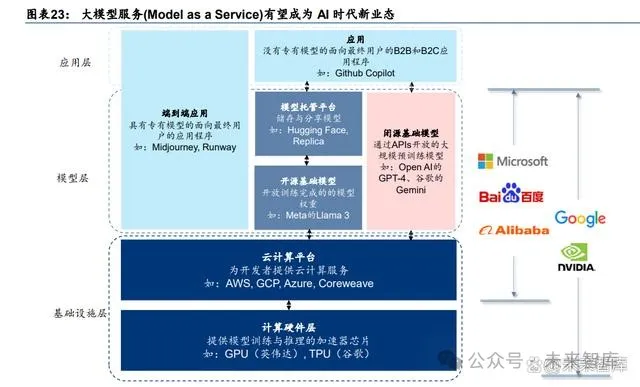
We believe that AI large models are the “anchor” of cloud computing business, with cloud vendors using large models as an important foundation to drive the transformation of cloud computing business towards MaaS. MaaS is an important business model for large model vendors, providing various services including computing power, models, data tools, and development tools. Currently, many tech giants have deployed large model capabilities in the cloud or provided them to enterprise users through private deployment, generating revenue through model API call fees, model hosting service fees, and customized solutions charged per project. Overseas, Microsoft has launched Azure OpenAI, Google has launched Vertex AI, and NVIDIA has launched AI Foundations; domestically, companies like Alibaba, Baidu, ByteDance, and Tencent have all launched MaaS models based on their own cloud services, while companies like SenseTime have also launched MaaS services based on their own AIDC and large model capabilities. Among them, the sources of large models include closed-source models trained by vendors themselves and open-source models, as well as third-party open-source models. Taking Microsoft Azure as an example, users can choose between OpenAI’s closed-source models, Microsoft’s own open-source Phi series, and third-party open-source models like Llama.
AI is beginning to drive revenue growth in cloud computing. Taking Microsoft as an example, from Q2 2023 to Q1 2024, AI contributed to the revenue growth rates of Azure and other cloud services by 1%/3%/6%/7% respectively. Google stated in its Q4 2023 and Q1 2024 earnings calls that AI’s contribution to Google Cloud is continuously increasing, with strong demand for vertically integrated AI product portfolios, creating new opportunities for Google Cloud in every product area. Amazon stated in its Q1 2024 earnings call that infrastructure construction and AWS AI functions are accelerating AWS’s growth rate. Driven by demand for generative AI and model training, AI revenue accounted for 4.8%/6.9% of Baidu’s AI intelligent cloud revenue in Q4 2023/Q1 2024, with most of the revenue coming from model training, but revenue from model inference is growing rapidly.
The price reduction of large models attracts customers to the cloud. In May 2024, ByteDance, Alibaba Cloud, Baidu, iFlytek, and Tencent successively announced price reduction strategies, lowering the API call fees for large models aimed at the B-end market. We believe that the price reduction of large model APIs is due to the improvement in computing power chip performance and optimization of inference deployment, aimed at attracting customers to use public clouds and purchase basic products such as computing, storage, networking, and security from cloud vendors.
Large Model Application #5: Large Models Empower Traditional Internet Businesses such as Search and Advertising
Search and advertising are representative traditional businesses of internet companies, and AI large models empower business performance enhancement. We see that AI assists internet companies’ advertising businesses in two aspects: optimizing advertising push mechanisms through algorithm improvements and generating advertising content through generative AI. Microsoft launched Copilot in Bing, and Google released the Search Generative Experience (SGE), providing more accurate, personalized, and intelligent search results. Among them, Microsoft’s Bing has seen an increase in market share due to the capabilities of the GPT model.
Advertising: AI Algorithms Optimize Push Mechanisms, Generative AI Achieves Automated Ad Production
AI technology optimizes push mechanisms through algorithms, increasing user traffic and advertising conversion rates. According to data from Meta Ads, after launching Reels short videos, thanks to the AI-driven discovery engine, the pushed content aligns more closely with user preferences, leading to a 24% increase in average usage time for Instagram users, with over 40% of advertisers choosing to deliver ads in Reels format. Google has improved Lens visual search and image-text cross-modal multiple searches using AI technology, with Lens user growth quadrupling from 2021 to 2023, reaching 12 billion monthly uses. Machine learning algorithms match ads with the most relevant audiences, improving advertising conversion rates. Meta Ads introduced similar audience and segmentation features, calculating the best ways to expand the target audience to optimize conversion volume and improve ad performance. The similar audience feature selects potential users most likely to convert based on a series of indicators, such as past purchases of similar products or visits to the advertiser’s website. According to Meta’s official data, this tool has reduced the median cost of incremental conversions by 37%. Google uses an AI-driven bidding system to optimize bids for maximum clicks throughout the marketing funnel, driving users’ intent to visit target websites and generating conversion data to create attribution reports, recommending efficient metrics worth bidding to advertisers.
Generative AI achieves automated ad production, improving ad creativity and marketing effectiveness. 1) Meta Ads launched the built-in free AI ad creation tool Advantage+ Creative, simplifying ad generation and standard beautification, helping improve ad creativity and marketing effectiveness. Advantage+ Creative’s sub-functions include text derivation, background generation, intelligent image expansion, and stylized production. Advertisers only need to provide ad creativity and business audience, and AI can create multiple versions of ads, selecting the versions most likely to resonate with the target audience. It can also make subtle improvements to ads, such as adjusting brightness, aspect ratio, and text layout. According to Meta’s official survey data, advertisers using Advantage+ Creative have seen a 32% increase in return on ad spend (ROAS), with 77% of advertisers reporting saving several hours each week. 2) Google utilizes AI to optimize search ads in real-time based on query context and enhances the visual presentation of ads through machine learning algorithms. Leveraging generative AI technology, Performance Max significantly simplifies the ad production process for advertisers, automatically filling in ad text and generating ad images based on the product URLs provided by advertisers. Additionally, when target audiences use search engines, Google optimizes search ads using automatically created material technology (ACA), reorganizing existing ads to generate new titles and images that better fit query content. The Demand Gen ad series can also integrate the best video and image material resources into the most visually impactful touchpoints, avoiding obstructions and helping advertisers attract more consumers in the most immersive visual interfaces. According to Google’s mid-2022 data, using Performance Max has led to a decrease in the cost of acquiring converted customers, with the median cost per action (CPA) decreasing by 17.3%; while maintaining the same expenditure, the number of ad conversions increased by 18%.
Search: After Introducing Large Models, Bing’s Market Share Increases
Google: From Understanding AI to Generative AI, the search engine giant widely applies artificial intelligence technology. Google holds a majority share of the search market, with its early applications of AI technology primarily focused on understanding AI. According to StatCounter statistics, from 2015 to the present, Google’s comprehensive search volume on PC and mobile has exceeded 90%. The first application of machine learning in Google’s products was the spelling correction system launched in 2001, which helped ignore spelling errors in search content to yield correct results. Subsequently, in 2019, Google used BERT to optimize the search ranking system by reading entire sentences, and developed a multimodal, multi-threaded unified large language model MUM that is 1,000 times better than BERT to understand and organize web content. With the increase in total search volume and the diversification of user demands, efficient and high-quality multimodal interactive search has become a development trend. In 2023, Google began launching the Search Generative Experience (SGE) experiment, based on the generative AI large model Gemini, automatically generating search content summaries and performing algorithm optimizations for vertical recommendations. AI Overviews is an upgraded version of SGE, released at the 2024 Google I/O developer conference as the “biggest update in 25 years,” integrated with Google’s core web ranking system, aiming to ensure search accuracy by only displaying results supported by high-quality web information. AI Overviews inherits the content summary generation capability of SGE, supports video search, and features multi-step reasoning capabilities for solving a series of problems in a single search, as well as planning functions integrated with Google Docs and Gmail. This product faced widespread criticism two weeks after its launch, prompting Google to implement improvements, but according to a survey by the enterprise SEO platform BrightEdge in June of the same year, Google has downplayed this feature, with the frequency of AI overviews appearing in searches dropping from an initial 84% to about 15%.
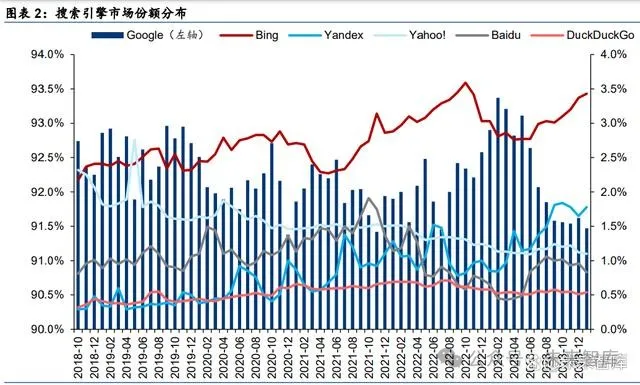
Microsoft Bing introduces GPT model capabilities to launch a new generative web search experience, increasing market share. In February 2023, Microsoft equipped its search engine Bing with an AI-enhanced web search experience assistant, New Bing. According to a March blog post on Bing, within four weeks of the preview assistant’s launch, daily active users exceeded 100 million, with about one-third of users being first-time users of Microsoft’s search engine. In November of the same year, Microsoft renamed New Bing to Copilot. Copilot, based on GPT-4 and DALL-E, summarizes web search results into lists of links and provides a chat experience to support users, with advantages including: 1) natural language understanding capabilities and multimodal search and generation capabilities; 2) a continuous questioning mode replacing multiple independent searches; 3) built into the sidebar of Microsoft browsers, synchronizing the search and web browsing process; 4) developed for multi-platform extension, connecting web search and different terminals such as Skype, Office365, GroupMe, etc. The traffic growth data brought by Copilot is impressive, with Microsoft FY2Q24 (Q4 2023) earnings call stating that Bing’s market share has surpassed Yahoo search, rising to 3.4%, with Copilot-supported search dialogues totaling 5 billion, and the company’s search and advertising revenue growing nearly 10% year-on-year in that quarter. According to StatCounter data, Bing’s market share in search engines has increased from 2.8% in February 2023 to 3.4% in January 2024.
Perplexity AI is a strong new unicorn focused on developing a natural language search engine. Perplexity AI is the world’s first search engine that integrates conversation and links, founded in August 2022, with a founding team that includes former members from OpenAI, Meta, Quora, and Databricks. According to data disclosed on its official website, in January 2024, Perplexity AI’s monthly active users exceeded 10 million, and the company’s valuation doubled within two months, reaching $1 billion in April of the same year, making it a unicorn in the search engine field. This search engine product mainly uses third-party large models, including GPT-4o, Claude-3, SonarLarge (LLaMa 3), and fine-tuned and enhanced open-source models like Mistral-7b and Llama2-70b. Users can choose the large model they prefer based on their preferences. By leveraging retrieval-augmented generation technology (RAG), Perplexity AI connects large models with external knowledge bases, ensuring that returned results are not limited to the data nodes trained by the large model itself, improving the accuracy of generated results. It can interpret natural language and has functions for chat dialogue search, intelligent document management, and intelligent text generation, supporting multi-turn dialogue and subsequent question prediction. Perplexity AI offers free users unlimited fast searches and five professional searches, while Pro subscription users can pay $20/month or $200/year for 300 professional searches per day.
Appendix: Progress of Domestic and International Large Model Companies
In November 2022, OpenAI launched ChatGPT based on GPT-3.5, triggering a global wave of AI large model technology development and investment. The performance of AI large models continues to improve rapidly. Taking the commonly used evaluation standard MMLU for measuring LLMs as an example, by the end of 2021, the most advanced large models globally had an MMLU 5-shot score of just 60%, which exceeded 70% by the end of 2022, and improved to over 85% by the end of 2023. For example, OpenAI’s GPT-3, launched in July 2020, scored 43.9%, while GPT-3.5, launched in November 2022, improved to 70.0%, and GPT-4 and GPT-4o, launched in March 2023 and May 2024 respectively, achieved scores of 86.4% and 87.2%. Google’s currently best-performing large model, Gemini 1.5 Pro, scored 85.9%. The performance of open-source models should not be underestimated, with the Llama 3 70B model launched in April 2024 already achieving a score of 82.0%.
In addition to language capabilities, the multimodal capabilities of AI large models have also rapidly improved. At the beginning of 2023, mainstream closed-source large models were typically pure text LLMs. Since 2023, the multimodal capabilities of closed-source models have significantly improved, with mainstream closed-source large models now generally possessing image understanding and generation capabilities. As shown in Chart 24, although the text capabilities of open-source models have improved significantly, most open-source models still lack multimodal capabilities. Currently, the technical focus of multimodal capabilities in large models has shifted towards native multimodality. Only Google and OpenAI have released their native multimodal models, Gemini and GPT-4o. When creating multimodal models, different modality models are often trained separately and then stitched together, while native multimodal models are pre-trained on different modalities (text, code, audio, images, and video) from the start, allowing for smoother understanding and reasoning of input content across modalities, resulting in better performance. For example, for non-native multimodal models like GPT-4, its voice mode consists of three independent models responsible for transcribing audio to text, receiving text and outputting text, and converting that text back to audio, leading to significant information loss—unable to directly observe tone, multiple speakers, or background noise, and unable to output laughter, singing, or express emotions. In contrast, the native multimodal model GPT-4o processes inputs and outputs across multiple modalities through the same neural network, resulting in less information loss and better model performance.
As AI large models continue to improve, thanks to the enhancement of computing power chip performance and optimization of inference deployment, the application costs of large models are rapidly decreasing, creating a foundation for the development of applications based on large models. Currently, OpenAI’s cutting-edge GPT-4o (128k) has an average input-output price that is half that of GPT-3 Da Vinci from November 2022, while the cost-effective GPT-3.5 (16k) has an average price that is 95% lower than GPT-3 Da Vinci. Among the GPT-4 series, GPT-4o (128k) has an average price that is 89% lower than GPT-4 (32K) from March 2023.
Overseas: Microsoft & OpenAI and Google Lead, Meta Chooses an Open Source Defensive Strategy
We reviewed the progress of overseas foundational large model training companies in large model technology, productization, and commercialization over the past year. Microsoft and OpenAI are currently the leading pioneers in large model technology and productization, with their continuous investment in disruptive innovation being the key reason for their current leadership. Google has a rich technical reserve, a broad ecosystem of its own business, and is a potential scene for AI implementation. However, due to loose management, it has not formed a cohesive force. We have seen Google begin to integrate Google Brain and DeepMind since 2023, and it is currently accelerating productization and ecosystem development to catch up. Meta has chosen a defensive strategy of model open-sourcing to respond to the strong closed-source models of competitors like OpenAI and Google.
Microsoft & OpenAI: Closed-source Models Lead Globally, Large Model Productization is at the Forefront
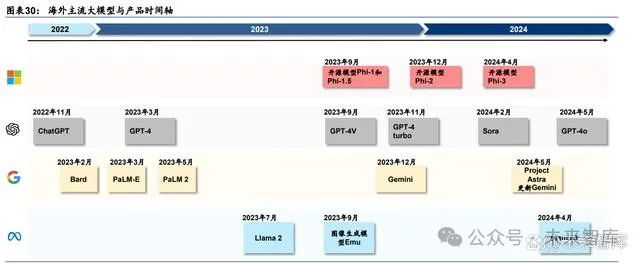
OpenAI’s cutting-edge GPT series continues to iterate. In November 2022, OpenAI launched ChatGPT based on GPT-3.5, which sparked the AI large model craze. Since then, OpenAI has continuously iterated the GPT series models: 1) In March 2023, GPT-4 was released, which supports image input and can truly understand, compared to GPT-3.5, which only supports text/code input and output; 2) In September 2023, GPT-4V was released, upgrading multimodal functions such as voice interaction and image reading and understanding; 3) In October 2023, DALL・E 3 was integrated with ChatGPT, supporting text-to-image functionality; 4) In November 2023, GPT-4 turbo was released, which improved performance and reduced costs compared to GPT-4, supporting a context window of 128k tokens (GPT-4 supports a maximum of only 32k); 5) In May 2024, the first end-to-end multimodal model GPT-4o was released, achieving GPT-4Turbo level performance in text, reasoning, and coding intelligence, while also improving performance in multilingual, audio, and visual functions. The price of GPT-4o is half that of GPT-4 turbo, but its speed is twice that of GPT-4 turbo. Thanks to the end-to-end multimodal model architecture, the latency of GPT-4o has been significantly reduced, greatly enhancing the human-computer interaction experience. OpenAI’s multimodal model layout is comprehensive. In addition to the text-to-image model DALL-E3, OpenAI launched the text-to-video model Sora in February 2024, which supports generating videos up to 60 seconds long from text or images, far exceeding the previous AI video applications’ generation durations, and also supports extending videos forward or backward in time, as well as video editing. Microsoft has also launched the Phi series of small models for open-source, while developing its own MAI series of large models. Microsoft has released small models Phi-1.0 (1.3B), Phi-1.5 (1.3B), and Phi-2 (2.7B) in 2023, and in 2024, it has open-sourced the Phi-3 series, including three language models—Phi-3-mini (3.8B), Phi-3-small (7B), and Phi-3-medium (14B), as well as a multimodal model Phi-3-vision (4.2B). Additionally, according to reports from The Information in May 2024, Microsoft is set to launch a large model with 500 billion parameters, internally referred to as MAI-1, supervised by former Google AI head and Inflection CEO Mustafa Suleyman.
In terms of productization, Microsoft and OpenAI are comprehensively upgrading the large model capabilities of their existing software products, cloud computing businesses, and smart hardware. 1) Microsoft has a complete product matrix around enterprise office, customer relationship management, resource management, employee management, and low-code development, and since 2023, it has launched corresponding Copilot products to empower existing products with AI large models, among which the earliest and most core product is Copilot for Microsoft 365, aimed at enterprise office scenarios, as well as Copilot for Windows aimed at C-end users, and Copilot integrated into Bing search and Edge browser. 2) In terms of cloud computing business, Azure cloud services are evolving towards MaaS, providing services such as computing power, models, data tools, and development tools. 3) In terms of smart hardware, Microsoft released Copilot+PC powered by GPT-4o in May 2024, and besides Microsoft Surface, PC manufacturers like Lenovo, Dell, HP, Acer, and ASUS will also launch new Copilot+PC products.
Google: Closed-source Models Lead Globally, Broad Ecosystem and Potential AI Implementation Space
Google’s cutting-edge closed-source models have shifted from the PaLM series to Gemini. From 2022 to 2023, the PaLM series models were Google’s main models, with the PaLM model released in April 2022, Flan PaLM released in October 2022, and PaLM-2 released at the I/O conference in May 2023 being Google’s main large models at that time. In December 2023, Google released the world’s first native multimodal model, Gemini, which includes Ultra, Pro, and Nano in different sizes. According to the Gemini Technical Report, the Ultra version outperforms GPT-4 in most tests. In February 2024, Google released Gemini 1.5 Pro, which has stronger performance and a groundbreaking long context window of 1 million tokens. At the I/O conference in May 2024, Google updated Gemini again: 1) Released 1.5 Flash, the fastest Gemini model provided through API. While possessing groundbreaking long text capabilities, it is optimized for large-scale processing of high-capacity, high-frequency tasks, making it more cost-effective to deploy. 1.5 Flash performs excellently in summarization, chat applications, image and video subtitle generation, and extracting data from long documents and tables. 2) Updated 1.5 Pro. In addition to expanding the model’s context window to support 2 million tokens, the code generation, logical reasoning and planning, multi-turn dialogue, and audio and image understanding capabilities of 1.5 Pro have been further enhanced.
In terms of productization, Google integrates large model capabilities into its own software business, cloud computing, and smart hardware. 1) In its own software business: Google announced at the I/O conference in May 2023 that it would apply PaLM 2 in over 25 functions and products, including the 2B office suite Workspace, chatbot Bard, etc. As Google shifts its main large model to Gemini, the large models behind Workspace and Bard will also switch accordingly. 2) In cloud computing: Google extends to MaaS through Vertex AI and Google AI Studio. Vertex AI is an AI development and operations (AIOps) platform that supports organizations in developing, deploying, and managing AI models. Google AI Studio is a web-based tool that allows users to design prototypes, run prompts, and start using APIs directly in the browser. 3) In smart hardware: According to Techweb, Google is expected to launch the Pixel 9 series in October 2024, which is anticipated to be equipped with an AI assistant based on the latest Gemini model, capable of executing complex multimodal tasks.
Meta: Llama Open Source Model Leads
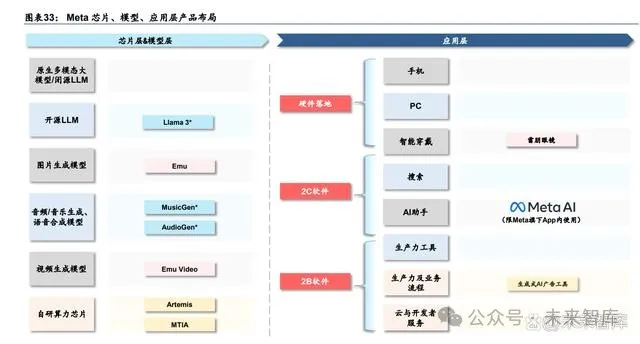
Meta stands out in the large model competition with its Llama series of open-source models, having released three generations of models. Meta launched Llama and Llama 2 in February and July 2023, respectively. Llama 2 offers three parameter scales of 7B, 13B, and 70B, with the 70B model scoring close to GPT-3.5 in language understanding and mathematical reasoning, performing comparably or better than PaLM 540B in almost all benchmark tasks. In April 2024, Meta released Llama 3, which significantly outperforms the previous generation Llama 2, achieving the best performance among models of the same level. This open-source version includes two versions with 8B and 70B parameters, with more versions to be released in the coming months, including upgrades in multimodal, multilingual capabilities, longer context windows, and stronger overall functionality. The largest 400B model is still in training, with design goals for multimodal and multilingual capabilities. According to Meta’s disclosed training data, its performance is comparable to GPT-4. Meta is building intelligent assistants like Meta AI and Ray-Ban Meta smart glasses based on the Llama series models. Meta is also updating the intelligent assistant Meta AI built on Llama 3, allowing seamless use of Meta AI in the search boxes of Instagram, Facebook, WhatsApp, and Messenger without switching. Llama 3 will soon be launched on platforms like AWS, Databricks, Google Cloud, Hugging Face, Kaggle, IBM WatsonX, Microsoft Azure, NVIDIA NIM, and Snowflake, supported by hardware platforms provided by AMD, AWS, Dell, Intel, NVIDIA, and Qualcomm.
Domestic Large Models: Clear Landscape, Closed-source Models Catching Up to GPT-4, Open-source Models with Global Competitiveness
We reviewed the progress of domestic foundational large model training companies in large model technology, productization, and commercialization over the past year: 1) Domestic closed-source large models continue to catch up with OpenAI: We see that from mid-2023 to the end of 2023, mainstream domestic large models have been benchmarked against GPT-3.5, and by 2023, they have begun to benchmark against GPT-4. For example, the updated Wenxin 4.0 (Ernie 4.0) in October 2023 is “comparable to GPT-4 in comprehensive capabilities”; the updated Zhipu GLM-4 in January 2024 has “overall performance approaching GPT-4”; and the updated SenseTime Riri Xin 5.0 in April 2024 has “comprehensive performance fully benchmarking GPT-4 Turbo.” 2) The competitive landscape in China is gradually becoming clear, with camps divided into leading internet companies, the previous generation of AI four little dragons, and startup companies. Among the leading internet companies, Baidu and Alibaba are currently leading in model iteration and productization, ByteDance has a leading 2C large model application Doubao, but public information about large model companies is relatively scarce, while Tencent’s large model iteration and productization are slightly lagging. SenseTime is the only company among the previous generation of “AI four little dragons” that has not fallen behind in this round of AI 2.0 wave, continuously innovating and leading. Among startup companies, each has its own characteristics: Zhipu has a complete layout, with both open-source and closed-source models, focusing on both 2C and 2B; Yuezhi Anmian focuses on 2C closed-source, using long text as a differentiated competitive point; Minimax chooses the MoE model, entering through 2C social products; Baichuan Intelligent has both open-source and closed-source models, focusing mainly on 2B; Lingyi Wanyi starts from open-source models, currently having both open-source and closed-source models. 3) Domestic open-source models have global competitiveness. Domestic open-source models represented by Alibaba’s Qwen series, Baichuan Intelligent’s Baichuan series, and Lingyi Wanyi’s Yi series have become important forces driving the progress of global open-source models.
Baidu: Wenxin Large Model Continues to Iterate, B/C End Commercialization Steadily Advances
The comprehensive capabilities of Wenxin 4.0 “are not inferior to GPT-4.” Following the release of the knowledge-enhanced large language model Wenxin Yiyan in March 2023, Baidu released the Wenxin large model 3.5 in May 2023, and the Wenxin large model 4.0 in October 2023. Compared to version 3.5, version 4.0 has significantly improved understanding, generation, logic, and memory capabilities: the improvement in understanding and generation capabilities is similar, while the improvement in logic is nearly three times that of understanding, and the improvement in memory is more than twice that of understanding. In terms of text-to-image capabilities, Wenxin 4.0 supports multi-style image generation, generating multiple images from one text, with improved image clarity. According to Baidu’s founder, chairman, and CEO Robin Li at Baidu World 2023, the comprehensive capabilities of Wenxin large model 4.0 “are not inferior to GPT-4.”
AI is reconstructing Baidu’s mobile ecosystem. Baidu’s mobile ecosystem applications such as search, maps, cloud storage, and library are being reconstructed with AI. 1) Search: The new search reconstructed by the large model features extreme satisfaction, recommendation stimulation, and multi-turn interaction. 2) Maps: Upgraded to an intelligent travel guide through natural language interaction and multi-turn dialogue, improving user travel and decision-making efficiency. 3) Baidu Cloud and Library: AI enhances creative capabilities. The cloud can accurately locate specific frames in videos and summarize long video content, extracting key information and highlights. The library utilizes its vast database to assist users in writing and creating PPTs, becoming a productivity tool. 4) Baidu GBI: The first generative business intelligence product in China built with AI native thinking. It executes data query and analysis tasks through natural language interaction, while also supporting professional knowledge injection to meet more complex and professional analysis needs. Baidu’s B/C end commercialization is steadily advancing. According to Robin Li’s speech at the Create 2024 Baidu AI Developer Conference in April 2024, the number of Wenxin Yiyan users has exceeded 200 million, with daily API call volume also exceeding 200 million, serving 85,000 customers, and the number of AI native applications developed on the Qianfan platform has exceeded 190,000. For C-end commercialization: After launching Wenxin Yiyan 4.0 in October 2023, Baidu initiated a charging plan, allowing members to use the Wenxin large model 4.0, while non-members use version 3.5. The monthly purchase price for members is 59.9 yuan/month, with a continuous monthly price of 49.9 yuan/month, and the joint membership price for Wenxin Yiyan + Wenxin Yige is 99 yuan/month. Wenxin Yiyan members can enjoy comprehensive upgrades of Wenxin large model 4.0, text-to-image capabilities, advanced plugins on the web, and 600 inspiration points per month on the App side, while Wenxin Yige members can enjoy rapid generation of multi-size high-definition images, creative posters and artistic characters, AI editing and image modification rights. For B-end landing: The Samsung Galaxy S24 5G series and Honor Magic 8.0 both integrate the Wenxin API, and Cheyijia uses the Wenxin API to support its AIGC applications. According to Baidu’s Q4 2023 earnings call, Baidu has achieved hundreds of millions of yuan in revenue in Q4 2023 through advertising technology improvements and helping enterprises build personalized models, and Baidu expects incremental revenue from AI large models to grow to tens of billions of yuan in 2024, mainly from advertising and AI cloud business.
Alibaba: Tongyi Large Model Has Both Open-source and Closed-source, Widely Implemented Across Industries
Tongyi Qianwen 2.5’s Chinese performance is on par with GPT-4 Turbo. Since its launch in April 2023, Tongyi Qianwen has released the performance surpassing GPT-3.5 Tongyi Qianwen 2.0 in October 2023, and the Tongyi Qianwen 2.5 in May 2024. In the Chinese context, version 2.5 has surpassed GPT-4 in multiple capabilities including text understanding, text generation, knowledge Q&A & life advice, casual conversation & dialogue, and safety risk assessment. Tongyi practices “full-modal, full-size” open-source. In August 2023, Tongyi announced its entry into the open-source arena, having successively launched more than ten open-source models. According to Alibaba Cloud’s official account, as of May 2024, the download volume of Tongyi open-source models has exceeded 7 million. In terms of large language models, Tongyi has open-sourced eight models with parameter scales ranging from 500 million to 110 billion: small-sized models include parameters of 0.5B, 1.8B, 4B, 7B, and 14B, which can be conveniently deployed on mobile phones, PCs, and other end devices; large-sized models like 72B and 110B can support enterprise-level and research-level applications; medium-sized models like 32B find the most cost-effective balance between performance, efficiency, and memory usage. Additionally, Tongyi has also open-sourced visual understanding models Qwen-VL, audio understanding models Qwen-Audio, code models CodeQwen1.5-7B, and mixture of experts models Qwen1.5-MoE. For B-end customers, Tongyi has served over 90,000 enterprises through Alibaba Cloud, collaborating with many leading customers across various industries. According to Alibaba Cloud’s official account, as of May 2024, Tongyi has served over 90,000 enterprises through Alibaba Cloud and over 2.2 million enterprises through DingTalk, and has landed in fields such as PCs, mobile phones, automobiles, aviation, astronomy, mining, education, healthcare, catering, gaming, and cultural tourism.
Tencent: Hunyuan Large Model Empowers Its Business Ecosystem for Intelligent Upgrades
The Hunyuan model has been integrated into multiple core products and businesses of Tencent, empowering cost reduction and efficiency enhancement. In September 2023, Tencent launched the Hunyuan large model. Hunyuan has been upgraded to a trillion-parameter MOE architecture model. As of September 2023, over 50 core businesses and products, including Tencent Cloud, Tencent Ads, Tencent Games, Tencent Financial Technology, Tencent Meetings, Tencent Documents, WeChat Search, and QQ Browser, have integrated the Hunyuan large model; in October 2023, over 180 internal businesses integrated Hunyuan; by April 2024, over 400 applications of Tencent’s collaborative SaaS products have fully integrated Hunyuan, including WeChat Work, Tencent Meetings, Tencent Documents, Tencent LeXiang, Tencent Cloud AI Code Assistant, Tencent Electronic Signature, Tencent Questionnaire, and more.
ByteDance: Doubao Large Model Empowers Internal Business, Dialogue Assistant “Doubao” Has Leading User Numbers
In 2023, ByteDance did not publicly announce its large model, but in May 2024, it was first publicly released at the Volcano Engine Original Power Conference. The Doubao large model family includes nine models, mainly including general model pro, general model lite, speech recognition model, speech synthesis model, text-to-image model, etc. ByteDance did not disclose the parameter size, data, and corpus of the models, but directly targeted vertical segmentation based on application scenarios. The Doubao large model completed self-research in 2023 and has been integrated into over 50 internal businesses, including Douyin and Feishu, processing 120 billion tokens of text daily and generating 30 million images. For 2C products, ByteDance has built the AI dialogue assistant “Doubao,” the AI application development platform “Kouzi,” interactive entertainment applications “Maoxiang,” and AI creative tools such as Xinghui and Jimeng. For 2B, the Volcano Engine has also collaborated with numerous enterprises in industries such as smart terminals, automotive, finance, and consumer goods, including OPPO, vivo, Xiaomi, Honor, Samsung, ASUS, China Merchants Bank, Jietu, Geely, BAIC, Zhiqi, GAC, Dongfeng Honda, Haidilao, and Feihe.
SenseTime: “Cloud, Edge, End” Full-stack Large Model, Version 5.0 Benchmarking GPT-4 Turbo
SenseTime’s Riri Xin 5.0 comprehensively benchmarks GPT-4 Turbo. In April 2023, SenseTime officially released the “Riri Xin SenseNova” large model system, achieving a comprehensive layout of CV, NLP, and multimodal large models. In April 2024, SenseTime’s Riri Xin SenseNova was upgraded to version 5.0, possessing stronger knowledge, mathematics, reasoning, and coding capabilities, with comprehensive performance fully benchmarking GPT-4 Turbo. The performance improvement of Riri Xin 5.0 is mainly attributed to three aspects: 1) Adopting the MOE architecture, activating a small number of parameters to complete reasoning. Moreover, the context window during reasoning reaches around 200K. 2) Based on training with over 10TB tokens, covering a massive amount of logical synthetic thinking chain data. 3) The joint optimization of SenseTime’s AI infrastructure SenseCore’s computing facilities and algorithm design.
SenseTime has launched a “cloud, edge, end” full-stack large model product matrix. 1) The cloud model is SenseTime’s most advanced foundational model series. 2) On the edge side, SenseTime has launched enterprise-level large model integrated machines for finance, healthcare, government, and coding industries. The integrated machine supports acceleration of trillion-parameter models and knowledge retrieval hardware acceleration, achieving localized deployment, saving 80% of reasoning costs for trillion large models compared to similar products in the industry; retrieval is greatly accelerated, reducing CPU workload by 50% and end-to-end latency by 1.5 seconds. 3) On the end side, the SenseChat-Lite 1.8B model comprehensively outperforms all open-source 2B-level models, even surpassing Llama2-7B and 13B models in most tests. The Riri Xin 5.0 end-side large model can achieve a reasoning speed of 18.3 characters/second on mid-range performance smartphones and 78.3 characters/second on high-end flagship smartphones, exceeding the reading speed of 20 characters/second for the human eye.