What is PCB?
The full Chinese name of PCB is Printed Circuit Board, which literally means a board printed with circuits. It can replace wires and serves to connect various electronic components. On the PCB, the yellow part is copper foil, which is conductive, equivalent to the core of a wire, while the green part is the substrate, which is insulating, equivalent to the outer skin of a wire. The PCB is designed with a layout for the circuits, and the required components can simply be inserted in the corresponding places.
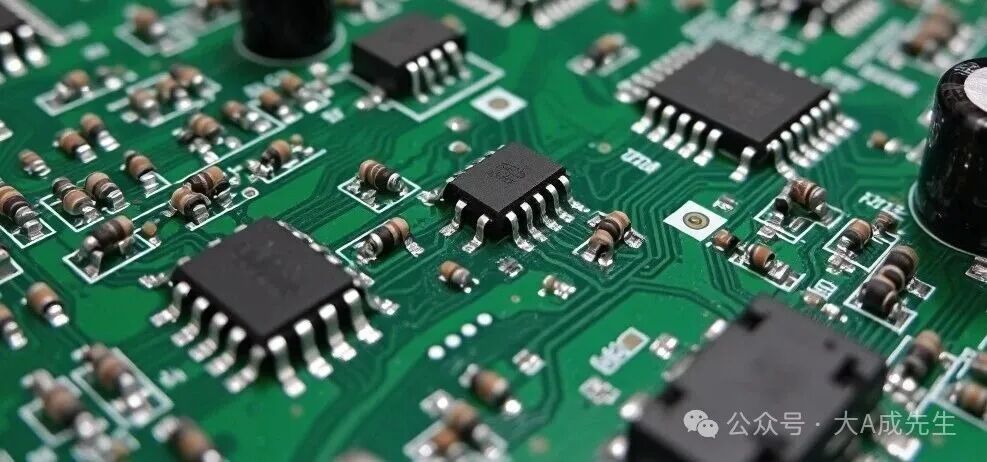
What components can be inserted? Almost anything, such as passive components, which do not require power, like resistors, capacitors, inductors, and transformers. Active components, such as diodes, transistors, and integrated circuits, which are chips. There are also switches, relays, sensors, etc. Almost all conceivable electronic components can be placed on it. Just think, with so many types of components packed into a small space, if there were no PCB, and only wires were used for connections, the wiring would be too complex, and it would be prone to damage and difficult to maintain.
Electronic Packaging Levels
Positioning and Related Technologies of PCB
Understanding the composition principles of PCB allows us to clearly see that, as a classification of connection technology, it is distinctly different from optical communication and copper connections. PCB has a short transmission distance, and high-end PCBs are more precise. To what extent? As we know, the packaging technology of chips is already very precise, and it can be said that the technological development of high-end PCBs is closely related to the development of packaging technology. PCB belongs to the second-level packaging of electronic packaging, also known as board-level packaging.
Let’s clarify, electronic packaging is divided into four levels. The first level is zero-level packaging, also known as wafer-level packaging, which is the process of turning a wafer into a chip.
The second level is first-level packaging, which is what we commonly refer to in the packaging and testing industry. The IC packaging substrate is the core of the chip packaging process, providing support, protection, and heat dissipation for the chip, while also providing electronic connections between the chip and the PCB. In simple terms, it involves packaging the chip on the IC substrate and then installing it on the next level of PCB. In fact, strictly speaking, the IC substrate is also a type of PCB, being the most technically sophisticated subdivision, which we will focus on later.
The third level is second-level packaging, also known as board-level packaging, which connects the chip packaged on the IC substrate to various electronic components through the PCB.
The final level is third-level packaging, which is essentially system assembly, installed in computers, mobile phones, or wearable devices for our use.
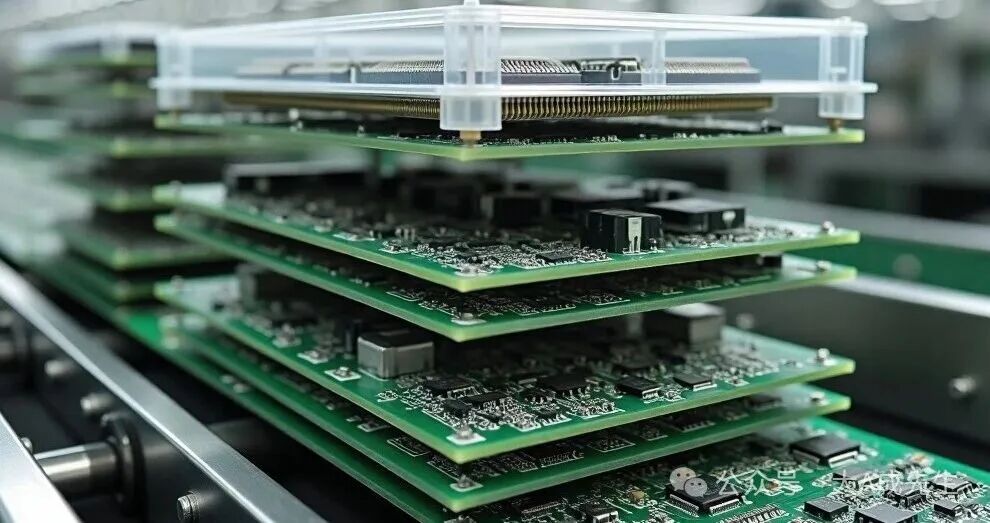
Now, with this understanding, you can grasp what we discussed in the last class about Taiwan Semiconductor Manufacturing Company’s CoWoS packaging technology, which is researching the removal of the ABF substrate, a type of IC substrate, to connect chips directly to the PCB, thus achieving greater efficiency.
At this point, some students may have doubts. Currently, we have at least two listed companies involved in the ABF substrate business, one of which has just begun mass production, while the other, a smaller company, has invested over 3 billion but has yet to achieve true mass production. If the future trend of the industry is to eliminate the ABF substrate, wouldn’t that render their investments futile?
First of all, we must say that this technology is not achieved overnight. If IC substrates cannot be produced, then we should also be unable to produce PCB boards that directly install chips. Technology must be broken through step by step. Additionally, there is still a long way to go from theory to practice, which also faces strong uncertainties.
Core Attributes of the PCB Industry
-
Technological Attribute: The technology industry is ever-changing and always faces the risk of technological iteration. The saying that the waves behind drive the waves in front, with the former perishing on the beach, summarizes the attributes of the technology industry. Therefore, the technology sector may be the most challenging category for investment. Strictly speaking, the technology sector is not suitable for long-term investment. However, in practice, both the US and China have leading technology companies that have remained at the forefront of technology for the past two to three decades without being abandoned by the times and the market. However, for investors, significant effort is required to study professional knowledge, which is what we are doing.
-
Cyclical Attribute: Looking at the data, the largest downstream application of the global PCB market is communications, accounting for 32%; followed by the computer industry at 24%; consumer electronics at 15%; and the server sector at 10%. People refer to PCB as the mother of electronic devices mainly because of its wide application and fundamental role in the technology industry. Thus, it inevitably has to follow the semiconductor industry cycle. Its previous cycle was the 5G construction cycle, during which the PCB industry experienced significant fluctuations, followed by a clear cyclical downturn. This time, the cyclical upturn is mainly driven by AI computing power construction.
In summary, the main function of PCB is precise connection, and high-end PCBs are closely related to the packaging industry. The PCB industry possesses both technological and cyclical attributes, and we should closely track the technological development path of the industry while paying attention to the AI computing power construction cycle. Follow me, and in the next class, we will study the classification of PCBs.
Risk Warning: The information and news contained in this article are for reference and learning purposes only for investors in securities investment and do not constitute investment advice. Investors bear the risks and consequences arising from investments made based on this information.
Disclaimer: 【Xiangcai Securities Co., Ltd. Shenyang Suihua West Street Securities Business Department – Cheng Wei –Investment Advisor – Registration Number: S0500611010051; The above represents personal views for reference only and does not serve as a basis for trading. Risks arising from operations based on this are borne by the investor. Investment involves risks; enter the market with caution】

Copyright Notice
Text | Cheng Wei Registration Number S0500611010051
Material | Data sourced from Wind
Editor | Zhao Shenqi Registration Number S0500625040003
Images | Sourced from the internet; if there is any infringement, please delete immediately!